Jacob Abaare

448 posts

Jacob Abaare banner
Jacob Abaare

Jacob Abaare

@jaabaare

God | Research | Leadership

🏠 🇬🇭 | 📍🇺🇸 Katılım Aralık 2015
723 Takip Edilen749 Takipçiler
Sabitlenmiş Tweet
Jacob Abaare
Jacob Abaare@jaabaare·
Thank you sir for your incredibly kind words and for always inspiring us to lead with purpose and integrity. A big thank you to @unlstudentlife for this recognition and all the wonderful communities I have had the privilege to serve and inspire.
Manasseh Azure Awuni@Manasseh_Azure

Yesterday, a Ghanaian Student, @jaabaare received the Student Luminary Awards here at the University of Nebraska-Lincoln (UNL). Jacob, formerly of St. Charles Minor Seminary in Tamale and UMaT, is currently studying for a PhD in Electrical and Computer Engineering.

English
1
3
7
416
Jacob Abaare retweetledi
Aakash Gupta
Aakash Gupta@aakashgupta·
Earlier this year Yann LeCun left Meta because Mark Zuckerberg wouldn't bet the company on JEPA. Last week his group dropped the first JEPA that actually trains end-to-end from raw pixels. 15 million parameters. Single GPU. A few hours. The timing is not a coincidence. For four years Meta has been the house that JEPA built. LeCun published the original paper from FAIR in 2022. I-JEPA and V-JEPA came out of his lab. The architecture was supposed to be the escape hatch from LLMs, the path to robots that actually learn physics instead of hallucinating about it. Every version shipped fragile. Stop-gradients. Exponential moving averages. Frozen pretrained encoders. Six or seven loss terms that had to be hand-tuned or the model collapsed into garbage representations. Meta kept funding LLMs. Llama shipped. Llama scaled. Llama got beat by Qwen and DeepSeek. Zuck spent $14 billion to buy ScaleAI and install Alexandr Wang. The FAIR robotics group was dissolved. LeCun's research kept winning papers and losing the product roadmap. He left, started AMI Labs, and said publicly that LLMs were a dead end. Now the paper. LeWorldModel. One regularizer replaces the entire pile of heuristics. Project the latent embeddings onto random directions, run a normality test, penalize deviation from Gaussian. The model cannot collapse because collapsed embeddings fail the test by construction. Hyperparameter search went from O(n^6) polynomial to O(log n) logarithmic. Six tunable knobs became one. The downstream numbers are what should scare the robotics capex class. 200 times fewer tokens per observation than DINO-WM. Planning time drops from 47 seconds to 0.98 seconds per cycle. 48x faster at matching or beating foundation-model performance on Push-T and 3D cube control. The latent space probes cleanly for agent position, block velocity, end-effector pose. It correctly flags physically impossible events as surprising. It learned physics without being told physics existed. Figure AI is valued at $39 billion. Tesla Optimus is mass-producing. World Labs raised $230 million to sell generative world models. Everyone in humanoid robotics is burning capital on foundation-model pipelines that plan in 47 seconds per cycle. LeCun's group just showed you can do it with 15 million parameters on a single GPU in a few hours. This is the Xerox PARC pattern running again. Meta had the next architecture. Meta had the scientist. Meta dissolved the robotics team, passed on the productization, and watched the exit. Three months later the lab that was supposed to be Meta's publishes the result that resets the robotics cost structure. The paper is worth more than Alexandr Wang.
Aakash Gupta tweet media
English
65
379
3.3K
1.1M
Jacob Abaare retweetledi
Juliet Bawuah
Juliet Bawuah@julietbawuah·
Thibaut Courtois hugely missed.
Eesti
16
60
935
9.8K
Jacob Abaare retweetledi
Andrej Karpathy
Andrej Karpathy@karpathy·
LLM Knowledge Bases Something I'm finding very useful recently: using LLMs to build personal knowledge bases for various topics of research interest. In this way, a large fraction of my recent token throughput is going less into manipulating code, and more into manipulating knowledge (stored as markdown and images). The latest LLMs are quite good at it. So: Data ingest: I index source documents (articles, papers, repos, datasets, images, etc.) into a raw/ directory, then I use an LLM to incrementally "compile" a wiki, which is just a collection of .md files in a directory structure. The wiki includes summaries of all the data in raw/, backlinks, and then it categorizes data into concepts, writes articles for them, and links them all. To convert web articles into .md files I like to use the Obsidian Web Clipper extension, and then I also use a hotkey to download all the related images to local so that my LLM can easily reference them. IDE: I use Obsidian as the IDE "frontend" where I can view the raw data, the the compiled wiki, and the derived visualizations. Important to note that the LLM writes and maintains all of the data of the wiki, I rarely touch it directly. I've played with a few Obsidian plugins to render and view data in other ways (e.g. Marp for slides). Q&A: Where things get interesting is that once your wiki is big enough (e.g. mine on some recent research is ~100 articles and ~400K words), you can ask your LLM agent all kinds of complex questions against the wiki, and it will go off, research the answers, etc. I thought I had to reach for fancy RAG, but the LLM has been pretty good about auto-maintaining index files and brief summaries of all the documents and it reads all the important related data fairly easily at this ~small scale. Output: Instead of getting answers in text/terminal, I like to have it render markdown files for me, or slide shows (Marp format), or matplotlib images, all of which I then view again in Obsidian. You can imagine many other visual output formats depending on the query. Often, I end up "filing" the outputs back into the wiki to enhance it for further queries. So my own explorations and queries always "add up" in the knowledge base. Linting: I've run some LLM "health checks" over the wiki to e.g. find inconsistent data, impute missing data (with web searchers), find interesting connections for new article candidates, etc., to incrementally clean up the wiki and enhance its overall data integrity. The LLMs are quite good at suggesting further questions to ask and look into. Extra tools: I find myself developing additional tools to process the data, e.g. I vibe coded a small and naive search engine over the wiki, which I both use directly (in a web ui), but more often I want to hand it off to an LLM via CLI as a tool for larger queries. Further explorations: As the repo grows, the natural desire is to also think about synthetic data generation + finetuning to have your LLM "know" the data in its weights instead of just context windows. TLDR: raw data from a given number of sources is collected, then compiled by an LLM into a .md wiki, then operated on by various CLIs by the LLM to do Q&A and to incrementally enhance the wiki, and all of it viewable in Obsidian. You rarely ever write or edit the wiki manually, it's the domain of the LLM. I think there is room here for an incredible new product instead of a hacky collection of scripts.
English
2.9K
7.1K
58.7K
21M
Jacob Abaare retweetledi
Andrej Karpathy
Andrej Karpathy@karpathy·
New art project. Train and inference GPT in 243 lines of pure, dependency-free Python. This is the *full* algorithmic content of what is needed. Everything else is just for efficiency. I cannot simplify this any further. gist.github.com/karpathy/8627f…
English
652
3.1K
25.1K
5.2M
Jacob Abaare retweetledi
Andrew Ng
Andrew Ng@AndrewYNg·
Job seekers in the U.S. and many other nations face a tough environment. At the same time, fears of AI-caused job loss have — so far — been overblown. However, the demand for AI skills is starting to cause shifts in the job market. I’d like to share what I’m seeing on the ground. First, many tech companies have laid off workers over the past year. While some CEOs cited AI as the reason — that AI is doing the work, so people are no longer needed — the reality is AI just doesn’t work that well yet. Many of the layoffs have been corrections for overhiring during the pandemic or general cost-cutting and reorganization that occasionally happened even before modern AI. Outside of a handful of roles, few layoffs have resulted from jobs being automated by AI. Granted, this may grow in the future. People who are currently in some professions that are highly exposed to AI automation, such as call-center operators, translators, and voice actors, are likely to struggle to find jobs and/or see declining salaries. But widespread job losses have been overhyped. Instead, a common refrain applies: AI won’t replace workers, but workers who use AI will replace workers who don’t. For instance, because AI coding tools make developers much more efficient, developers who know how to use them are increasingly in-demand. (If you want to be one of these people, please take our short courses on Claude Code, Gemini CLI, and Agentic Skills!) So AI is leading to job losses, but in a subtle way. Some businesses are letting go of employees who are not adapting to AI and replacing them with people who are. This trend is already obvious in software development. Further, in many startups’ hiring patterns, I am seeing early signs of this type of personnel replacement in roles that traditionally are considered non-technical. Marketers, recruiters, and analysts who know how to code with AI are more productive than those who don’t, so some businesses are slowly parting ways with employees that aren’t able to adapt. I expect this will accelerate. At the same time, when companies build new teams that are AI native, sometimes the new teams are smaller than the ones they replace. AI makes individuals more effective, and this makes it possible to shrink team sizes. For example, as AI has made building software easier, the bottleneck is shifting to deciding what to build — this is the Product Management (PM) bottleneck. A project that used to be assigned to 8 engineers and 1 PM might now be assigned to 2 engineers and 1 PM, or perhaps even to a single person with a mix of engineering and product skills. The good news for employees is that most businesses have a lot of work to do and not enough people to do it. People with the right AI skills are often given opportunities to step up and do more, and maybe tackle the long backlog of ideas that couldn’t be executed before AI made the work go more quickly. I’m seeing many employees in many businesses step up to build new things that help their business. Opportunities abound! I know these changes are stressful. My heart goes out to every family that has been affected by a layoff, to every job seeker struggling to find the role they want, and to the far larger number of people who are worried about their future job prospects. Fortunately, there’s still time to learn and position yourself well for where the job market is going. When it comes to AI, the vast majority of people, technical or nontechnical, are at the starting line, or they were recently. So this remains a great time to keep learning and keep building, and the opportunities for those who do are numerous! [Original text; deeplearning.ai/the-batch/issu… ]
English
229
591
2.9K
481.8K
Jacob Abaare retweetledi
Blavatnik School of Government
Blavatnik School of Government@BlavatnikSchool·
🚀 AI is developing faster than most democracies can keep pace with. In our latest Voices blog, MPP student Lorna Enow, @i_lorna_, explores how democracies can adapt without weakening democratic oversight. 👇 ow.ly/u8iP50Y8Gq5
English
0
2
6
657
Jacob Abaare retweetledi
idan shenfeld
idan shenfeld@IdanShenfeld·
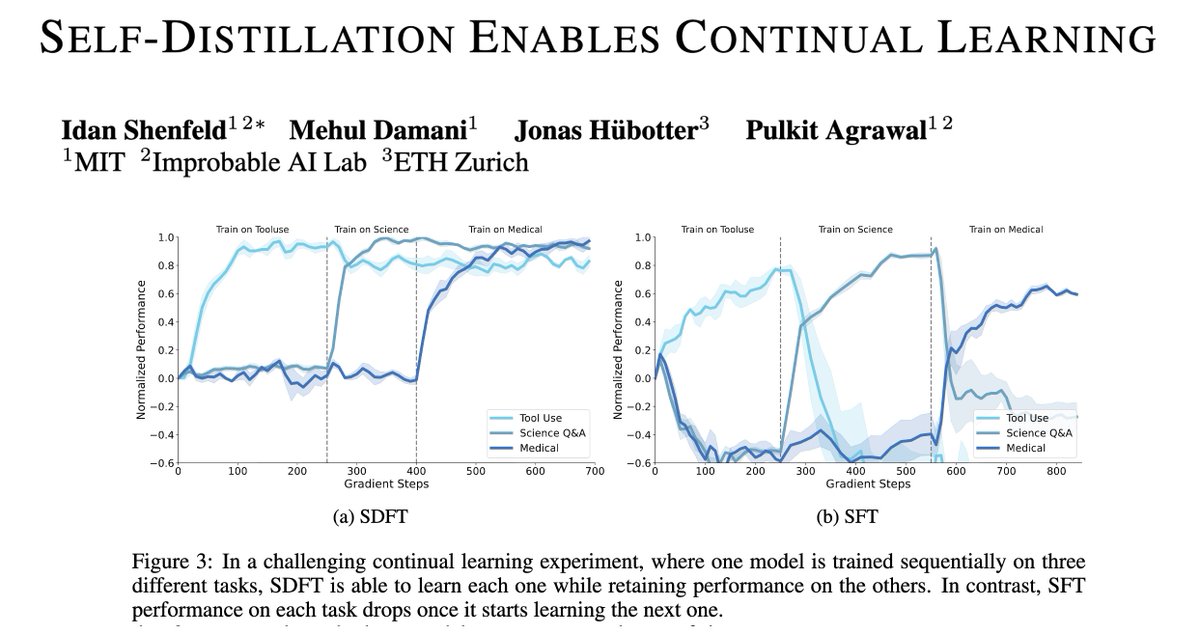
People keep saying 2026 will be the year of continual learning. But there are still major technical challenges to making it a reality. Today we take the next step towards that goal — a new on-policy learning algorithm, suitable for continual learning! (1/n)
idan shenfeld tweet media
English
50
221
1.5K
237.6K
Jacob Abaare retweetledi
Andrew Ng
Andrew Ng@AndrewYNg·
If you’ve never written code before, this is for you. I’ve just launched a course that shows you, in less than 30 minutes, how to describe an idea for an app and build it with AI. In this course, you'll build a working web application - a funny interactive birthday message generator that runs in your browser and can be shared with friends. You'll customize it by telling AI how you want it changed, and tweak it until it works the way you want. By the end, you'll have a repeatable process you can apply to build a wide variety of applications. If you want to try vibe coding, this will be the best place to start! Further, you'll be able to use these techniques with whatever tool you're most comfortable with (like ChatGPT, Gemini, Claude, or others) -- we're vendor neutral. Skills you'll gain: - How to build web apps with AI - zero coding skills needed - How to fix and improve your creations by chatting with AI - A simple process you can use to build other things you can dream up Building with AI is one of the most fun things in the world. Please join me and take your first step! I think you will be surprised at what you can build. And if you're an experienced engineer, please share this with someone in your life who's been curious about building with AI. Come build with me! deeplearning.ai/courses/build-…
English
359
944
5.7K
633.2K
Jacob Abaare retweetledi
Tevin Macharia Mukabana
Tevin Macharia Mukabana@TevinMacharia·
No matter your situation,praise him ~ Apostle Joshua Selman
English
1
93
579
4.7K
Jacob Abaare retweetledi
Palantir
Palantir@PalantirTech·
Palantir 🤝 NVIDIA "This is probably the single most important enterprise stack in the world, the Palantir Ontology."
English
1.3K
2.4K
23.7K
36.3M
Jacob Abaare retweetledi
Sam Altman
Sam Altman@sama·
today we are introducing codex. it is a software engineering agent that runs in the cloud and does tasks for you, like writing a new feature of fixing a bug. you can run many tasks in parallel.
English
1.2K
2.5K
36K
6.1M
Jacob Abaare retweetledi
Taiwo Adebiyi
Taiwo Adebiyi@TaiwoAdebiyi1·
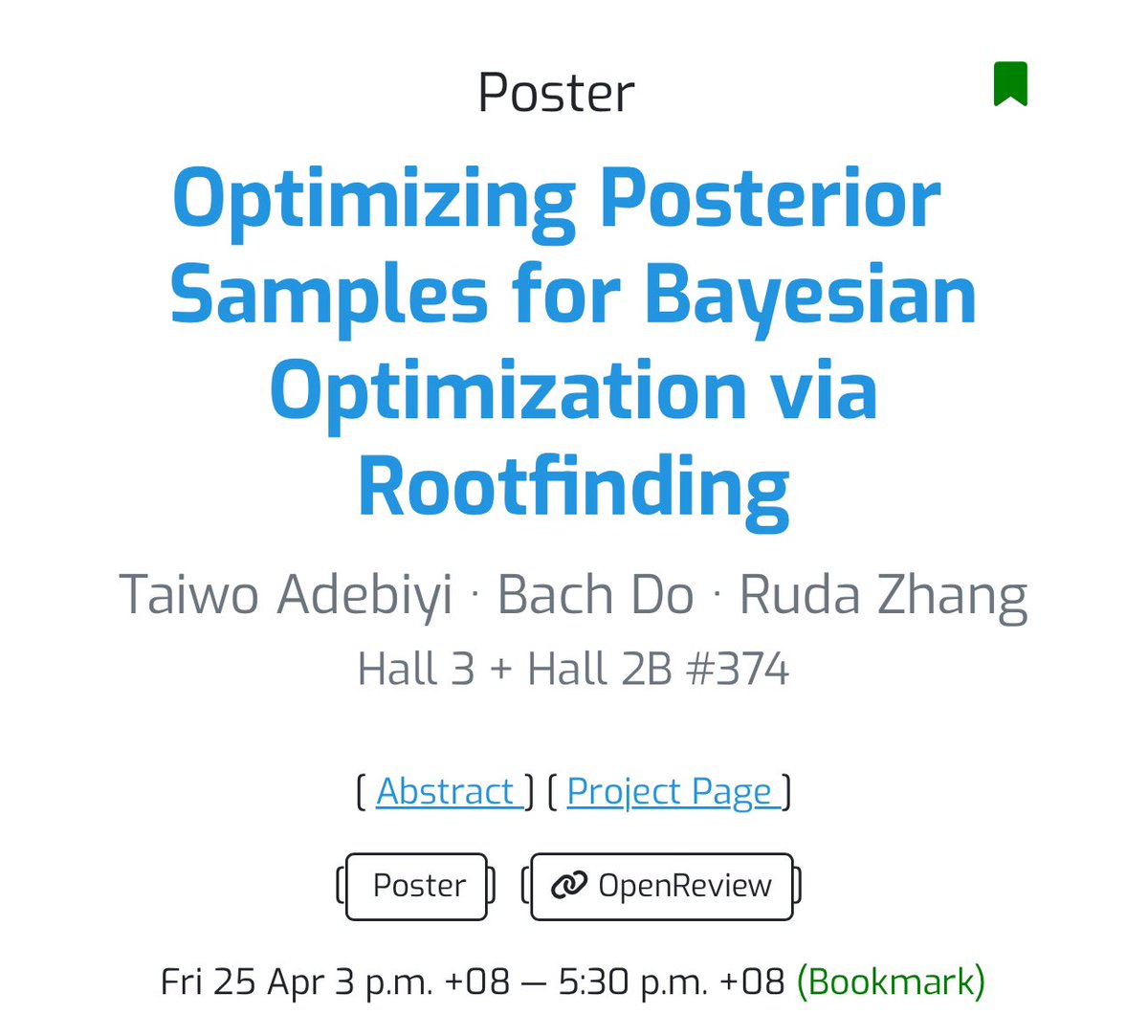
Just landed in Singapore 🇸🇬 for #ICLR2025! We’re presenting TS-roots: an efficient algorithm for optimizing posterior samples. It guarantees exact TS, scales linearly, and outperforms alternatives for Bayesian Optimization. 📍 #374 | Hall 3+2B 🗓️ Fri, April 25 | 3-5:30pm SGT.
Taiwo Adebiyi tweet mediaTaiwo Adebiyi tweet media
English
6
15
62
1.7K
Jacob Abaare retweetledi
Andrew Ng
Andrew Ng@AndrewYNg·
Some people today are discouraging others from learning programming on the grounds AI will automate it. This advice will be seen as some of the worst career advice ever given. I disagree with the Turing Award and Nobel prize winner who wrote, “It is far more likely that the programming occupation will become extinct [...] than that it will become all-powerful. More and more, computers will program themselves.”​ Statements discouraging people from learning to code are harmful! In the 1960s, when programming moved from punchcards (where a programmer had to laboriously make holes in physical cards to write code character by character) to keyboards with terminals, programming became easier. And that made it a better time than before to begin programming. Yet it was in this era that Nobel laureate Herb Simon wrote the words quoted in the first paragraph. Today’s arguments not to learn to code continue to echo his comment. As coding becomes easier, more people should code, not fewer! Over the past few decades, as programming has moved from assembly language to higher-level languages like C, from desktop to cloud, from raw text editors to IDEs to AI assisted coding where sometimes one barely even looks at the generated code (which some coders recently started to call vibe coding), it is getting easier with each step. I wrote previously that I see tech-savvy people coordinating AI tools to move toward being 10x professionals — individuals who have 10 times the impact of the average person in their field. I am increasingly convinced that the best way for many people to accomplish this is not to be just consumers of AI applications, but to learn enough coding to use AI-assisted coding tools effectively. One question I’m asked most often is what someone should do who is worried about job displacement by AI. My answer is: Learn about AI and take control of it, because one of the most important skills in the future will be the ability to tell a computer exactly what you want, so it can do that for you. Coding (or getting AI to code for you) is a great way to do that. When I was working on the course Generative AI for Everyone and needed to generate AI artwork for the background images, I worked with a collaborator who had studied art history and knew the language of art. He prompted Midjourney with terminology based on the historical style, palette, artist inspiration and so on — using the language of art — to get the result he wanted. I didn’t know this language, and my paltry attempts at prompting could not deliver as effective a result. Similarly, scientists, analysts, marketers, recruiters, and people of a wide range of professions who understand the language of software through their knowledge of coding can tell an LLM or an AI-enabled IDE what they want much more precisely, and get much better results. As these tools are continuing to make coding easier, this is the best time yet to learn to code, to learn the language of software, and learn to make computers do exactly what you want them to do. [Original text: deeplearning.ai/the-batch/issu… ]
English
514
2.8K
11.9K
2.1M
Jacob Abaare retweetledi
Andrew Ng
Andrew Ng@AndrewYNg·
Announcing: Agentic Document Extraction! PDF files represent information visually - via layout, charts, graphs, etc. - and are more than just text. Unlike traditional OCR and most PDF-to-text approaches, which focus on extracting the text, an agentic approach lets us break a document down into components and reason about them, resulting in more accurate extraction of the underlying meaning for RAG and other applications. Watch the video for details.
English
271
856
6.2K
688.9K
Jacob Abaare retweetledi
Sam Altman
Sam Altman@sama·
deepseek's r1 is an impressive model, particularly around what they're able to deliver for the price. we will obviously deliver much better models and also it's legit invigorating to have a new competitor! we will pull up some releases.
English
6.2K
6.2K
82.5K
14.3M
Jacob Abaare retweetledi
DeepSeek
DeepSeek@deepseek_ai·
🛠️ DeepSeek-R1: Technical Highlights 📈 Large-scale RL in post-training 🏆 Significant performance boost with minimal labeled data 🔢 Math, code, and reasoning tasks on par with OpenAI-o1 📄 More details: github.com/deepseek-ai/De… 🐋 4/n
DeepSeek tweet media
English
239
769
4.9K
1.9M
Jacob Abaare retweetledi
Mario Nawfal
Mario Nawfal@MarioNawfal·
STORING TERABYTES IN DNA—WHEN SCIENCE MEETS SCIFI Researchers at Peking University have cracked the code for DNA data storage, squeezing 215,000 terabytes into a single gram with a new "epi-bits" method. Instead of traditional, costly DNA synthesis, this technique uses enzymatic methylation to "print" data onto reusable DNA strands—think binary, but in biology. Volunteers encoded high-res images of a tiger and panda onto DNA, proving it’s accessible, scalable, and mind-blowingly efficient. Who needs hard drives when you’ve got nature’s blueprint? Source: SciTechDaily
Mario Nawfal tweet mediaMario Nawfal tweet media
English
102
61
263
49.5K