Honestly nakakasawa na mamuksa ng condo ipis na maliit. Kahit maglinis ka kung ang problema sa labas, wala din. Nagtatakbuhan sila kanina sa kusina mukhang may anak na ung mga ipis. Masaya sila naglalaro. Kadiri man pero enjoy kayo. Pagod na ako tsinelasin at Baygonan kayo
HIV Awareness Through Gaming
Zypher Jude G. Regencia, Chief Research Officer & Principal, co-authored a study in Discover Public Health on how the mobile game “Battle in the Blood” supports HIV awareness in the Philippines through gamified learning.
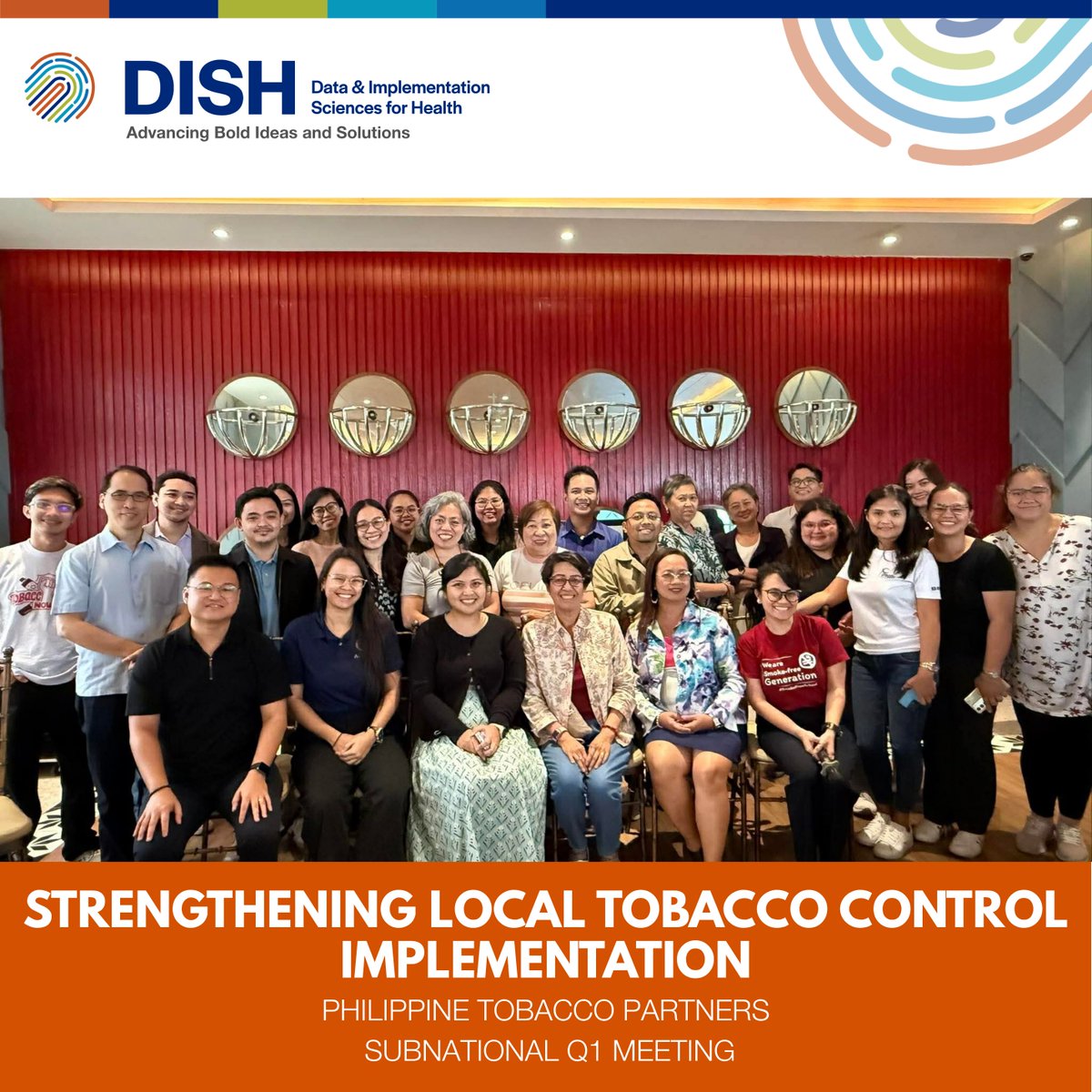
On 8 Apr 2026, partners met in Quezon City for the Philippine Tobacco Partners Q1 meeting at Harold Hotel. Discussions focused on LGU enforcement gaps, a Subnational Theory of Change, and building a coordination secretariat for stronger tobacco control outcomes.
DISH successfully completed Phase II of its Access to Thyroid Care Project in Cebu—strengthening LGU capacity, training frontline health workers, and integrating thyroid screening into routine services to improve community-level care in the Philippines.
IN FOCUS: Master’s Degree in Forensic Medicine
The culture of impunity has long been carved in the justice system of the country when it comes to extrajudicial killings. Evidently, there is a need for more forensic experts to improve death investigations in the Philippines.
The Master’s Degree in Forensic Medicine at UP Manila marks a historic step in strengthening forensic expertise and supporting the justice system. This pioneering initiative brings together experts from the university, international partners, and government agencies to provide advanced training and build the country’s forensic capacity. Putting an end to the endless questionable deaths in the guise of enforcing the law is the true north of the country’s first master’s degree program in forensic medicine.
Watch Dr. Jose Carnate Jr., Chair of the Department of Pathology at the University of the Philippines College of Medicine, as he shares the goal of the program, its pioneer students, and the various careers the graduates could pursue upon finishing the master’s degree.
Read more:
upm.edu.ph/cpt_news/phili…
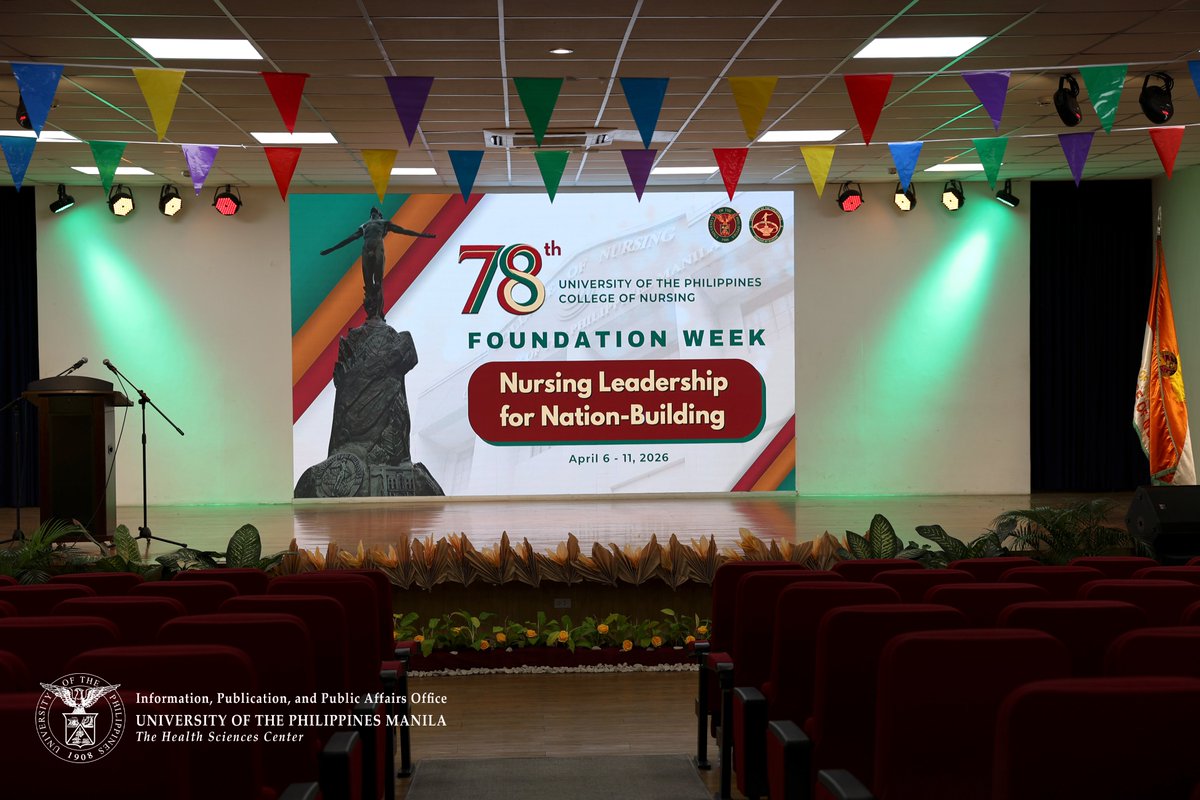
IN PHOTOS: Seventy-eight years after its founding, the University of the Philippines College of Nursing (UPCN) marked a historic milestone, becoming a Joanna Briggs Institute Center for Evidence-Based Healthcare and Nursing Development.
Already recognized as a World Health Organization Collaborating Center for Leadership in Nursing Development, UPCN, alongside the University of the Philippines Manila National Institutes of Health Institute of Clinical Epidemiology, now joins a global network of over 90 institutions driving research, innovation, and evidence-based practice to improve healthcare outcomes worldwide.
📷 Sarah Hazel Moces Pulumbarit
Link to the full article in the comment section.
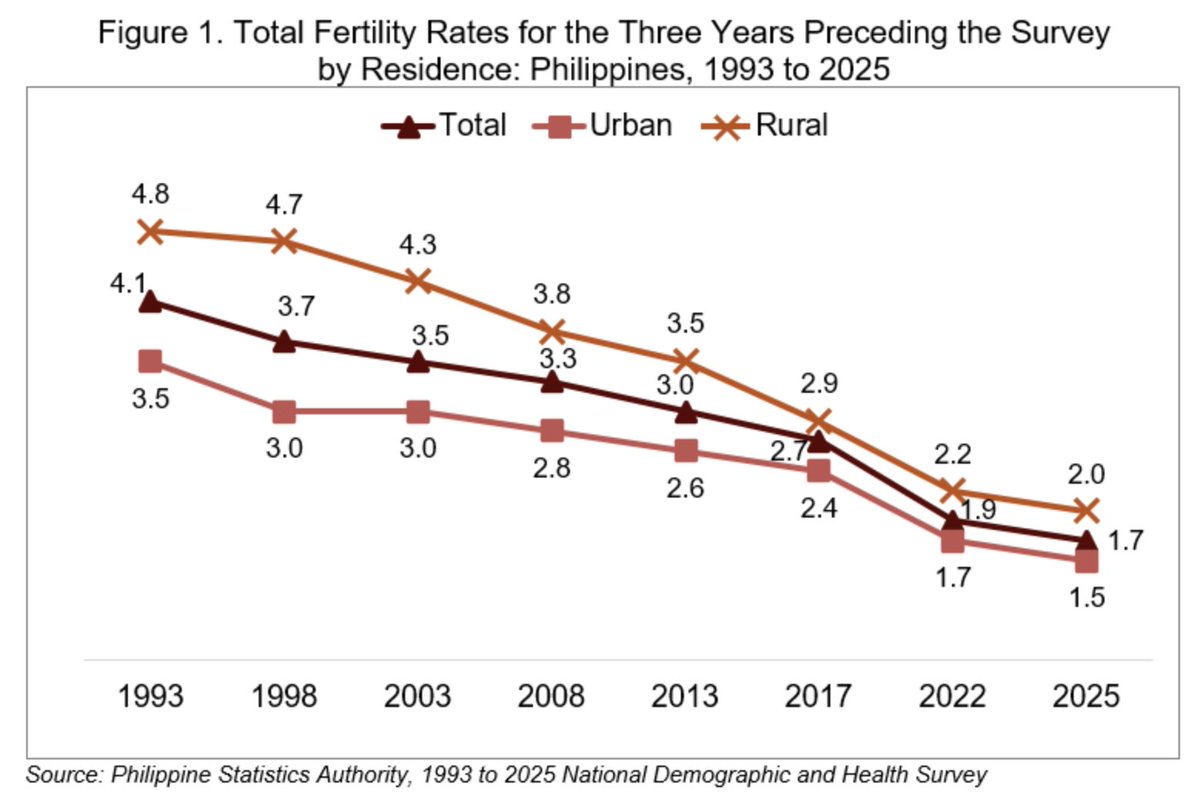
The Philippines is a fantastic example of how deep and fast the drop in fertility is nearly everywhere on the planet.
Just last week, on March 30, 2026, the Philippine Statistics Authority released the 2025 National Demographic and Health Survey (NDHS). The total fertility rate for the last three years has reached 1.7 children per woman, a dramatic fall from 4.1 in 1993, and well below the replacement rate (around 2.1 for a country like the Philippines).
Since the NDHS computes the total fertility rate over three years, and it is dropping quickly, the total fertility rate for 2025 alone should be around 1.6, the same level as in the U.S. Let me repeat this: the Philippines and the U.S. have roughly the same total fertility rate.
But U.S. income per capita is about 7.3 times the Philippine income per capita (when adjusted for purchasing power parity). Or to put it differently, Philippine income per capita today is the same as the U.S. had in 1910. In that year, the total fertility rate of the U.S. was around 3.5. At the same level of income per capita, the Philippines has a total fertility rate that is less than half.
In some more urban regions, such as Calabarzon, the total fertility rate is 1.3. Historically, the rest of the country has followed the patterns of regions like Calabarzon with some lag, so the most likely scenario is that in a few years, the Philippines will have a total fertility rate of around 1.3 as well.
Compared with the United Nations World Population Prospects (WPP), the Philippines is now at the fertility level the WPP had forecast for 2047, despite the aggressive reduction it made to the Philippines’ forecast fertility between 2022 and 2024.
The Philippines is interesting because, compared with other Asian countries, it is a relatively religious and rural country without the Confucian obsession with education found in China or South Korea.
It is also a country that many still associate with high fertility. Just yesterday, one reader left a comment on my previous post on fertility, using the Philippines as an example of high fertility, that “refuted” my claims. No, it does not.
Finally, three technical points.
First, I am reporting total fertility, not completed fertility (and yes, I am keenly aware of the difference between the two). Looking at age-specific fertility rates suggests that completed fertility for younger women will actually be below the current total fertility rate.
Second, no, emigration does not matter here. I am talking about fertility rates, not birth rates.
Third, the official release:
psa.gov.ph/content/fertil…
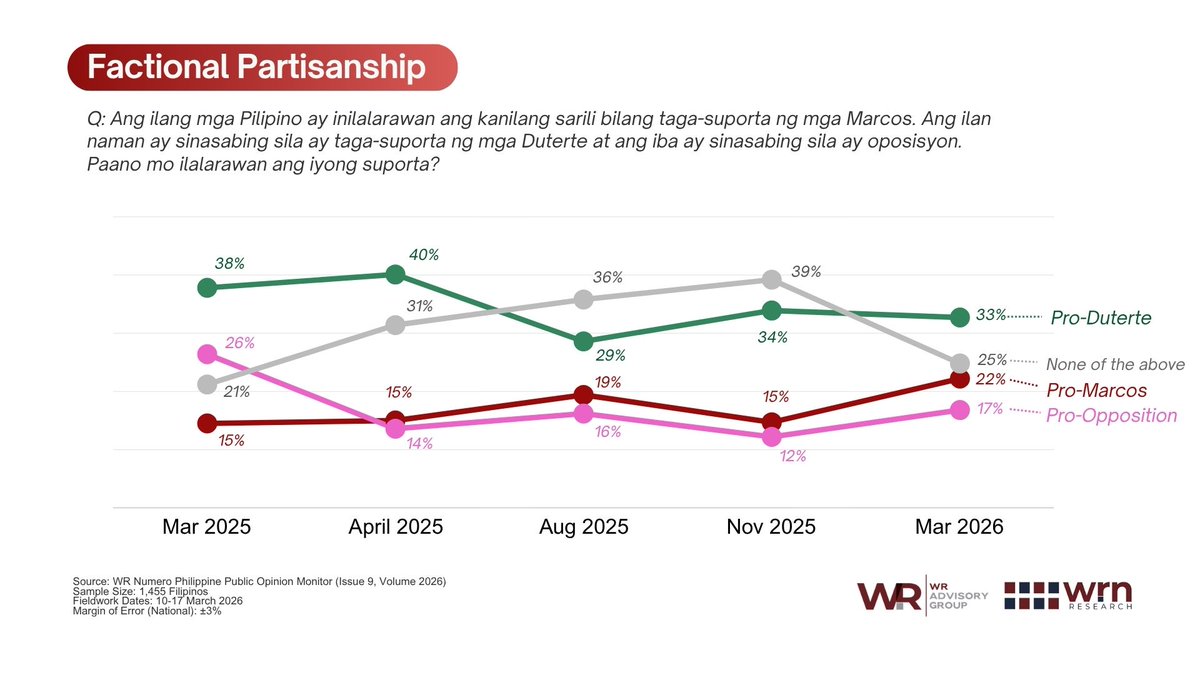
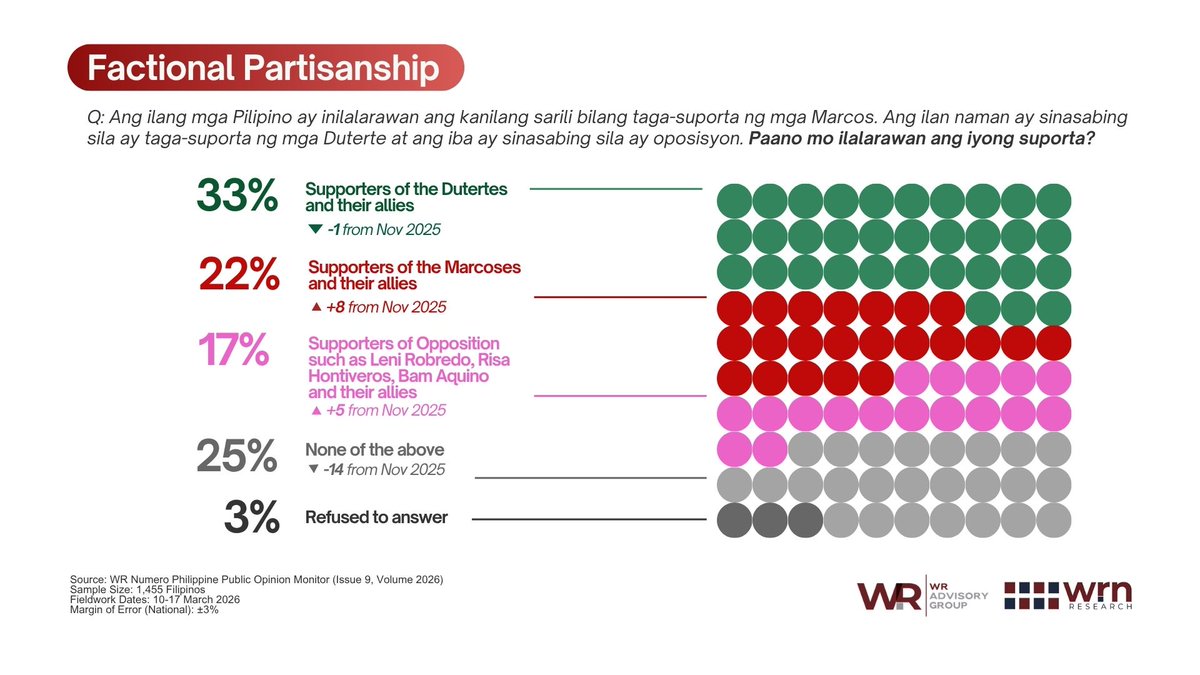
Number of Filipinos not identifying with any of the factions is down by 14% pts. Pro-Marcos and Pro-Opposition camps benefitted from this, growing 8 pts and 5 pts, respectively.
Duterte camp is biggest and most cohesive among factions. Pro-Opposition is smallest faction, but second most cohesive. Meanwhile, pro-Marcos camp maybe second biggest but it's the weakest in terms of solid support.
3 in 10 Filipinos still identify as pro-Duterte. More Filipinos now say they're pro-Marcos (22%) and pro-Opposition (17%). A quarter of Filipino adults, significantly less now, still identify as independents. Data from @WR_Numero March 2026 national survey.
Presenting the most detailed map of the Philippine educational attainment ever. 🗺️
It is testament to the deep divides which shapes the Filipino nation. Let us explore it, bawat barangay, buong bayan. 🏛️
More below ⬇️⬇️⬇️
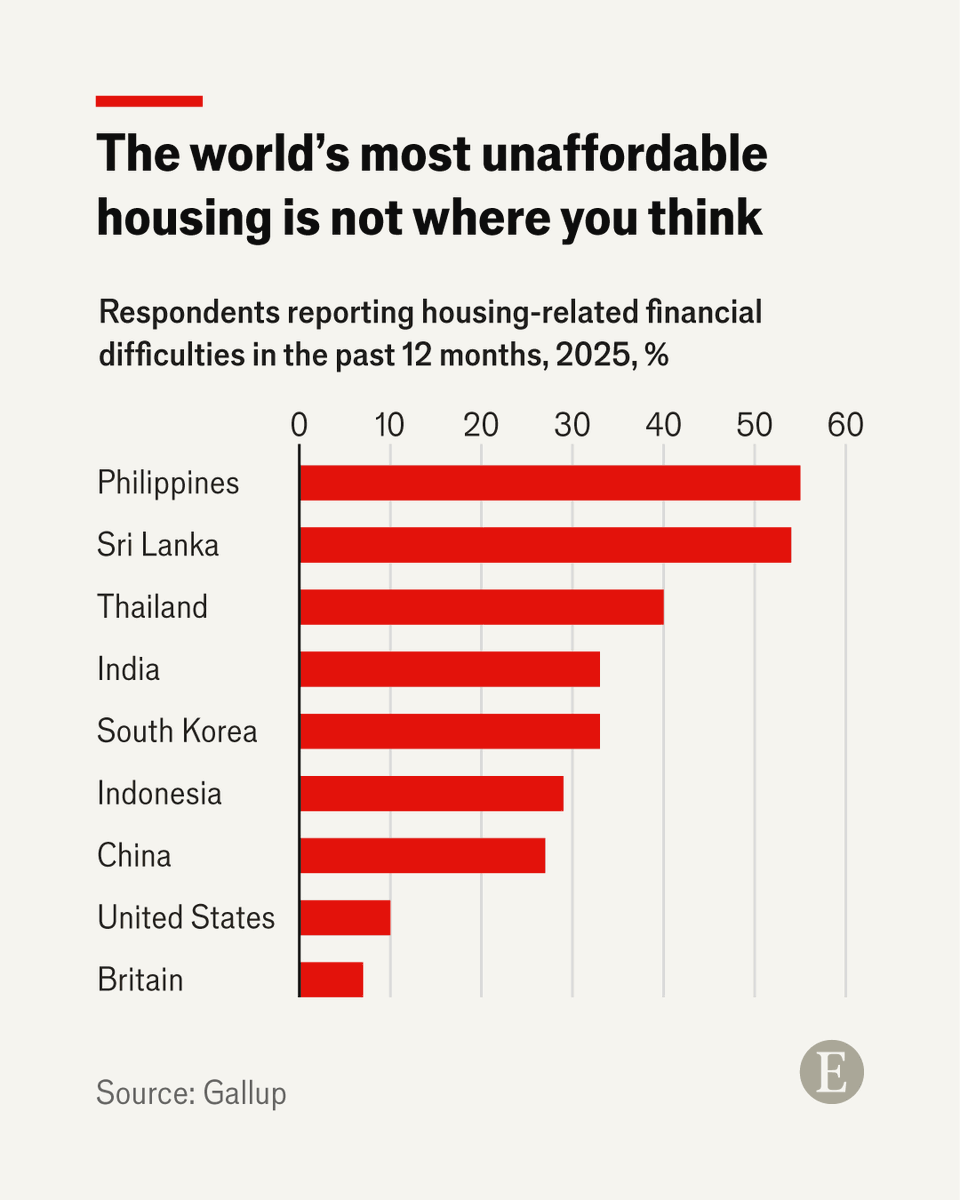
The greatest challenge for Asia’s metropolises is a shortage of decent and affordable housing. Fixing that would improve millions of lives. To find out how, register to continue reading (it’s free) econ.st/4uMPi2F