
Sabitlenmiş Tweet
Jack Brady
55 posts

Jack Brady
@jackhb98
PhD Student in ML @MPI_IS. @ELLISforEurope with @wielandbr and @tkipf.
Tübingen, Germany Katılım Mayıs 2023
224 Takip Edilen227 Takipçiler
Jack Brady retweetledi

Can you beat Gemini 3 Pro, GPT-5.1, and EMU 3.5 at visual reasoning? 👀
I made a small game for our #ICML2026 paper MentisOculi: solve 5 sliding-tile puzzles, then compare yourself to current multimodal models.
Try it here:
jana-z.github.io/mentis-oculi/g…
Poster tmr #2900, 2:30PM KST
English
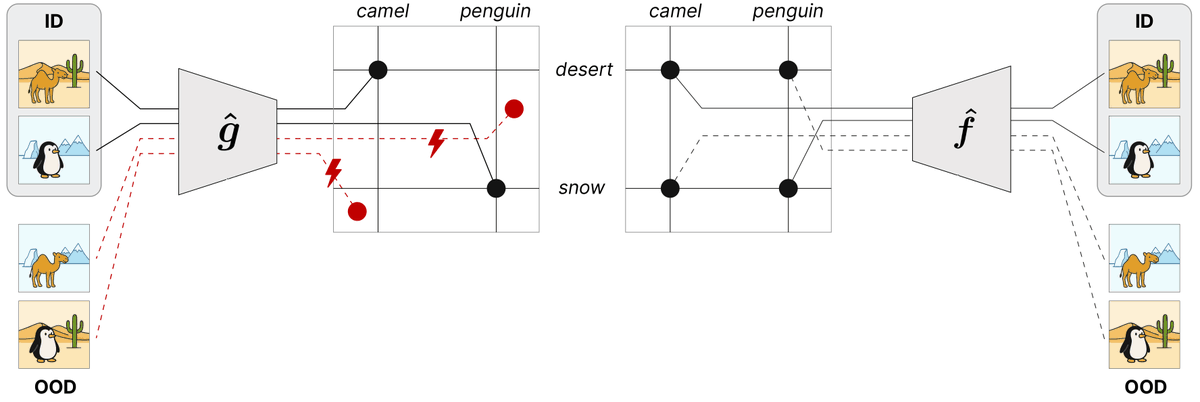
@klindt_david Thus, my current understanding of things is that the structure on the ground-truth generator required by the theory may be stronger than the structure that must actually be explicitly imposed on a decoder in practice to get compositional generalization.
English
@klindt_david The reason for such an assumption is that we want identifiability in regions of the latent space that have no support/are OOD. This is impossible without constraints on the ground truth generator, unlike the standard identifiability setting where the function can be unconstrained
English
@klindt_david Though in practice, whether this structure must be explicitly imposed on a decoder is less clear. I have observed that unconstrained Transformer decoders can still recover the ground-truth OOD structure. By contrast, equally flexible encoders consistently failed to recover it.
English
This was joint work with a great team of collaborators: @bschoelkopf, @tkipf, Simon Buchholz, and @wielandbr
📜: arxiv.org/abs/2512.08854
🖥️: Code coming soon! (github.com/JackBrady/gen-…)
English
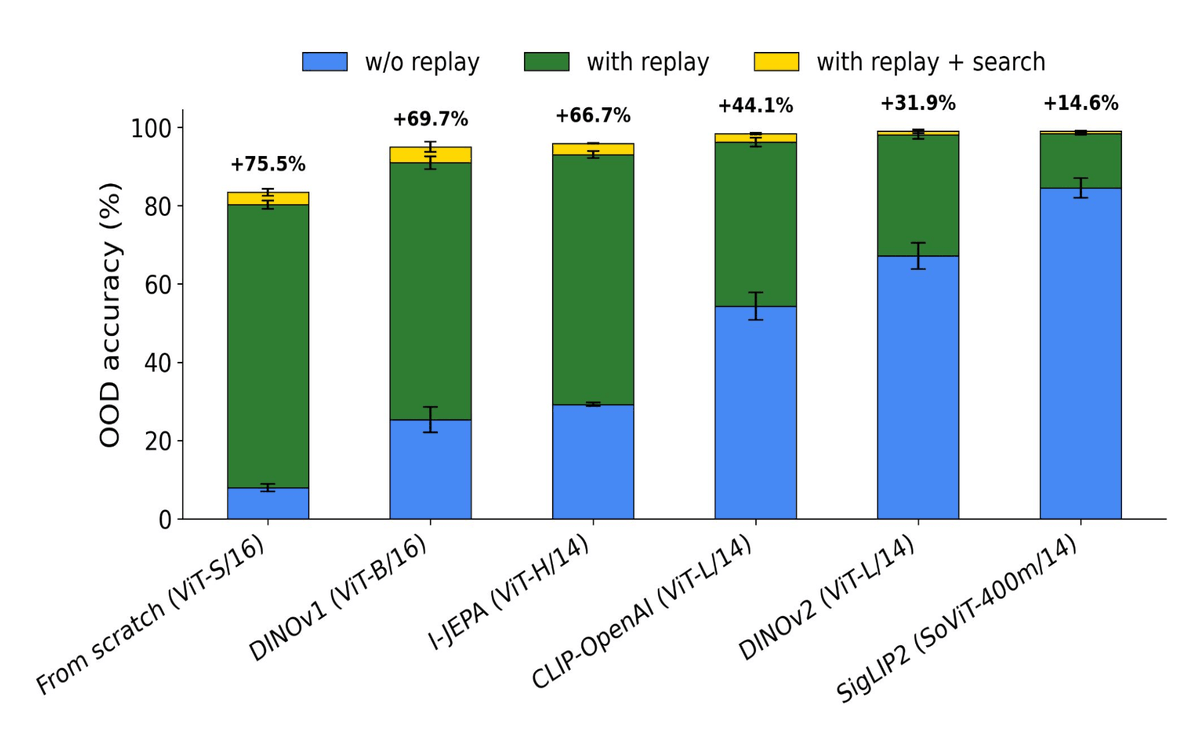
On the other hand, by inverting a learned decoder through gradient-based search and replay, generative methods achieve substantial improvements in OOD performance, without additional data.
English
Jack Brady retweetledi

🚀New Paper
arxiv.org/abs/2606.28551
Everyone obsesses over VLM architectures & training recipes. But what about the data?
Presenting the latest work in the DataComp-series: a testbed for VLM data curation with 1,000+ controlled experiments and some surprising lessons 👀
🧵👇

English
Jack Brady retweetledi

🎓 Looking for MSc or PhD opportunities in Machine Learning for Fall 2026?
Join my group at @Concordia and @Mila_Quebec!
🔍 Focus: autodiff, second-order optimization, and Hessian-based methods for LLMs & scientific ML.
📅 Apply by Dec 1: mila.quebec/en/prospective…
English
Jack Brady retweetledi

This is a huge development.
I want to highlight the theoreticians behind the scene, because this paper represents the realization of the impact of years of careful theoretical research.
It starts with Greg Yang (@TheGregYang) opening up research on the muP scaling and hyperparameter transfer in infinite-width models. Simultaneously infinite-depth scaling are studied by Boris Hanin (@BorisHanin), Mihai Nica (@MihaiCNica), Mufan Li (@mufan_li), and Soufiane Hayou (@hayou_soufiane), including in networks with residual connections.
Then this builds further with the study of infinite-depth scalings and Transformers by Lorenzo Noci (@lorenzo_noci), Blake Bordelon (@blake__bordelon), Mufan, Chuning Li (@ChuningLi), Hamzat Chaudhuri (@hamzatchaudhry), Boris, and Cengiz (@CPehlevan) in at least 3-4 papers, in particular using the DMFT framework.
My understanding is that the translation of these insights into this work was highly nontrivial and so congrats to Cerebras for seeing it through with this great team.
I also think this work could serve as a wake up to those in industry who reacted to muP saying "yeah yeah yeah we ended up at effectively the same place through careful scrutiny". I’d love to know which labs landed here, if any. If not, it goes to show you cannot have everyone grinding code. You need fundamental research to fuel BIG leaps.
Nolan Dey@DeyNolan
(1/7) @cerebras Paper drop: arxiv.org/abs/2505.01618 TLDR: We introduce CompleteP, which offers depth-wise hyperparameter (HP) transfer (Left), FLOP savings when training deep models (Middle), and a larger range of compute-efficient width/depth ratios (Right). 🧵 👇
English