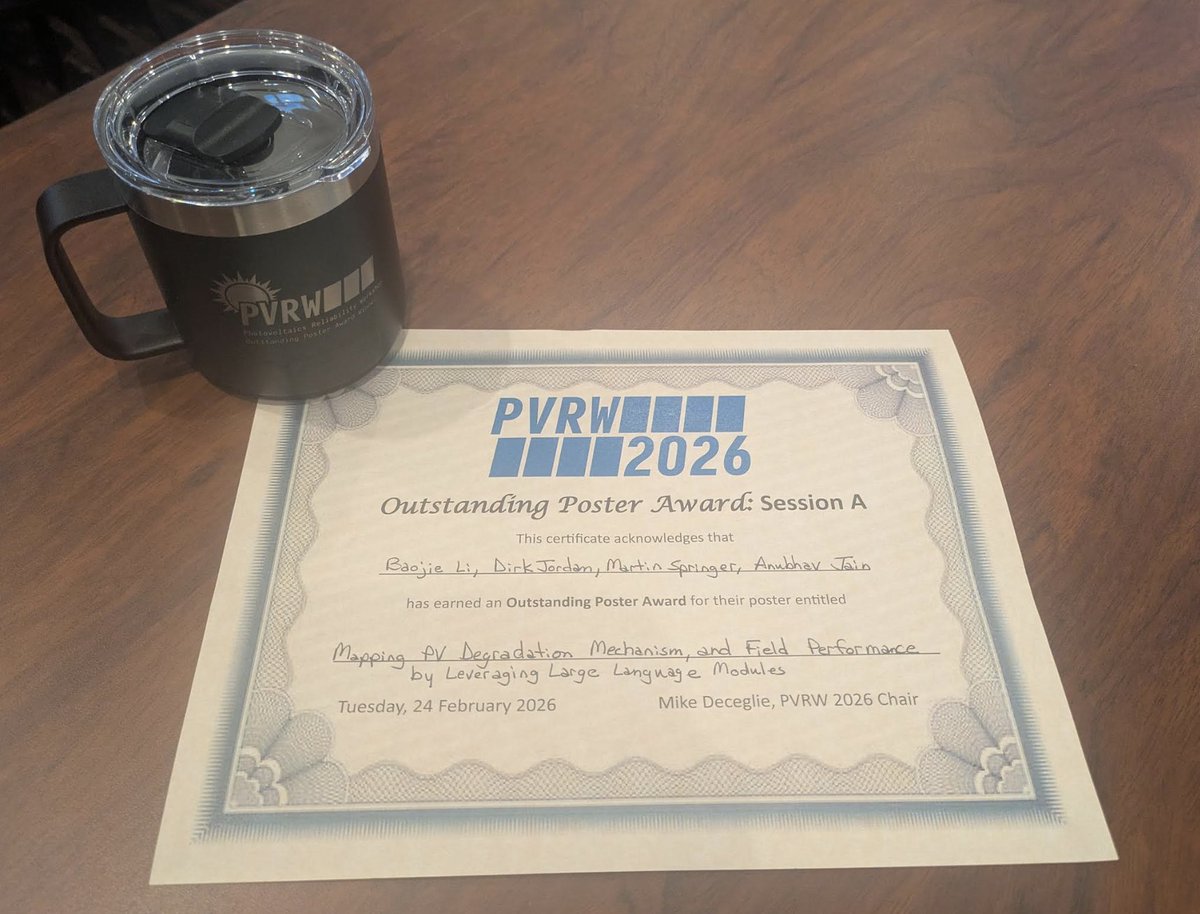
Congratulations to Baojie Li from our group on winning a best poster award at the recent Photovoltaic Reliability Workshop for his work on using LLMs to analyze solar PV degradation!
Solid-state synthesis rarely reports “failures.” We used LLMs to report 80,806 syntheses, including 18,869 impurity-phase reactions. ~15% of cases form impurity phases even when the target phase is thermodynamically more stable.
Lee et al., Sci Data
doi.org/10.1038/s41597…
Our group's longstanding involvement in building the Materials Project database in collaboration with researchers worldwide was recently featured in LBL news:
newscenter.lbl.gov/2026/01/13/acc…
If you're a current graduate student and want to spend time working with our lab in Berkeley (funded), please look at the SCGSR program and reach out to me with your interests (check full eligibility requirements first):
science.osti.gov/wdts/scgsr
We’re hiring a postdoctoral scholar at Lawrence Berkeley National Laboratory to work at the frontier of AI-enabled synthesis science and materials degradation.
Please apply by Feb 19 for full consideration:
jobs.lbl.gov/jobs/duramat-p…
Happy to collaborate on hashin_shtrikman_mp, a Python tool that combines theoretical bounds, genetic ML optimization, and Materials Project data to design optimal composite formulations from desired properties.
Becker et al., J. Open Source Softw.
doi.org/10.21105/joss.…
Can machines learn microscopy without labels?
Work with KIT/UCB on self-supervised ConvNeXtV2 achieves ~41% error reduction over untrained models (15% vs ImageNet) for particle segmentation using 25k SEM images.
Rettenberger et al., npj Comp Mater
doi.org/10.1038/s41524…
U.S. PhD students: interested in spending time at Berkeley Lab working with us on AI agents, computational materials design, data-driven synthesis, or the Materials Project?
Check out the DOE SCGSR program: lnkd.in/gkpXqDYQ
If interested and eligible, please reach out!
🚀 We’re hiring a Materials AI Postdoc at Berkeley Lab! Join us in building the next generation of AI for materials discovery, spanning simulations, autonomous labs & DOE supercomputers via AI agents.
Apply here 👉 jobs.lbl.gov/jobs/postdocto…#AI#MaterialsScience#PostdocJobs
Electrocatalysts can treat tough water contaminants, but discovery is slow. We review how ML potentials + autonomous screening platforms can accelerate catalyst design for next-gen water purification.
Wang et al., AI for Sci.
doi.org/10.1088/3050-2…
With ~180K materials and millions of calculated properties, the Materials Project enables inverse design, synthesis screening, and discovery. Examples include phosphors, thermoelectrics, electrides, and battery electrolytes.
Horton et al, Nature Materials
doi.org/10.1038/s41563…
Atomate2 is a fully modular workflow platform for high-throughput DFT and MLIP calculations. Supports ~30 workflows, hybrid DFT/MLIP chaining, defect and phonon automation, & more - collaboration amongst multiple groups!
Ganose et al., Digital Discovery
doi.org/10.1039/D5DD00…
MLIP evaluation: Matbench Discovery focuses on predicting stability; universal interatomic potentials (UIPs) are top performers w/ ~5X improvement in discovery efficiency. Regression accuracy not the same as discovery!
@jrib_ et al., Nat. Mach. Intell.
doi.org/10.1038/s42256…
PV-Pro detects off-MPP behavior in solar arrays using real-time modeling that accounts for system degradation. Analyzing a 271 kW array, ~5% of points are detected as off-MPP, largely due to current loss.
Li et al, IEEE PVSC
doi.org/10.1109/PVSC48…
RuO₂-based catalysts remove >90% Se(IV) in wastewater (8 hours). DFT shows Sn doping lowers the energy barrier for reduction by stabilizing intermediates, explaining the superior activity of Ru₀.₉Sn₀.₁Oₓ/TP over pure RuO₂.
Hao et al, Nano Lett.
doi.org/10.1021/acs.na…
BiFeO3 synthesis: simulations indicate that Bi nitrate + 2ME form stable dimers via nitrite bridges, contrary to the assumed full solvation route. Text mining shows precursors most often leading to phase-purity.
Baibakova & Cruse et al, Digital Discovery
doi.org/10.1039/d5dd00…
@GroupHelms For those building automated labs, this paper is a deep dive into the software stack: frameworks, DBs, drivers, and design choices (like how MP inspired MongoDB use elsewhere). Other papers from @cedergroup will be about materials, e.g.: arxiv.org/pdf/2501.03165
AlabOS is a Python-based framework for managing autonomous materials labs. Supports modular DAG workflows, device/resource coordination, and real-time tracking; used to synthesize >3500 samples at LBNL in 1.5 years.
Fei & Rendy et al, Digital Discovery
doi.org/10.1039/d4dd00…
Using 492 text-mined AuNP syntheses, we show that precursor choice (e.g., CTAB vs citrate) can accurately classify final NP morphology (e.g., rod, cube). But even “identical” recipes can yield 86% difference in aspect ratio.
Lee et al, Digital Discovery
doi.org/10.1039/d4dd00…