Jamie D. Greenberg

1.4K posts

Jamie D. Greenberg

Jamie D. Greenberg

@jamiedgreenberg

Toronto, Ontario Katılım Ekim 2010
1K Takip Edilen370 Takipçiler
Jamie D. Greenberg
Jamie D. Greenberg@jamiedgreenberg·
@jasonkilar Scale in terms of distribution (you can access them all everywhere through the same portal) or scale in terms of content selection? Btw I buy your Netflix thesis, but think in the AVOD case licensing isn’t zero sum, necessarily.
English
1
0
1
144
Jason Kilar
Jason Kilar@jasonkilar·
@jamiedgreenberg Assuming scale, the better business model will earn a better offering through time. And Netflix (ad supported subscription) has the better business model - and is at scale.
English
1
0
1
566
Jason Kilar
Jason Kilar@jasonkilar·
Sharing observations about licensing library series and movies in the streaming era…and what it can mean for media companies and their valuations. I get asked about this topic a lot (when I am not being asked about naming strategies for streaming services 🎬🙂) In an earlier era, when PAR/Warner/NBCU/DIS used to license their libraries to other *linear* TV channels, it was strategically a win without caveats given that 1) their own linear TV channels were already fully stocked and well taken care of (there was simply no shelf space left on the linear TV channels they owned given the capped-at-24hr programming grid and the large size of their respective libraries), and 2) licensing attractive library series and movies to other linear TV channels (even though those TV channels were owned by a competitor) made the Pay TV bundle overall more attractive to consumers…which in aggregate meant more paying subscribers to the Pay TV bundle and thus more affiliate fees to the likes of PAR/Warner/NBCU/DIS for the linear channels they did own (because linear TV channel owners got paid $ each month for every subscriber to the Pay TV bundle, regardless of what those subs watched each month). More linear Pay TV subs = more money. And by far the biggest pot of gold in media in that era was - and still is for several - affiliate fees (and the related ad revenue) from the linear Pay TV bundle complex. The more everyone licensed to each other, the more the linear Pay TV bundle tide would rise, lifting all boats. But as Hollywood incumbents - those that own streaming services like HBO Max, Peacock, Paramount+ and Disney+/Hulu - currently aggressively license their libraries to Netflix and Amazon, I'll posit that the strategic consequences are different compared to the linear television era. In today’s world, the consumer appeal of streaming services are often a function of quality, exclusivity, and quantity given the fundamental nature of on demand services. Ask any Netflix exec and they will surely tell you that even after investing $17B+/year to program their service, they wish they could offer even more given the varied appetites of the world’s consumers. No streaming service is yet fully stocked and no streaming service is yet fully taken care of…and indeed the market is still up for grabs each day. What this means is that licensing out libraries to others simply means less value for one’s own streaming service. The second strategic consequence - and this is the bigger of the two - is that with each decision made to license a library series or movie to Netflix, Netflix becomes more attractive and all of the value from that (more paying subs, lower churn, etc) accrues to Netflix and only Netflix. There is no rising tide, no situation where all boats are getting lifted as Netflix’s subs and engagement continue to go up*. That is a massive shift from what used to happen in the linear Pay TV era. Today, Wall Street seems to have internalized this strategic reality - and other realities of course - given what they have assigned in market cap to Netflix (nearly $500B, more than 5x what it was 3 yrs ago) and what they have assigned in market cap to the incumbents which a) are all dealing with the secular decline of linear Pay TV and b) in aggregate license and provide 50% of Netflix’s viewing minutes each month with their libraries (Warner’s market cap is $23B, down over 50% over the same 3 year period, Paramount is $8B, down 2/3, etc). The overall point is that licensing in today’s era has different strategic consequences than what used to be. A secondary point is that licensing is very small economically compared to the value that can be created and captured from thoughtfully executed, well received aggregation. It is a very different and fascinating new era for sure compared to media's earlier days. And yes, things are still up for grabs. P.S. To this day, Netflix has never to my knowledge licensed any of its library to another streaming service. Yes, they could perhaps today get a billion or more per year from doing so aggressively. I suspect it would reduce their future prospects (including their valuation) by 100x that amount. *For those that may make the argument that licensors can ask for more $ from Netflix as Netflix’s scale and pocketbook gets larger: keep in mind that no single series or movie is a must have for Netflix…as their value proposition is not that they will have everything or even any one thing, but that they will have something that you will love tonight when you open Netflix first. So they can walk away - and do walk away - from the licensing table if they are asked for more than they are willing to pay. Netflix has the leverage given its ability to walk away, knowing they will be fine in doing so.
English
12
15
117
25.5K
Jamie D. Greenberg
Jamie D. Greenberg@jamiedgreenberg·
@Buster_ESPN Not to mention his father has earned over $100m in his career, and he's been around baseball negotiations his whole life, he's likely looking at this in a much more sophisticated way than most people assume.
English
0
0
1
805
Buster Olney
Buster Olney@Buster_ESPN·
Something worth remembering in the Vladimir Guerrero Jr. negotiations -- by the end of this season, he will have already made $75 million in his career. He's got leverage in this moment, because he can talk to all 30 teams at the end of this year. It's not as if this current negotiation is his one shot at money; it's not like he's a 0-2 years service time player getting his first big deal.
English
36
17
270
152.3K
Adam Epstein
Adam Epstein@aepstein_·
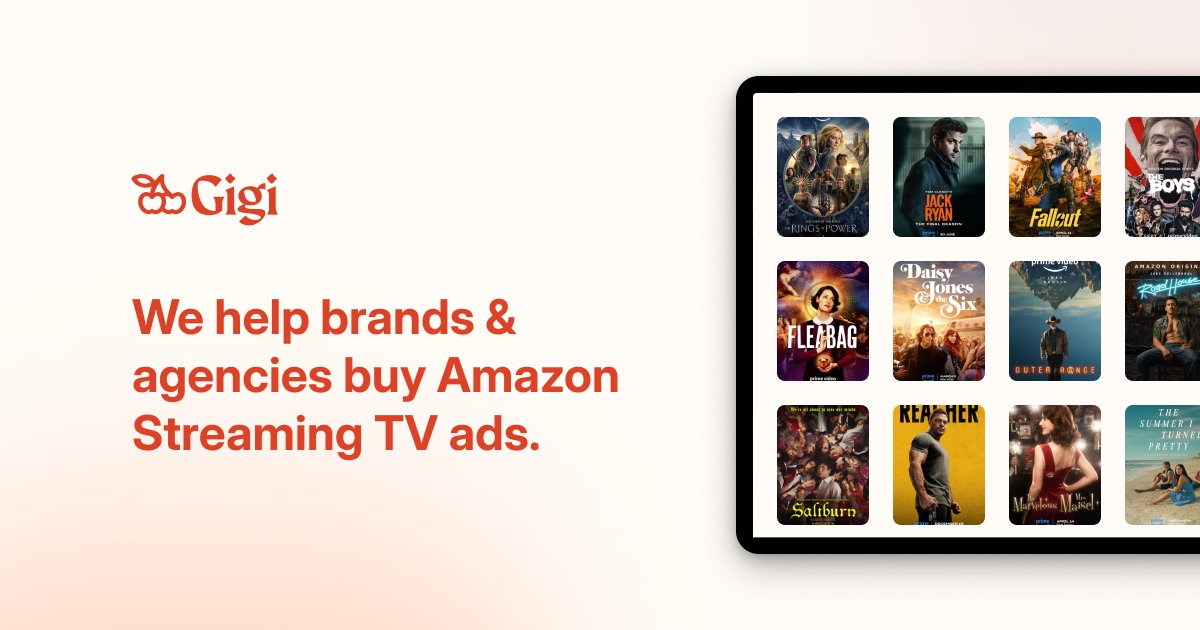
Incredibly excited to introduce you all to @gigico_tv 🍒 We help brands and agencies buy and measure Amazon Streaming TV ads by enabling collaboration with first-party data & Amazon Marketing Cloud to build the right audiences & measure commerce outcomes. We’ve created a unified workflow that harmonizes Amazon Marketing Cloud and Amazon DSP to plan, buy, and measure on Amazon’s premium Streaming TV inventory. Feel free to reach out if you’d like to learn more. gigico.tv
Adam Epstein tweet media
English
8
3
44
3.9K
Jamie D. Greenberg
Jamie D. Greenberg@jamiedgreenberg·
@DanEbs @tron @colindeacon Ironically, at the time Dvai was likely the most important analyst that championed the new entrants. I remember at the time us all reading his investment notes while at Public Mobile. How times have changed.
English
0
0
2
195
Jamie D. Greenberg
Jamie D. Greenberg@jamiedgreenberg·
@baekdal Come to Canada we get the worst of all worlds. High prices. Less choice. All within 75km of the US
English
1
0
2
24
Thomas Baekdal
Thomas Baekdal@baekdal·
@jamiedgreenberg Yeah, I get that :) ... I'm very well aware of geoblocking. What I'm not okay with is that I have to pay a higher price here in Denmark for a subscription product that has far less features.
English
1
0
0
27
Thomas Baekdal
Thomas Baekdal@baekdal·
I just realized that, as a YouTube Premium subscriber, I can watch 'free' movies: (well, 'free' in the sense that I pay for YouTube Premium)
Thomas Baekdal tweet media
English
1
0
1
677
Jamie D. Greenberg
Jamie D. Greenberg@jamiedgreenberg·
@baekdal It’s probably blocked in all nordics not just Denmark. Nordics are usually grouped. You can test it out with Norway, Sweden, etc
English
1
0
0
22
Jamie D. Greenberg
Jamie D. Greenberg@jamiedgreenberg·
@AndrewStoeten At least then there (theoretically) could be the semblance of an arms length tv rights deal at closer to true value
English
0
0
0
0
Jamie D. Greenberg
Jamie D. Greenberg@jamiedgreenberg·
@albertwenger It’s really shocking how a company which raised so much money from sophisticated investors was allowed to jettisoned governance as a tenet, forget about “good” governance
English
1
0
1
0