Javier Alaves

1.3K posts

Javier Alaves banner
Javier Alaves

Javier Alaves

@javalaves

Design Partner at Sparkle ✨ with @AliAbdaal. Working theses on AI, work, creativity, and what it means to live intentionally in computational abundance.
My work thesis for 2026 → Katılım Ocak 2020
1.1K Takip Edilen816 Takipçiler
Javier Alaves
Javier Alaves@javalaves·
My homemade apps are janky and break sometimes. But they solve MY problems perfectly. I'll take that over a polished app that gets me 80% of the way.
English
0
0
0
74
Javier Alaves
Javier Alaves@javalaves·
Build your own ideas next year.
English
0
0
1
96
Javier Alaves
Javier Alaves@javalaves·
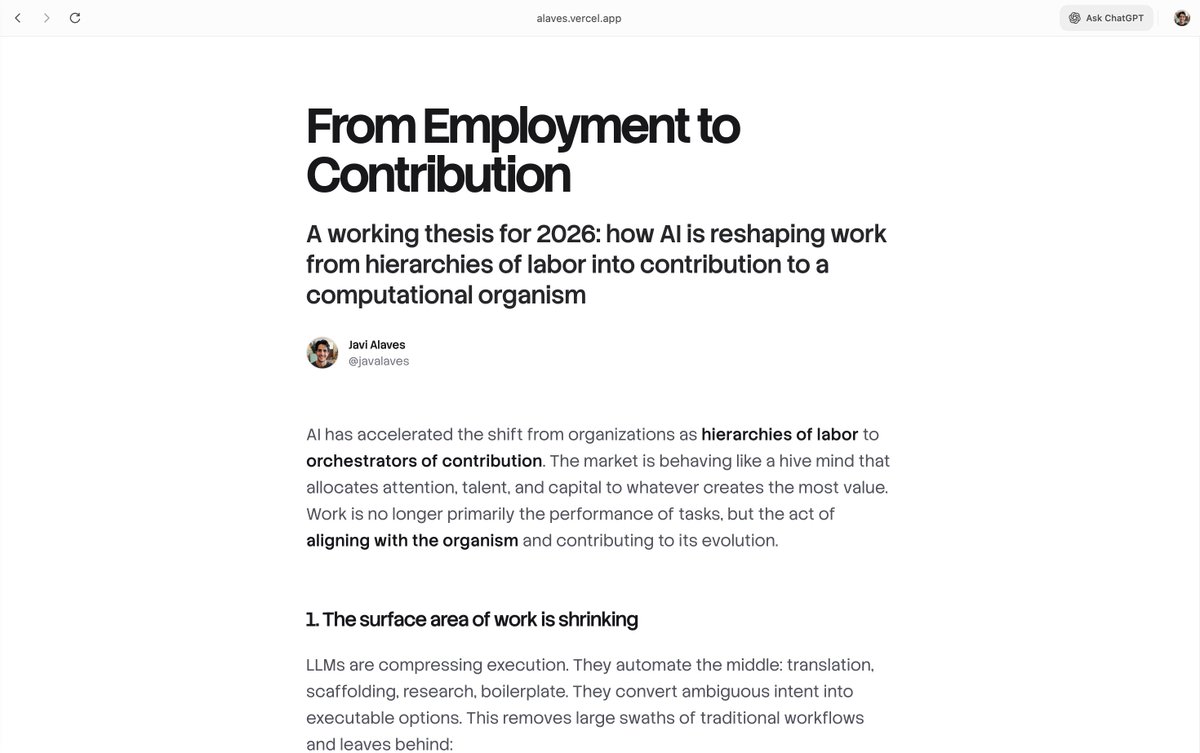
A thesis for the year ahead on what it means to be building software from personal experience. AI has accelerated the shift from organizations as hierarchies of labor to orchestrators of contribution. The market is behaving like a hive mind that allocates attention, talent, and capital to whatever creates the most value. Work is no longer primarily the performance of tasks, but the act of aligning with the organism and contributing to its evolution. LLMs are compressing execution. They automate the middle: translation, scaffolding, research, boilerplate. They convert ambiguous intent into executable options. This removes large swaths of traditional workflows and leaves behind decision making, responsibility, sequencing and prioritization, taste and discernment, and narrative clarity. This raises the premium on the uniquely human faculties that guide direction. Expertise matters differently: taste + product sense + emotional intelligence become productive skills, not soft ones. If execution is compressed, coordination costs fall. This enables viable ventures at the scale of one to five people, operating like studios. Like how @AliAbdaal, @pablo_simko, myself and others work together at Sparkle. Solopreneurs are micro-organizations, small teams are networks rather than hierarchies, and people collaborate like APIs that connect when needed. Ownership is not a job function. It is the default posture. As AI turns intent into code, business logic migrates into repos. Departments are not departments. They are folders. Marketing, product, content, finance, ops become modular subsystems. The "org chart" becomes the file tree. The business becomes legible and programmable. This makes organizations public by default, auditable by design, and forkable in principle. Branching is the new download. You don't join a company. You branch it. You experiment. You contribute back. A venture becomes an evolving artifact rather than a fixed entity. Instead of hiring headcount, organizations request computation with constraints. Humans plug into AI systems to supervise, correct, and contextualize. The work product is not a deliverable. It is a change to the state of the system. This reframes jobs as contributing to ongoing computation with ethical and strategic guardrails, negotiating with models rather than commanding subordinates, and deciding what should not be optimized. The skill is not doing. It is stewarding the direction of doing. As organizations become code, they need verifiable memory. Onchain primitives supply origination (how ventures start, who contributed what), attribution (proof of authorship, proof of impact), and distribution (value-sharing without bureaucracy). This turns equity and compensation into programmable agreements. Collaboration becomes composable. Trust is not assumed. It is cryptographically scaffolded. Excited to see more from chains like @plumenetwork @solana building in this space. A venture is not a company. It is a hypothesis in motion. The hive mind tests hypotheses continuously. Projects live, die, fork, merge. People participate in multiple ventures simultaneously. Careers are portfolios, not ladders. Roles are states, not titles. Stability comes from identity and reputation, not tenure. The labor market becomes a coordination protocol between individuals and problems that need solving. The future of work is an economy of responsible agency. Individuals are nodes in a computational organism that is constantly reconfiguring to solve the highest value problems. AI collapses the distance between decision and execution, imagination and instantiation, and organization and code. The central differentiator becomes how well a person can define direction and uphold it. Taste is strategy. Sequencing is leverage. Responsibility is the new status.
Javier Alaves tweet media
English
0
0
1
92
Javier Alaves
Javier Alaves@javalaves·
Most products are designed to minimize friction. When something feels confusing, the instinct is to add flexibility, extra options, or soft exceptions so fewer people complain. That approach works if your goal is adoption or short-term satisfaction. But it quietly teaches users that the system will adapt to them rather than tell them the truth. Over time, this is going to inevitably kill your business. Clarity is a harder choice. It means being precise about what things mean, even when that precision creates moments of discomfort. It means deciding that some actions have consequences, some states are mutually exclusive, and some ambiguity should be resolved by narrowing behavior rather than expanding options. Clarity asks more from the user, because it removes the comforting illusion that everything can be handled later or reinterpreted generously. The cost of clarity is friction. Users will pause. They will think twice. Some will bounce. But the benefit is something flexibility can never buy: trust. When people understand exactly what happened, what counted, and why, they stop negotiating with the system. They no longer wonder whether the tool is quietly lying to keep them happy. The relationship goes from convenience to confidence. Systems built this way are rarely loved at first. They feel strict, opinionated, even demanding. But over time, they earn something stronger than enjoyment. They earn belief. And once a system consistently tells the truth, even when it is inconvenient, people start relying on it in places that actually matter. That's the tradeoff. Pick one and one only. Fewer complaints in the short term, or deeper trust in the long run.
English
0
0
2
48
Javier Alaves
Javier Alaves@javalaves·
I realized you only need two things to build products that genuinely reshape reality: earned trust, and honest conversations grounded in a product that isn’t trying too hard to change people. Reflect and understand something before trying to improve it.
English
0
0
0
40
Javier Alaves
Javier Alaves@javalaves·
This is the new full stack.
Ryan Carson@ryancarson

Because of LLMs, the only type of people I’d hire now are what I’d call “super-unicorns” - Developer - Designer (or great design taste) - Product-focused (vs feature-focused) - Marketer - Agent expert - High emotional intelligence - 5+ years experience creating web app products - Extreme ownership (h/t @jockowillink) There are very few folks with all these traits … but I just wouldn’t want to work with someone who didn’t have all these skills/behaviors. This will keep team sizes very small. 2026 is going to be very interesting for the whole industry.

English
0
0
0
80
Javier Alaves
Javier Alaves@javalaves·
your app's first website should be: - a manifesto that shows your thinking - a thesis with zero product visuals - an easter egg
Javier Alaves tweet mediaJavier Alaves tweet mediaJavier Alaves tweet mediaJavier Alaves tweet media
English
0
0
1
70
Javier Alaves
Javier Alaves@javalaves·
a handful of people showed up to our presale today and helped us make our first $1K+ 🎉 early wins.
English
0
0
0
57
Javier Alaves
Javier Alaves@javalaves·
Been building something with @AliAbdaal for the past few months that helps people focus and get more meaningful work done. I've been using it for the past +3 weeks and it's become indispensable to my workflow as a designer. Can't wait to show you ✨ youtube.com/watch?v=SBKS42…
YouTube video
YouTube
English
0
0
2
105
Javier Alaves
Javier Alaves@javalaves·
@benln Hey Ben! I remember back when we coordinated bringing Notion to Berlin and kickstarted community there. Would love to bring Cursor to my hometown Madrid now 🇪🇸 Just submitted the form!
English
1
0
2
52
Ben Lang
Ben Lang@benln·
Bring Cafe Cursor to your city We're taking over local cafes for a full day. Come build with the community, grab coffee and credits, and meet the team. Reach out to get involved.

Ben Lang tweet media
English
505
59
1.9K
219.3K
Javier Alaves
Javier Alaves@javalaves·
Quiet shifts are happening in how we design software. Design used to live inside tools like @figma: static, abstract, clean. It was where we shaped flow and form, and handed it off for translation into code. But now, with AI-assisted environments like @cursor_ai, that boundary is dissolving. Designers are starting to work directly in the medium of the product itself: code. This doesn’t mean becoming an engineer. And it doesn't mean leaving Figma. It means expanding the definition of design. Because the experience of a product is no longer just what it looks like; it is how it behaves, how it feels to use, how it responds. When the design lives in code, those layers become part of the creative process. The shift introduces new kinds of friction: debugging, logic, setup. But it also creates new speed and depth. You can think through the full arc of an experience, end to end, and see it come to life immediately. The tool becomes a feedback loop, not a deliverable. The result might not be production grade, but it is expressive enough to work. It shows intent in motion. And that changes collaboration: instead of handing off static artifacts, we share living prototypes that engineers evolve into robust systems. Designing in code blurs roles but clarifies purpose. It reminds us that design is not a stage before development; it is development, at the level of experience.
English
0
0
0
128
Javier Alaves
Javier Alaves@javalaves·
After OpenAI launched a browser, what's next is... the OpenAI operating system? OpenOS, OpenAIOS, OpenS... The system that operates for you, instead of the other way around.
Javier Alaves tweet media
English
0
0
0
92
Ryo Lu
Ryo Lu@ryolu_·
no matter the title, we’re all builders prepping a talk to introduce @cursor_ai to designers – what would you want to see?
English
118
86
1.9K
140K
Javier Alaves
Javier Alaves@javalaves·
Having a conversation with a website on Atlas feels like a more intuitive way to "bookmark" something than to simply store a URL inside a folder. Instant utility right away – the conversation itself.
English
0
0
0
78
Javier Alaves
Javier Alaves@javalaves·
When the interface changes, everything else does too.
English
0
0
0
64
Javier Alaves
Javier Alaves@javalaves·
Switching my browser today.
Javier Alaves tweet media
English
0
0
0
56