
Jason Waterman 🇨🇦

826 posts

Jason Waterman 🇨🇦 banner
Jason Waterman 🇨🇦

Jason Waterman 🇨🇦

@jaywaterman

Fractional CTO, Prev: @mozilla (PM Add-ons, Firefox SDKs), CTO & Co-founder of @momentumdash, Passionate about Technology & Productivity. Proud dad of 3.

Calgary, Alberta, Canada Katılım Nisan 2009
2.8K Takip Edilen7.2K Takipçiler
Jason Waterman 🇨🇦 retweetledi
Hon. Thomas A. Lukaszuk
Hon. Thomas A. Lukaszuk@LukaszukAB·
So let’s get this straight. If Alberta can’t balance its budget without increasing g taxes and fees while oil prices are high and oil production volume is highest ever, how is this independent Alberta going to be tax free? Reality vs. Fantasy #ForeverCanadian
Hon. Thomas A. Lukaszuk tweet media
English
138
490
1.3K
31.4K
Jason Waterman 🇨🇦 retweetledi
Calgary Public Library
Calgary Public Library@calgarylibrary·
Did you know? There have been more than 800 book challenges in Canada in the last five years, with 120 of those coming in 2025. You have the right to intellectual freedom. Your Library provides you access. Learn more about the Library’s commitment to intellectual freedom by visiting our website at: bit.ly/3UtuSL0 #CalgaryLibrary #FTRW26 #FreedomToReadWeek #FreedomToRead
Calgary Public Library tweet media
English
0
9
11
822
Jason Waterman 🇨🇦 retweetledi
The Breakdown
The Breakdown@TheBreakdownAB·
With speculation running rampant that Smith’s address will feature immigration heavily, it’s worth reupping this clip from just a couple of years ago… Where she said she wanted 10 million people in Alberta by 2050. #abpoli #ableg #cdnpoli
English
83
640
1.3K
89.7K
Jason Waterman 🇨🇦 retweetledi
Team Canada
Team Canada@TeamCanada·
TEAM CANADA WILL PLAY FOR GOLD ON SUNDAY! 🥇🇨🇦
Team Canada tweet media
English
251
2.1K
15.7K
314.7K
Jason Waterman 🇨🇦 retweetledi
Corey Hogan 🇨🇦
Corey Hogan 🇨🇦@coreyhoganyyc·
The separatists are a noisy bunch but the vast majority of Albertans are fiercely patriotic Canadians - as are all Alberta MPs. Liberal, Conservative, NDP, other. We disagree about how to govern this country, not its inherent value or how lucky we are to be Canadian.
Scott Robertson@sarobertsonca

Pierre Poilievre on Alberta separatism: "We are entirely a federalist caucus. I have not had a single MP express that view. And as for myself, I'm a very proud federalist, born and bred Albertan, and we will be fighting for a united Canada."

English
206
68
373
22.5K
Jason Waterman 🇨🇦 retweetledi
Tabstack
Tabstack@tabstack·
🚀 Tabstack: Browsing Infrastructure for AI Agents You built a brilliant agent. Then you connected it to the internet, and everything broke. 💥 Stop paying to tokenize noise. We fixed the infrastructure so you can focus on the intelligence 🧠 mzl.la/4qm92aD
English
0
1
4
321
Jason Waterman 🇨🇦 retweetledi
Addy Osmani
Addy Osmani@addyosmani·
Every time we've made it easier to write software, we've ended up writing exponentially more of it. When high-level languages replaced assembly, programmers didn't write less code - they wrote orders of magnitude more, tackling problems that would have been economically impossible before. When frameworks abstracted away the plumbing, we didn't reduce our output - we built more ambitious applications. When cloud platforms eliminated infrastructure management, we didn't scale back - we spun up services for use cases that never would have justified a server room. @levie recently articulated why this pattern is about to repeat itself at a scale we haven't seen before, using Jevons Paradox as the frame. The argument resonates because it's playing out in real-time in our developer tools. The initial question everyone asks is "will this replace developers?" but just watch what actually happens. Teams that adopt these tools don't always shrink their engineering headcount - they expand their product surface area. The three-person startup that could only maintain one product now maintains four. The enterprise team that could only experiment with two approaches now tries seven. The constraint being removed isn't competence but it's the activation energy required to start something new. Think about that internal tool you've been putting off because "it would take someone two weeks and we can't spare anyone"? Now it takes three hours. That refactoring you've been deferring because the risk/reward math didn't work? The math just changed. This matters because software engineers are uniquely positioned to understand what's coming. We've seen this movie before, just in smaller domains. Every abstraction layer - from assembly to C to Python to frameworks to low-code - followed the same pattern. Each one was supposed to mean we'd need fewer developers. Each one instead enabled us to build more software. Here's the part that deserves more attention imo: the barrier being lowered isn't just about writing code faster. It's about the types of problems that become economically viable to solve with software. Think about all the internal tools that don't exist at your company. Not because no one thought of them, but because the ROI calculation never cleared the bar. The custom dashboard that would make one team 10% more efficient but would take a week to build. The data pipeline that would unlock insights but requires specialized knowledge. The integration that would smooth a workflow but touches three different systems. These aren't failing the cost-benefit analysis because the benefit is low - they're failing because the cost is high. Lower that cost by "10x", and suddenly you have an explosion of viable projects. This is exactly what's happening with AI-assisted development, and it's going to be more dramatic than previous transitions because we're making previously "impossible" work possible. The second-order effects get really interesting when you consider that every new tool creates demand for more tools. When we made it easier to build web applications, we didn't just get more web applications - we got an entire ecosystem of monitoring tools, deployment platforms, debugging tools, and testing frameworks. Each of these spawned their own ecosystems. The compounding effect is nonlinear. Now apply this logic to every domain where we're lowering the barrier to entry. Every new capability unlocked creates demand for supporting capabilities. Every workflow that becomes tractable creates demand for adjacent workflows. The surface area of what's economically viable expands in all directions. For engineers specifically, this changes the calculus of what we choose to work on. Right now, we're trained to be incredibly selective about what we build because our time is the scarce resource. But when the cost of building drops dramatically, the limiting factor becomes imagination, "taste" and judgment, not implementation capacity. The skill shifts from "what can I build given my constraints?" to "what should we build given that constraints have in some ways been evaporated?" The meta-point here is that we keep making the same prediction error. Every time we make something more efficient, we predict it will mean less of that thing. But efficiency improvements don't reduce demand - they reveal latent demand that was previously uneconomic to address. Coal. Computing. Cloud infrastructure. And now, knowledge work. The pattern is so consistent that the burden of proof should shift. Instead of asking "will AI agents reduce the need for human knowledge workers?" we should be asking "what orders of magnitude increase in knowledge work output are we about to see?" For software engineers it's the same transition we've navigated successfully several times already. The developers who thrived weren't the ones who resisted higher-level abstractions; they were the ones who used those abstractions to build more ambitious systems. The same logic applies now, just at a larger scale. The real question is whether we're prepared for a world where the bottleneck shifts from "can we build this?" to "should we build this?" That's a fundamentally different problem space, and it requires fundamentally different skills. We're about to find out what happens when the cost of knowledge work drops by an order of magnitude. History suggests we (perhaps) won't do less work - we'll discover we've been massively under-investing in knowledge work because it was too expensive to do all the things that were actually worth doing. The paradox isn't that efficiency creates abundance. The paradox is that we keep being surprised by it.
Aaron Levie@levie

x.com/i/article/2004…

English
126
624
3.3K
552K
Jason Waterman 🇨🇦 retweetledi
Peter Guthrie
Peter Guthrie@PeterGuthrie99·
It’s official. We move forward as the Progressive Tory Party of Alberta - a progressive conservative option focused on accountability, stability, and a government that works for people. Vote TORY #toryab #ableg #abpoli #alberta #abpc
English
631
134
707
203.3K
Jason Waterman 🇨🇦 retweetledi
corblund
corblund@CorbLund·
Hey Alberta. Expect approval soon on our petition to stop coal mining in our Rockies, source of our drinking water. We're gonna need TONS of canvassers. Go to CoalPetition.ca give us your email and tell 50 friends. When approved we'll give you info on how to help. Pls RT.
Lethbridge, Alberta 🇨🇦 English
176
687
1.6K
57.7K
Jason Waterman 🇨🇦 retweetledi
Peter Guthrie
Peter Guthrie@PeterGuthrie99·
Debate: Cancelled! After Question Period today, the UCP shut down the Legislature and cancelled Private Members’ Business - stopping non-government MLAs from debating anything at all. That move killed debate on my Motions for Return and Written Questions. In six and a half years here, I’ve never seen this done. They’re suing opponents. They’re banning party names. And now they’re shutting down debate. That’s not transparency. That’s control. When a government avoids questions and silences MLAs, every Albertan should be concerned. #abpoli #ableg #alberta #albertaparty #pcalberta
English
66
413
1K
54.6K
Jason Waterman 🇨🇦 retweetledi
Tom Bielecki
Tom Bielecki@tombielecki·
This is a crime in broad daylight?? @nenshi @shoffmanAB @PeterGuthrie99 There is no legal provision granting any minister, including the Minister of Service Alberta and Red Tape Reduction, special or elevated access to confidential voting information such as whether an individual has voted. Any personal information, including voting participation, is protected, and breaches of access or misuse can result in significant penalties. Furthermore Dale Nally is weaponizing this private information.
English
5
56
179
16.2K
Jason Waterman 🇨🇦 retweetledi
The Breakdown
The Breakdown@TheBreakdownAB·
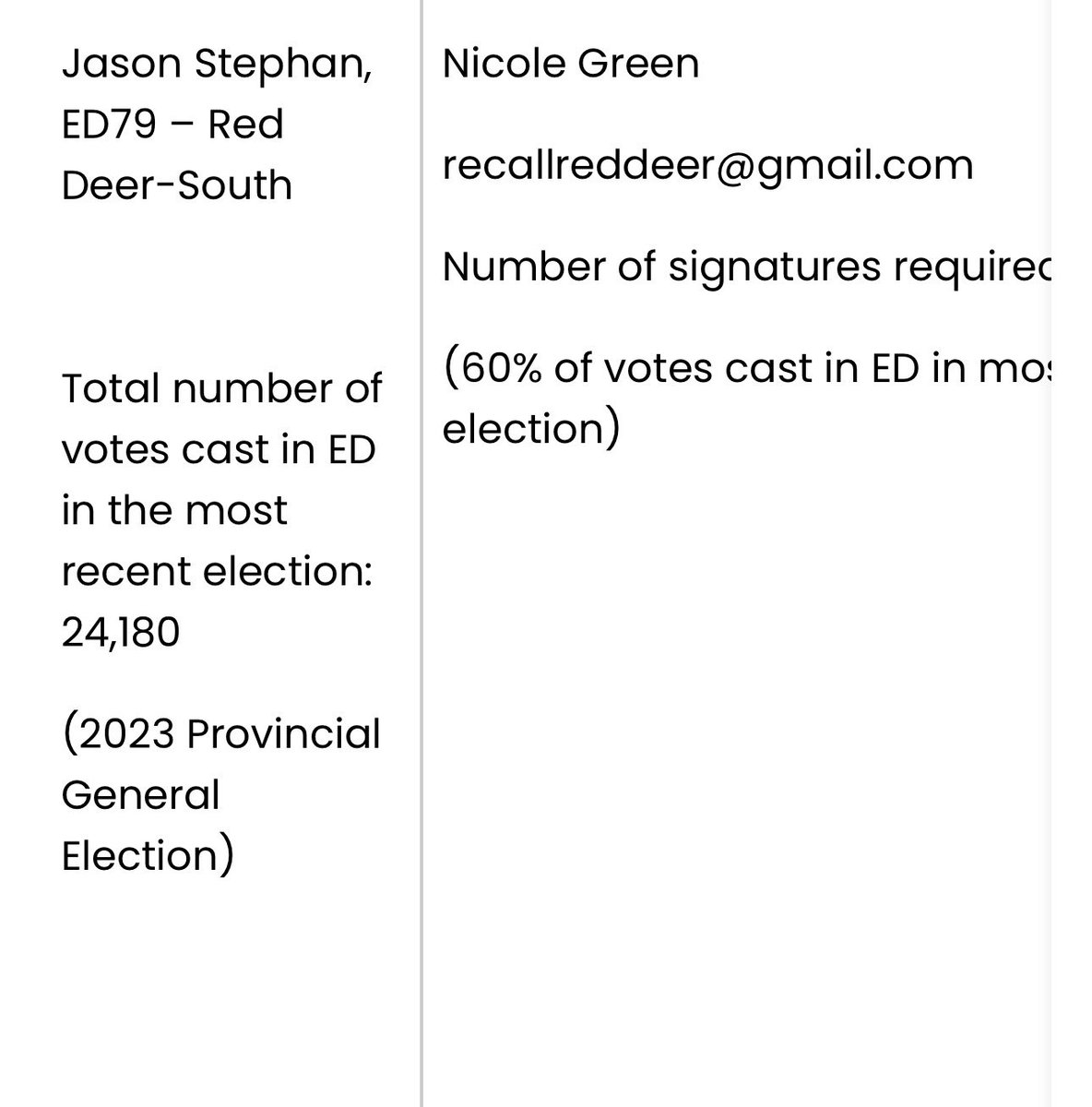
14 now! There are a total of 14 UCP MLA’s up for recall! With 47 sitting MLA’s that’s almost a full 1/3 of the UCP caucus up for recall! #abpoli #ableg #cdnpoli
The Breakdown tweet mediaThe Breakdown tweet mediaThe Breakdown tweet mediaThe Breakdown tweet media
English
65
227
923
38.9K
Jason Waterman 🇨🇦 retweetledi
Court Ellingson
Court Ellingson@CourtEllingson·
In the midst of an affordability crisis, the UCP Gov is telling Albertans: 1) Prepare to pay 15% more for auto insurance over the next 2 years. 2) The only way to receive faster health care is to pay out of pocket. 3) Minimum wage won't go up & your tips aren't protected.
English
26
129
224
5.8K
Jason Waterman 🇨🇦 retweetledi
Gil McGowan
Gil McGowan@gilmcgowan·
On the day the UCP unveils its latest big plan to privatize health care, the Auditor General releases a report showing that their last big plan to privatize health care was an unmitigated failure. Everything they touch turns to crap. We all pay the price.
Lorian Hardcastle@Lorian_H

AG report on Dynalife is out. Unsurprisingly finds that it was a total waste of money. $125 million "non-value-add expenditure of taxpayer dollars". /1

English
11
223
559
10.5K