จิตร์ทัศน์

31.7K posts

จิตร์ทัศน์

จิตร์ทัศน์

@jittat

Mastodon: [email protected]

Katılım Ekim 2007
4.4K Takip Edilen3.9K Takipçiler
จิตร์ทัศน์ retweetledi

Sebastien Bubeck
Sebastien Bubeck@SebastienBubeck·
Ramsey numbers are one the most basic objects in combinatorics, a beautiful illustration of structure within chaos. They have been heavily studied for almost a century now, so it came as a real surprise to us when an internal version of GPT-5.5 proved a new elementary result about them: \lim_{n\to \infty} R(k,n+1)/R(k,n) = 1 for all k This was also known as Erdos problem #1014, although I personally think the more relevant bit is that it's a basic result about off-diagonal Ramsey numbers. As it often happens (for now), the proof is reasonably simple in hindsight, although it is quite a wire act and it relies on some unexpected numerics (the "unexpected" part here is probably why this wasn't discovered before). Despite being simple, it's certainly the type of result that could now be taught in a combinatorics class. Pdf of the proof (produced by @mehtaab_sawhney): cdn.openai.com/pdf/6dc7175d-d… Lean verification of the proof (produced by Boris Alexeev): github.com/plby/lean-proo…
Sebastien Bubeck tweet media
English
14
82
508
68.7K
จิตร์ทัศน์ retweetledi
Rose Yu
Rose Yu@yuqirose·
How to bridge the gap between informal math reasoning with formal verification? Check out our #ICLR2026 paper Hilbert: Recursively Building Formal Proofs with Informal Reasoning! Paper: arxiv.org/abs/2509.22819 Code: github.com/Rose-STL-Lab/m… (1/3)
Rose Yu tweet media
English
2
23
125
9.2K
จิตร์ทัศน์ retweetledi
Jared Duker Lichtman
Jared Duker Lichtman@jdlichtman·
In my doctorate, I proved the Erdős Primitive Set Conjecture, showing that the primes themselves are maximal among all primitive sets. This problem will always be in my heart: I worked on it for 4 years (even when my mentors recommended against it!) and loved every minute of it. [Primitive sets are a vast generalization of the prime numbers: A set S is called primitive if no number in S divides another.] Now Erdős#1196 is an asymptotic version of Erdős' conjecture, for primitive sets of "large" numbers. It was posed in 1966 by the Hungarian legends Paul Erdős, András Sárközy, and Endre Szemerédi. I'd been working on it for many years, and consulted/badgered many experts about it, including my mentors Carl Pomerance and James Maynard. The the proof produced by GPT5.4 Pro was quite surprising, since it rejected the "gambit" that was implicit in all works on the subject since Erdős' original 1935 paper. The idea to pass from analysis to probability was so natural & tempting from a human-conceptual point of view, that it obscured a technical possibility to retain (efficient, yet counter-intuitve) analytic terminology throughout, by use of the von Mangoldt function \Lambda(n). The closest analogy I would give would be that the main openings in chess were well-studied, but AI discovers a new opening line that had been overlooked based on human aesthetics and convention. In fact, the von Mangoldt function itself is celebrated for it's connection to primes and the Riemann zeta function--but its piecewise definition appears to be odd and unmotivated to students seeing it for the first time. By the same token, in Erdős#1196, the von Mangoldt weights seem odd and unmotivated but turn out to cleverly encode a fundamental identity \sum_{q|n}\Lambda(q) = \log n, which is equivalent to unique factorization of n into primes. This is the exact trick that breaks the analytic issues arising in the "usual opening". Moreover, Terry Tao has long suspected that the applications of probability to number theory are unnecessarily complicated and this "trick" might actually clarify the general theory, which would have a broader impact than solving a single conjecture.
Boaz Barak@boazbaraktcs

This is one of the coolest such examples! See comments from Lichtman below, who proved the related primitive set conjecture arxiv.org/abs/2202.02384

English
56
379
2.9K
978.2K
จิตร์ทัศน์ retweetledi
Nathan Lambert
Nathan Lambert@natolambert·
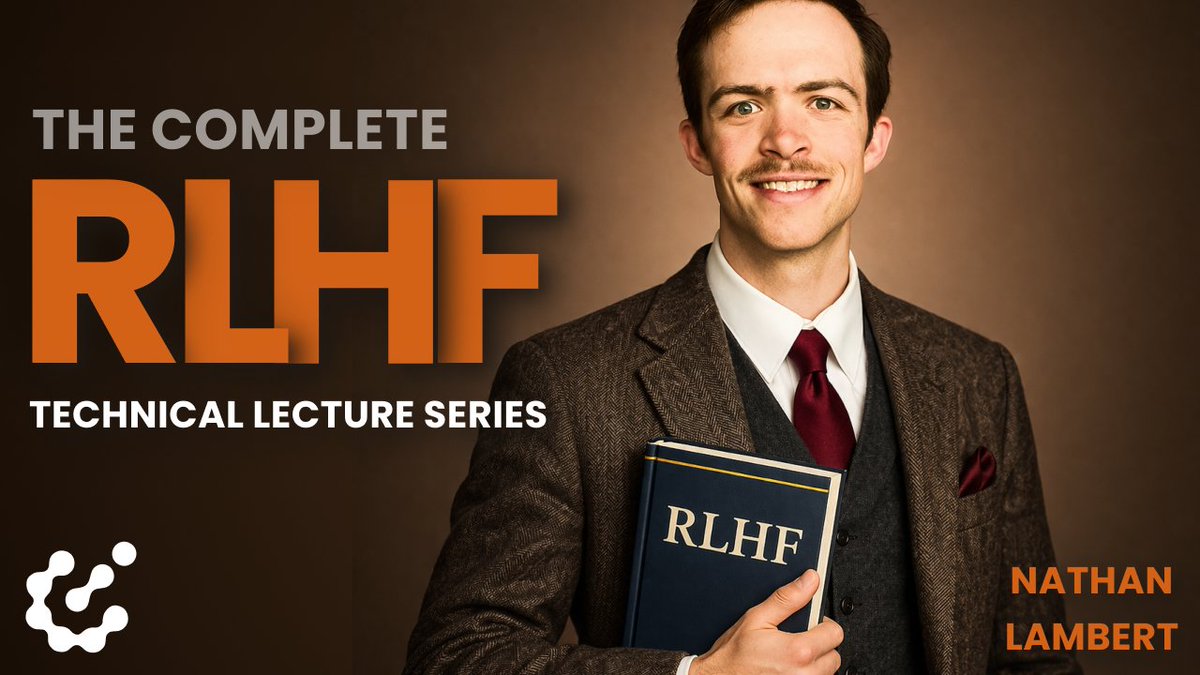
Excited to launch the accompanying free RLHF Course for my book. To kick it off, I've released: - Welcome video - Lecture 1: Overview of RLHF & Post-training - Lecture 2: IFT, Reward Models, Rejection Sampling - Lecture 3: RL Math - Lecture 4: RL Implementation I'm going to add question & answer videos throughout the lecture to go deeper on topics that need it, and potentially cover some topics that are too recent and in flux to go in print. I expect 10-15 videos in total over the next few months. At the same time, development around the code for the book is picking up. It's a great time to build the foundation for post-training methods. YT playlist and course landing page below.
Nathan Lambert tweet media
English
50
237
1.8K
188.7K
จิตร์ทัศน์ retweetledi
@srakrn
@srakrn@srakrn·
คิดว่าต้องเขียนถึง Exteen (@exteen) ด้วยความเคารพรัก จำได้ว่า Exteen เป็นบ้านของนักวาดจำนวนมาก จำความได้ก่อนเคยได้ยินคำว่า "สายผลิต" ด้วยซ้ำ นักวาดทุกท่านคงรักบ้านหลังนี้มาก แต่คิดว่ากลับมาเปิดใหม่ ภาพปกเป็นภาพสร้างด้วยเอไอ น่าจะเหมือนกลับมาเปิดบ้านแล้วเอารูปวายร้ายขึ้นบิลบอร์ด
ไทย
2
861
514
56.1K
จิตร์ทัศน์ retweetledi
wiennat
wiennat@wiennat·
เมื่อวานฟัง youtube.com/watch?v=zTxQMO… ก็มีคำถามคล้ายๆ กันออกมาว่า AGI ออกมาแล้วเราจะเตรียมตัวกันยังไง สรุปสั้นๆ อาจารย์มะนาวอธิบายประมาณว่า การศึกษาในมหาลัยไม่ได้ทำให้ผู้เรียนได้แค่ความรู้ (ในวิดีโออธิบายว่าจริงๆ นี่คือ by-product เพราะผ่านไปไม่กี่ปีก็ obsolete แล้ว) แต่มันยังสร้างทักษะ สร้างตัวตน เช่นความอดทนหรือแพสชั่นในการเรียนรู้ ซึ่งพวกนี้มันน่าจะเป็น direct product ของการศึกษาระดับมหาวิทยาลัย ถ้ามี AGI แล้วเราอาจจะไปเน้นเรื่องความรู้ที่เป็น by-product น้อยลง แล้วไปเน้นเรื่องการเรียนรู้ที่เป็น direct product ง่ายขึ้น แต่จะทำยังไงก็ต้องไปศึกษาต่อไป ส่วนอาจารย์นัททีก็ตอบแบบสั้นๆ ว่าอะไรที่เอไอทำได้ก็ให้เอไอทำ ส่วนเราก็ไปทำอะไรที่มนุษย์ยังต้องทำต่อไป ซึ่งมันก็พ้องกับในโพสท์ด้านล่างนี้แหละว่า เราก็ต้องไปคิดกันต่อว่าแล้วความเป็นมนุษย์ หรือสิ่งที่มนุษย์ยังต้องทำต่อไปนี้มันคืออะไร ------ ส่วนตัวผมคิดว่า ความสามารถหนึ่งที่แสนมหัศจรรย์ของมนุษย์คือ มนุษย์มีเจตจำนงค์อย่างแรงกล้าที่จะมีชีวิตอยู่ต่อไป ขอเพียงเราไม่ยอมแพ้ และพยายามคิดหาทางปรับตัวต่อไปเรื่อยๆ เราก็จะหาทางอยู่ต่อไปได้อยู่ดีนั่นแหละ ดังนั้นก็ไม่ต้องไปกังวลมากเกิน แค่เตรียมตัวให้พร้อมกับความเปลี่ยนแปลงให้ดีที่สุดก็น่าจะเพียงพอแล้วล่ะมั้ง
YouTube video
YouTube
ched@worachet

x.com/i/article/2044…

ไทย
1
137
146
23.2K
จิตร์ทัศน์ retweetledi
Kevin Hartnett
Kevin Hartnett@KSHartnett·
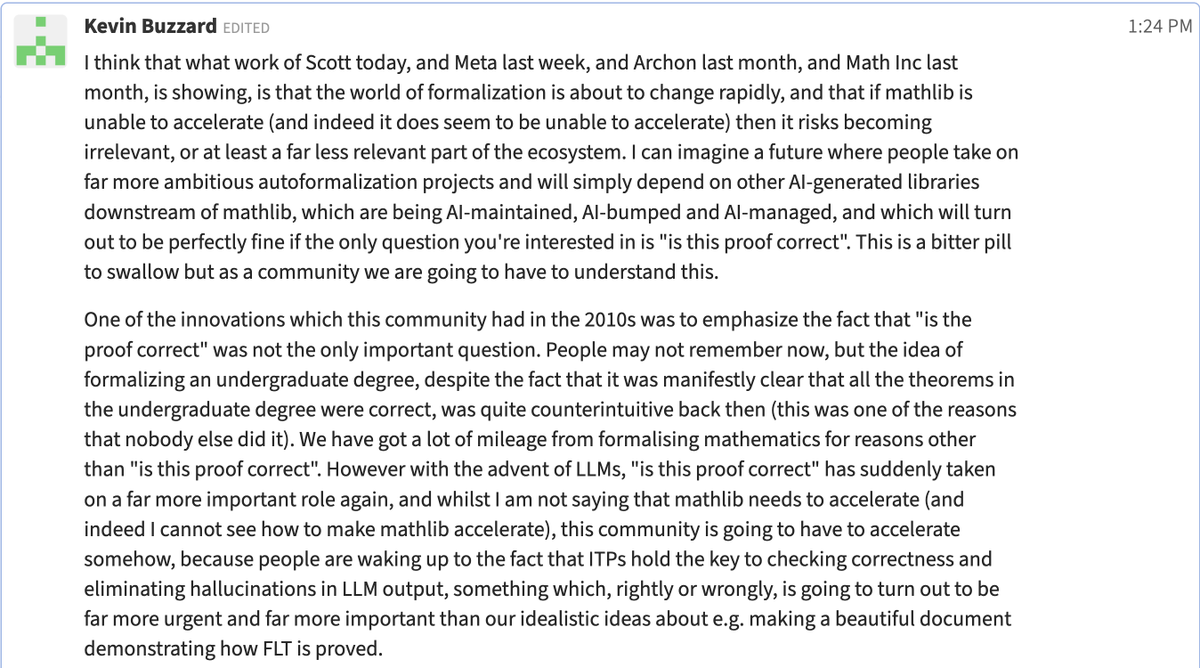
It's stunning to read Kevin Buzzard writing about his dreams for Mathlib being outstripped by technological advances. I can hear Kevin telling me how excited he was when he first defined the complex numbers in Lean. Commit #21 to Mathlib, 8 years ago. github.com/leanprover-com… I tell that story in my book, The Proof in the Code, about the development of Lean and Mathlib. Preorders: quantabooks.org/books/the-proo…
Alex Kontorovich@AlexKontorovich

One more zulip comment worth reposting here:

English
0
13
95
8.7K
จิตร์ทัศน์ retweetledi
Saman Habibi Esfahani
Saman Habibi Esfahani@Saman_Habibi_E·
Today I attended an interesting important talk by Lauren Williams on the “First Proof” project at Harvard CMSA. Mathematicians listed problems they had solved but not posted online, and invited AI companies to solve them, testing AI beyond internet-available answers. (1/3)
Saman Habibi Esfahani tweet media
English
6
38
270
28K
จิตร์ทัศน์ retweetledi
Chao Ma
Chao Ma@ickma2311·
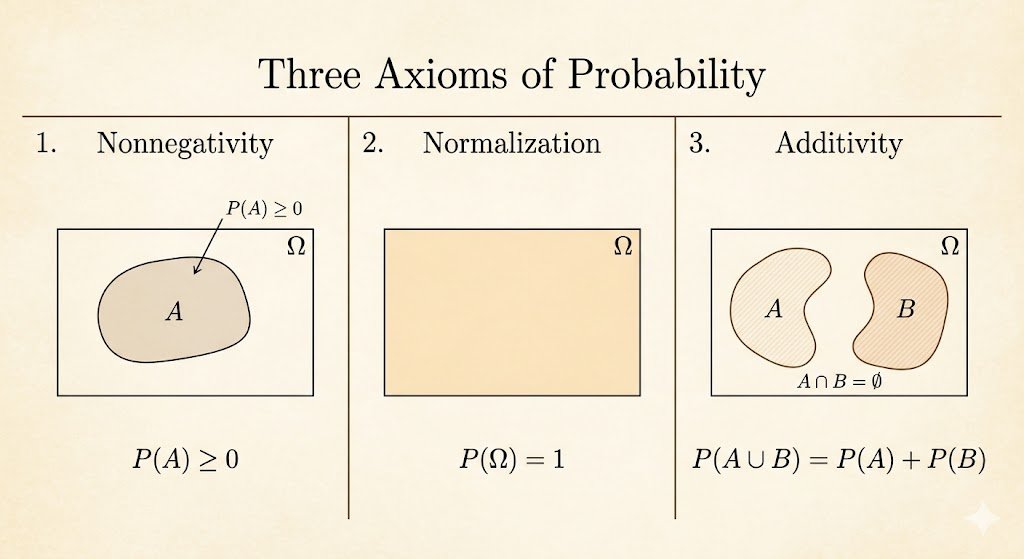
MIT 6.041 Lecture 1: Probability Models and Axioms. I started MIT 6.041:Probability Systems Analysis and Applied Probability. For me, linear algebra, calculus, probability, and optimization are the four core math pillars of AI, so this course completes an important part of that foundation. Clear, practical, and easy to follow. My note: ickma2311.github.io/Math/Probabili…
Chao Ma tweet media
English
5
67
498
16.2K
จิตร์ทัศน์ retweetledi
Paata Ivanisvili
Paata Ivanisvili@PI010101·
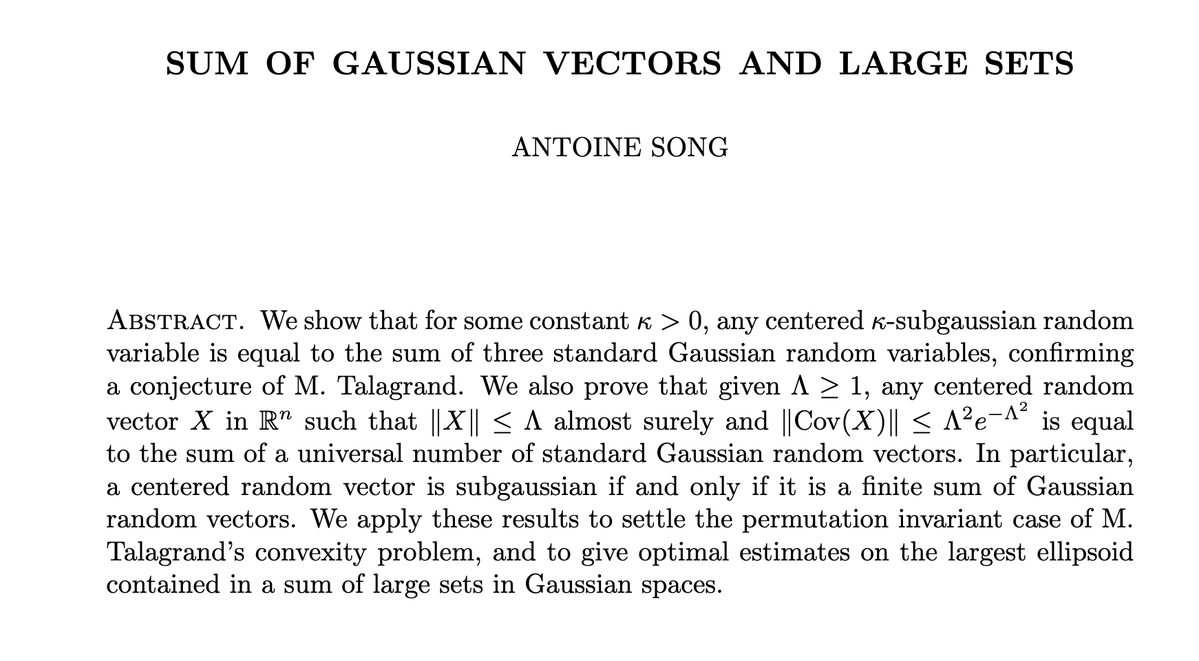
Every subgaussian is a sum of Gaussians -- Antoine Song resolves Talagrand's conjectures arxiv.org/pdf/2602.22342
Paata Ivanisvili tweet media
English
6
65
403
40.1K
จิตร์ทัศน์ retweetledi
Alex Kontorovich
Alex Kontorovich@AlexKontorovich·
A preview of my talk tomorrow at the Newton Insitute @NewtonInstitute (comments welcome) My primary interest is research math: solving problems, proving theorems. Before 2019, I was accustomed to using Mathematica to check tedious, error-prone algebra in my papers. Do it once, and never waste time checking it again. But algebra was only part of the issue. If I had a lemma, and in a 60-page paper I might have 20 of them, with a dozen parameters all moving around in different ranges and needing to line up perfectly at the end, then even a single stray minus sign could kill the entire paper. The whole enterprise was extremely complex and fragile. (What I'm describing is very common in loads of fields in modern research math.) In 2019, I watched a lecture of Kevin Buzzard's, and realized the answer: I should use an interactive theorem prover like Lean to check my lemmas the same way Mathematica checks my algebra. (Of course, as I've since learned, there are many benefits to working formally beyond correctness, and these have been extensively enumerated elsewhere, so I won't repeat them here.) But my original motivation for getting involved in formalization was simple: I hoped it would speed up my workflow. It did not. In fact, formalization is brutally tedious, requiring painstakingly spelling out facts that to a human expert are blatantly obvious. Fast forward to 2025, and AI was getting genuinely good at helping with formalization. I was already using Claude rather extensively when we crossed the finish line on the "Medium" PNT in July 2025. By September 2025, Math Inc's Gauss system autoformalized the Strong PNT, writing over 20K lines of compiling Lean autonomously. Earlier this month, they outdid themselves again, writing 200K lines autonomously and formalizing Viazovska's theorems on optimal sphere packing in dimensions 8 and 24. So isn't that the dream? AI can now, in some instances, autoformalize very significant theorems. Can we mathematicians just get back to thinking, sketching, and letting AI do the formalization for us? Not so fast. Autoformalization only works because it is built on top of a big, comprehensive, efficient, coherent monorepo of high-quality formalized mathematics, namely Mathlib. And even in the PNT+ and Viazovska examples, the autoformalizations still depended on substantial earlier human work: setting up the right definitions, the right API, the right abstractions, and so on. So maybe we now get a nice positive feedback loop: Research -> formal math (thanks to AI) -> grows Mathlib -> enables more research. Still no. AI formalization, and frankly the first-pass human formalization too, is usually local, ad hoc, single-purpose work. It is not necessarily general, abstract, efficient, or reusable. So it does not in and of itself help grow Mathlib. The second arrow is broken. Actually, this is not some temporary annoyance, it is inevitable! The goals of doing research and building libraries are misaligned, like scrambling up a cliff versus building an elevator to the top. Both are trying to go up, but for completely different reasons and in completely different ways. In fact, it is even worse than that: the second arrow may make the feedback loop negative. Let us give that second arrow a name: "canonization". By canonization, I mean the process of taking a local, one-off formalization and turning it into library mathematics: general, reusable, coherent, efficient, and compatible with the rest of the monorepo. This is an extremely difficult and time-consuming task. It requires a large amount of prior knowledge and skill, often in several quite different areas at once. And here's why the feedback loop may be negative: while a rough formalization can certainly be a technical head start, socially it often strands the problem in the worst possible state: too solved to feel pressing, too idiosyncratic to be reusable. If a formalization already exists in some ad hoc form, then people are much less incentivized to do this work! They get less credit for succeeding, there is less urgency, and less motivation. Does this sound familiar? It's the same structural problem we had back in 2019, going from proved results to formalized results! So the answer should be obvious. In June 2025, I claimed that (quasi)autoformalization, meaning not entirely autonomous but allowing human intervention and steering, was the greatest short-term challenge in realizing the dream of speeding up research [K2025]. The corresponding claim today is: (Quasi)auto-canonization is the greatest short-term challenge for AI systems. I personally know of only one AI company so far that seems to be taking this challenge seriously, namely Harmonic with its Aristotle agent. Imagine if we get this right. Definitions will still be difficult to automate, but there are orders of magnitude fewer definitions than theorems. Once those foundations are laid (which will still be a ton of human time and effort!), everything else can scale on top. Right now, the vast majority of research mathematicians working in formalization are, very commendably, working toward growing Mathlib. But they comprise maybe 1% of all professional mathematicians. This is not necessarily because people do not want to work formally. It is because the current system does not match how most mathematicians want to work. People are diverse. They have different strengths and weaknesses, different interests, different workflows. If we embrace an ecosystem where people are encouraged to formalize freely, with heavy AI assistance, and where the right pieces later get (quasi)auto-canonized into the central monorepo, then I think we could potentially be in position, given the right incentives, training, and culture-shifts, to move from a handful to the majority of mathematicians doing math formally.
English
22
64
369
102K
จิตร์ทัศน์ retweetledi
Leonardo de Moura
Leonardo de Moura@Leonard41111588·
Cray Distinguished Colloquium at UMN, next Monday. An AI converted zlib to Lean and proved it correct. 10 AI agents built a verified DSL in a weekend. Three IMO teams, no competing platform. The slides are written in Verso: checked by Lean. leodemoura.github.io/static/minneso…
English
8
38
127
10.6K
จิตร์ทัศน์ retweetledi
상일
상일@sioum·
4색 정리 새로운 증명이 arXiv에 올라왔습니다. New proof of the four color theorem by Yuta Inoue, Ken-ichi Kawarabayashi, Atsuyuki Miyashita, Bojan Mohar, Carsten Thomassen, Mikkel Thorup arxiv.org/abs/2603.24880
한국어
4
61
227
32.4K
จิตร์ทัศน์ retweetledi
Alex Kontorovich
Alex Kontorovich@AlexKontorovich·
This is the future! Make sure to scroll down to hear how there turned out to be a subtle error in Claude's natural language proof, which was only caught during Lean formalization! As I said in my ICM lecture (arxiv.org/abs/2510.15924), no matter how good agentic LLMs will get, I won't even begin to consider their claims seriously unless they come with a formalization. These days the latter is getting easier and easier to come by!
Ashvin Swaminathan@aaswaminathan01

A decade ago, I abandoned the first math problem my PhD advisor ever gave me. This week, I finally solved it—and formally verified it—using @AnthropicAI's Claude Code, @OpenAI's Codex, and @HarmonicMath's Aristotle. Here’s how AI turned my 10-year-old notes into a 15,000-line Lean 4 proof. 🧵

English
8
37
246
34K
จิตร์ทัศน์ retweetledi
Mohammad Hajiaghayi (IG@mhajiaghayi,YT:hajiaghayi)
Excited to lead a UMD–MIT team on a $2.6M DARPA expMath grant to advance AI for tackling long-standing open problems. Program x.com/patrickshafto/… initiated by @patrickshafto include Sanjiv Arora, Shafi Goldwasser, Venkat G, Amit Sahai, Terry Tao. More: today.umd.edu/umd-to-lead-da…
UMD Department of Computer Science@umdcs

🔊@UofMaryland will lead a $2.6M @DARPA-funded effort to accelerate mathematical discovery with #AI. Led by @MTHajiaghayi, the GENIUS project aims to develop AI systems that reason alongside mathematicians to solve complex problems. 🔗 go.umd.edu/Hajiaghayi-3-2…

English
3
9
60
6.4K
จิตร์ทัศน์ retweetledi
Lean
Lean@leanprover·
Have you seen the new Verso website? "Verso is a platform for writing documents, books, course materials, and websites with Lean. Every code example is type-checked. Every rendered page is interactive." Already in use for the Lean Reference Manual, Theorem Proving in Lean 4, Functional Programming in Lean, and Terence Tao's Analysis I, and the Lean website (lean-lang.org). Learn more here: verso.lean-lang.org
Lean tweet media
English
7
21
227
15.2K