jlgarciapacheco (🐘@vivaldi.net)🇺🇦

17.1K posts

jlgarciapacheco (🐘@vivaldi.net)🇺🇦 banner
jlgarciapacheco (🐘@vivaldi.net)🇺🇦

jlgarciapacheco (🐘@vivaldi.net)🇺🇦

@jlgarciapacheco

EECS, Software, Telecom, ICT, Biomed, COVID, MentalHealth. 🇪🇺EU, 🌎🌍🌏Iberismo, Iberofonía. 🇬🇧🇪🇸🇫🇷🇵🇹

Europa Katılım Haziran 2015
3.3K Takip Edilen521 Takipçiler
jlgarciapacheco (🐘@vivaldi.net)🇺🇦
« The proposed fix is familiar: more open source software, more domestic capability, and a deliberate push toward "digital sovereignty," defined as control over infrastructure, data, and technology. Or as Killock put it: "Public money should be spent on public code that benefits us all, rather than lining the pockets of Big Tech's shareholders." » #soberaníaDigital #DigitalSovereignty
The Register@TheRegister

UK told its Big Tech habit is now a national security risk go.theregister.com/feed/www.there…

English
0
0
0
5
jlgarciapacheco (🐘@vivaldi.net)🇺🇦 retweetledi
Crémieux
Crémieux@cremieuxrecueil·
Nature finally published it! The Reich Lab article on genetic selection in Europe over the last 10,000 years is finally online, and it includes such interesting results as: - Intelligence has increased - People got lighter - Mental disorders became less common And more!
Crémieux tweet media
English
76
659
5K
350.2K
jlgarciapacheco (🐘@vivaldi.net)🇺🇦 retweetledi
Infobae América
Infobae América@infobaeamerica·
Tres años de guerra en Sudán: la mayor crisis de desplazamiento del mundo #Echobox=1776281875-1" target="_blank" rel="nofollow noopener">infobae.com/america/mundo/…
Español
0
4
0
687
jlgarciapacheco (🐘@vivaldi.net)🇺🇦 retweetledi
The Political Room
The Political Room@Political_Room·
✍🏻 Djerba alberga la última gran comunidad judía del Magreb. Un caso único que desafía el éxodo hacia Israel y revela las claves históricas, religiosas y sociales de su permanencia. thepoliticalroom.com/blog/los-judio…
Español
0
2
9
3.4K
jlgarciapacheco (🐘@vivaldi.net)🇺🇦 retweetledi
Allen Holub. https://linkedIn.com/in/allenholub
I really don't get "spec-based development," which is nothing but a fancy way to describe a phase-gated "waterfall." An upfront specification is never correct, at least if our goal is to develop software people actually want to use. The more detailed and larger the spec, the less correct it is. We all learned the hard way that the most effective way to develop a product that people actually want to buy is incrementally, in very small chunks, delivered as frequently as possible to get feedback, and then continuously adjusting what we're building based on that feedback. I suppose you could argue that you can specify each small increment, but even there, it's best to get feedback while we're working, so the spec will be fluid. The irony of the AI stans demanding a full specification up front is that AI actually makes incremental development easier and more effective. We can try out ideas with less effort and get them into customers' hands much faster. In other words, the real advantage of AI-assisted development is that it tightens the feedback loop and enables incremental development. Why would anybody throw away that advantage and revert to a half-century-old way of working that has been proven ineffective? Seems nuts.
English
60
37
313
30.4K
jlgarciapacheco (🐘@vivaldi.net)🇺🇦 retweetledi
Grady Booch
Grady Booch@Grady_Booch·
Andrew, please know that I am absolutely delighted that you and your colleagues have rediscovered some of the fundamentals of software engineering. I delivered a lovely little keynote at the International Conference on Software Engineering a few years ago in Florence, on the history and the future of the field. I think you might find it useful and I’d be happy to show you. TL/DR, what of the fundamentals have changed since the advent of agenetic coding? Pretty much nothing.
Andrew Ng@AndrewYNg

New course: Spec-Driven Development with Coding Agents, built in partnership with @jetbrains, and taught by @paulweveritt. Vibe coding is fast, but often produces code that doesn't match what you asked for. This short course teaches you spec-driven development: write a detailed spec defining what to build, and work with your coding agent to implement it. Many of the best developers already build this way. A spec lets you control large code changes with a few words, preserve context across agent sessions, and stay in control as your project grows in complexity. Skills you'll gain: - Write a detailed specification to define your mission, tech stack, and roadmap, giving your agent the context it needs from the start - Plan, implement, and validate features in iterative loops using a spec as your agent's guide - Apply the same repeatable workflow to both new and legacy codebases - Package your workflow into a portable agent skill that works across agents and IDEs Join and write specs that keep your coding agent on track! deeplearning.ai/short-courses/…

English
28
60
666
93.5K
jlgarciapacheco (🐘@vivaldi.net)🇺🇦
“Como sociedad, la pregunta fundamental es: dado nuestro PIB total, ¿cuánto deberíamos gastar en pensiones y otras prestaciones contributivas y no contributivas? ¿El 15% del PIB? ¿El 25%? ¿El 50%?”
Jesús Fernández-Villaverde@JesusFerna7026

¿Cuál es el peor contraargumento posible contra el problema presupuestario que tenemos en España ahora mismo con las pensiones públicas? Que este problema se soluciona de manera indolora si reducimos gastos innecesarios o incrementamos ingresos. Este contraargumento viene en dos versiones, ambas igual de falaces. 🔹 Versión izquierda: Del lado del gasto: si reducimos el gasto en defensa, Corona, Iglesia o el rescate bancario, hay dinero de sobra. Del lado de los ingresos: si reducimos el fraude fiscal o conseguimos que los ricos/la banca paguen lo que tienen que pagar, hay dinero de sobra. 🔹 Versión derecha: Del lado del gasto: si reducimos el gasto en “paguitas”, redes clientelares de políticos o el gasto improductivo de las administraciones públicas, hay dinero de sobra. Del lado de los ingresos: si bajamos los impuestos, se generará mucha más actividad económica y al final habrá más ingresos totales. ⚠️ Ambas versiones sufren de dos problemas: uno serio y otro catastrófico. El problema serio es de órdenes de magnitud. El déficit del sistema contributivo y de clases pasivas en 2024 fue de 60.105 millones de euros, un 3,79% del PIB. Fíjese que hablo del sistema contributivo: estas son las pensiones de quienes pagaron cotizaciones sociales, y no incluye “paguita” alguna (y, por favor, mire los números bien, un presupuesto hay que entenderlo; no bajarse una tabla aleatoria de una página web). Este déficit, además, irá incrementándose a gran velocidad en los próximos años. Solo por poner un ejemplo: en defensa nos gastamos unos 15.000 millones (ahí va TODO el gasto en defensa, no solo el presupuesto del Ministerio de Defensa). Incluso aunque redujésemos el gasto en defensa a cero, solo cubriríamos el 25% del déficit del sistema contributivo y de clases pasivas. Y el presupuesto de la Casa Real es de 8,5 millones. Incluso si uno lo multiplica por diez para incluir todos los gastos posiblemente asociados a la Corona que aparecen en otras partidas (y ya es mucho multiplicar por diez), ni empezamos a cubrir nada de magnitud alguna. Con respecto a los gastos superfluos: he llegado a leer que estos podrían ser de 80.000 millones de euros. Ese número es un absurdo que solo puede decir alguien que nunca ha mirado los presupuestos de las administraciones públicas. En España, las administraciones públicas gastan en pensiones, sanidad, educación e intereses de la deuda. Todo lo demás es poca cosa. Con los ingresos pasa lo mismo: los números no cuadran por un orden de magnitud en cuanto uno es realista. Pero el verdadero y catastrófico problema del contraargumento, en sus versiones de izquierda y de derecha, es que ignora el principio más básico de la economía: el coste de oportunidad. Este se define como el valor de la mejor alternativa a la que renunciamos al gastar dinero en un área en lugar de otra. Supongamos que España logra reducir el gasto público un 3% del PIB recortando aquello que cada cual considera menos prioritario. La pregunta clave es: ¿por qué ese 3% debería destinarse a pensiones y no a educación, sanidad, infraestructuras, vivienda o reducción de impuestos? Y da igual que el ajuste sea del 3% o del 9%. Nunca habrá dinero para todo: siempre se podrá gastar más en educación o sanidad, o bajar aún más los impuestos. Como sociedad, la pregunta fundamental es: dado nuestro PIB total, ¿cuánto deberíamos gastar en pensiones y otras prestaciones contributivas y no contributivas? ¿El 15% del PIB? ¿El 25%? ¿El 50%? Cada euro extra destinado a pensiones es un euro que no se puede usar en otro ámbito, y su valor debe medirse según su mejor alternativa posible. Pero este es precisamente el gran reto de España. Nadie, ni izquierda ni derecha quiere afrontar el problema de fondo: con un sistema de reparto y una población envejecida, hay límites estrictos a cuánto podemos gastar en pensiones. La única diferencia entre la izquierda y la derecha en España es la falacia infantil que cada cual se cuenta para evitar afrontar el problema. Al final del día, todos son igual de irresponsables. Y mientras tanto, el déficit crece y el reloj demográfico no se detiene.


Español
0
0
0
9
jlgarciapacheco (🐘@vivaldi.net)🇺🇦 retweetledi
Kiko Llaneras
Kiko Llaneras@kikollan·
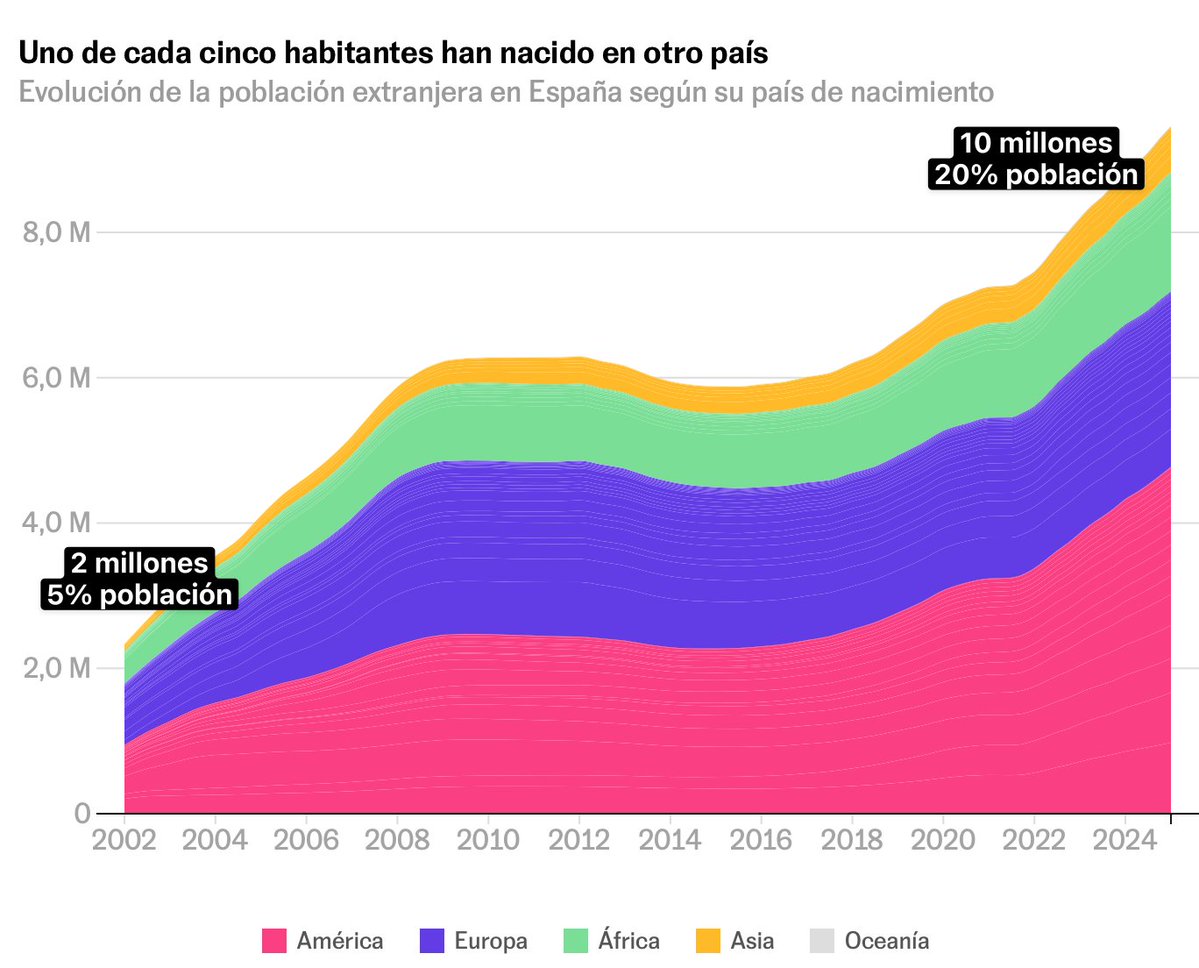
¿El fenómeno demográfico del siglo? El 20% de las personas que viven en España han nacido en el extranjero. Su peso se ha multiplicado 4x en veinte años. Datos, mapas y patrones👇
Kiko Llaneras tweet media
Español
24
279
561
55K
jlgarciapacheco (🐘@vivaldi.net)🇺🇦 retweetledi
Mayukh
Mayukh@mayukh_panja·
One thing academia does extremely well and startups and companies massively screw up is hiring. Hear me out! A friend of mine, PhD in Astrophysics, solved a tough problem for their PhD: when light from stars travels through the Earth's atmosphere, the turbulence and density fluctuations cause the light rays to become "squiggly" instead of straight and the resulting image you get from a telescope becomes blurry. So he had to model atmospheric turbulence and then write a piece of software in C++ that inverts this problem to get de-blurred images. This involved understanding physics, maths, computation, a bit of ML and writing production-level code in C++. When he tried to look for an industry job he simply couldn't find any. It was also hard to just get interviews. The first problem is that recruiters, who are often deeply non-technical, look for specific keywords in CVs and they just don't know how to parse a non-standard CV. This is a guaranteed way of missing out on outlier candidates. Second, a lot of hiring managers over index on niche knowledge about a specific tool/framework/language and the ability to remember syntax off the top of your head. A solid researcher sees programming languages, machine learning, physics, maths etc as tools that are at their disposal and may not know/remember very specific information or every little detail about arbitrary technical things. The whole process essentially becomes a lottery. This was how we hired at our Max Planck Institute: the candidate would be given a paper a week before the interview and the interviewer and the candidate would discuss it together. A second interview would entail asking the candidate about THEIR past work and checking if they deeply understood what they did. This interview format doesn't require the candidate to memorizes stuff beforehand and is pretty much independent of the whims, fancies and "taste" of the hiring manager. A lot of stuff is wrong with academia but this is an area where they do much much better than startups/companies.
English
27
107
1.1K
68K
jlgarciapacheco (🐘@vivaldi.net)🇺🇦
« But, on a daily basis, only a limited number of EU languages are commonly used to work, the so-called EU working languages (English, French and German). Because ultimately, for practical reasons, you need a sort of lingua franca and a language of reference to negotiate. But even there, influence wars take place. » Maybe you could elaborate on how and why there were 3 languages chosen ( not one or two) and why these ones , sidelining Spanish on the way (and Italian for that matter)
English
3
0
4
4K
Mepassistant (Quentin)
Mepassistant (Quentin)@mepassistants·
Let's talk about EU languages, because it is a VERY political topic despite appearances. Official EU languages are languages that can be used in the EU institutions and in which every EU document must be translated and interpretation provided. There are currently 24 official EU languages, which led the EU institutions (who share interpreters) to have the biggest pool of permanent interpreters in the world (more even than the UN). An official language of a Member State does not automatically become an official EU language. You must specifically require its recognition, either when joining the EU or later on. And if you have several official national languages, you can pick and choose which may become (or not) an official EU language. For example, Luxembourg never asked the recognition of Luxembourgish as an EU official language, so you will not find a single EU document in this language nor can you use it in any official capacity. This led to a Luxembourgish MEP being sanctioned because he spoke in Luxembourgish in a Parliament plenary speech. To get your language recognised as an official EU language, you need ALL the other Member States to agree. Spain, as part of a national political agreement, is trying to get Catalan recognised as a EU language, but other Member States are refusing to avoid creating a precedent for other regional languages. Like I said, language is VERY political and some countries are very sensitive about this, as language is a mean of influence and soft power in the institutions. Why ? Because language carry meaning (copyright and droit d'auteur are not the same thing) and because people who speak your language can be more susceptible to your views and cultural sensitivities. It's also necessary to enable politicians, particularly MEPs, to use the language they are most comfortable with to carry out their duties and shape EU rules with the nuance and precision required. Language also matters because it means that EU decisions and debates may be accessible for citizens. And it's a matter of legitimacy, because why would you accept far-away institutions that take decisions for you but don't even bother to speak your language ? But, on a daily basis, only a limited number of EU languages are commonly used to work, the so-called EU working languages (English, French and German). Because ultimately, for practical reasons, you need a sort of lingua franca and a language of reference to negotiate. But even there, influence wars take place. France is notoriously waging a constant guerilla to ensure that multilinguism is respected within the EU institution (and particularly prevent English from becoming the default EU language). French civil servants are under instruction to actively protest if any French national in a EU institution does not use French to speak when interpretation is available. Recently, France lead the opposition to a Commission effort to have EU trade agreements being communicated in English only (instead of being translated in all languages) when sent for ratification by the Council. French used to be the dominant EU language (EU Treaties were negotiated in French until 2005) but following the Eastern enlargement of 2004, English became the de facto lingua franca, even after Brexit (English remaining an official EU language thanks to Malta and Ireland). As an exception however, it remains the dominant language in the EU Court of Justice. Fun fact to reward those who read until the end: The first ever legal act of the EU in 1958 (literally "Regulation 1") was to set up the list of official languages that could be used in the institutions.
European Commission@EU_Commission

Hello, Bonjour, Γειά σου, Hallo, Ciao, Здравейте, Ahoj, Olá, Hoi, Labas… 👋

English
15
95
1.2K
135.1K
jlgarciapacheco (🐘@vivaldi.net)🇺🇦 retweetledi
EL PAÍS
EL PAÍS@el_pais·
🔴 Bruselas plantea un día de teletrabajo obligatorio y abaratar el transporte público para paliar la crisis energética social.elpais.com/pprs33
Español
257
684
3K
508.4K
jlgarciapacheco (🐘@vivaldi.net)🇺🇦 retweetledi
Anna Stokke
Anna Stokke@rastokke·
I'm still reading posts on LinkedIn claiming that Finland is the best education system in the world. It's not. They performed top in reading once (2000) and have been declining ever since. The Finland Education Myth Explained in 60 Seconds. Link below👇
English
13
55
224
26.4K
jlgarciapacheco (🐘@vivaldi.net)🇺🇦 retweetledi
Iván Fernández Amil
Iván Fernández Amil@ivanfamil·
En la Guerra de Vietnam, los estadounidenses decían que el Vietcong disparaba primero a los médicos. A pesar de ello, un médico gallego viajó al delta del Mekong, ganándose el respeto de todos, junto a sus compañeros. Se llamaba Argimiro García Granados. Tira del hilo 🧵👇🏽👇🏽👇🏽
Iván Fernández Amil tweet media
Español
9
115
500
30.9K
jlgarciapacheco (🐘@vivaldi.net)🇺🇦 retweetledi
Kruptos
Kruptos@KuptoKosmos·
⚠️🇪🇺 L’European Age Verification App est officiellement prête à l’emploi !! 📱 Officiellement pour "protéger les enfants" (porn, jeux d’argent, algorithmes addictifs…).... Une app UE gratuite, open source et "privacy-by-design" qui délivre une simple preuve d’âge anonyme sans aucune autre donnée personnelle, sans traçabilité d'après @vonderleyen 🤔 ➡️ À intégrer par toutes les plateformes (réseaux sociaux, sites adultes…) ➡️ Liée directement à l’EUDI Wallet (deadline fin 2026) et au DSA déjà en vigueur Tests pilotes en cours dans 5 pays, déploiement imminent ✅ Fin de l’anonymat en ligne pour les adultes, preuve d’âge obligatoire pour naviguer librement, contrôle centralisé par Bruxelles sur qui voit quoi sur internet… le tout vendu comme une "solution parentale"... mais l'objectif est clairement le traçage et le classement social !! Tout avance très vite en ce moment, souvent encore une fois sans débat public massif 🤔 Nous regardons sagement notre liberté disparaître 💢 #UE #Privacy 🪦
Ursula von der Leyen@vonderleyen

It is for parents to raise their children. Not platforms. The European Age Verification App is ready ↓ twitter.com/i/broadcasts/1…

Français
128
343
884
91.1K
jlgarciapacheco (🐘@vivaldi.net)🇺🇦 retweetledi
Uncle Bob Martin
Uncle Bob Martin@unclebobmartin·
AIs are just another step up the semantic expression ladder. We initially expressed our semantics in binary, then assembler, then Fortran, then C, then Java, then Python, etc. AI is just the next step up that same old ladder. And when you take that step, nothing else changes. You are still expressing behavioral semantics. You still need to express structural semantics. All the old principles still apply. You still have to be concerned about design and architecture. And even though the syntax allows informal statement, you cannot abandon formalism. When you express behavior you need a formal way to enforce the behavior you want. I use Gherkin for this. It seems to work pretty well. Consider that Gherkin is written in triplets of Given/When/Then. Each of those GWT triplets is a transition of a state machine. A full suite of Gherkin triplets is a formal description of the finite state machine that represents the behavior of the application. Other formalisms that matter are things like module dependency graphs, testing constraints, complexity constraints, and many others. This step up the semantic expression ladder provides you with an enormous amount of options. But you'd better choose those options wisely!
English
53
70
619
29.5K
jlgarciapacheco (🐘@vivaldi.net)🇺🇦 retweetledi
Ursula von der Leyen
Ursula von der Leyen@vonderleyen·
Our app ticks all the boxes. ✅ Highest privacy standards in the world ✅ Works on any device ✅ Easy to use ✅ Fully open source
English
776
125
650
347.9K
jlgarciapacheco (🐘@vivaldi.net)🇺🇦 retweetledi
Informativos Telecinco
Informativos Telecinco@informativost5·
#ÚLTIMAHORA | Bruselas plantea un día de teletrabajo obligatorio para paliar la crisis energética
Español
191
326
1.9K
795.6K