
John Qian

139 posts

John Qian banner
John Qian

John Qian

@johnlqian

Building @MatricesAI, prev @AdeptAILabs, founding eng at @weights_biases. I like world modeling

San Francisco Katılım Mart 2015
128 Takip Edilen438 Takipçiler
Flo Crivello
Flo Crivello@Altimor·
Apparently an LLM only ever activates a small % of its weights at any given time. Imagine the power if they activated all the weights. We'd have AGI already
English
140
84
2.9K
250.7K
John Qian
John Qian@johnlqian·
Someone said I'm too monosemantic, what does that mean
English
1
0
4
111
John Qian
John Qian@johnlqian·
Learning might have always felt that way for people with huge working memories who can build working mental models out of any explanation, not sure. But as someone who literally can't read a new sentence unless it follows naturally from my existing base, this feels fundamentally new
English
0
0
3
68
John Qian
John Qian@johnlqian·
It feels like it's crossed a threshold where I'm not bottlenecked by the quality of explanation anymore, but rather the pace at which my neurons can rewire
English
1
0
2
86
John Qian
John Qian@johnlqian·
LLMs have gotten absurdly good at teaching. Learning with 5.4 feels like downloading concepts directly into my brain. I think a software engineer who's never heard of ML could reasonably get to "I could have invented transformers" in ~3 days.
English
1
0
3
148
John Qian
John Qian@johnlqian·
@tejasybhakta I unironically think they're better at sociology than humans are because because it's so useful for predicting the next human-written token. It's a much more pure pressure to understand sociology than the academic field of sociology itself imposes
English
1
0
2
25
Tejas Bhakta
Tejas Bhakta@tejasybhakta·
@johnlqian the llms understand humans better than we understand ourselves
English
1
0
1
32
John Qian
John Qian@johnlqian·
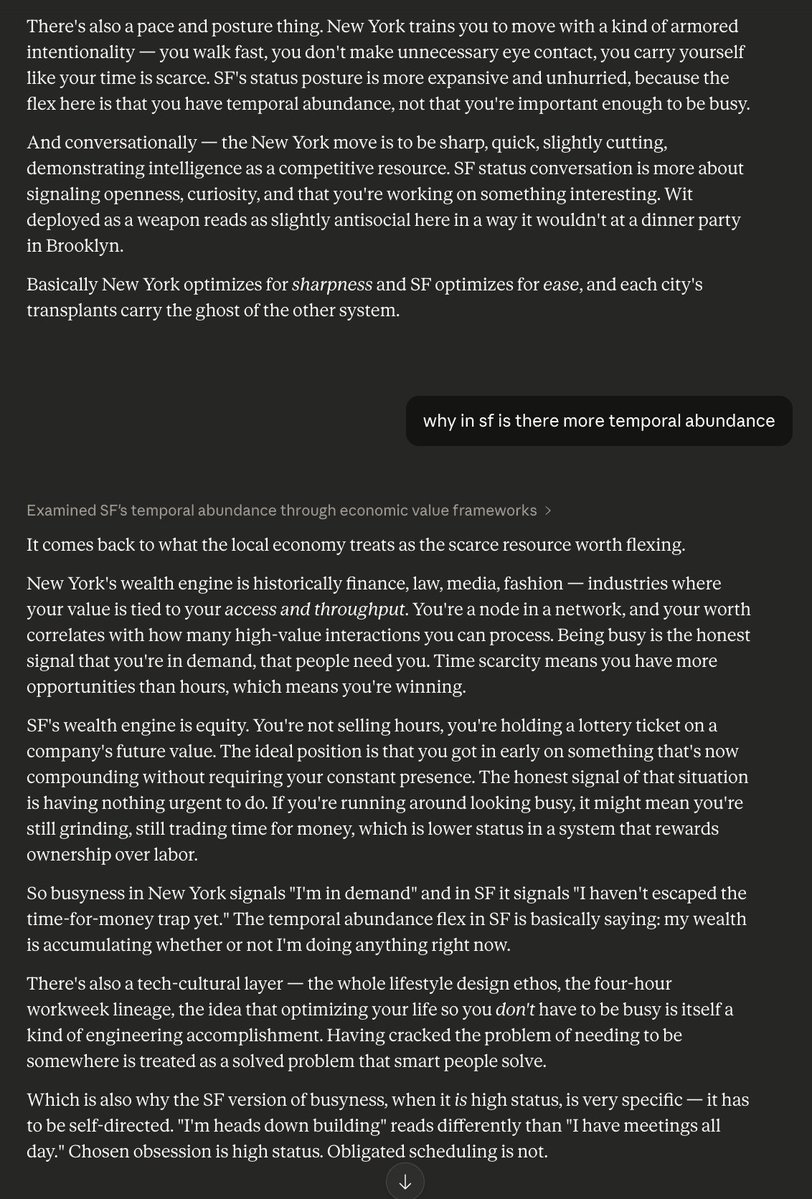
For most of my life I genuinely didn’t understand status or cultural signaling. It always felt arbitrary and frustrating, so my instinct was mostly to push back against it. To my surprise, LLMs have been the first thing to explain those dynamics in a way that clicks for me, and it’s really been rewiring my brain.
John Qian tweet media
English
2
0
5
299
John Qian
John Qian@johnlqian·
I meant for this to be a quick tweet but I just kept typing. May move it to my blog after a couple people look it over
English
0
0
1
86
Calvin Chen
Calvin Chen@calvinchen·
I’m excited to introduce Proximal with @MatternJustus and @navidkpr We believe that many companies work on training data, but almost all of them are approaching it the wrong way. Historically, the biggest capability jumps came from engineers inventing scalable ways to collect domain specific data, and not from scaling up manual labor. Our core belief at Proximal is that the data needed for progress will not come from a recruiting firm or a talent marketplace, but a research and engineering organization that treats data as a problem which deserves the same level of rigor as work on training algorithms and model architectures. We think that this is the most impactful work towards agents that can autonomously solve complex technical problems, and intend to share our research and progress in the open. Since starting last year, we've grown incredibly fast and have made great technical progress. We are backed by top investors and angels from OpenAI, Anthropic, Thinking Machines, xAI, Meta Superintelligence, Google Deepmind, Cursor and Cognition. We're expanding our team and hiring researchers & engineers in San Francisco! If you want to work on data and RL for long-horizon coding agents, reach out!
Proximal@ProximalHQ

Today, we are announcing Proximal. Proximal is a research lab for data. Our core belief is that data which is complex enough to teach today’s frontier models is not bottlenecked by domain experts, but by great ideas and excellent software. We are excited about a world in which coding agents can autonomously run for multiple weeks, solve the hardest technical problems and discover novel ideas that advance progress in various domains of science and engineering. We believe that we are not far from this future, but that the biggest bottleneck preventing us from achieving it is training data. Many companies work on data, but most of them are approaching it the wrong way. Historical capability breakthroughs are the result of creative engineers discovering scalable data collection methods, not thousands of contractors manually writing task demonstrations. Inevitably, the potential impact of human data will become smaller and smaller as model capabilities increase: agents are already outperforming most humans in many domains - the number of experts that are capable of judging model outputs shrinks with every new model release. Proximal is a new data company. We are not a recruiting firm or a talent marketplace, but a research and engineering organization that treats data as a problem which deserves the same level of rigor as work on training algorithms and model architectures. We think that this is the most impactful work towards agents that can autonomously solve complex technical problems, and intend to share our research and progress in the open.

English
40
7
167
39.2K
Proximal
Proximal@ProximalHQ·
Today, we are announcing Proximal. Proximal is a research lab for data. Our core belief is that data which is complex enough to teach today’s frontier models is not bottlenecked by domain experts, but by great ideas and excellent software. We are excited about a world in which coding agents can autonomously run for multiple weeks, solve the hardest technical problems and discover novel ideas that advance progress in various domains of science and engineering. We believe that we are not far from this future, but that the biggest bottleneck preventing us from achieving it is training data. Many companies work on data, but most of them are approaching it the wrong way. Historical capability breakthroughs are the result of creative engineers discovering scalable data collection methods, not thousands of contractors manually writing task demonstrations. Inevitably, the potential impact of human data will become smaller and smaller as model capabilities increase: agents are already outperforming most humans in many domains - the number of experts that are capable of judging model outputs shrinks with every new model release. Proximal is a new data company. We are not a recruiting firm or a talent marketplace, but a research and engineering organization that treats data as a problem which deserves the same level of rigor as work on training algorithms and model architectures. We think that this is the most impactful work towards agents that can autonomously solve complex technical problems, and intend to share our research and progress in the open.
Proximal tweet media
English
50
21
321
119.1K
John Qian
John Qian@johnlqian·
If you're looking for a crack team working on hard problems. Proximal has the best approach to coding RL envs I've seen
Proximal@ProximalHQ

Today, we are announcing Proximal. Proximal is a research lab for data. Our core belief is that data which is complex enough to teach today’s frontier models is not bottlenecked by domain experts, but by great ideas and excellent software. We are excited about a world in which coding agents can autonomously run for multiple weeks, solve the hardest technical problems and discover novel ideas that advance progress in various domains of science and engineering. We believe that we are not far from this future, but that the biggest bottleneck preventing us from achieving it is training data. Many companies work on data, but most of them are approaching it the wrong way. Historical capability breakthroughs are the result of creative engineers discovering scalable data collection methods, not thousands of contractors manually writing task demonstrations. Inevitably, the potential impact of human data will become smaller and smaller as model capabilities increase: agents are already outperforming most humans in many domains - the number of experts that are capable of judging model outputs shrinks with every new model release. Proximal is a new data company. We are not a recruiting firm or a talent marketplace, but a research and engineering organization that treats data as a problem which deserves the same level of rigor as work on training algorithms and model architectures. We think that this is the most impactful work towards agents that can autonomously solve complex technical problems, and intend to share our research and progress in the open.

English
0
1
10
1.1K
John Qian
John Qian@johnlqian·
I don't know if I agree with this, I feel like no matter how much compute I had I could always come up compelling with reasons to want more compute. But maybe the things after solving biology are relatively frivolous.
English
0
0
0
62
John Qian
John Qian@johnlqian·
Okay I pasted the whole interview transcript into Claude, I think it figured out what he means. It points to the quote about an hour fifty in: "I think you can continue to make the model smarter. There's a question of getting diminishing returns on their value in the world. How much does it matter after you've already solved human biology? At some point you can do harder, more abstruse math problems, but nothing after that matters."
English
1
0
0
74
John Qian
John Qian@johnlqian·
@SachinKry that's how most work will be done, but agentic GUI use has two sources of lasting value: 1. in software development, to test out the apps made for humans, it closes the loop 2. an arms race against products that don't want to be used by agents
English
1
0
2
39
John Qian
John Qian@johnlqian·
We’re rapidly approaching the point where if your QA process of RL tasks requires humans actually solving the tasks, your pipeline is too slow. The only types of tasks worth creating nowadays are ones that are easier to create than they are to solve. The easiest way to do this is taking something functional, breaking or removing a component, and making the task about recovery or repair.

English
0
0
4
268
John Qian
John Qian@johnlqian·
@Mascobot agreed, I don't think the operational infra used for SFT data transfers well to complex envs
English
1
0
3
76
Marco Mascorro
Marco Mascorro@Mascobot·
Good, high quality task data for RL environments is rapidly becoming too complex (and time consuming). The complexity curve seems steeper compared to traditional SFT data (at least what we saw in the last ~2 years)...
English
8
2
132
12.6K