

John Warren
627 posts

@miriam_cates What is Burnham risking? If he loses, he can just carry on as Mayor of Greater Manchester on an annual salary of £118,000!
English

Of course there’s an argument that Burnham is only ‘in it for himself’. But in a political culture so utterly devoid of courage, it is notable that Burnham and Simons are willing to take such great personal risks to try to save their party - and, no doubt in their view, the country. You don’t have to agree with their politics to recognise this.
English

There's something interesting happening with $RDDT right now...
English
@DanNeidle Are you saying that Halifax RLFC actually gave these scammers a wad of cash?
English

This scheme is bonkers. Obviously.
But it's being widely used.
Sometimes by desperate normal businesses (Halifax Rugby League Football Club Limited!)
Sometimes by people already engaged in abusive or fraudulent tax schemes.
English
A company called Liberty Rock claims you can pay your tax with a magic cheque.
They'll make all your tax go away, for the small, small fee of 30% of the amount.
The only problem: it's a fraud.
We’ve obtained the documents and are naming the names.
Thread:

English





@dougponder 3. Wisdom is not imparted. There's no time left to help people choose wisdom rather than what is not sinful but not the best. Because we are talking about holiness, sin and substitutionary atonement 10 weeks out of 10.
English

"Ten thousand thousand are their texts, but their sermons are all one," as some wise chap (allegedly Spurgeon) once quipped.
This happens nowadays when the "gospel-centered" preacher's eagerness to preach Christ—which is right (John 5:39; Col. 1:28)—is combined with his rejection of moralism (which is also good) without attention to the particular details of the passage itself.
The result is that every sermon becomes the same, saying very little besides "You're a sinner, and Christ is your Savior." That's true, and vitally important, but the Bible says a lot more than this. (Indeed, if that were all that God had wanted to say, he could have done so a lot more concisely. Yet, as James Jordan once said, "The Holy Spirit never wastes his breath." And that means the details matter.)
On top of making every sermon virtually identical, two other unhappy effects are produced:
1. Biblical imperatives are rarely, if ever, preached. And if/when they are, the commands are used almost exclusively to cite our inability to obey the Lord and the necessity of Christ's death. Again, this is true, but it completely obscures the other (two) uses of moral laws in God's world.
2. Biblical figures are never used as examples. This is an effect of the "You're not David!" emphasis of the last generation. This sounds good to those who imagine that moralism is the only way to miss Christ, but it's a significant departure from the Bible's own teaching. Christians are repeatedly called to consider both positive (Luke 10:37; Rom. 15:4; Heb. 11; ) and negative examples (1 Cor. 10:6–11; Heb. 12:16; 1 John 3:12), imitating the one and rejecting the other.
The way forward is to preach ten thousand thousand texts with one saving Lord (i.e., the whole Christ) as the central focus without diminishing the ten thousand thousand implications of his fullness.

English
@avidseries I'm British - I'd have Nevada and Illinois a level higher, but really the bottom three rows are effectively equal last.
English


@talkChristianly If the existing church doesn't want renewing then renewal attempts will end in tears. Only option then is to plant new congregations.
English

Just had a sparky conversation about church planting in rural contexts.
My argument was that the church in this country did much of its planting in rural areas at least 600 years ago.
In many places we don't need a new church, we need to renew the existing church.
🧵...
English
@theiaincameron @Starkey_Comics What's that small area on the first map? Sheffield? Leeds? Derby?
English

Seven maps showing what people call ‘mother’ around Britain and Ireland.
I think these are likely to provoke debate…
1/2
Maps by @Starkey_Comics
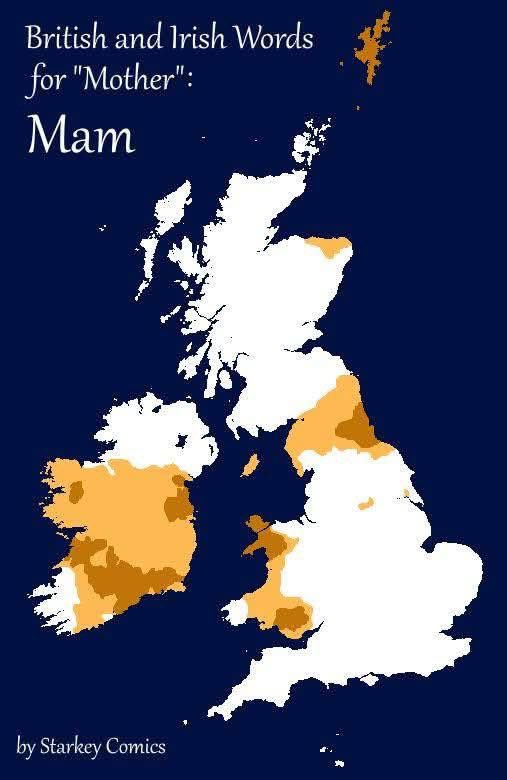
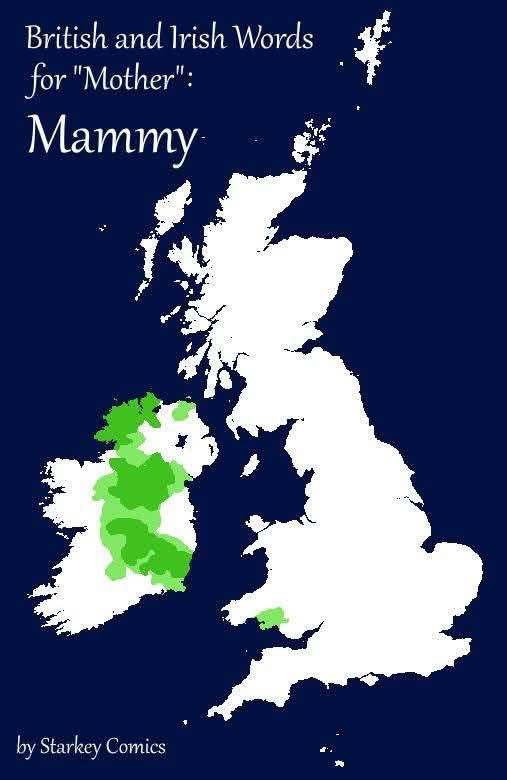
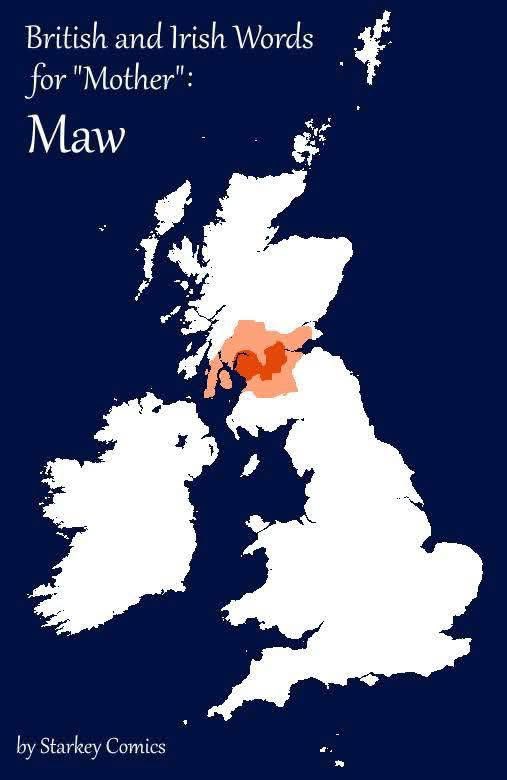
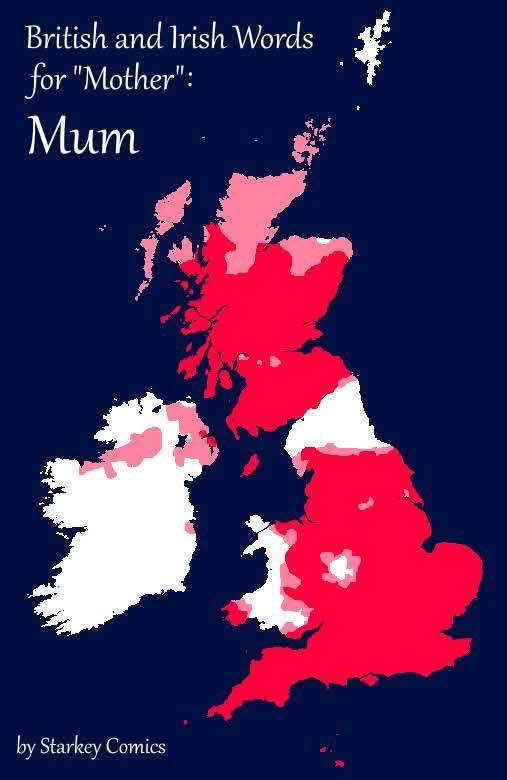
English

$SEZL +13% AH. Big Q!
2027 Guidance raised to $5.10 EPS
“Average quarterly purchase frequency reached a new Company high of 7.1x and Active Subscribers grew 48.4% year over year, reflecting the growing value consumers see in Sezzle.
GMV increased 37.3% YoY to $1.1 billion, supported by record average quarterly purchase frequency of 7.1x
Total Revenue grew 29.2% YoY to $135.5 million, representing 12.2% of GMV
Net Income increased 41.9% YoY
Adj Net Income increased 41.5% YoY
EPS $1.47, Adj-EPS $1.43
English
@realroseceline Interesting. They are "one of the only entities on earth capable of writing enormous checks instantly without relying on financing markets. That is a huge strategic advantage.". Just seems to me they are too reluctant to use that advantage. They pass on great opportunities.
English

My thoughts on $BRK
People overcomplicate $BRK because they try to value every piece perfectly down to the decimal. They debate price to book, intrinsic value formulas, and build giant spreadsheets modeling every subsidiary. Meanwhile I look at it much more simply. $BRK has roughly $400b in cash and around $300b in stocks.
That’s about $700b right there between cash and equities alone. So when the company is worth around $1t, you’re basically paying roughly $300b for everything else. That includes the railroad, the energy business, insurance operations, manufacturing, distribution, service businesses, and one of the greatest collections of operating assets ever assembled.
And honestly I think people massively underestimate the value of the insurance float. The float is one of the greatest financial assets ever created because $BRK gets access to enormous amounts of capital at extremely attractive economics. Most people do not fully understand how powerful that becomes over decades. That float has quietly fueled one of the greatest compounding machines in financial history.
But the part that fascinates me most is the discipline. Almost every CEO on earth would have cracked by now sitting on $400b of cash. Most management teams would feel pressure to force acquisitions just to appear active. $BRK has basically said if we cannot find something intelligent to buy at scale, we are willing to wait.
People look at the cash and think it’s dead money, but optionality matters. $BRK effectively owns a giant call option on future chaos. When markets panic and liquidity disappears, $BRK becomes one of the only entities on earth capable of writing enormous checks instantly without relying on financing markets. That is a huge strategic advantage.
The other thing people miss is how rare true permanence is in capitalism. Most corporations optimize for optics. CEOs rotate, incentives change, cultures decay, and strategies constantly shift depending on sentiment. $BRK was built differently.
It was designed almost like an anti Wall Street structure where long term thinking itself became the competitive advantage. In many ways that culture may end up being Buffett’s greatest creation, even bigger than the stock portfolio itself. A lot of companies talk about long term thinking. $BRK actually structured the organization around it.
I also think people misunderstand what $BRK really is. They think it’s just “an insurance company that owns stocks.” But $BRK is basically a giant ecosystem of real world economic activity. Railroads, energy infrastructure, manufacturing, freight movement, insurance, distribution, consumer spending, and financial assets all under one umbrella.
In many ways it’s almost like owning a miniature version of the American economy. But unlike an index fund, the capital allocation is centralized under highly disciplined operators. You get diversification without complete chaos along with durability, liquidity, tax efficiency, reinvestment flexibility, and world class balance sheet.
And honestly the most underrated asset may simply be trust. If $BRK calls during a crisis, people pick up the phone. If $BRK wants to buy a family owned business, sellers trust the company will preserve the culture and operate responsibly.
I also think people are underestimating Greg Abel. Nobody is Warren Buffett and nobody ever will be, but that doesn’t mean $BRK suddenly stops being $BRK. Greg already understands the culture, operational discipline, and capital allocation philosophy better than almost anyone alive.
That’s why $BRK almost a forever asset or a savings account on steroids. No, it’s not going to triple overnight and no, it’s not some hyper growth AI stock. But when I look at over $700b between cash and equities, elite operating businesses, insurance float, fortress balance sheet strength, world class reputation, and disciplined reinvestment talent, I have a hard time viewing it as expensive.
🌹
English
@ariaradnia "One up on Wall Street" is a great read - entertaining as well as informative, and part 3 on when to sell is magnificent.
English
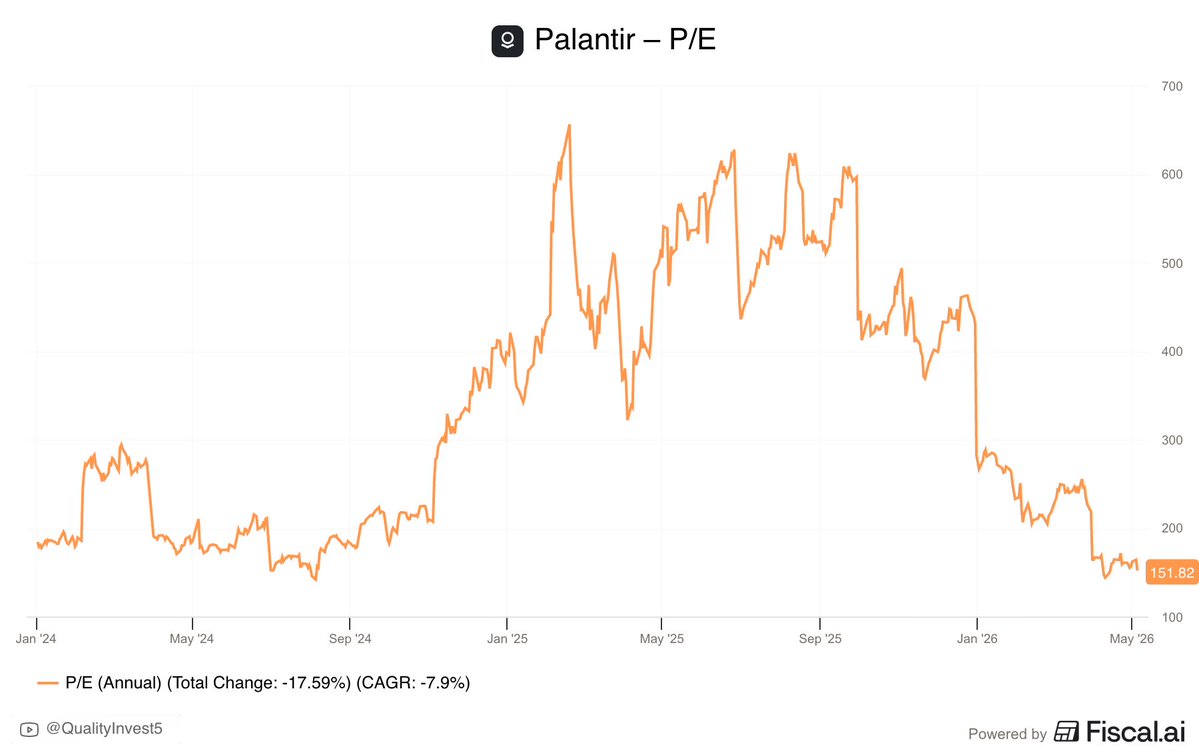
$PLTR now at 150x GAAP P/E
If they maintain their current 85%~ growth rate
You're looking at 2x PEG... not bad?
English
@stocksandbjj @compound248 I think this is possibly true. Even if half that cash pile was in investments that were solid but not spectacular they'd be much better off.
English

@compound248 They are just way too cheap and life has passed them by
English
“Your job is to say ‘no.’”
- Ajit Jain, $BRK’s insurance chief
“It is very difficult to recruit people to sit back and do nothing.
“You will get bombarded with deals, day in and day out. Your base case is, ‘just say no.’
“Every now and then, you will come across a deal that will hit you with a 2x4 and it will be screaming money.
“That’s when you come to me.”
Ajit and Greg note that insurance, investing, and capital allocation all share this trait.
Personally, I am not worried that Berkshire will lack wisdom or lose its way - I look forward to seeing what comes next.
English
During my interview with @DrewCohenMoney, we talked about something most investors don’t want to admit. Truly great deals are rare, and far rarer than people think.
I gave him a simple example. If we walked around San Francisco looking for an incredible real estate deal, something you’d actually want to own for years and feel confident putting serious money into, we probably wouldn’t find one. Not quickly, not easily, and probably not for a long time.
Now imagine someone told you they find a deal like that every single week or month. You wouldn’t think they’re brilliant. You’d assume they don’t actually know what a great deal is. That same logic applies to the stock market, but people forget it the moment a ticker is involved.
Part of the problem is the system itself. Everything around you is designed to push activity. Brokers make money when you trade, media gets paid when you pay attention, and online everyone grows by constantly having something new to say. No one gets rewarded for sitting still and none of that good feeling dopamine gets released into your brain.
But in investing, sitting still is often the job. The best investors are not the ones doing the most. They are the ones filtering the hardest. They are willing to look at a hundred ideas and reject ninety nine without hesitation, because they understand that truly great opportunities are rare.
There’s also a cost people don’t talk about. It’s not just losing money, it’s wasting attention. Every hour you spend digging into an average business is an hour you’re not sharpening your thinking or recognizing something truly exceptional when it finally shows up. Attention, not capital, is the real constraint.
The hard part is that doing nothing feels wrong. You see others constantly trading, posting wins, talking about opportunities, and it creates this quiet pressure that you’re falling behind. So people lower their standards without realizing it. They stop asking whether something is truly great and start asking whether it’s good enough to act on because they can make some money perhaps.
That’s where most mistakes come from. A simple way to think about it is this. If you wouldn’t be excited to put a meaningful portion of your net worth into a business and hold it for years, it’s probably not one of those rare opportunities.
That doesn’t mean you’ll only find one idea every five years like Warren Buffett has suggested, but the number is still very small. In most years, finding one or two truly great opportunities is an exceptional outcome. Some years you’ll find more, some years none, but that’s just the nature of the game. The goal isn’t to always be active, it’s to become so selective that almost nothing qualifies.
🌹
Tren Griffin@trengriffin
Ajit Jain: “Insurance, much like investing, is a game that requires patience,” Jain said on Saturday. “It is very difficult to get people to sit back and do nothing. Every now and then you will come across a deal that will hit you with a two-by-four and it will be screaming ‘money’. That’s when you come to me and we’ll make a decision whether to do it or not.”
English

I see people lamenting the lack of "evangelical elites" so here's my perspective:
I graduated from Princeton summa cum laude and then went to UC Berkeley for a PhD in theoretical chemistry. My career was all planned out: awards, academia, prestige.
Then I became a Christian 1/
English

A truly epic day. Very proud to have run the London marathon in exactly 4 hours (to the second according to the official race timing), albeit my watch thought I was slightly quicker!
Thanks to everyone who’s sponsored me so far, many of you will know I ran the marathon for cancer charities in memory of my brother who I lost last year.
There is still time to sponsor me and anything you can do to get me closer to my target would mean a lot. 2026tcslondonmarathon.enthuse.com/pf/josh-fenton…




English
@90sFootballUK1 @PremiershipYrs Stone cold last!!!! Shaymen 'till I die!!!
English

This is how all four divisions finished in the 1992-93 season. Where was your team? Thanks to @PremiershipYrs for this!

English
@tomhfh We changed leaders over a piece of cake. We stopped being serious quite some time ago.
English

Honestly, I don’t think Keir Starmer should lose his job over Peter Mandelson.
If Keir Starmer were to lose his job it should be because he has presided over a flatlining economy, higher inflation, failed energy policy, insane asylum policy, and the collapse of British housebuilding.
Standing for election, he promised to supercharge growth by banishing the blockers and getting Britain building.
What has actually happened? Housebuilding has collapsed. No serious blocker busting reform has been enacted. Last year just 5,547 new homes were started in London. That’s compared to Labour’s own (reduced) target of 88,000 per year.
This is an abject failure on an issue that Labour convinced many they would deliver fundamental change. And almost no one is talking about it.
The only change has been downwards. If our politics were serious, that is what Starmer would be booted out over.
Beth Rigby@BethRigby
Via @joshglancy: Starmer acknowledges the Mandelson appointment was a mistake that needs looking at, but he is also deeply frustrated by Westminster’s obsession with it. He views a political-media class that only wants to talk about vetting forms and not about the Strait of Hormuz as fundamentally unserious. “I understand why there are questions,” he says. “I’ve answered I don’t know how many of them. But at the same time, I’ve got a huge amount of work to do on the war on two fronts.”
English