
Jon Baker

1.1K posts

Jon Baker banner
Jon Baker

Jon Baker

@jonbaker_ocean

Climate Scientist @metoffice 🌍 🌊 | Exploring AMOC and global ocean circulation | Views are my own

Exeter, UK Katılım Mayıs 2020
491 Takip Edilen571 Takipçiler
Sabitlenmiş Tweet
Jon Baker
Jon Baker@jonbaker_ocean·
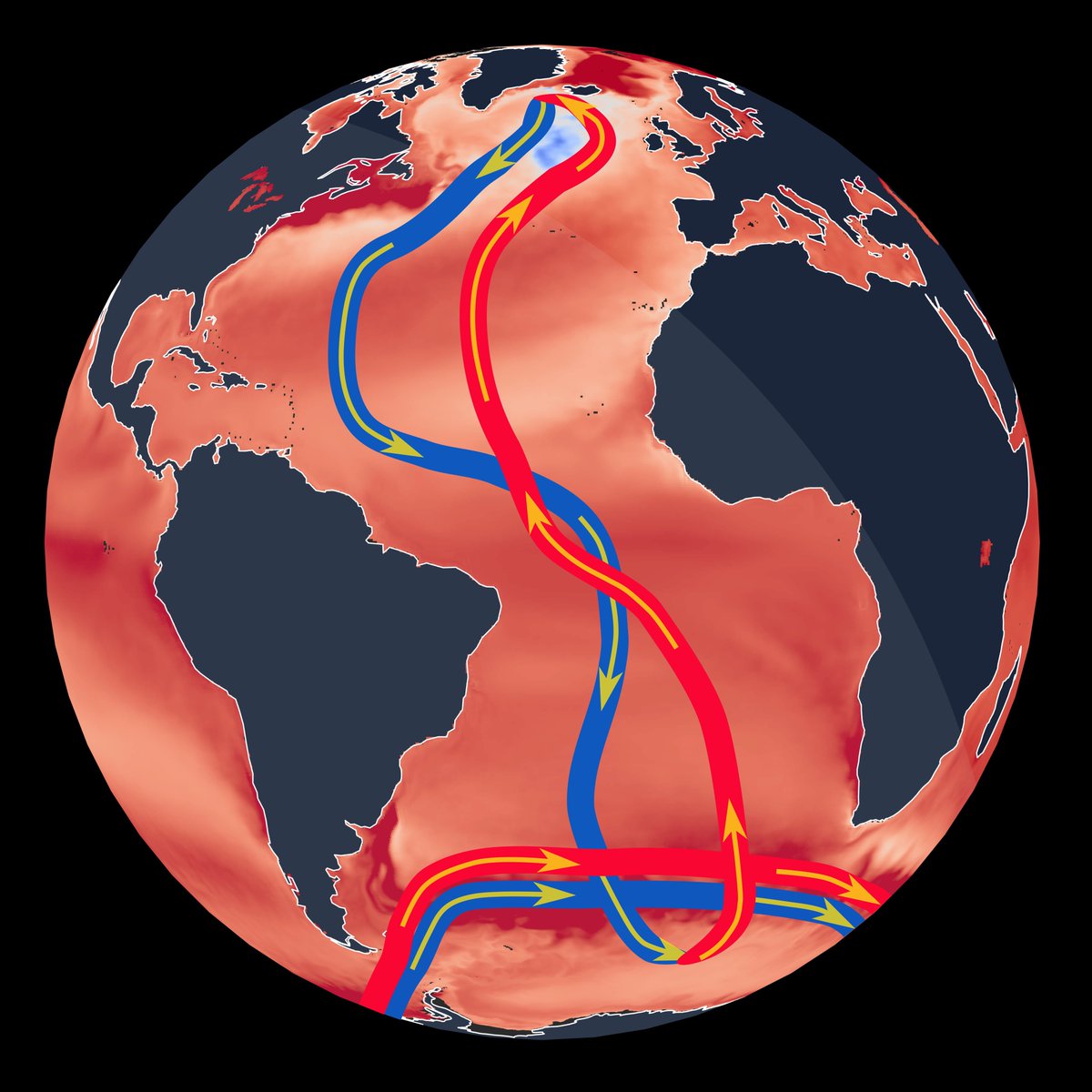
🌊 Today in @Nature: Is the AMOC on the brink of collapse? Unlikely before 2100—but the risks are real 🚨 We find Southern Ocean winds keep this vital ocean “heat engine” running, even under extreme #climatechange. But the Pacific holds a surprise… Let’s explore 🧵👇
Jon Baker tweet media
English
33
321
896
178.4K
Jon Baker
Jon Baker@jonbaker_ocean·
Speaking at #OSM2026 tomorrow (Thu 11:50, Hall 1) in the ocean overturning dynamics session. Presenting results from our Nature paper on why the AMOC weakens but is unlikely to collapse this century: Southern Ocean winds sustain the circulation in climate models.
Jon Baker tweet media
English
0
1
7
190
Jon Baker retweetledi
Zack Labe
Zack Labe@ZLabe·
We have a new study out! In this work, we examine how the Gulf Stream & Kuroshio co-vary, & this is tied to atmospheric variability & potentially sea-ice anomalies. However, this linkage may be changing in a warming world. @ScienceAdvances ➡️ #OpenAccess: science.org/doi/10.1126/sc…
English
3
19
66
6.7K
Jon Baker
Jon Baker@jonbaker_ocean·
📢 PhD opportunity! “To collapse or not: the stability of the AMOC in a warming climate” Deadline: 8 Jan 2026 Work with Bristol, Liverpool & the Met Office on AMOC stability using observations, models & AI. Details: nercgw4plus.ac.uk/projects-2025-…
English
0
1
1
205
Jon Baker
Jon Baker@jonbaker_ocean·
Exciting to see our overturning pathway method applied in new research! Song et al. use it on CMIP6 PMIP glacial models and find these pathways shape the AMOC response - confirming our earlier idealised results for glacial climates 🌊 nature.com/articles/s4146…
English
0
1
2
229
Jon Baker
Jon Baker@jonbaker_ocean·
Always interesting to see this come up again 😄 Our Nature paper didn’t “redefine” collapse — no single threshold, though ~6 Sv is common. 0 Sv only in extreme 4×CO₂ runs (full shutdown). Real-world forcing: models stay above 6 Sv this century — no collapse. Clarified 🌊👇
Prof. Stefan Rahmstorf 🌏 🦣@rahmstorf

High resolution images from satellite and from eddy-resolving ocean circulation models point to an ongoing decline of the Atlantic overturning circulation, a key ocean current for our climate. Read more about it in my new blog article. 🌊 realclimate.org/index.php/arch…

English
1
1
4
260
Jon Baker
Jon Baker@jonbaker_ocean·
🎥 My recent ClimTip talk on our Nature paper is now online! An AMOC collapse is unlikely this century as Southern Ocean winds pull deep waters up to the surface, stabilising it in a weakened state. Still, global ocean circulation will change greatly 🌊 youtube.com/watch?v=ScQGBi…
YouTube video
YouTube
English
0
1
1
342
Jon Baker
Jon Baker@jonbaker_ocean·
@blacklodgeb0b No, this new study does not contradict our findings. Our study concludes that an AMOC collapse is unlikely this century, while the new study suggests the risk increases after 2100, though with significant uncertainty. The two are consistent in that regard.
English
1
0
1
68
Jon Baker
Jon Baker@jonbaker_ocean·
My comments in The Guardian on a new study — AMOC collapse risks rise after 2100, especially under extreme scenarios, but also in some low ones. We need more model runs extending beyond 2100 to assess these risks properly. theguardian.com/environment/20…
English
3
1
18
1.4K
Jon Baker
Jon Baker@jonbaker_ocean·
⏰ Reminder: Tomorrow I’ll join @ClimTip_Project to discuss the future of the AMOC. Our Nature study suggests collapse is unlikely this century — but the risks remain critical. 🗓️ 2 Sept, 14:00-15:00 CEST 👉 tum-conf.zoom.us/j/69334210340?…
Jon Baker tweet media
English
0
1
4
192
Jon Baker
Jon Baker@jonbaker_ocean·
No worries! Indeed, that other study came out just a few days earlier using freshwater forcing experiments. I’m still catching up on this one. These models have full atmosphere–ocean–sea ice coupling, but not a Greenland ice sheet coupling. Future models need that, and its impact on AMOC is still debated, though likely secondary.
English
0
0
1
56
Rutger
Rutger@neorutje·
@jonbaker_ocean Sorry, I was looking at the other study that the Guardian also links to. Had both open but mixed them up. Is the one you're specifically commenting on fully coupled? The paper still seems to mention some caveats in that regard?
Rutger tweet mediaRutger tweet media
English
1
0
0
66
Jon Baker
Jon Baker@jonbaker_ocean·
This study uses future warming scenarios, not idealised freshwater forcing. The models don’t have fully interactive ice sheets, but they do represent Greenland melt. Both positive and negative feedbacks will matter. The high-end case is extreme (and hopefully unrealistic); mid/lower-end cases are plausible. Beyond 2100 we only have a few model runs, so risks remain uncertain. A collapse before 2100 remains unlikely.
English
1
0
1
81
Rutger
Rutger@neorutje·
@jonbaker_ocean How useful is that if they keep icesheets fixed and apply a hypothetical freshwater flux? It seems very much a theoretical exploration and less the modelling of actual conditions. Wouldn't feedbacks involving Greenland be incredibly impactful for what will actually happen?
English
1
0
0
100
Jon Baker
Jon Baker@jonbaker_ocean·
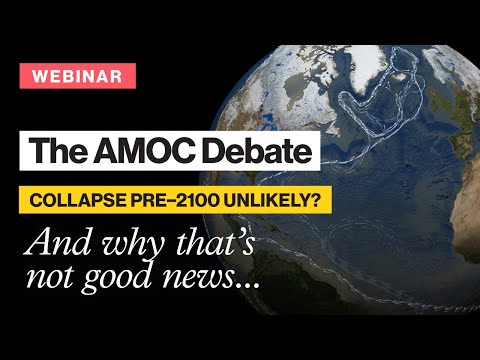
🌊 The Atlantic Ocean “conveyor belt” is crucial for global climate, but what does its future hold? I’m excited to be speaking at the next ClimTip webinar on what our recent @Nature study reveals about AMOC collapse risk, and why its future remains a critical concern. 🗓️ 2 Sep | 14:00–15:00 CEST bit.ly/climtip-webinar
Jon Baker tweet media
English
3
8
24
808
Jon Baker
Jon Baker@jonbaker_ocean·
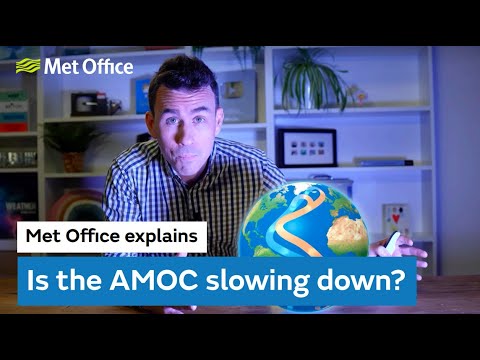
The future of the AMOC is one of the most urgent — and uncertain — questions in climate science. In this new Met Office video, I share insights from our Nature paper on how Southern Ocean winds may help prevent an AMOC collapse as the planet warms 🎥 youtu.be/GbmdoB1tN9I?fe…
YouTube video
YouTube
English
1
6
15
4.7K