I find it interesting that the word "science" in English has acquired a rather narrow meaning, usually referring only to the natural sciences. I have been wondering for some while now if not the shift of the meaning and use of the word "science" has had an impact on how the English-speaking world thinks about knowledge discovery, often dismissing knowledge in any discipline that is not part of what they call "science".
If you look up the German translation of “science”, you will get "Wissenschaft", which means loosely speaking 'dealing with knowledge' (“Wissen” = knowledge). But it’s a poor translation, because “Wissenschaft” is about knowledge discovery in general, not about the natural world in particular.
The origin of the word "science" is the Latin word "scientia" from scire ‘know’. That is, the original meaning also referred to knowledge in general, not to some disciplines in particular.
Consequently, in German, mathematics is -- of course -- a science. We also have "music science" (Musikwissenschaft) and "religion science" (Religionswissenschaft) and "literature science" (Literaturwissenschaft), etc, as they all deal with knowledge in some sense.
These latter examples are part of what in English is called "humanistics". In German they are called "Geisteswissenschaft", which means kind of "science of the mind" (that makes it sound like consciousness research, but I can't think of a better translation).
Philosophy is also a "science of the mind", in the German sense, as it concerns itself with knowledge.
I have talked to some Spanish people who have told me that they use the word 'ciencia' more in the German meaning of the word, not in the English one (not sure this is correct, my Spanish isn’t great).
You may notice this sometimes online, if you have non-native English speakers, some tend to assume eg that mathematics is science, whereas English native speakers find this odd.
One of the consequences of this linguistic shift seems to have been that as the English speaking world became dominant in science, the new “scientists” stopped paying attention to philosophy, as that was no longer part of their “science”.
This is especially obvious in physics, where you can see this happening in the early 20th century. While physicists previously had valued philosophical discourse, they later discarded it as supposedly useless.
Personally I think it’s a big problem and the major reason why the foundations of physics have stagnated. The new ‘scientists’ in this discipline seem to think that ‘theories’ are ‘scientific’ just because you can write them in maths. As a consequence, they keep on producing mathematical theories about nothing in particular.
If they stopped to think about what they are doing and why it’s not working and maybe read some philosophers, we’d make more progress.
The blame is partly on philosophers though because they seem to take pride in not being useful to scientists, usually not concerning themselves with any questions that physicists could actually use. Like why aren’t there thousands of philosophers discussing cosmological priors or naturalness or how to find out whether two models are “the same”.
Somewhat disturbingly, I have had several exchanges with so-called philosophers of science who clearly seem to take pride in being useless, and get offended if you ask them to be useful, as they see ‘being useful’ as being the task of scientists, which they are not.
And that returns me to my misgiving about the English use of the word ‘science’.
This was a “short” reply I wrote to Philip’s quote from Dirac…
x.com/philipcball/st…
I went to one of the world's biggest glass factories & it was REALLY cool.
Here's what I saw👇
The factory is the @Encirc plant in Cheshire.
It's enormous. Acres & acres.
If you poured anything from a glass bottle in the UK this Xmas there's a good chance it came from here...
🧵
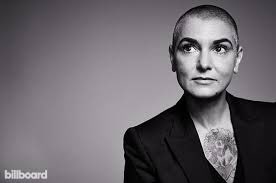
A great Irish poet and singer left us today.
She was beautiful, courageous and wore her heart on her sleeve. She was before her time.
Nothing will ever compare to Sinéad O’Connor.
Rest easy Sinéad.
"Soul clap its hands and sing, and louder sing
For every tatter in its mortal dress." - from Sailing to Byzantium (1926)
The poet William Butler Yeats was born in Sandymount in Dublin on this day in 1865.
@eircare Hi, I've tried 1747 a couple of times, but it tells me I'm a prepay customer so I should call 1747. No, not a typo.
My question--
How can I identify the region my roaming allowance is good for? Is it for Europe or North America? Where can I find this information?
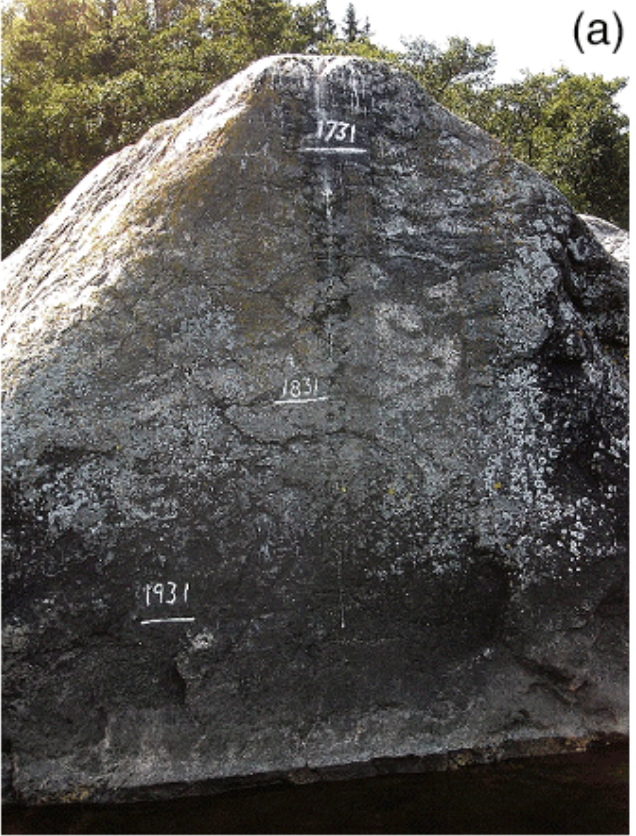
Decades (and centuries) later, researchers could see how much the rebound has altered sea level since then. Here's one of the seal rocks in Lövgrunden, near Gävle in Sweden (Pic: Martin Ekman) 7/9
@VodafoneIreland I just had an internet installation this morning. Your team did this to the front of my house. I called your helpline but it seems you have no process for dealing with these issues. Can you get back to me about it.
As promised….
🌻Win a pair of tickets to Bloom 2022 along with a signed @nevenmaguire cookbook!🌻
Entering is easy:
🌸 Comment below & Tag who you would bring along to the fantastic event
🌸 Make sure you are following our page!
Winner will be notified on Tuesday 24th May!