
Jeffrey Fredrick

8.8K posts

Jeffrey Fredrick banner
Jeffrey Fredrick

Jeffrey Fredrick

@Jtf

Father, husband, developer, executive coach, active dreamer Co-author of the book Agile Conversations: Transform Your Conversations, Transform Your Culture

Katılım Temmuz 2007
727 Takip Edilen1.6K Takipçiler
Jeffrey Fredrick retweetledi

Douglas Squirrel
Douglas Squirrel@douglassquirrel·
This week on Troubleshooting Agile with @jtf and I discover how the simple yet powerful technique of walking the board can reshape executive accountability, improve focus on strategic initiatives, and foster team cohesion. buff.ly/Er8LktJ
English
0
2
2
51
Jeffrey Fredrick retweetledi
Neet
Neet@neet_sol·
I hope this email doesn't find you I hope you've escaped That you're free
English
68
4.9K
29.2K
450.9K
Jeffrey Fredrick retweetledi
@norootcause.surfingcomplexity.com on Bluesky
Coding was the bottleneck, then code reviews were the bottleneck. At some point, incidents are going to be the bottleneck.
English
51
175
2.2K
81.7K
Jeffrey Fredrick retweetledi
Nick Davidov
Nick Davidov@Nick_Davidov·
16 year old: Dad, I just drove my friend’s manual car! Me: wait, I didn’t teach you how to drive a manual, how? 16: well I figured it out! Me *suspicious*: how many pedals did it have? 16: 2 of course! Turns out a “manual” is a car without FSD
English
79
107
8.6K
635.5K
Jeffrey Fredrick retweetledi
Matt Ridley
Matt Ridley@mattwridley·
250 years ago today Adam Smith gave the world a fantastic insight. That order, cooperation and prosperity are not ordered from above by priests or chiefs but emerge from the social interactions of ordinary people. It’s the most revolutionary and benign idea ever proposed.
English
74
725
3.6K
118.6K
Jeffrey Fredrick retweetledi
Andrej Karpathy
Andrej Karpathy@karpathy·
It is hard to communicate how much programming has changed due to AI in the last 2 months: not gradually and over time in the "progress as usual" way, but specifically this last December. There are a number of asterisks but imo coding agents basically didn’t work before December and basically work since - the models have significantly higher quality, long-term coherence and tenacity and they can power through large and long tasks, well past enough that it is extremely disruptive to the default programming workflow. Just to give an example, over the weekend I was building a local video analysis dashboard for the cameras of my home so I wrote: “Here is the local IP and username/password of my DGX Spark. Log in, set up ssh keys, set up vLLM, download and bench Qwen3-VL, set up a server endpoint to inference videos, a basic web ui dashboard, test everything, set it up with systemd, record memory notes for yourself and write up a markdown report for me”. The agent went off for ~30 minutes, ran into multiple issues, researched solutions online, resolved them one by one, wrote the code, tested it, debugged it, set up the services, and came back with the report and it was just done. I didn’t touch anything. All of this could easily have been a weekend project just 3 months ago but today it’s something you kick off and forget about for 30 minutes. As a result, programming is becoming unrecognizable. You’re not typing computer code into an editor like the way things were since computers were invented, that era is over. You're spinning up AI agents, giving them tasks *in English* and managing and reviewing their work in parallel. The biggest prize is in figuring out how you can keep ascending the layers of abstraction to set up long-running orchestrator Claws with all of the right tools, memory and instructions that productively manage multiple parallel Code instances for you. The leverage achievable via top tier "agentic engineering" feels very high right now. It’s not perfect, it needs high-level direction, judgement, taste, oversight, iteration and hints and ideas. It works a lot better in some scenarios than others (e.g. especially for tasks that are well-specified and where you can verify/test functionality). The key is to build intuition to decompose the task just right to hand off the parts that work and help out around the edges. But imo, this is nowhere near "business as usual" time in software.
English
1.6K
4.8K
37.3K
5.1M
Jeffrey Fredrick retweetledi
Troubleshooting Agile
Troubleshooting Agile@TShootingAgile·
It’s okay to be confused about Vibe Coding! On this week's episode of Troubleshooting Agile, @jtf and @douglassquirrel respond to a listener’s argument from our series with @RealGeneKim on Vibe Coding. Link in the reply.
English
1
1
1
40
Jeffrey Fredrick retweetledi
The Other Alistair
The Other Alistair@TotherAlistair·
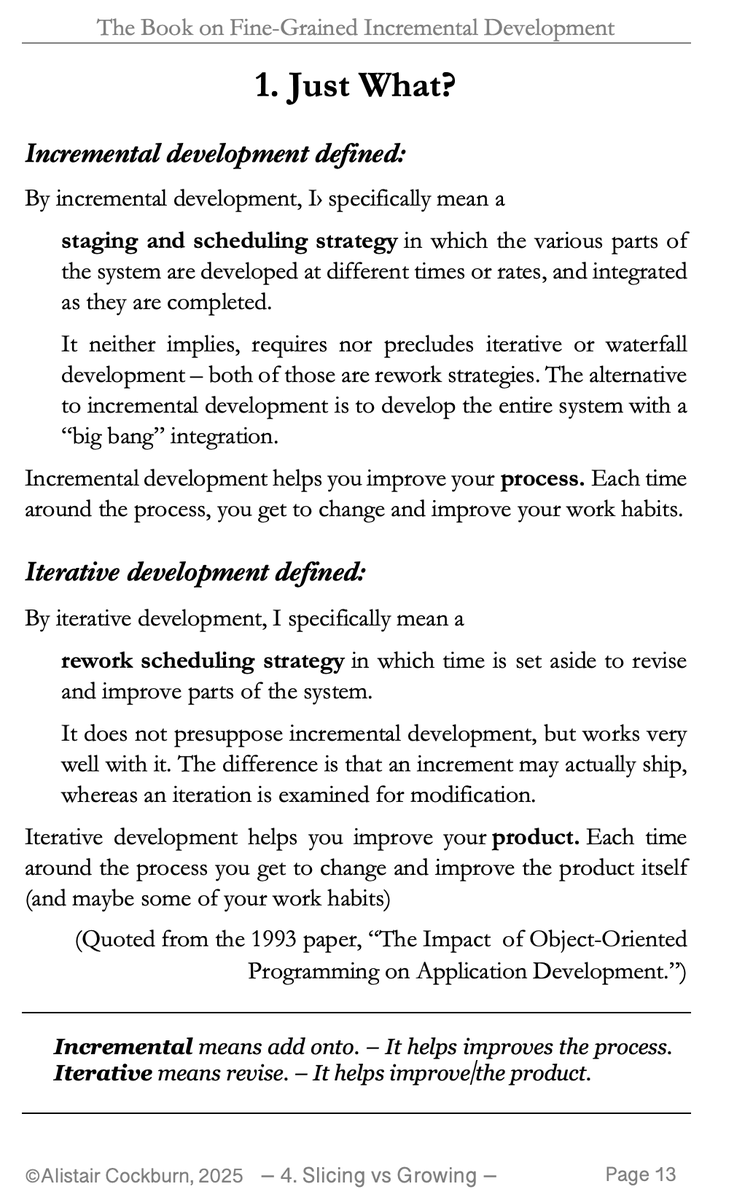
I could probably republish this page every month and it would do some people good.
The Other Alistair tweet media
English
0
4
7
704
Jeffrey Fredrick retweetledi
Troubleshooting Agile
Troubleshooting Agile@TShootingAgile·
Heard of the Glidepath Method? This week @douglassquirrel and @Jtf talk about how the method of landing a plane can be useful in effective project management. Navigate uncertainty and complexity in your projects - no plane landing experience necessary! Link in the reply.
English
1
1
1
36
Jeffrey Fredrick retweetledi
Troubleshooting Agile
Troubleshooting Agile@TShootingAgile·
Movie logic and montages distort real-life problem-solving and team dynamics. This week @jtf and @douglassquirrel start from a post by @catehall on movies relying on artificial drama to create tension and end up discussing the UK cycling team's success. (link in reply)
English
1
1
1
57
Jeffrey Fredrick retweetledi
Pamela Hobart
Pamela Hobart@gtmom·
I graduated with high honors from an affluent, acclaimed high school and then again with high honors with a BA in philosophy & pre-law before EVER once hearing the idea that prices convey information and coordinate actors. I'll never forget rolling up to a philosophy conference in Pasadena in 2008 and wandering into a session on "price gouging" and the pro-"price gougers" introduced this concept. Possibly the single most transformative moment of my entire education.
Josh Barro@jbarro

Really interesting piece on how University of Chicago professors helped a national network of food banks get surplus food much more efficiently to where it's needed, by creating an internal auction market. slowboring.com/p/how-to-actua…

English
86
169
3.4K
890K
Jeffrey Fredrick retweetledi
Douglas Squirrel
Douglas Squirrel@douglassquirrel·
@jtf and I discuss the challenges and rewards of learning and focus on three key types of learning - knowledge, methods and skills. Find out how these elements interact, and what it’s got to do with driving in Alabama! buff.ly/BRHCLv8
English
0
2
2
96
Jeffrey Fredrick retweetledi
Douglas Squirrel
Douglas Squirrel@douglassquirrel·
In the final part of our trilogy, spurred on by Ed Bradon’s article, @jtf and I look at examples of systems thinking implemented in both small and large government projects, highlighting successes like the UK's automatic enrolment in pensions. buff.ly/LgD31i9
English
0
1
2
111
Jeffrey Fredrick retweetledi
Loopy
Loopy@strangestloop·
"Things change when you start doing things differently."
English
0
3
15
2.7K
Jeffrey Fredrick retweetledi
Patrick McKenzie
Patrick McKenzie@patio11·
In this thread: an LLM (and, critically for the time being, a PMC advocate for a patient) knock ~$150k off a medical bill by a) looking at it b) asking questions and c) not taking the first offer. @nthmonkey/post/DQVdAD1gHhw" target="_blank" rel="nofollow noopener">threads.com/@nthmonkey/pos…
English
7
23
248
57.7K
Jeffrey Fredrick retweetledi
Ed Bradon
Ed Bradon@EdBradon·
Yes this is directionally right (but I would still start with Gall's book! Would be interested to know what you think of it). There’s a philosophical / empirical disagreement beyond the question of execution quality. Just a first obvious distinction: my target is not all study of and thinking about systems - which would just be anti-intellectualism - but the specific tradition of Systems Thinking (ST) associated with Forrester and Meadows that has gained traction in government (and many big companies too). What ST and systemantics agree on, in my understanding, is (1) the modern world features lots of complex systems (2) they often go wrong in surprising and unexpected ways, with bad consequences for all of us (3) they are the proper object of study As the article (para 15) explains, for (relatively) simple systems, there is also agreement that (4) it is possible to map a system, analyse stocks & flows, feedback loops etc., and intervene successfully to fix it The disagreement is that, on the systemantics view, there is an impossibly steep difficulty curve that kicks in beyond a complexity and number-of-humans-involved threshold. By contrast ST doesn't accept this sharp discontinuity, and argues that you can still do this systems-analysis-and-targeted-intervention successfully at the scale of big bureaucracies and national / global systems. (In evidence: a big chunk of Meadows' book is about places to intervene, she cites the World model as a successful example, and - despite sensible caveats - directly talks about the existence of "magical leverage points”.) To put the disagreement in a facile way, from the systemantics point of view, trying to intervene in e.g. a dysfunctional national health system is like trying to fight a bear, and Systems Thinking is the equivalent of a ‘How To Fight A Bear’ book. It’s not enough for the book to say ‘bears are dangerous, make sure you dodge the claws, and go for the weak spots’. The overwhelming advice needs to be ‘Don’t fight the bear!’ And for me, as I argue in the piece, when I look at the recent history of big bureaucracies in the West I see a lot of citizens and employees who have been mauled by bears, and a lot officials, politicians and CEOs who are way, way too relaxed about them.
English
0
1
1
45
Jeffrey Fredrick retweetledi
Nori Nishigaya
Nori Nishigaya@Xeeban·
My next article in the #100DaysOfAI journey is about how I am experimenting with using AI to be a productivity coach, accountability partner, mentor, and more! Obsidian + Claude Code is Beyond Useful - It's Transformative open.substack.com/pub/emergentin…
English
0
2
4
145
Jeffrey Fredrick retweetledi
Patrick McKenzie
Patrick McKenzie@patio11·
This is your periodic reminder: I have a podcast, it’s called Complex Systems, it is available from a variety of platforms, and including a link or specific identification of how one finds a podcast can result in getting yeeted into the shadow realm.
English
20
6
348
28K
Jeffrey Fredrick retweetledi
Patrick McKenzie
Patrick McKenzie@patio11·
I'm joined on Complex Systems this week by Oliver Habryka, whose non-profit runs LessWrong and also a conference venue. We had a fun conversation about the rationalist community (not a member, but I read from many communities I'm not a member of), Internet forums as the inheritors of the Parisian salon, our experiences in charitable fundraising (and my advice that rationalists should chat up a church or synagogue to do some social technology transfer), and the challenges of building beautiful things in Berkeley. (00:00) Intro (01:44) The origins of LessWrong (04:28) Challenges of running an online forum (06:28) Reviving LessWrong (15:12) The importance of conference venues (25:55) The complexities of venue management (37:45) The impact of wide roads on American car culture (38:12) Fire safety regulations vs. traffic fatalities (39:24) Microeconomic analysis in policy making (40:47) Building codes and staircase requirements (41:57) Berkeley's shift in construction policy (43:48) Fundraising challenges in the nonprofit sector (44:58) Effective altruism and fundraising dynamics (47:02) The collapse of FTX and its impact on fundraising (52:52) Strategies for successful fundraising (55:08) Lessons from religious fundraising practices (01:05:49) Fundraising experiences and challenges (01:13:37) Wrap
English
4
7
144
18.9K