The best chance of BSV to eventually be recognized and accepted as Bitcoin, and not as yet-another-scam crypto coin, is to distance itself as far from crypto as it can, especially BTC. We're on the right track.
PSA: You need a Chief of Staff.
I hired one last year:
My productivity doubled – and I’m having a ton more fun.
I regret not doing it years ago.
Here's a thread on how I did it:
UNUSUAL🚨: Scientists discover that silence regenerates the brain─ being in complete silence for at least 2 hours a day can stimulate the creation of new brain cells, especially in regions linked to memory and learning.
An interesting little fact, which may amuse those who still imagine that truth is a matter of evidence rather than fashion, emerged during my court proceedings in the United Kingdom. The learned judge, in his wisdom—or perhaps in his accommodation—determined that any description of Bitcoin prior to 2016 was, quite remarkably, to be excluded from consideration. One might have thought that origins matter, that definitions are not so easily rewritten by the calendar, yet such quaint notions were set aside.
Instead, only the post-2016 characterisation was permitted to stand, as though history itself were an inconvenience to be edited rather than a record to be examined. It is a curious thing, is it not, that in a court of law—where truth is ostensibly sovereign—the past may be declared inadmissible, leaving only a carefully curated present to speak on its behalf.
I've been in the process of building a custom home for 5 years. Bought the land in 2021. Got the building permit this year. Haven't started construction yet.
During those 5 years, I accumulated thousands of emails with dozens of architects, engineers, surveyors, contractors, government agencies, title companies, and others. Hundreds of PDFs I opened once and never found again.
My project management system was email search and my own memory.
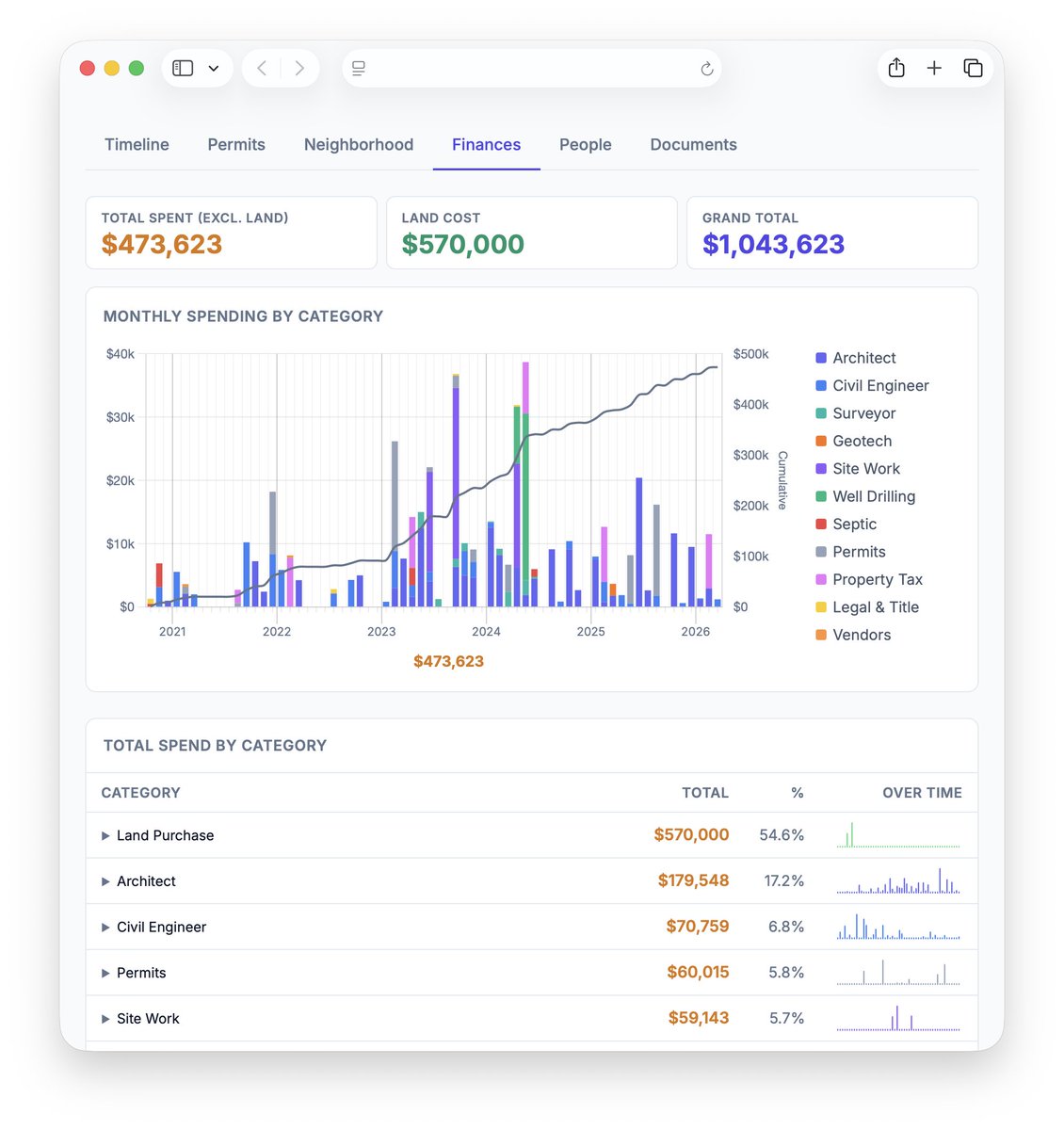
I could always find individual emails when I needed them. What I couldn't do was see the project. How much money have we actually spent, and on what? Who are all the contractors we talked to, and how did we find each one? What happened with the easement, not one email about it, but the full arc across three years? Why did we stop using the original surveyor?
The answers were all in my inbox. But they were spread across hundreds of threads. No single email contained the story. The story only existed in the connections between them.
So I tried something. I pointed OpenClaw at my full email inbox and said: read all my emails in chronological order and figure out what happened with this project over the last 5 years. Build me a timeline. Find all the documents. Track the money. Map the people.
That's it. I didn't sort anything. I didn't classify anything. I didn't tell it which threads mattered. I just pointed at the inbox and let it work.
And it worked way better than I expected.
It found 1,850 emails across 450 threads involving 58 people at 35 organizations. From that, it produced 511 timeline events describing what actually happened over 5 years. Not "Daniel emailed the architect" but "Easement delay threatens grading permit" or "architect warns the entire permit depends on securing the neighbor's access agreement." Real project history in PM language.
It identified 690 documents and classified each one: invoice, permit, survey map, legal agreement, environmental report, estimate, and so on, and it linked them to the timeline events that referenced them.
It extracted 170 finance records from email bodies and PDF attachments. Invoices, payments, estimates, and receipts with amounts, dates, and payees pulled from messy documents.
It mapped out 58 contacts with their roles, their organizations, and how they related to the project over time.
All interlinked. Click a timeline event, see the emails that produced it and the documents attached. Click a payment, trace it back to the invoice and the email thread. Click a person, see every event they were involved in.
It built a dashboard on top of it and for the first time in 5 years, I could actually see the whole project. The full arc. Every dollar. Every person. Every decision. Stitched together from raw correspondence into something I can sit down and browse.
The key insight for me was realizing this is basically an ETL process: Extract, Transform, and Load. The emails are the source data. The agent does the extraction from emails and loading into a database. But the really powerful part is the Transform: the LLM reads the raw correspondence with enough context to do intelligent enrichment across hundreds of threads spanning months and years.
And by enrichment I don't mean summarization. I mean it actually reconstructed the narrative of the project.
It traced how we almost hired the wrong well driller. We originally hired one company, paid a deposit, and were ready to go. Then the architect heard from someone in his network that they weren't reliable. We pivoted to a different driller who came recommended through a chain of referrals the agent traced back to its origin. The new company came out, drilled 140 feet, hit an artesian well with water pressure above ground level, and finished in two weeks. The original deposit got refunded. The agent reconstructed that entire sequence from first contact to final invoice, across dozens of emails and multiple contractors, and presented it as one coherent story.
It reconstructed the full permit saga. Four separate permits with the county, each with its own cycle of applications, reviews, correction letters, resubmissions, and approvals. Years of back and forth. The agent built the complete timeline for each permit and linked every document and payment to the right stage.
It tracked the money flow end to end. Not just "we paid the architect X." It found every invoice, matched them to the work described in the email threads, categorized the spending, and produced a financial history of the entire project broken down by architect, engineer, surveyor, contractor, county fees, and everything else.
It mapped out relationships between people that I had half-forgotten. Which engineer referred which surveyor. Which contractor's crew member later became a separate vendor. Which county reviewer handled which permit. All of it was in the email, I just never had the time to stitch it together myself.
One of the most fun things it did was writing honest personality profiles for each contact based purely on their communication style. How responsive they are. How they handle pushback. Whether they tend to over-promise. Whether they're the kind of person who answers at 11pm or takes five days to reply. Reading an AI's unfiltered take on the people you've been doing business with for years, based on nothing but their emails, is surprisingly entertaining and uncomfortably accurate.
The thing that surprised me most is how much structure was already hiding in the email. I didn't add information. The agent found what was already there. The timeline, the document graph, the money flows, the cast of characters. It was all latent in the correspondence. Five years of decisions and negotiations and payments, all recorded in email, just never connected.
I think a lot of people are sitting on projects like this without realizing it. Your renovation emails are a project database waiting to be assembled. Your legal correspondence is a case file. Your immigration threads are an application history. The raw material has been accumulating for months or years. It's rich, timestamped, and complete. It's just in a format designed for messaging, not for understanding.
Point an agent at it. Let it read everything. Let it do the transform. The whole story was in my inbox the entire time. I just needed something that could read all of it at once.
We’re hiring for Markets @Polymarket
You'll identify what questions the world is asking and deploy markets to answer them.
It requires editorial taste, deep understanding of the micro+macro landscape, obsessive understanding of market structure — & being terminally online 🧵
This is an exciting one. We're hiring a first of its kind role at JRB.
A few months back I posted that i think AI will disrupt Ecom teams first and today that day is here. One person can do today what took 3 to 4 people last year. And do it better.
I've been vibe coding Shopify sections, landing pages, and built a Claude powered CRO roadmap in my "spare time". It's truly wild what I've been able to do with a few hours each night and weekend.
Now I'm going to hand it off to this person and have them run with it while training them.
We're looking for one highly ambitious, independent person with Ecom knowledge and the want to go all in with Claude. You don't need to be at my level; you need a baseline level and the right temperament to dive all in.
You'll still have design and dev support. The goal is not to remove them, but to able to test ten times faster and smarter and do as much as you can yourself.
I'll post the job description in the comments. If this is you, please slide in my DMs. If you know anyone or can share this, it's always appreciated.
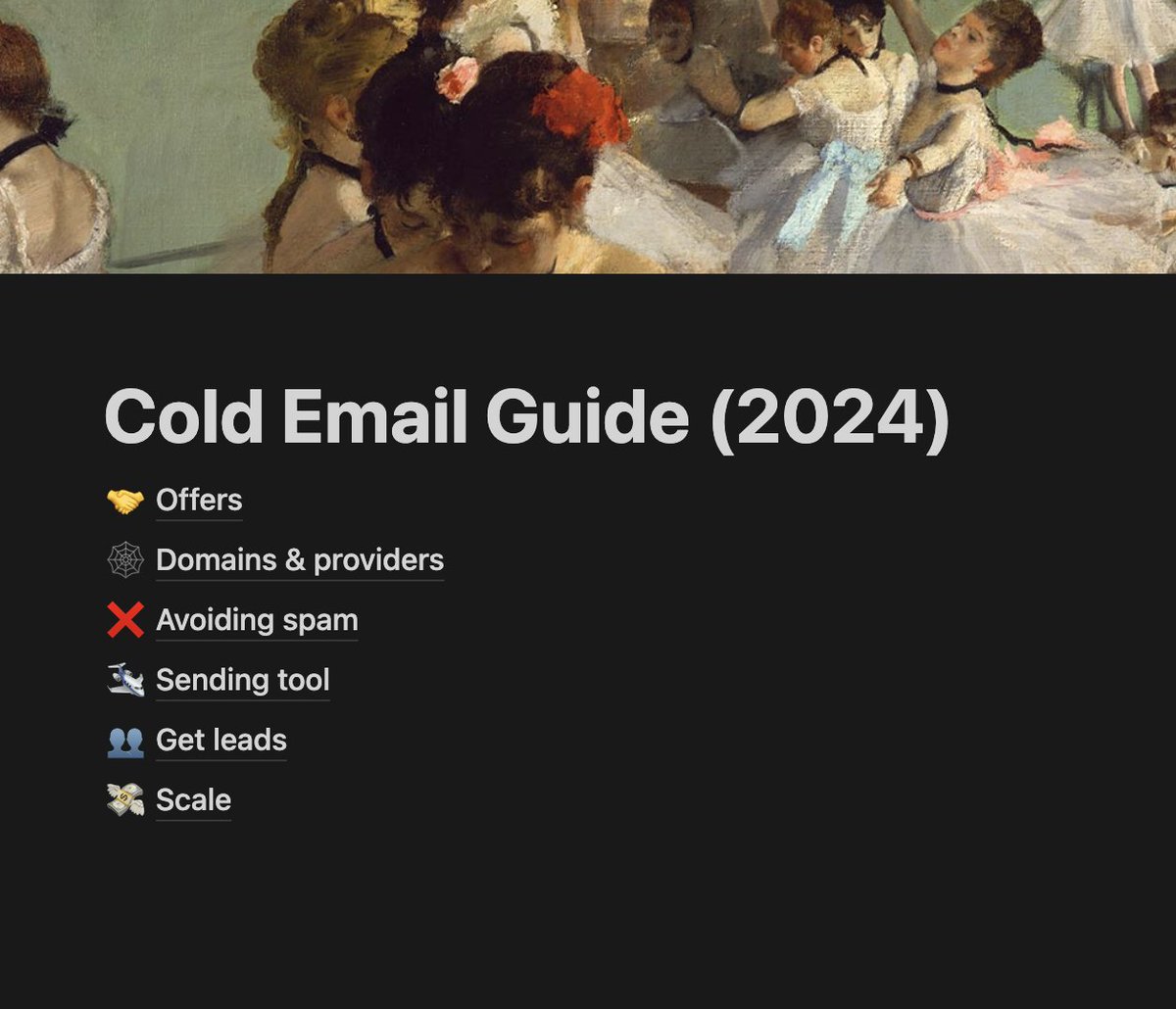
My agency sends 30,000+ cold emails/day.
I just created a FULL guide on how to make $10-20k/mo with cold email.
Like + Comment "COLD" and I'll DM it to you.
(Must be following)
i'm opening my calendar for 15 min slots this Friday!
a16z speedrun application opening is just weeks away - come AMA 1:1
first come, first served... drop a comment / like and I'll send you a link to schedule! (if there's space remaining)
I'm looking for a full time "consultative" closer.
OTE $10k/m.
Must deeply understand online B2B businesses.
Be able to coach prospects into a decision.
Ideal if you want to start an agency in the future.
- Work closely w/ me
- 100% inbound qualified leads
- Remote
DM me.
i'm gonna regret leaking this but fuck it
20 cold email scripts that have booked me 3,000+ calls
took me 2 hours to put together 30 pages of pure copy-paste scripts
- the 2-line script that booked 103 calls in 12 days
- the client name trick that gets 1%+ reply rates
- scripts for agencies, ecom, local, SaaS
- the follow-up sequence that books most of the calls
- proof from real campaigns
after sending 1,000,000+ emails these are the ones that ACTUALLY work
like + comment "SCRIPTS" and i'll send it over
(must follow + RT for priority access)
I’d love to angel invest in a handful of new startups this month.
Ideally former operators but open to all.
If you think I’d make a good addition to your cap table, reach out, DMs are always open!
My value add to you:
Distribution: Our media channel receives millions of monthly views which you automatically have access to!
Power: A mighty powerful rolodex! 😍
im hiring for amplify
- gtm engineer: you handle sales and marketing > growth
- customer success: ongoing following up with developers allocated, charisma and ppl person
- tech recruiter: find best ai talent out there
- english teacher: to invest in our talent pool base and train devs comms skills
Has anybody vibe coded their way into product market fit?
From the top of my dome:
Claude Code: founded in 2024 as an internal tool by @bcherny who prototyped it at Anthropic and within a week nearly half of developers there were using it. Long considered their moat, eventually it was decided to release it to the public. After being so successful internally, this dogfooded product had already found a market fit among the devs and it spread like wildfire.
OpenClaw: This tool by @steipete initially named ClawdBot, then at Claude legal department’s request renamed to MoltBot, and eventually OpenClaw along with acquisition by OpenAI and MoltBook by Meta, was another success story that was made real by granting AI executive power, just like Claude Code.
These two vibe coded tools share a lot of similarities - they are AI harnesses that give the models that run them agentic power, in other words, permission to edit files autonomously.
Any other vibe coded tools found a product market fit?
openclaw as your CMO is real.
and just saved me 120K USD.
I am witnessing it now.
I will be creating an entire series dedicated to this topic,
starting from 0 to having a fully operational marketing claw.
follow.
Yesterday Mark Cuban reposted my work, DM'd me, and told me to keep telling my story.
So here it is.
I'm a Master Electrician. IBEW Local 369. 15 years pulling wire in Kentucky. Zero coding background. I didn't go to Stanford. I went to trade school.
Every week I'd show up to a home where someone just bought a Tesla or a Rivian. And every time, someone had already told them they needed a $3,000-$5,000 panel upgrade to install a charger.
70% of the time? They didn't need it.
The math is in the NEC — Section 220.82. Load calculations. But nobody was doing them for homeowners. Electricians upsell. Dealers don't know. And the homeowner just pays.
I got angry enough to build something about it.
I found @claudeai. No coding experience. I just started talking to it like I'd explain a job to an apprentice. "Here's how load calcs work. Here's the NEC code. Now help me build a tool that does this."
6 months later — @ChargeRight is live. Real software. Stripe payments. PDF reports. NEC 220.82 calculations automated. $12.99 instead of a $500 truck roll.
I'm still pulling wire. I still take service calls. I wake up at 5:05 AM for work.
But something shifted.
Yesterday @vivilinsv published my story as Claude Builder Spotlight #1. Mark Cuban saw it. The Claude community showed up. And for the first time, I felt like this thing I built in my kitchen might actually matter.
I'm not a tech founder. I'm a dad who wants to coach little league and be home for dinner. I just happened to build something that helps people.
If you're in the trades and thinking about using AI — do it. The barrier isn't technical skill. It's believing you're allowed to try.
EVchargeright.com