Crémieux@cremieuxrecueil
In the Children of the National Longitudinal Survey of Youth study, it looks like the kids born later in time are 2/3 to 4/5 of a standard deviation smarter than the ones born at the beginning of the sample.
Did kids get smarter?
It depends what you mean by that!
In one sense, the answer is definitely 'yes'! The kids born later in the sample are, indeed, smarter than the kids born earlier in the sample. But, can you see a problem with that when you look at this graph in this graph?
If you click in, you'll notice that the kids born later in the sample tend to have mothers who are smarter, better-educated, and they're less likely to be Black. In other words, year of birth is majorly confounded.
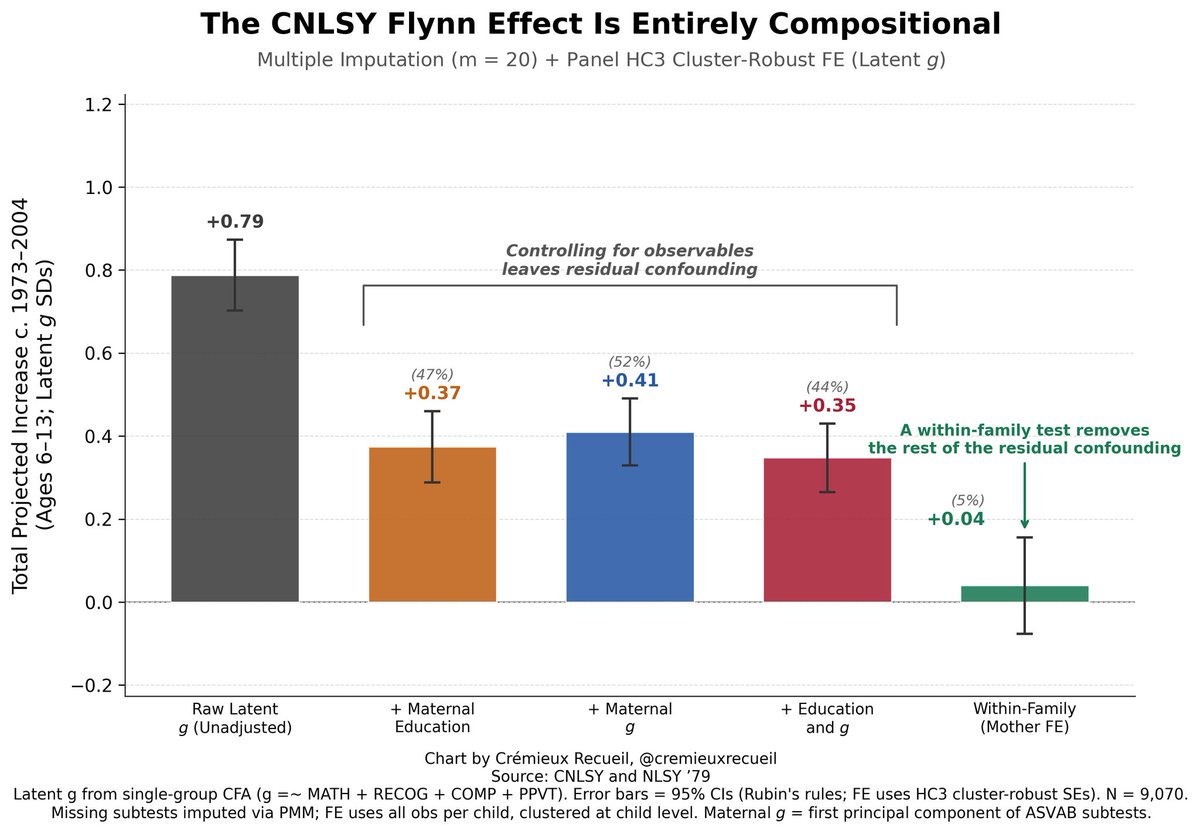
To get what's going on, I'm going to visualize the 'Flynn effect' in this sample for you. I'll also show you what happens when we control for various characteristics of the mother in the hopes of eliminating that confounding. Take a look:
If you just control for the characteristics of the mother, that doesn't go quite far enough. What you end up with is a greatly reduced Flynn effect. And, in fact, a few researchers have published on this dataset and ended up trying to explain that greatly-reduced Flynn effect. But they didn't go far enough, because if we look at the size of the effect of birth year *within families* by comparing siblings, we get...
NOTHING!
There is no trend over time whatsoever! The apparent trend just gets smaller and smaller, but you have to be able to control for the family unit to see it. Otherwise, you're stuck with tons of residual confounding!
In reality, kids did not get smarter over time. There was actually just no change at all, and what some researchers have suggested is evidence of kids getting much smarter in roughly one generation is actually just smarter mothers having kids later, leading to the smarter kids being born later. But when we check on this trend within families? Birth year is irrelevant!
Sampling bias sort of like this is a common explanation for when people find evidence of Flynn effects—increases (and sometimes decreases) in scores over time. And yet, it barely ever comes up in the published literature. The big question is, why?
I don't know. It could have something to do with the methodological sophistication of the researchers. But regardless, it really seems like people are content to waste time explaining trends that aren't even real in the first place.
To learn more, go check out my latest article: cremieux.xyz/p/the-other-ty…