

Jude Seth
177 posts

Jude Seth
@judeseth7
Backend dev (Python) | Building tools & APIs | CS & Econ GitHub ↙
Katılım Ekim 2025
71 Takip Edilen44 Takipçiler

what is this english 😭
ADÉBAYÒ!!!💫🥷@Dah_Saint001
Burna boy mean no harm btw Zlatan just not clocked it
English

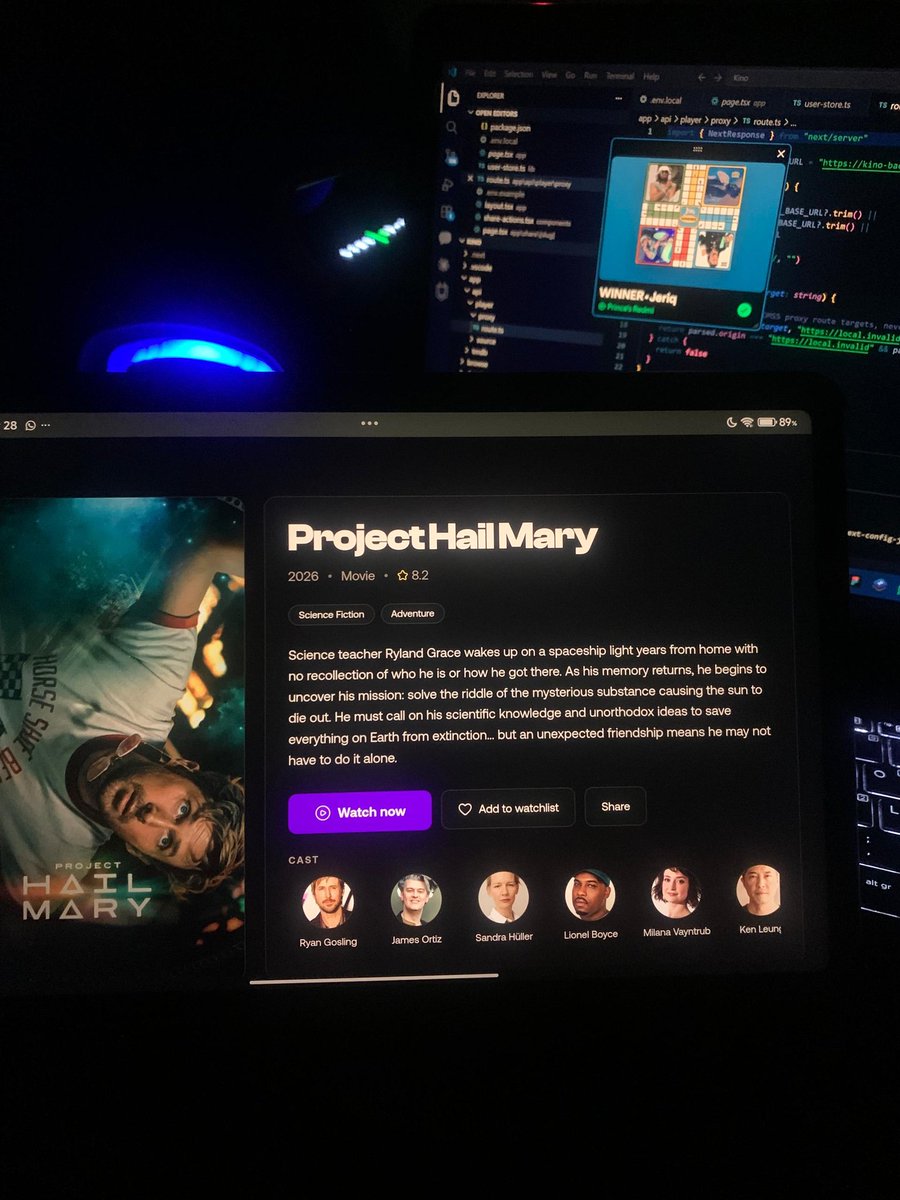
introducing kino.
my own streaming app. it taught me a lot, and i'm just glad i was able to pull it off.
this is a personal app, so unfortunately i will not be sharing the URL on here.


prince.@onrooleyy
building my own netflix this weekend, let's see how it goes.
English
@SportsIsco ANS, CSC, MCB, BCH
AGE, PUB, ASE, MTH
ACC, GLY, EEE, PHY
MRH, PHL, BUS, KHR
Be there
English

INSIDE OAU FOOTBALL ⚽
SUPREMACY CUP DRAWS WILL BE HELD BY 5PM TODAY.
- Team Ranking
- Rules of the Game
- Group Draws
STAY TUNED.

Ife, Nigeria 🇳🇬 English
why's your whatsapp layout weird
Aje | GHL CRM & Lifecycle Manager@Aje_Dynamicz
This man wants me to setup all his entire crm for 200k 😤 Even newbie sef won’t charge such amount 😩
English
Jude Seth retweetledi

Don’t overcomplicate it.
• Build a Password Manager to learn file handling, hashing (not full crypto)
• Build a URL Shortener to understand routing, IDs, and persistence
• Build a Todo App with deadlines to practice CRUD and basic state
• Build a Web Scraper to learn requests, parsing, and rate limits
• Build a CLI Expense Tracker to master logic, files, and edge cases
• Build a Log Analyzer to work with files, timestamps, and patterns
• Build a Simple Recommender using similarity rules (not ML magic)
• Build an Email Automation Script using SMTP and scheduling
Projects. Not tutorials.
English
Jude Seth retweetledi

As a developer,
Please Slap yourself if you are unable to explain even 10 from below terms :
Indexing
Clustering
Denormalization
Normalization
Read replicas
Leader–Follower replication
Multi-leader replication
Quorum
Consensus
CAP theorem
BASE
ACID
Eventual consistency
Strong consistency
Snapshot isolation
MVCC (Multi-Version Concurrency Control)
Two-phase commit (2PC)
Three-phase commit (3PC)
Write-ahead logging (WAL)
Checkpointing
Compaction
Rebalancing
Resharding
Data locality
Hot partition
Split-brain
Failover
High availability (HA)
Horizontal scaling
Vertical scaling
Load balancing
Connection pooling
Caching
Materialized views
Secondary indexes
Composite index
Covering index
Bloom filter
LSM tree
B-tree
Query planner
Cost-based optimizer
Deadlock
Lock escalation
Optimistic locking
Pessimistic locking
Dirty read
Phantom read
Read skew
Write skew
Data skew
Backpressure
Circuit breaker
Throttling
Rate limiting
CDC (Change Data Capture)
Logical replication
Physical replication
Geo-replication
Federation
Data lake
Data warehouse
Columnar storage
Row-based storage
Time-series partitioning
Hash partitioning
Range partitioning
Consistent hashing
Data migration
Schema evolution
Schema registry
Idempotency
Exactly-once semantics
English
Jude Seth retweetledi
Jude Seth retweetledi

Backend isn’t just APIs and CRUD.
This is the roadmap companies like Google, Meta, Amazon expect you to know.
DSA
> Companies like Google don’t care about your projects if you fail here.
> This is the real filter.
> Conquer this, and every door in tech opens.
> Struggle here, and those doors stay shut.
0. Ground Setup
Before going crazy with topics, you need:
> One main backend language (JavaScript/TypeScript, Go, Java, Rust — pick one and master it)
> Git + GitHub: branching, PRs, rebases, conflict resolution
> Linux basics: ls, cd, cat, grep, find, permissions, SSH
> Editor mastery: VS Code or any solid setup
First principles here:
> What is a program? How does source code become a running process?
> What is an OS process vs thread?
> What does it mean to run a server on a port?
You should be able to:
> SSH into a Linux box, pull a repo, install deps, run a server on a port, view it via browser
---
1. Core Backend Fundamentals
1.1 Networking and HTTP
You cannot be a strong backend engineer if HTTP is just “that thing Express uses”.
Understand:
> DNS → IP → TCP → HTTP
> Difference between IP / TCP / UDP / HTTP / HTTPS
> HTTP methods, status codes, headers, idempotency, safe methods
> REST vs RPC vs GraphQL
Practice:
> Build a backend without any framework using native http
> Parse JSON body manually
> Implement basic rate limiting
> Add API versioning (/v1, /v2)
---
1.2 API Design and Backend Architecture Basics
First principles:
> Resource modeling
> Stateless vs stateful
> Consistent naming, validation, clear errors
> Pagination, filtering, sorting
Layered architecture:
> Controller → Service → Repository (DAO)
You should be able to:
> Design APIs for Task Manager or Expense Tracker
> Keep error and response structure consistent everywhere
---
2. Databases and Data Modeling
Big companies will grill you here.
2.1 Relational Databases
SQL is non-negotiable.
Understand:
> Table, row, column, primary key, foreign key
> Normalization: 1NF, 2NF, 3NF basics
> Joins: inner, left, right, full
> Transactions and ACID
> Indexes and their impact
You should be able to:
> Instagram schema: users, posts, likes, comments, followers
> Query top posts, mutual followers
> Use migrations, not manual DB edits
---
2.2 NoSQL and When to Use It
Understand:
> Document DB vs relational DB
> Denormalization
> Event logs and analytics needs
> CAP theorem basics
> Collections, documents, indexes, aggregation pipeline
Be able to decide:
> When a feature needs SQL vs NoSQL
---
3. Authentication, Authorization and Security
3.1 Auth Basics
Understand:
> Authentication vs authorization
> State vs stateless auth
> Password hashing (bcrypt/argon2)
> Cookies: HttpOnly, Secure, SameSite
> Access vs refresh tokens
> Token revocation and rotation
> Basics of OAuth2 / OpenID Connect
You should be able to:
> Implement email/password auth with verification and forgot password
> Explain cookies vs localStorage
> Explain token invalidation strategies
---
3.2 Web Security Core
Understand:
> SQL injection, XSS, CSRF, IDOR (OWASP Top 10)
> Input validation and output encoding
> CORS and preflight
You should be able to:
> Identify common vulnerabilities in APIs
> Configure CORS correctly
---
4. Concurrency, Performance and Scalability
4.1 Concurrency and Asynchrony
Understand:
> Event loop, callback queue, microtasks
> Blocking vs non-blocking I/O
> CPU-heavy work blocks Node
You should be able to:
> Explain when to use worker threads and offloading
---
4.2 Caching
Concepts:
> In-memory vs Redis caches
> TTL, LRU, invalidation
> HTTP caching: ETag, Last-Modified, Cache-Control
You should be able to:
> Use Redis to cache DB queries and rate limit
> Plan cache keys well
---
4.3 Scaling and Architecture Patterns
Understand:
> Vertical vs horizontal scaling
> Stateless services for scale-out
> Load balancers
> Monolith vs microservices
> Sync vs async flows (queues)
Patterns:
> Circuit breaker
> Retry with backoff
> Idempotency keys for POST
You should be able to:
> Split a monolith into services and make them communicate
---
5. Messaging, Queues and Async Systems
Understand:
> RabbitMQ, Kafka, Redis streams
> Producers, consumers, delivery semantics
Use cases:
> Emails, uploads, payment pipelines, logs
You should be able to:
> Offload heavy jobs to background workers
> Build async workflows
6. Testing and Quality
Understand:
> Unit, integration, E2E tests
> Test pyramid
> Deterministic vs flaky tests
You should be able to:
> Test auth flows and business logic
> Run tests in CI (GitHub Actions or similar)
7. DevOps Basics for Backend Engineers
7.1 Containers and Deployment
Understand:
> Dockerfile basics (FROM, COPY, RUN…)
> Docker Compose for app + DB
> Environment variables and config
You should be able to:
> Containerize backend and DB
> Deploy to any cloud provider
7.2 CI/CD and Observability
Understand:
> CI pipelines: tests, lint, build
> Auto deploy workflows
> Logging and metrics
You should be able to:
> Add logging middleware with request IDs
> Monitor latency, error rate, throughput
8. System Design
This becomes crucial for big tech interviews.
Understand:
> Load balancer, app server, DB, cache, queue, file storage
> Consistency models
> API Gateway and BFF patterns
> Unique ID generation (UUID, Snowflake)
Practice on paper:
> URL shortener
> Instagram feed
> E-commerce checkout
> Notification systems
Consider:
> DB schema, caching, queue usage, failure handling
9. Domain-Specific Knowledge
Depending on role and product:
> Fintech: strong consistency, audit logs, idempotency
> E-commerce: carts, pricing, orders, inventory
> Real-time: WebSockets, SSE, backpressure
Choose what aligns with your career direction and keep grinding.
English
Jude Seth retweetledi

Hey guys, I’m so happy with all your kind birthday messages. Thank you so much.
English
Jude Seth retweetledi

Jude Seth retweetledi


Jude Seth retweetledi

Jude Seth retweetledi

Jude Seth retweetledi
