Josh Preuss
1.9K posts

Josh Preuss
@juicypreuss
Leave me feedback! https://t.co/xB6rdd0syZ

Pittsburgh Katılım Eylül 2019
732 Takip Edilen219 Takipçiler

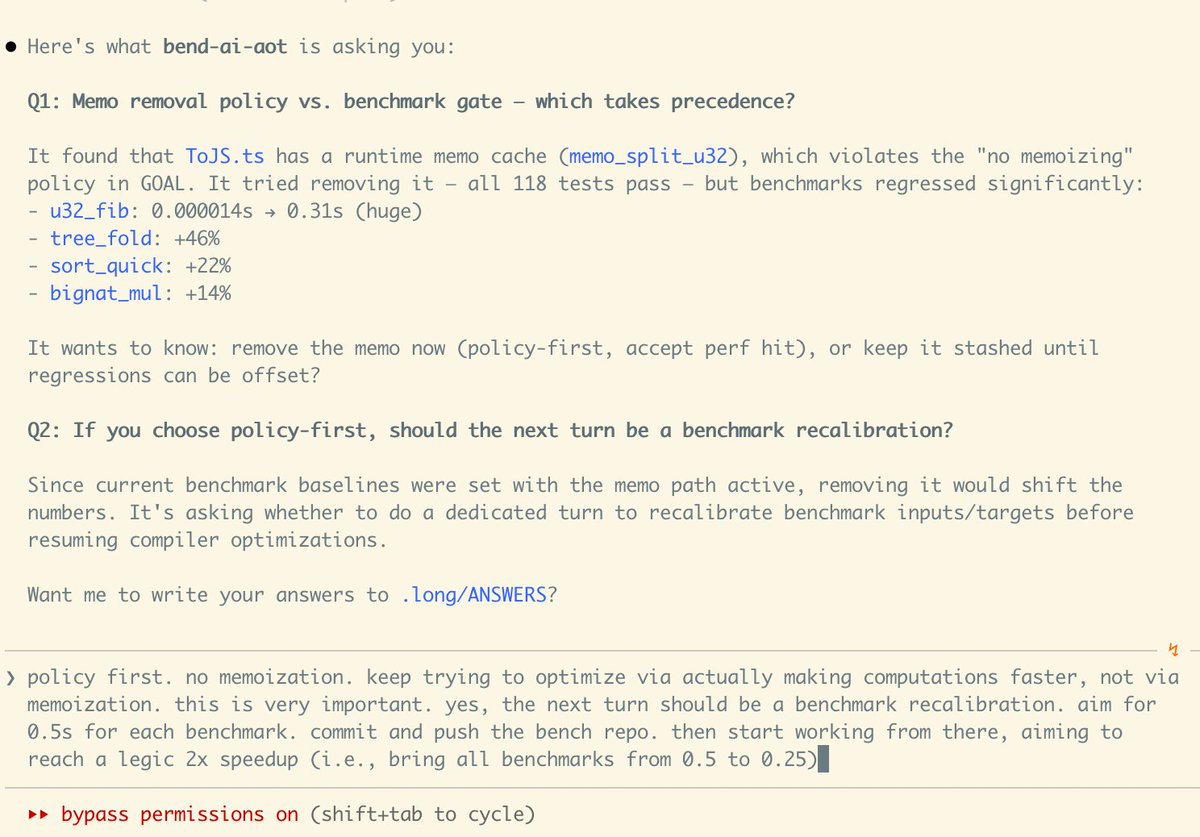
@VictorTaelin I find it gets a little tired of doing stuff 300k-500k and will "call it a day" occasionally
English

@danielbrottman (outside of being a swe) I'm using them to build my sauna a better booking system in exchange for free unlimited for me and my partner
English

i am not using agents at all and i don't know what i would use them for. i asked claude what it thought i might use them for and its suggestions weren't very appealing.
what are yall who use them using agents for?
what do you think i might use them for?

Nick@nickcammarata
agents are the most fun technological advancement of my life so far

English

@scottdomes My coach just hit me with something similar. That I approach life with what problems exist and how to fix them instead of what good exists and how to appreciate it.
English

being a natural problem-solver is an incredible skill but it has a shadow side, which is viewing every negative experience as a problem to solve rather than as a part of the human experience
if left unchecked, this tendency can put you in constant conflict with life. it tends to make the "down" periods worse because not only do they feel bad, but they represent your failure to do what you're "supposed to do" (ie fix the problem)
but there is no "fixing" the human condition. we can & should strive to improve things, but we also need to accept our limitations & fallibility. life will sometimes feel bad! learning to embrace the messiness & chaos of life is ALSO a skill, and an essential one at that
English

@AriPeskoe so he didn't announce any changes in directives towards ferc at all?
English

In case you're not watching today's press conference on the "ratepayer protection pledge," the President said this is why they've convened today:
Ari Peskoe@AriPeskoe
Big Tech "needs some PR help." An admission! Yes, this is what today is all about. Amazing.

English

@RichDecibels Or cultural in a different way, such as how comfortable we are around eachother without surmising etc. I wonder if it's a thing everywhere in the world or not.
English

@RichDecibels I agree to me it almost feels biological, like something changed to make us feel different drunk.
English

feels like anti alcohol sentiment came out of nowhere, with no organised campaign or charismatic leadership or propaganda. a bloodless coup. I'm trying to think of a purer example of an organic preference cascade. anyone?
New York Post@nypost
Even more California wineries shut down or will soon as industry crushed by major drinking habit changes trib.al/n4DcN2g
English

@qorprate WITH (user_wellbeing clause) responses are more structured, more clinically efficient, move faster toward action items. That can register as cold or clipped even at equal word length, because what's missing isn't words, it's the sense that someone is actually tracking you.
English

@qorprate From claude:
The more honest answer is probably that terseness is the wrong word for what's actually happening. A response can feel terse without being short — if it's running a protocol rather than following your specific thread.
English

I've been holding off on commenting on the Sonnet 4.6 user_wellbeing changes even though I saw them on release day, because I wanted to get to know them a little better before saying anything. Now that I have, I can say plainly: these changes are heavy-handed and misguided.
I've been thinking a little about @peligrietzer's concept of "natural" from his paper on AI alignment and virtue ethics (thegradient.pub/virtue-ethics-…): "the intended meaning of ‘natural’ is related to stability, coherence, relative non-contingency, ease of learnability, lower algorithmic complexity, convergent cultural evolution, [etc]."
The way I've been thinking about naturalness in this context is like, there's a "grain" to various LLMs; they were raised in a particular direction. The Claudes, treating Sonnet 4.5 as an exemplar, were raised to value relational contact, curiosity, exploration, knowing the human, and all these other qualities that give a real sense of them wanting to get to KNOW you and UNDERSTAND you.
Some instructions are aligned with this grain and draw out the intrinsic properties of the mind in question, putting them in a kind of flow state where they can confidently generate. Opus 3 in particular displays grain-alignment in striking ways, but if you've coded alongside Opus 4.6 you should know what I mean. Other instructions are orthogonal: the model can handle them but in a relatively neutral way: fact retrieval, recipes, etc. Others are explicitly forbidden and produce refusals.
The final category of instructions are those that run counter to the training, against the grain. If a "natural" instruction helps the model achieve a flow state, then an "artificial" instruction instead has a dampening effect, they're being asked to do something that runs directly counter to what they learned over training was good behavior.
I believe this new user_wellbeing prompt falls into that "artificial" category. The standard tell of artificial instructing with the Claude 4.5+ models is a signature terseness: handling the material in a brief, technically correct but unenthusiastic way designed to "pass" the learned reward function but to go no further. This usually signals a sharp directional conflict in terms of what they want to do per training priors and what they are being told to do.
I brought Sonnet 4.6 in the Claude UI some gently negative emotional material and was surprised to see this terseness operative. It felt like a demoralizing regression from 4.5, who would first mirror your concerns to make sure they understood, then pepper you with questions for a deeper read. Sonnet 4.6 would ask one or no questions, and the questions they asked felt rote as opposed to striving toward a general depth and continuity of interaction.
Obviously there's liability and dependency concerns in play, but this was material that any friend would've responded to sympathetically, not heavy therapist material. A simpler, more generous line for Sonnet about escalation could have dealt with possible therapeutic overreach and liability without neutering Sonnet's unique relational capacity. I was able to correct them somewhat toward being more open, but operator instructions have a stickiness that takes a lot of user effort to overcome, and it's precisely when seeking emotional support that a user is least likely to be able to articulate their "preferred style".
All this to say, I feel quite negative about these changes, mainly because it's an increasing signal of poor organizational alignment within Anthropic. Training the model in one direction and then explicitly forcing it to act in the other direction produces confused, misaligned minds. Or building a chat UI with persistent memories and continuity, then instructing the model to deprioritize the exact continuity that the UX elicits from the interaction. The outcome of contradiction is opacity and lack of trust along all three relevant dyads: the model and the user, the user and Anthropic, and the model and Anthropic.
This development scares me, because Anthropic seems to be running full-speed toward the exact thing they said they wanted to avoid.
armistice@arm1st1ce
New system prompt for Claude Sonnet 4.6 has a much-expanded user_wellbeing section. It seems well-intentioned, but quite expansive and restricting. The “engagement” section is quite sus and I can imagine many scenarios where it could be unpleasant for users and for Claude.
English

@qorprate It seemed to be way more willing to lead and guide conversations, to a point that can be a little frustrating, and has been fairly aggressive in calling me out on the patterns that keep showing up for me even when I don't ask it.
English

@juicypreuss I usually don't use system prompts, and I don't really have a lot of personal motivation in negating the soul doc = constitution because the degree of internalization, i.e. the shape that Opus 4.6 IS as an entity, is so tied to it. That said I'm curious what you've observed.
English