
Joonho Lee

454 posts

Joonho Lee banner
Joonho Lee

Joonho Lee

@junja941

Roboticist at Neuromeka, KR

Seoul, Korea Katılım Ocak 2019
276 Takip Edilen1.4K Takipçiler
Sabitlenmiş Tweet
Joonho Lee
Joonho Lee@junja941·
Here we show one of our experiments on AI + automation in factory. Built from certified industrial hardware, the system is fully compliant in the industrial enviroment. It achieved: 1. 99.4% SR (verified by actual QC tests) 2. 5.5 hours continuous run 3. Near-human takt time
English
9
36
361
36.1K
Joonho Lee retweetledi
Pulkit Agrawal
Pulkit Agrawal@pulkitology·
Eka means unity -- “one,” in Sanskrit and “first” in Finnish. We’re building intelligence for the physical world in its native language: forces. Until now, robotics faced a tradeoff — generality or speed. The real world requires both. Robotics also faced a data problem. Our Vision–Force–Action (VFA) model — the first of its kind — breaks the generality-speed tradeoff and the data barrier. It's a new foundation uniting performance, generality, and safety for putting capable robots in everyone's hands. Today, I am excited to share our journey of pushing robots beyond human limits. Today, dexterity becomes scalable. Today, I welcome you to the Era of Eka. Co-founded with @haarnoja, and so thrilled and grateful to be working with a dream team at @EkaRobotics. Learn more: ekarobotics.com
English
63
221
1.9K
302.3K
Eris
Eris@2nisi·
@junja941 We have same philosophy at Duatic 🚀
English
1
0
1
159
Joonho Lee
Joonho Lee@junja941·
In the end, it was not about fancy large models or massive datasets. We chose to harness small learned models within well-established workflow tools such as state machines and behavior trees. That made the system more predictable, debuggable, and easier to integrate.
Yunho Kim@awesomericky99

We present "hybrid system" that supplements conventional automation with "learning" for task & safety-level adaptiveness Deployed in factory for motor cable soldering (< 0.6 mm tolerance), resulting 108 motors, 99.4% SR with < 20 min data per task Paper: arxiv.org/abs/2604.22235

English
4
21
128
15.8K
Joonho Lee
Joonho Lee@junja941·
This might not sound “scientific” or "researchy", but it was one of the hardest lessons from the field: collecting data and training in the factory is very expensive. Start with small data, make the first task work reliably, and then expand.
English
1
0
9
431
Joonho Lee
Joonho Lee@junja941·
From this experience and know-hows, our next goal is to make something more generic and reusable across other industrial tasks.
English
1
0
5
469
Joonho Lee retweetledi
Yu Lei
Yu Lei@_OutofMemory_·
🤖Co-training is everywhere (sim↔real[e.g. GR00T, LBM], human↔robot[e.g. PI, EgoScale], even non-robot data[e.g. PI, LBM). But why does it work? How can we improve it further? Taking sim-and-real imitation learning in diffusion/ flow-based models as the test bed, we performed a rigorous mechanistic analysis, drawing on theoretical insights and multi-layered experiments. 😮Key insight: it’s all about representations. - Alignment → enables transfer - Discernibility → enables adaptation ⚖️Both are necessary — it's better to have more aligned representations, but the model must be able to discern the domains. We term this as structured representation alignment. ⬇️Let’s take a deep dive into that: Paper: arxiv.org/pdf/2604.13645 Website: science-of-co-training.github.io
Yu Lei tweet media
English
5
66
383
60K
Joonho Lee retweetledi
Xie Zhaoming
Xie Zhaoming@zhaomingxie·
I decided to write down some of my thoughts in blog posts. In this post: zhaomingxie.github.io/blog/posts/wor…, I share my thoughts on world model, purely in the context of using simulation data to train a dynamic model of an articulated rigid body system, e.g., a humanoid robot.
English
8
17
143
8.9K
Joonho Lee retweetledi
Xie Zhaoming
Xie Zhaoming@zhaomingxie·
Finally I can share the video: youtu.be/pbSf08WbIMY?si…. Preprint arxiv.org/pdf/2602.18312 if you are interested. One thing I am thinking is if we can go from these learned matrices to an ILQR formulation (inverse optimal control?) so that we can have policy explainability?
YouTube video
YouTube
Xie Zhaoming@zhaomingxie

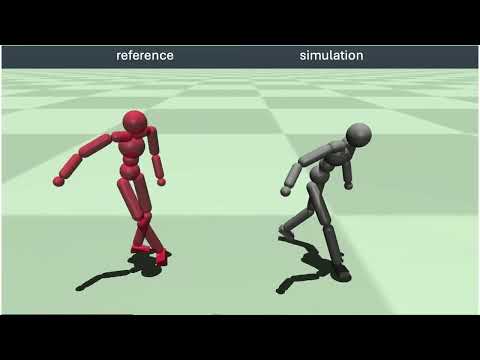
We recently explored how to learn a time-varying linear (TVL) policy for character control. It works surprisingly well! In simulation, a TVL policy can handle every Deepmimic-style task we throw at it. No neural net at deployment, just a sequence of matrices.

English
4
16
89
12.4K
Joonho Lee retweetledi
Abhishek Gupta
Abhishek Gupta@abhishekunique7·
Excited to share the project that has surprised me the most in the last year! Large-scale RL in simulation, no demos and no reward engineering can solve dynamic, dexterous and contact rich tasks. The learned behaviors are reactive, forceful and use the environment for recovery in ways that are extremely challenging to bake in or teleoperate! You can play with the policies yourself to see: weirdlabuw.github.io/omnireset/ And, the learned behavior transfers to real world robots from RGB camera inputs! So what’s the trick - using simulator resets carefully! Let’s unpack (1/10)
English
17
91
614
81.3K
Joonho Lee
Joonho Lee@junja941·
@GuanyaShi Fully agree. Sometimes that kind of novelty argument is just an easy way to criticize a paper.
English
0
0
11
1.4K
Joonho Lee retweetledi
Guanya Shi
Guanya Shi@GuanyaShi·
I’m so tired of writing rebuttals to this kind of “lack of novelty” review: “This paper trivially combines A, B, and C, so the algorithmic novelty is limited.” Technically, most (if not all) robotics papers are convex combinations of existing ideas. I still deeply appreciate A+B+C papers—especially when they deliver: - New capabilities: the “trivial combination” unlocks behaviors we simply couldn’t achieve before - Sensible & organic design: A+B+C is clearly the right composition—not some arbitrary A′+B+C′ - Nontrivial interactions: careful analysis of the dynamics, coupling, or failure modes between A, B, C - Rehabilitating old ideas: A was dismissed for years, but paired with modern B/C, it suddenly works—and teaches us why - System-level & "interface" insight: the contribution is not any single piece, but how the pieces talk to each other - Scaling laws or regimes: identifying when/why A+B+C works (and when it doesn’t) - Engineering clarity: making something actually work robustly in the real world is not “trivial” - New problem formulations: sometimes the real novelty is in the reformulation—only under this view does A+B+C make sense. Maybe worth keeping these in mind when reviewing the next A+B+C paper : )
English
30
120
965
111.8K
Joonho Lee retweetledi
Arip
Arip@machinestein·
Zero-Shot Off-Policy Learning Behavioral foundation models are pretrained on large, reward-free transition datasets. At deployment time, they can be "prompted" to infer a policy for a new reward in a zero-shot manner, without any fine-tuning. This falls under offline or off-policy RL: once the inferred policy is executed, its state-action visitation may diverge from the dataset, leading to distribution shift, value overestimation, and other typical off-policy issues. The missing ingredient is a principled off-policy correction—specifically, stationary occupancy (density-ratio) correction. In this paper, we show that by using Forward–Backward successor representations, this density-ratio correction can also be performed in a zero-shot manner! Paper: alphaxiv.org/abs/2602.01962 Code: github.com/machinestein/Z…
English
2
37
184
11K
Joonho Lee retweetledi
Lucas
Lucas@quantbagel·
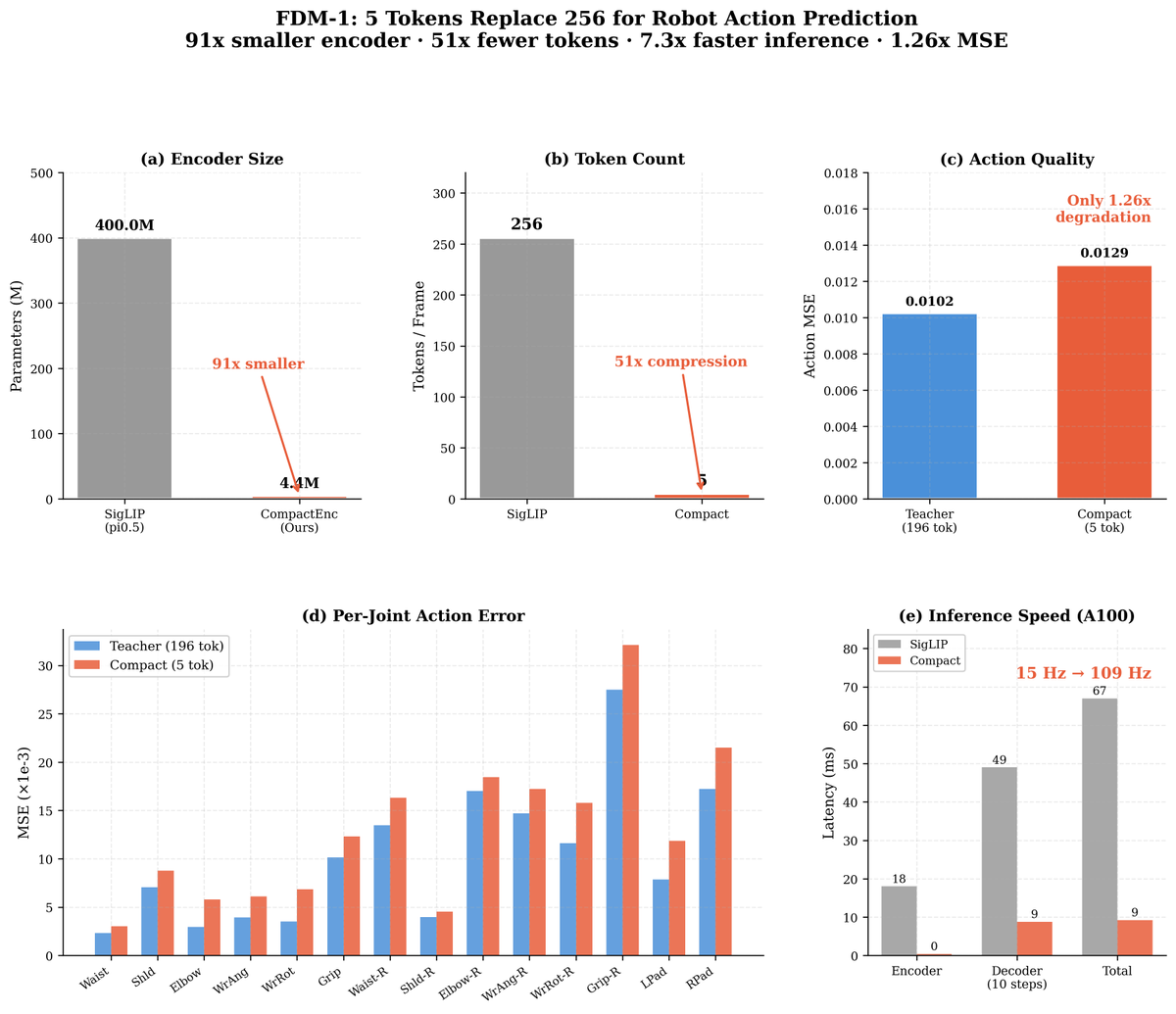
Robot action models shouldn't need 256 vision tokens per frame. Pi0.5 spends 400M parameters on SigLIP just to see. We replaced it with a 4.4M encoder that outputs 5 tokens — and action quality barely changes. 91x smaller. 51x fewer tokens. 7.3x faster inference.
Lucas tweet media
English
23
31
362
21.1K
Joonho Lee retweetledi
Quanting Xie
Quanting Xie@DanielXieee·
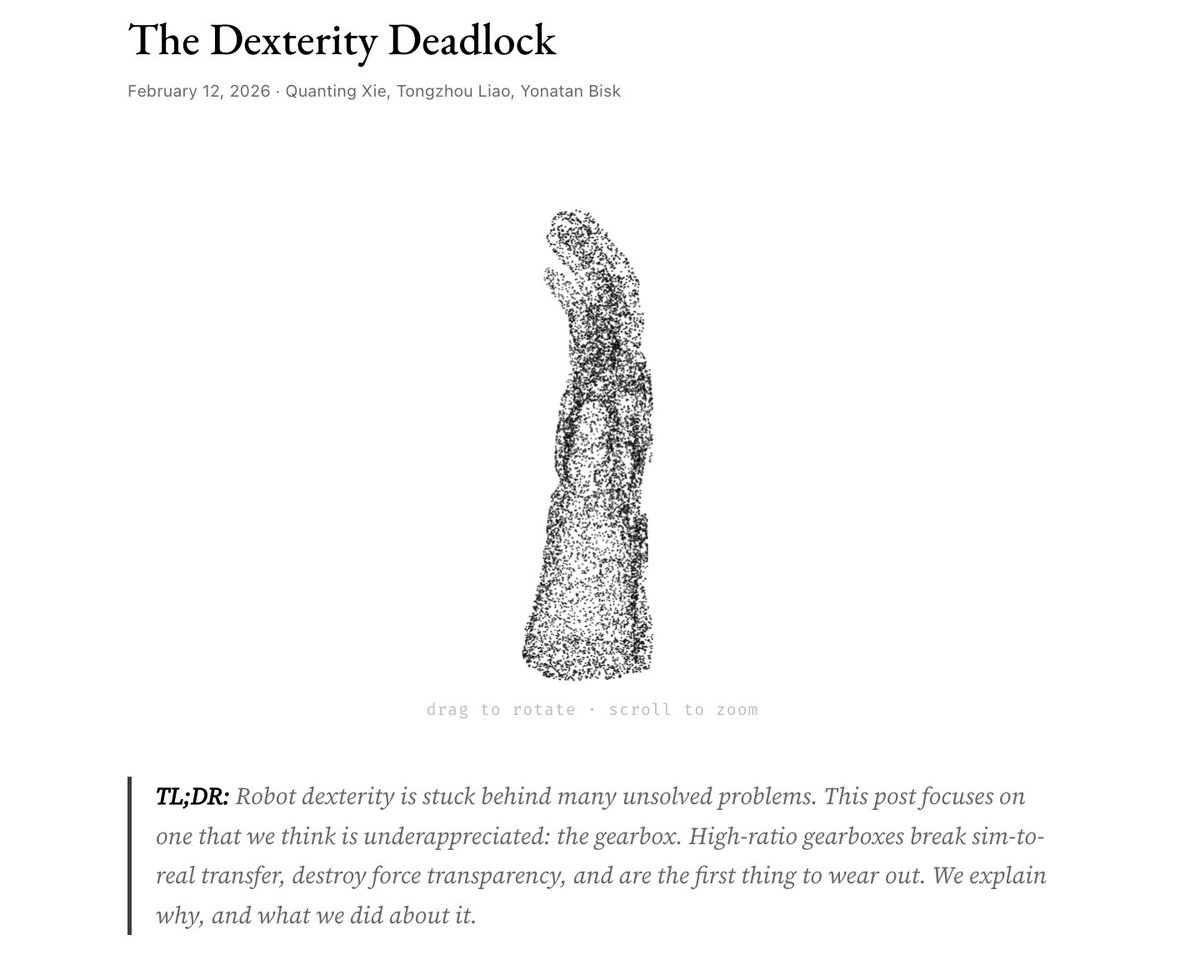
Why does manipulation lag so far behind locomotion? New post on one piece we don't talk about enough: The gearbox. The Gap You've probably seen those dancing humanoid robots from Chinese New Year. Locomotion isn't entirely solved; but clearly it's on a trajectory. But we haven't seen anything close for manipulation. 𝗪𝗵𝘆? When sim-to-real transfer fails, the instinct is to blame the algorithm. Train bigger networks. Crank up domain randomization. Those approaches have made real progress; we don't deny that. But we started wondering: are we treating the symptom or the disease? The Hardware Bottleneck: Fingers are too small for powerful motors. So most hands use massive gearboxes (200:1, 288:1) to get enough torque. But those gearboxes break everything manipulation needs:   • Stiction and backlash are complex to simulate. Policies trained on smooth physics hallucinate when they hit that reality.   • Reflected inertia scales as N². At large gear ratio, the finger hits with sledgehammer momentum.   • Friction blocks force information. The hand becomes blind. And they're the first thing to break. What we are trying to build at Origami, we cut the gear ratio from 288:1 to 15:1 using axial flux motors and thermal optimization. The transmission becomes more transparent: backdrivable, low friction, forces propagate to motor current. Early signs are encouraging. Still running quantitative benchmarks. Why Interactive? I love how Science Center uses interactive devices to explain complex ideas. I want to borrow this concept and help people understand the hard problems in robotics better visually. The post has demos where you can toggle friction, slide gear ratios, watch the sim-to-real gap widen in real-time. What's inside:   • Interactive demos (friction curves, N² scaling, contact patterns)   • Comparison table: 14 robot hands by sim-to-real gap and force transparency   • The math behind why low-ratio matters Read it here: origami-robotics.com/blog/dexterity… We're not claiming we've solved dexterity. The deadlock has many pieces. But we think this one's foundational. Curious what you think.
Quanting Xie tweet media
English
24
102
663
147.2K