JURA Bio, Inc.

164 posts

JURA Bio, Inc. banner
JURA Bio, Inc.

JURA Bio, Inc.

@jura_bio

We sample from our generative biological sequence models at peta-scale. Read about our work: https://t.co/54LW2OWekw You can find us on 🦋

BOS | BSL | OSL | KBH | LGA Katılım Ağustos 2020
10 Takip Edilen915 Takipçiler
JURA Bio, Inc. retweetledi
Elizabeth Wood 🧬🖥️🥼
We have made the world's largest screening platform for AI-designed proteins and peptides. To celebrate it, & inspired by @ChordomaFDN great tbxtchallenge.org, we're soliciting hard targets. At scale, undruggable doesn't take any longer: ✉️ challenge@jurabio.com
English
0
6
37
3K
JURA Bio, Inc. retweetledi
Suzanne Jin
Suzanne Jin@suzannejin·
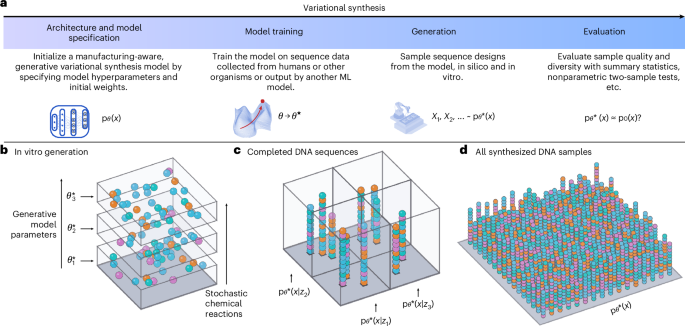
Massive lab-to-AI loops. Wondering how exactly it is done? This "manufacturing-aware" model generates novel protein designs that can also be synthesized at scale. Using this they synthesised billions of antibodies, feeding that right back to train next-gen binding models.
Elizabeth Wood 🧬🖥️🥼@lizbwood

Our paper on variational synthesis is out now in Nature Biotechnology. Manufacturing-aware generative models — AI architectures that know how to physically build their own designs — enabling synthesis of DNA encoding ~10^16 AI-designed proteins at a cost that would be roughly a quadrillion dollars using conventional methods.

English
0
2
7
1.5K
JURA Bio, Inc. retweetledi
Elizabeth Wood 🧬🖥️🥼
Grateful for the comparison, and I do suppose that if we were included in the benchmark and you squinted, it might happen to fall our way this time around, but I think this interpretation misses a big difference in goals. We design our ultra-large data sets to enable model training. This has some unintuitive consequences. For example, often the most informative data points are the ones thought to be very unlikely to bind or interact at all. When they end up working, they're maximally informative. Benchmarking models works differently: it wants to take the best guesses and confirm that they work. Very nice work from the @nvidia et al. team, and if you're interested in learning more about our (@jura_bio) AI systems that design and capture the data they want to learn from, you can read our newest technical post: jurabio.com/blog/screening… Or to learn more about the underlying technology, that allows us to scale to petascale in our DNA designs, our paper on scaling variational synthesis is out today in @NatureBiotech rdcu.be/e8zUb
Tweeting Bio@tweeting_bio

if you compare @nvidia Proteina-Complexa (1M designs, 127 targets) paper w @jura_bio Vista (209M designs, 100 targets), it looks like jura wins for capturing data (expected) but also for designing binders over targets? IIUC jura did not train on PDB.

English
1
4
26
2.8K
JURA Bio, Inc. retweetledi
Elizabeth Wood 🧬🖥️🥼
Our paper on variational synthesis is out now in Nature Biotechnology. Manufacturing-aware generative models — AI architectures that know how to physically build their own designs — enabling synthesis of DNA encoding ~10^16 AI-designed proteins at a cost that would be roughly a quadrillion dollars using conventional methods.
Elizabeth Wood 🧬🖥️🥼 tweet media
English
6
37
197
28.7K
JURA Bio, Inc. retweetledi
Elizabeth Wood 🧬🖥️🥼
We built Sovereign AI to go from generative design to real, manufacturable therapeutics as fast as the problem demands: and in this case, even faster than the target can escape. Today we're announcing a partnership with @KoaBio to do rapid, function-based discovery of biologics against emerging multi-drug-resistant bacteria in-lab and in-theater. Collaborators at WRAIR and AFRIMS surveil threats, @jura_bio rapidly generates threat-neutralizing candidates, and Koa Bio scales and deploys what works. AMR is projected to kill 10 million people a year by 2050 and the bacteria aren't slowing down. It's for problems like these -- where speed is critical and success mandatory -- that I'm proudest that JURA is able to offer a solution unlike any other.
Elizabeth Wood 🧬🖥️🥼 tweet media
English
1
3
19
1.4K
JURA Bio, Inc. retweetledi
Elizabeth Wood 🧬🖥️🥼
New causal design blogpost up at @jura_bio: In 1929, a Johns Hopkins pathologist noticed something strange in his autopsy data: patients with active tuberculosis had lower rates of cancer, and he couldn't explain why. Three decades later, researchers showed that mice infected with Bacillus Calmette-Guérin (BCG) had increased tumor resistance, and in 1976, a urologist named Alvaro Morales tried BCG on nine bladder cancer patients and saw a twelve-fold reduction in recurrence. When he sought funding, he was told his concept was "a throwback to the stone age of tumor immunology," but he persisted, and by 1990 BCG was FDA-approved. Fifty years later, it remains the gold standard for first-line intervention for bladder cancer, while its mechanism is still debated. This is an example of what you might call causal medicine: interventions validated by observing their effect on patients, with mechanism understood later, or even never. They suggest something important about how we should be building AI for drug design. Most AI in this space inherited a target-based structure oriented around predicting structure, predicting binding, and optimizing affinity. This happened because structure and binding data was clean, relatively abundant, and well-labeled, while clinical outcomes were messy, confounded, and sparse. The PDB was carefully built over decades, and the field naturally followed the data toward what was measurable. For many (but not all) targets, binding is relatively easy to satisfy since lots of sequences will bind a given target, while clinical efficacy is hard because the sequences that actually help patients are rare and we don't fully understand the constraints that make them rare. Optimizing for binding and then trying to put into place the screens that will ensure that efficacy follows is likely working the problem backwards. The human population is already running massive parallel experiments on what works. Trillions of immune receptors encounter disease every day, with patient immune systems generating candidates, testing them against emergent diseases, and selecting for effectiveness. The results are recorded in clinical systems and observable through repertoire sequencing. The challenge is confounding, but the biology of immune receptor generation provides a way out: somatic recombination is essentially randomized at the sequence level, which means we can estimate causal effects from observational data if we're careful. Instead of starting with targets and hoping to reach clinical efficacy, you start with clinical outcomes and leverage natural experiments to train models capable of causal generation, training on patient data directly and using binding, stability, and manufacturability as filters at the end rather than constraints at the beginning. I wrote up the case for causal design & generation: jurabio.com/blog/causaldes….
Elizabeth Wood 🧬🖥️🥼 tweet media
English
2
3
26
1.7K