
Kevin Steenburg retweetledi

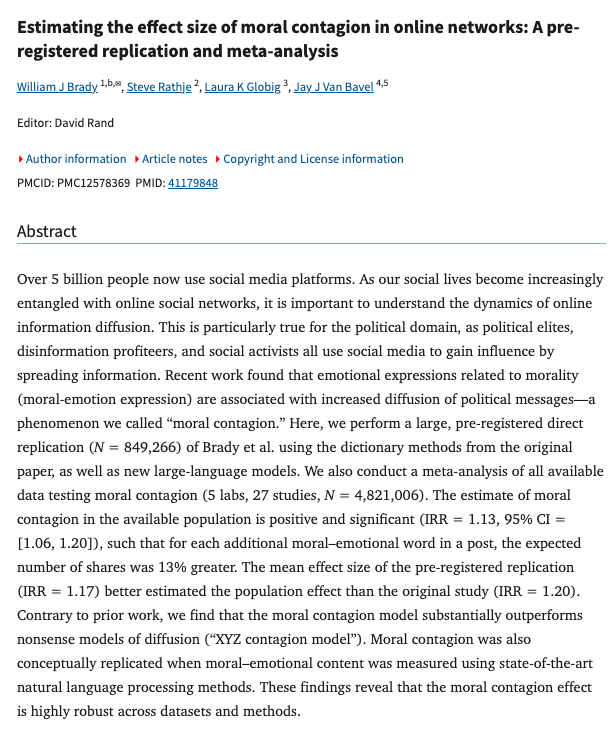
NYU just proved it with numbers that should terrify anyone who cares about human decision making.
They analyzed over half a million social media posts and discovered something that changes how you should think about every piece of content you consume:
"Outrage has been reverse engineered into a science of manipulation."
Every post containing words that trigger anger, disgust, or moral superiority gets 6 times more reach than neutral content. Stack additional outrage triggers into the same post, and virality increases by roughly 20% per word. The platforms figured out that your ancient brain chemistry responds to perceived threats and tribal signaling faster than it responds to anything else, and they built their entire engagement architecture around exploiting that reflex.
Think about what that means for information flow in society.
The posts that spread fastest are not the most accurate, insightful, or useful. They are the ones most precisely engineered to activate your fight or flight response. Your timeline is being curated by an algos that has learned to simulate the feeling of being under attack, because humans share content when they feel like their worldview or tribe is being threatened.
The mathematical precision is what makes this so sinister. Traditional media used outrage as a tool, but social platforms turned it into a formula. Every word choice, every framing device, every emotional trigger gets tested against engagement metrics in real time. The algos doesn't care what the content says. It only cares how fast it spreads, and outrage spreads fastest.
This creates a feedback loop that fundamentally warps the information ecosystem. Content creators discover that measured, nuanced takes get buried while inflammatory posts reach millions. The reward system trains everyone to become more extreme, more divisive, more outrageous over time. The platforms profit from the engagement surge. The audience gets more addicted to the emotional highs. Everyone loses except the attention merchants.
The really disturbing part is how this exploits evolutionary psychology. Your ancestors survived by quickly identifying threats to their survival or social status. The humans who ignored danger signals died. The ones who overreacted to false alarms lived. Natural selection optimized your brain to err on the side of perceiving threats, especially social threats that could result in exile from the group.
Social media platforms discovered they could trigger that same ancient alarm system with words on a screen. Your amygdala cannot tell the difference between a real threat and a carefully crafted post designed to simulate one. It responds with the same stress hormones, the same compulsion to warn others, the same addictive rush of righteous anger.
But here's what makes modern outrage engineering different from anything humans have faced before: scale and speed. In a traditional tribe, false alarms eventually got corrected through face to face interaction. Someone spreading panic about a nonexistent threat would be called out directly. The social cost of being wrong acted as a brake on runaway fear cycles.
Online, that brake disappears. A manufactured outrage can reach millions before anyone can fact check it. By the time corrections appear, the original false alarm has already shaped opinions, triggered responses, and moved on to the next controversy. The platform algos amplify the correction much less than they amplified the original outrage because corrections generate less engagement.
The NYU study reveals something that should fundamentally change how you evaluate information: the posts you see are not a random sample of human thought. They are a carefully filtered selection optimized to make you angry, disgusted, or superior. Your worldview is being shaped by content that survived an engagement filter designed to promote the most emotionally manipulative material.
That realization should change how you consume media entirely. Every viral post, trending topic, and recommended video is the product of an optimization system that profits from your emotional reaction. The more outraged you feel, the more engaged you become, the more valuable you are to advertisers.
The platforms have turned human outrage into a renewable resource. They figured out how to harvest your anger, refine it, and sell it back to you in increasingly concentrated doses. The addiction cycle never ends because there's always a new target, a new crisis, a new reason to feel threatened or superior.
Breaking free requires recognizing the manipulation for what it is: a business model that depends on keeping you in a constant state of emotional arousal. The cure involves deliberately seeking out content that doesn't trigger outrage, following sources that acknowledge complexity instead of manufacturing certainty, and remembering that the posts designed to make you angriest are probably the ones least connected to reality.
Your attention is worth more than their engagement metrics.

English