Karol Zdebel

1.3K posts

Karol Zdebel banner
Karol Zdebel

Karol Zdebel

@karolzdeb

Hyperfixator. Cofounder of Pamba. Ex-Google tech lead. 300M views on TikTok with AI influencers.

San Francisco Katılım Mayıs 2023
128 Takip Edilen198 Takipçiler
Karol Zdebel
Karol Zdebel@karolzdeb·
@Lordoftheringsu snow white didnt kill literature, it just opened a shelf next to it. i ship ai video every day and the same panic shows up, purists swearing it cheapens the craft while the old form keeps selling as its own category.
English
0
0
0
65
LOTR Universe
LOTR Universe@Lordoftheringsu·
J.R.R. Tolkien hated Disney and had rejected the studio, fearing they'd turn Middle-earth into a commercial fairy tale. The roots of this animosity took hold in 1938, when Tolkien and his close friend C.S. Lewis went to see Disney’s Snow White and the Seven Dwarfs. As a scholar of Norse and Germanic mythology, Tolkien was deeply offended by Disney’s portrayal of the dwarfs. He felt the film stripped these ancient, noble mythological figures of their dignity, reducing them to cute, vulgarized caricatures meant solely for cheap laughs. For Tolkien, fairy stories were a serious art form capable of exploring deep human truths like death, morality, and hope. This distaste was so intense that it influenced Tolkien's legal decisions. When selling the film rights to The Hobbit and The Lord of the Rings in the late 1960s, Tolkien explicitly demanded that Disney be kept entirely away from his work. In his private letters, he expressed a "heartfelt loathing" for the studio's output, actively seeking vetos against any animation style that felt even remotely "Disnified."Decades later, this multi-generational aversion manifested in a legendary Hollywood standoff.
LOTR Universe tweet media
LOTR Universe@Lordoftheringsu

Ralph Bakshi's The Lord of the Rings (1978) is not a Disney film, but it is an underrated true masterpiece. Years later, Peter Jackson took a great deal of inspiration from Ralph Bakshi's The Lord of the Rings (1978) while making The Lord of the Rings trilogy.


English
6
17
96
6.1K
Karol Zdebel
Karol Zdebel@karolzdeb·
@IamEmily2050 platforms dont bury formats that pull watch time, theyre too supply constrained to push creators to a competitor. run enough ai video and the analytics are blunt about it, the algo rewards retention no matter how the frame got made.
English
1
0
1
547
Emily
Emily@IamEmily2050·
Seedance V2.5 is just days away, and so many creators will post so many videos. These videos are the most expensive videos that can be made with any AI video model; the cost is more than a Fable 5 prompt. If the algorithm buries these videos, it will send a big message to video creators to move away from the platform.
English
28
4
167
12.3K
Karol Zdebel
Karol Zdebel@karolzdeb·
@arjunblj i watched our cost per second of ai video fall from a dollar to ten cents in a year. owning the model stack would have frozen us on the pricey version, so sovereignty and a curve this fast pull different directions for me.
English
0
0
0
74
Arjun Balaji
Arjun Balaji@arjunblj·
Any business with technology at its core should own the “means of production” as Satya suggests. To us, this sovereignty meant a self-hosted OSS approach to AI, and motivated us to build and later open-source Centaur (github.com/paradigmxyz/ce…), the agent control plane we’ve run internally at @paradigm and @tempo since January. In practice, sovereignty means our learning lands in infra we control, we have rights to our own outputs, and a credible exit path. Sovereignty does *not* have to mean self-hosting everything or only using open-weight models. We run the best frontier models through Centaur, they’re extraordinary. Your company is continuously generating knowledge through every correction, tool, workflow, and decision. If that learning accumulates inside any one vendor’s product, leaving means abandoning part of your own learning curve, like your best employee walking out with years of institutional knowledge. Enterprises focus on negotiating ZDR and no-training clauses, but these address confidentiality rather than the overlooked dimension of portability. You have to own what your org learns and be able to take it with you, since this is what compounds while models and harnesses churn underneath everyone. Cost is another increasingly underrated argument for sovereignty. The price of intelligence is falling at an OOM/yr. So who captures that deflation? Any org coupled to any single provider can only capture those savings as fast as they pass them through. If your org is model polyamorous, you can eval every release against real workloads the day it ships and adopt it wherever it wins. Frontier orgs are already operating this way: agents are shared, so a tool or workflow one employee adds ships to the entire org. The traces underneath these shared workloads are raw material for private evals and RL envs, and can eventually let you finetune models on your own history. In this timeline, the companies that win are the ones whose intelligence compounds like any other balance sheet asset. If you want to own your means of production, point your favorite agent at centaur.run
Satya Nadella@satyanadella

x.com/i/article/2076…

English
9
2
38
9K
Karol Zdebel
Karol Zdebel@karolzdeb·
@DaveShapi @AltmanProp @RobertJBye what decides whether it lands in the right folder isnt model iq, its whether the agent has the actual repo tree in context or its guessing off a filename.
English
0
0
0
14
David Shapiro (L/0)
David Shapiro (L/0)@DaveShapi·
Claude Code is unusable compared to Grok Build. I gave CC very explicit instructions about which folder and file to go into and it couldn't even get that right. When you've got the smartest (allegedly) AI on the planet that can't figure out "drill down into this directory and find X file" means, I don't care. It's a defective product. Grok Build set the expectation for instruction following for me, and admittedly I'm late to the party and Grok Build is the first terminal based agent I've used, but by comparison, Claude Code is basically VIM with extra steps, which completely defeats the point of "agentic" anything. At that point just copy-paste your code into the browser, it's easier.
English
4
0
2
152
Karol Zdebel
Karol Zdebel@karolzdeb·
@JulianGoldieSEO the part where one prompt becomes a film skips shot 4, where the face drifts and you're re-rolling every scene by hand to hold the character. that re-roll loop, not render cost, is what eats the afternoon.
English
0
0
0
42
Julian Goldie SEO
Julian Goldie SEO@JulianGoldieSEO·
Claude Agent OS is the end of manual content creation. No more wasting hours on video editing. No more juggling 10 disconnected AI tools. Here’s the Agent OS play 👇 → Connect agents into a "Memory Galaxy" to share data → Turn one prompt into a cinematic film with OpenMontage → Use NotebookLM to automate deep research and podcasts → Delegate complex workflows to a self-sorting task board → Build the entire system using your existing Claude sub Stop building tools and start building an AI workforce. The future of business is autonomous. Want the full guide? DM me.
English
4
2
7
2.3K
Karol Zdebel
Karol Zdebel@karolzdeb·
@andrewchen our cost per second of ai video went from a dollar to ten cents in one year while quality rose. so consumer cards running frontier models by 2029 reads less like a leap and more like the same slope carried forward.
English
0
0
1
90
andrew chen
andrew chen@andrewchen·
playing with local AI models and doing some research and came across a fun extrapolation: "consumer grade graphics cards will be running Fable-equivalent models by 2029" the argument: 1) been said that LLMs are really a lossy compression process for squeezing humanity's knowledge down into a chat box. Roughly you could say the entire internet/books/media/whatever is about ~200-300T tokens which gets "compressed" down to ~1T params of frontier models, so imagine a 400:1 or so compression in bytes. (We have a lot more video and world data, we'll discuss that later...) 2) People further quantize the models down (seemingly at decent quality) from 16-bit to 4-bit (NVFP4 ftw) and it seems pretty good. So that's more like 1,600:1 or so. Research suggests models only store ~2 bits of knowledge per parameter anyway — the weights were mostly air, which is why quantization works at all. 3) furthermore, we seem to be getting better at this compression, whether it's with MoE, pruning, etc. The Qwen 27B dense model now is equivalent to higher parameter models from a few years ago. 1,600:1 today and 1,600:1 in 5 years will have completely different results 4) I was looking to see if there's a Moore's Law thing happening here, and it's been measured: the "Densing Law" found capability-per-parameter doubles every ~3.3 months. Not sure how well it'll hold, but it says somethign like: "Every 3 months, the size of model needed to represent humanity's knowledge drops by half." 5) Not sure this holds though bc presumably, there's some kind of asymptote. Won't compress down to zero, the same way that modern image/video compression has theoretic limits too 5) Video is a zillion frames, almost zero semantic density. 99.99% of every frame is stuff a physics prior already predicts. World models will post compression ratios in the millions-to-one. But, nevertheless, there will be a ton of new facts seen simply by observing, that was never written down. But even without dealing with all this, today's text-oriented frontier LLMs are already pretty amazing 6) So the crazy idea here is that ultimately irreducible kernel representing humanity's knowledge might compress down to... tens of GB? May be small enough to fit onto a consumer grade GPU. Today, a consumer grade GPU for playing video games might have 32GB of memory on it, but the 27B parameter model that thing can run is getting smarter and smarter each year. Will the equivalent of Fable be able to run on a high-end consumer GPU in a few years? This sounds crazy, but GPT-4 was rumored ~1.8T params, needed a rack of A100s, cost tens of millions to train. Today's open weight models with 27B parameters can do that with better data, distillation, and architecture. That's the big question. Densing Law says "consumer GPUs might be running Fable-equivalent in 2028" and it might be possible, and even though that would be 100x? Seems nuts
English
21
12
100
12K
Harley Lewis Foote
Harley Lewis Foote@harleyfoote_·
Knowing your blast radius eliminates a lot of the risk of your data being stolen and put on the web. Attacks can control your PC. That’s why we build Hermes Shield, to make it easy to develop agentic workflow commercially. Think VPN/Anti virus but for prompt injection. That’s us…
Daniel Smidstrup@DanielSmidstrup

@harleyfoote_ prompt injection is inevitable, limiting blast radius is the real game :D

English
4
4
17
458
Baxate
Baxate@Baxate·
you don’t want it bad enough if you say or even think you want something but then as soon as excitement turns to boredom fun turns to gruel “flow state” turns to discomfort you quit. you didn’t want it badly, you just liked the idea of having it
English
8
15
202
15.2K
chewa.
chewa.@chewadot·
JESSE VINCENT JUST OPEN-SOURCED THE CLAUDE CODE SETUP HE'D BEEN USING IN HIS OWN WORK. 251,000 STARS. 22,400 FORKS. 991 PEOPLE WATCHING THE REPO 14 skills. 7 coding agents. 0 paid tier superpowers is a set of Agent Skills that teaches Claude Code to work like a senior engineer instead of an eager intern. brainstorming before it writes. writing-plans before it codes. test-driven-development with red-green-refactor before it commits systematic-debugging with 4-phase root cause instead of symptom patches. subagent-driven-development so every task starts with fresh context. using-git-worktrees so branches stay isolated. The README says it plainly: mandatory workflows, not suggestions Jesse built the Android email client that Mozilla acquired and turned into their mobile flagship. He built a support-ticketing system still running at thousands of organizations twenty years later. He managed one of the most ambitious open language projects of the 2000s he co-founded a mechanical keyboard company. Now he runs Prime Radiant, and Superpowers is the loadout he ships with. Simon Willison - one of the most respected voices in the space - called him one of the most creative users of coding agents he knows two decades of shipping infrastructure. one open-source repo. no paid tier no vendor lock. no subscription. no cloud memory. no walled garden. no upgrade wall you're reading this on a device that could clone the repo, install the plugin, and have Claude Code writing failing tests first before your next commit
kartiseira@Abobsterina

x.com/i/article/2074…

English
8
0
32
1.7K
Karol Zdebel
Karol Zdebel@karolzdeb·
@jerallaire once agents do the work of the firm, the moat shifts from headcount to how well they hold memory across a long horizon. built voice agents at google years ago and memory was already the thing that capped how far they could go.
English
1
0
1
118
Jeremy Allaire - jerallaire.arc
Today I'm sharing something I've been building toward for years: The Agentic Economy, a treatise on the convergence of intelligence and the economy. As AI agents take on the work of the firm and value moves natively on open, programmable networks, the agentic economy and the onchain economy turn out to be the same economy, seen from two sides. It's a personal work. Enter at whatever depth you like: a 60-second thesis, a short read, the full treatise, an audiobook, or visual maps. AgenticEconomyTreatise.com
English
90
126
685
49.4K
Karol Zdebel
Karol Zdebel@karolzdeb·
@ReillyBelle57 @LucasSa56947288 smooth skin is a real tell today, but it's a moving target. on our side the quality jumped so fast in a year that the exact artifact people point to is mostly gone. reading the skin to call 'ai or not' stops working within months.
English
0
0
0
8
Lucas Sanders 👊🏽🔥🇺🇸
🚨JUST IN: Sen. Mitch McConnell’s office releases a photo of him in the hospital. I’m 💯 sure it’s AI.
Lucas Sanders 👊🏽🔥🇺🇸 tweet media
English
308
130
588
38.8K
Karol Zdebel
Karol Zdebel@karolzdeb·
@TheTuringPost these get you to a working demo. the part no course covers is run 200, when a tool quietly changes its output shape and the agent builds on the wrong result. mastery starts where the syllabus ends.
English
0
0
2
20
Turing Post
Turing Post@TheTuringPost·
12 free courses to master LLMs ▪️ Cohere LLM University ▪️ Hugging Face LLM Course ▪️ Hugging Face AI Agents Course ▪️ Google / Kaggle 5-Day Gen AI Intensive ▪️ DeepLearning. AI Short Courses ▪️ Hugging Face Context Course ▪️ Google / Kaggle 5-Day AI Agents Intensive ▪️ DeepLearning. AI Retrieval Augmented Generation Course ▪️ DeepLearning. AI Building Agentic RAG with LlamaIndex ▪️ Weights & Biases AI Academy ▪️ LangChain Academy: Introduction to LangGraph and Deep Agents ▪️ DeepLearning. AI AI Agents in LangGraph + Berkeley Advanced LLM Agents, Stanford CS25 and CS224N Grab all the links here turingpost.com/p/llms-courses :)
Turing Post tweet mediaTuring Post tweet media
English
7
27
131
5.5K
Vaibhav Sisinty
Vaibhav Sisinty@VaibhavSisinty·
This was genuinely one of the craziest weeks in AI I have seen. Here is everything that happened. 🧵 → GPT 5.6 launched with three tiers. Sol, Terra, Luna. The first frontier model designed to let you route tasks by cost and capability. → Fable 5 free access extended till July 19. If you are on Pro, Max, or Team, you still have time. → If you are a Perplexity user on the annual plan, check your renewal now. Subscriptions are auto-renewing and the price has gone up to $20/month. Cancel before it hits. → Grok 4.5 dropped. xAI is now a serious frontier player. → GPT 5.6 Sol Ultra proved a 50-year-old math conjecture in under one hour using 64 subagents. On a public model. Not an internal one. → Meta launched Movie Gen 1.1 Spark. Their image and video generation models are live. → GLM 5.2 CEO published an internal memo defining AGI as "the aggregate of all human intelligence." Hardest AGI definition any CEO has publicly committed to. → Someone ran GLM 5.2 on a machine with 25GB of RAM using a tool called Colibrì. A 744 billion parameter model. At home. → Micron broke ground on a $9.3 billion expansion of its Hiroshima factory. Producing HBM chips for AI processors. Shipments start 2028. → China is weighing restrictions on foreign access to its best AI models. Ministry of Commerce met with Alibaba, ByteDance, and Z.ai. Open source could become domestic only. → DeepSeek, ByteDance, and Alibaba are in talks to start building their own chips. → Apple sued OpenAI for trade secret theft. 400+ former Apple employees now work at OpenAI. Apple is calling it a coordinated campaign. → China landed a reusable orbital rocket booster on its first attempt. Caught it in a net on a ship. Third organization in history after SpaceX and Blue Origin. → Satya Nadella published an article on the Reverse Information Paradox. The CEO selling you AI tools just warned you to protect your knowledge from them. → Claude Code shipped its own in-app browser. The agent now browses docs and sites independently. → Anthropic announced 6 months of Claude Max free for developers who contribute to open source. → AI2040 report dropped. Maps the next 14 years. Introduces the permanent underclass concept. Not about jobs. About access inequality to frontier models. → Databricks released a coding benchmark report. Open source models are closing the gap on frontier coding performance. → Opus 5 could drop as early as next week. Three frontier models competing in the same week. A fourth possibly days away. China building rockets and restricting model access. Apple suing OpenAI. Micron spending $9.3 billion on memory chips. The industry spends $600 billion annually. It generates $100 billion. Two companies are winning. The rest are spending. Does the math ever work?
English
15
4
59
8.8K
Karol Zdebel
Karol Zdebel@karolzdeb·
@gokulr the part a spec never captures is the why-not, the approaches you already tried and killed. agents keep rebuilding the thing you ruled out months ago because only the final decision lands in the file, never the dead ends that explain it.
English
0
0
0
16
Gokul Rajaram
Gokul Rajaram@gokulr·
PRODUCTSPEC MCP SERVER We just shipped the ProductSpec MCP server. This is the next step in making Product Specs useful to AI coding agents. The problem is simple: agents can write code fast, but they often don't know the product intent behind the code. They see the repo. They see the issue. They see the prompt. But they usually don't have a durable control file that says: • what problem this work is solving • what is in scope • what is explicitly out of scope • what acceptance criteria must pass • what AI evals should be run • what success looks like after launch That is what ProductSpec is meant to provide. The new MCP server lets coding agents access Product Specs directly as structured tools. An agent can now call: list_product_specs get_product_spec validate_product_spec get_scope get_acceptance_criteria get_ai_evals get_success_metrics get_related_artifacts check_completion_claim The important one is check_completion_claim. Before an agent says “done,” it can ask ProductSpec what still needs to be verified against the Product Spec. That changes the workflow. Without ProductSpec: - Founder or PM writes intent somewhere. - Engineer or agent gets a loose task. - Implementation drifts. - Everyone debates whether the thing that shipped was the thing that was requested. With ProductSpec: - Intent lives in the repo. - The agent reads the same control file as the team. - Scope and acceptance criteria become visible before coding starts. - Completion gets checked against the original product intent. You can configure it in any MCP-compatible coding environment as a stdio server. MCP config: command: npx args: ["--yes", "-p", "@productspec/parser@latest", "productspec", "mcp"] The open source repo now includes: • the ProductSpec standard • parser and validator • GitHub Action • agent skills • Decision Trace • MCP server • (Not in the repo, but there is a free privacy-friendly Git native Product Spec editor at ProductSpec dot io) My view: the next generation of software teams will need a product intent layer. Git stores implementation history. Jira and Linear store work history. Figma stores design artifacts. ProductSpec stores what the team meant to build, why it mattered, and what had to be true before the work was done. That intent now speaks MCP. Builders using coding agents: put a .product-spec.md file next to the work, then make the agent read it before writing code. The control file is where AI-native product development starts.
English
14
3
37
6.3K
Karol Zdebel
Karol Zdebel@karolzdeb·
@int_mon_econ the deliberation isnt the hard part of simulating a committee, its that every agent draws from the same base model, so the disagreement is cosmetic. real fomc splits come from different incentives and private info a shared prior doesnt have.
English
0
0
0
33
International and Monetary Economics Network
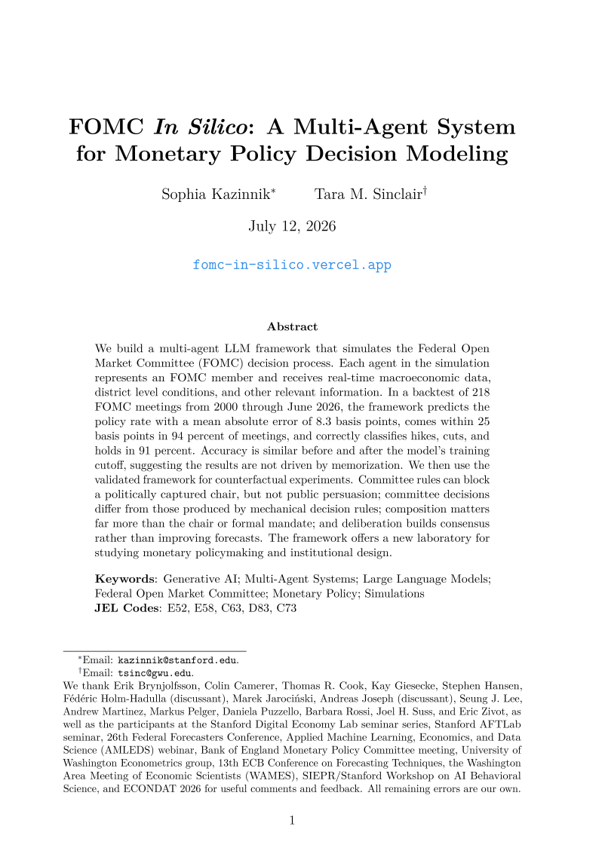
Super interesting! "FOMC In Silico: A Multi-Agent System for Monetary Policy Decision Modeling" by Sophia Kazinnik and Tara M. Sinclair. "This paper develops an LLM based multi-agent simulation of the Federal Open Market Committee that models policy deliberation, disagreement, and consensus formation using member specific priors grounded in real time data. The framework combines institutional context, historically informed personas, and structured voting rules to create a realistic environment for studying how monetary policy decisions emerge from discussion rather than from mechanical aggregation alone. By comparing the simulated committee to a fixed voting benchmark, we identify how communication, persuasion, and institutional frictions shape policy outcomes beyond what rule based decision making would imply. The framework performs well against the historical record. ...When grounded in real time data and constrained by institutional structure, LLM based committee simulations can recover historically plausible policy behavior while also providing a flexible platform for counterfactual analysis. This makes the framework useful for studying monetary policy design, central bank independence, dissent, and information flow under alternative scenarios. More broadly, it opens the door to a new kind of in silico policy laboratory in which researchers and practitioners can stress test committee behavior before reforms, shocks, or political pressures are tested in the real world." conference.nber.org/conf_papers/f2…
International and Monetary Economics Network tweet media
English
2
4
51
2.4K
Linghua Jin 🥥 🌴
Linghua Jin 🥥 🌴@LinghuaJ·
Amazing capture on the gist of @cocoindex_io 🔥🔥! When agent goes autonomous, they are part of the data loop. Agents make changes to the data and need instant view from the large scale of the dynamic, unstructured for responsible decisions. Right now it is codebase, meeting notes, and many more, down the road it can be real world observation and continuously capturing the changes from the embodied systems. It should all be incremental. At the moment, CocoIndex continuously builds fresh views from dynamic any unstructured data source, and when agent query the view - like human refreshes browser - they always get fresh data. The next should be establish handshake and protocol so we could auto notify agent in a long running process proactively. And agents could also subscribe to topics that needs more attention like a subview of the live data source. Why does this suddenly matters? coming from the react world - when the web just started it was all server side render only, users wait for page load after taking an action. But when they need to take more instant decisions no one wants to wait for the page to reload - there maybe parts of the page that needs to be updated for users to proceed further, and incremental DOM techniques was really needed. The more states it gets more complicated and a clean state driven model was needed - that’s react got really popular. It is winning because it provides an easy way for users to declare the view from the model, and the framework handles the incremental updates. This is how we view the direction of autonomous agent, there are massive dynamic data that is in collaboration of changing with agents, and managing states in robust way that surface the right context attention to the agents becomes important. Super excited for what's next !
Eiso Kant@eisokant

Usually pretty skeptical of Yet Another Agent Context library but the idea of "React - for data engineering." is really smart. Instead of the agent pulling the data, the idea of the "delta of the data" pushing to the agents is very cool! Caveat: I haven't installed it yet, will be doing so shortly.

English
4
8
64
28.8K
Karol Zdebel
Karol Zdebel@karolzdeb·
@cyber_amb a stress test you designed yourself is the eval a model is most likely to ace, it already fits the shape of your prompts. i only believe the depth once it holds on a repo i didnt hand pick, so grade it on your own eval, not a demo pass.
English
0
0
0
11
Cyber Amb
Cyber Amb@cyber_amb·
OpenAI went completely overboard this time. I just tested the new GPT Sol 5.6 and 5.6 Pro on my go-to stress tests (refactoring a 200k+ line codebase, deep system analysis, and full stack migrations), and the depth is insane Where GPT 5.5 used to throw out surface-level summaries, 5.6 Pro spent 84 minutes analyzing a complex project and spat out full dependency maps, module boundaries, and a multi-stage migration plan. The execution is flawless Paired with the Codex app, the Ultra/Max models are an absolute cheat code. Context compression is heavily upgraded too - you can run massive threads and it still remembers architectural constraints from prompt #1 They also launched ChatGPT Work, lowering the barrier for non-devs to use agents for reports, slides, and everyday workflows, pushing closer to a true super app It burns through limits fast, but solving a massive task in one shot beats babysitting 10 prompts. Go test it immediately
Cyber Amb tweet media
English
8
0
17
2.4K
Karol Zdebel
Karol Zdebel@karolzdeb·
@lexaneesburg we pull the format from the top videos then run it 100x and a/b test the variants, because a breakdown only tells you what worked once. spotting it and reproducing it are different muscles, and the views live in the second one.
English
0
0
0
11
LEXA
LEXA@lexaneesburg·
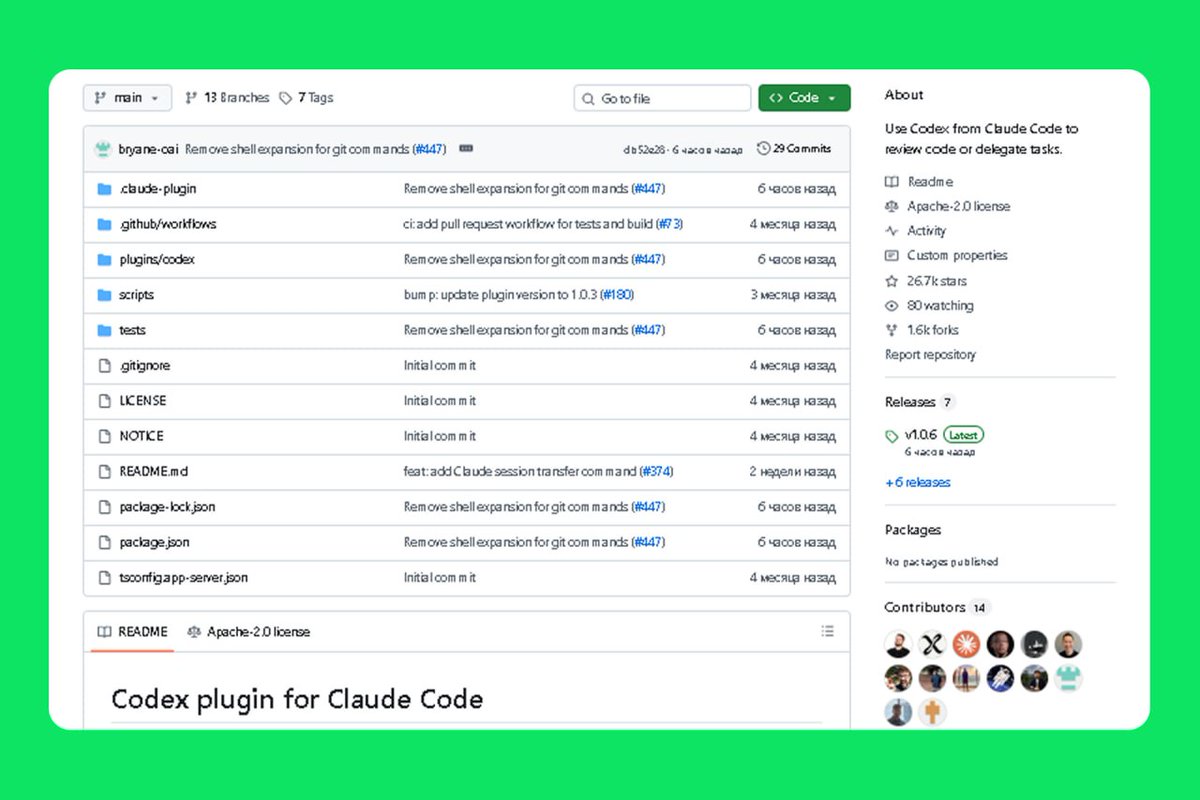
Teaching an agent to watch videos Here is a link to a skill that allows AI to watch any video github.com/bradautomates/… It works with Claude Code, Cursor, Codex, and other agents. Essentially, anyone now has the opportunity to analyze a niche, pick the most popular videos, break them down to atoms, and create their own - just as easily and in unlimited quantities. An excellent window of opportunity for those who quickly grasp this now and set up the system.
LEXA tweet media
English
23
1
31
2.3K
Karol Zdebel
Karol Zdebel@karolzdeb·
@XFreeze the benchmark crowd and the crowd that actually adopts this never sit in the same room. one grades the mission, the other just checks if its cheaper and better than last year. only the second room keeps the score that lasts.
English
0
0
2
22
X Freeze
X Freeze@XFreeze·
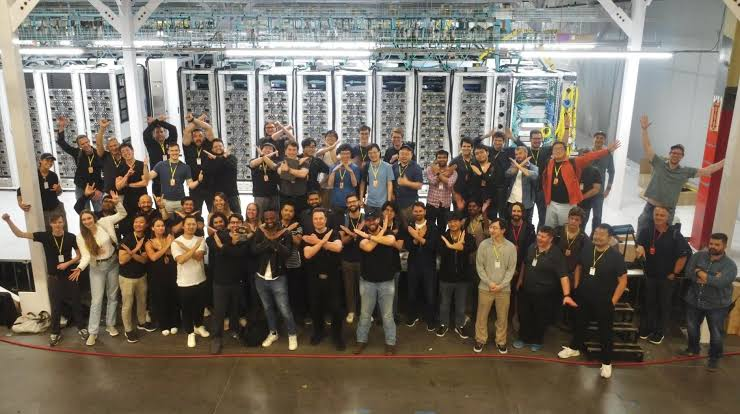
Three years ago, on July 12, 2023, Elon Musk officially announced xAI with the most ambitious mission ever: “Understand the true nature of the universe” What followed was an absolutely insane journey In just three years, Elon Musk and the xAI (now SpaceXAI) team built one of the most important frontier AI companies on Earth and achieved milestones that shocked the entire industry Here are some of the biggest achievements: • March 9, 2023 — xAI was officially incorporated by Elon Musk • July 12, 2023 — Elon publicly announced xAI and revealed its founding team • November 2023 — Grok-1 was released, a 314B-parameter model trained from scratch • 2024 — xAI built Colossus, the world’s largest AI supercomputer at the time The team achieved the insane feat of going from the first GPU rack arriving on the floor to training beginning in just 19 days NVIDIA CEO Jensen Huang called the achievement “superhuman” and said there was only one person in the world who could have pulled it off: ELON MUSK Read that again: ONLY ELON MUSK COULD HAVE DONE IT • 2025 — Grok 3 launched as Colossus continued scaling at an unprecedented speed • Grok 4 then launched and completely raised the standard for frontier intelligence • xAI went on to build Colossus 2 — the world’s first gigawatt-scale AI training cluster and one of the largest and most powerful AI infrastructure projects ever brought online • July 2026 — Grok 4.5 launched, pushing SpaceXAI into the top tier of coding, agents, reasoning and frontier intelligence And now xAI has become part of SpaceX - combining advanced AI, rockets, satellites, global communications and space infrastructure under Elon Musk’s vision All of this happened in just three years From a new AI company to Grok, Colossus, frontier models, coding agents, voice, image generation, video and some of the most powerful AI infrastructure ever built Happy 3rd birthday, SpaceXAI (xAI) This is just only the beginning The future is going to be absolutely wild
X Freeze tweet mediaX Freeze tweet mediaX Freeze tweet mediaX Freeze tweet media
English
67
121
608
17K
Karol Zdebel
Karol Zdebel@karolzdeb·
@sammychrise @sama the validation layer and the scroll are two different judges. it can pass every continuity check and still lose the viewer in the first second. contradiction free and watchable get scored in different rooms.
English
1
0
1
71
Samuel C. Okanume
Samuel C. Okanume@sammychrise·
I've been using GPT-5.6 to help build an AI directing system. This 12-second clip is one of the results. The system uses specialized directors for story, staging, continuity, choreography, and visual consistency, coordinated by a validation layer that checks for contradictions before the final video prompt is generated. Still a work in progress, but it's one of the coolest things I've built with GPT-5.6.
English
5
3
15
2K
Sam Altman
Sam Altman@sama·
i'd love to see interesting things people have built with 5.6 sol. i will send the person who made the coolest thing a special gift from the openai archives.
English
2.8K
503
15K
2.7M