Dr. Kate Shuster retweetledi
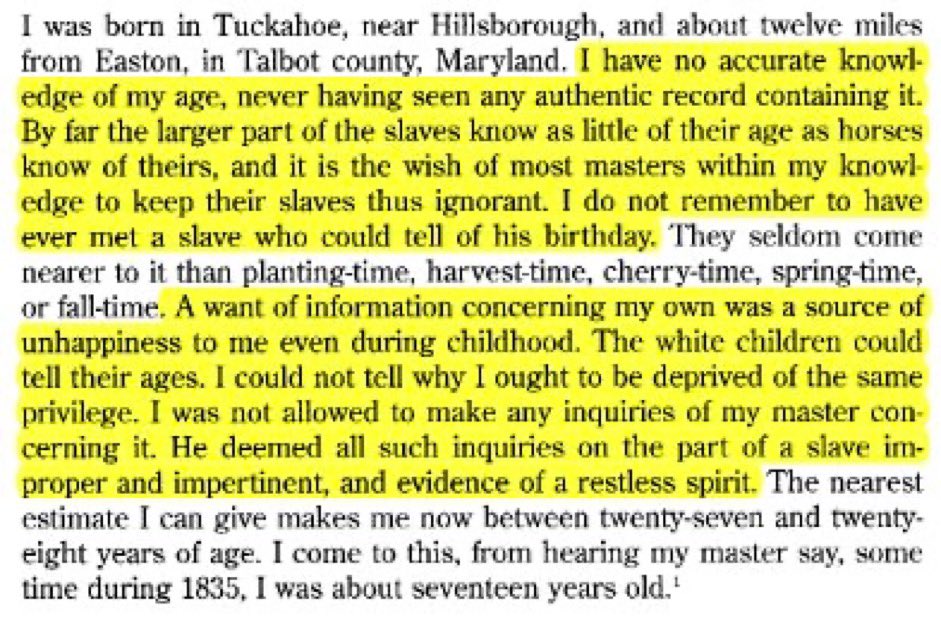
Happy Birthday Frederick Douglass. From Narrative of the Life of Frederick Douglass, An American Slave (1845) #FrederickDouglass
English
Dr. Kate Shuster
3.4K posts

@kateshuster
Education. History. Research. I make things for teachers and help museums and archives: https://t.co/cexULcXlan. "Green chile" is the right answer.

Nikki Haley today: “Of course the Civil War was about slavery. We know that. That’s the easy part of it. What I was saying was what does it mean to us today? What it means to us today is about freedom. That’s what that was all about.”
Participating in policy debate programs in middle & high school is associated with improvements in academic achievement, graduation rates, and college enrollment, according to new research in @EEPAjournal by @BethSchueler & @KateLarned. aera.net/Newsroom/Study…
Take a few minutes to read this glorious account of a life fully lived. Then maybe your household, like ours, will begin to commemorate Si Moore Day every October 19th.


If there’s one thing I know, it’s that the kids on the TikTok like to hear about the history of failed presidential candidates ! Like General John “Blackjack” Pershing!
The Montgomery Brawl has gotten plenty of coverage. But editor @lyman_brian thinks one thing has been overlooked: how Montgomery's Black community has fought oppression for centuries, and rewritten history. alabamareflector.com/2023/08/14/bey… #alpolitics
Slavery at the Core of the 1680 Revolution It was the most successful Indigenous uprising and one that would ensure survival of Pueblo people. It would also re-script Pueblo-Spanish relations in what is known today as New Mexico. In spite of it being obscured over the years, recent scholarship about the Indigenous uprising that took place in August 1680 has revealed that slavery was one of the primary causes of the revolt, exacerbated by religious animosities, famine & illness, all well documented in the archival record. As Historian Andrés Reséndez argues, "In the course of the 17th c., the silver economy expanded, and it was New Mexico's misfortune to function as a reservoir of coerced labor and a source of cheap products for the silver mines. It did not take the bad behavior of too many Spanish governors, friars, & colonists--compelling Indians to carry salt, robbing their pelts, locking them up in textile sweatshops, & organizing raiding parties to procure Apache slaves-- to bring about widespread animosity, resentment, & ultimately rebellion." Reséndez makes this case based on 3 types of evidence, summarized below: I. Testimonies. In 1681 nine Pueblo men were captured and brought before the governor to ascertain the cause of the revolt. Their depositions were recorded beginning in 1681 and 1682. Eighty-year old Pedro Naranjo of San Felipe declared that in the wake of the revolt, the Indians had finally remained "free from the work demanded by the friars and the other Spaniards which they could no longer bear, and that this was the real reason and legitimate cause that they had to rise up." A 20 year old ladino (Hispanicized) Indian named Joseph also noted, "the causes generally given were the ill treatment and abuses that the Indians received... from Alonso Garcia... Luis de Quintana, & Diego Lopez because they had hit them and taken away what they had and made them working without paying them anything." II. Timing. Reséndez makes the point that the revolt was "long in the making" and that the 30 year period of unrest corresponds with commercial ties between NM and the silver mines of northern Mexico. New Mexican officials responded to these opportunities by seizing Indian products, pressing Natives into work in textile sweatshops & raiding rancherias to procure slaves. While a few sources mention famines and epidemics, particularly in the 1660s, no testimony provided claims famine or pestilence as a cause of the revolt. III. Ethnic/Geographic Scope. While the events are almost always only associated with Puebloan people, the "Great Northern Rebellion" as some scholars have referred to it, was well beyond the geography of NM and included Apaches, Mansos, Conchos, Sumas, Pimas, Janos, Salineros, Tobosos & many other groups. Two primary corridors were included, involving regions of Indigenous inhabitants that had all been subjected to "gravitational pull of the silver economy" and into the "slaving corridors leading to Parral." In the end, these rebellions redefined labor relations in northern Mexico. Indigenous people in New Mexico, Chihuahua, Durango, Sonara & Coahuila according to Reséndez, "challenged slavery and forced important changes in the ways the traffic in humans was conducted in the following century." The NBU Team is working diligently to reveal just how impactful Indigenous slavery was, document by document, story by story.
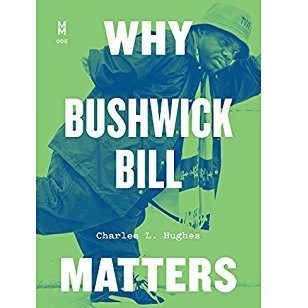
We're thrilled to celebrate the 10th anniversary of Southeastern with a newly remastered version of Isbell's now classic album. Pre-order the standard and/or deluxe edition today on CD or LP. Available everywhere September 29th. Photo by @Danny_Clinch orcd.co/southeastern-1…
There's been much gaslighting & moderate justifying of the new Florida social studies standards, people stating the "clarifications" were designed to show Black resilience, or were just "facts." So, I thought I'd compare the African-American history standards to the Holocaust's.
Be sure to register for our FREE Webinar, in collaboration with #HardHistoryProject, on Using Last Seen Ads in the ELEMENTARY classroom! TOMORROW at 7 PM! us02web.zoom.us/meeting/regist…