
Kathy

332 posts

Kathy banner
Kathy

Kathy

@katxtong

applied research & consulting @delphidigital

Katılım Ekim 2015
483 Takip Edilen378 Takipçiler
Kathy retweetledi
Delphi Digital
Delphi Digital@Delphi_Digital·
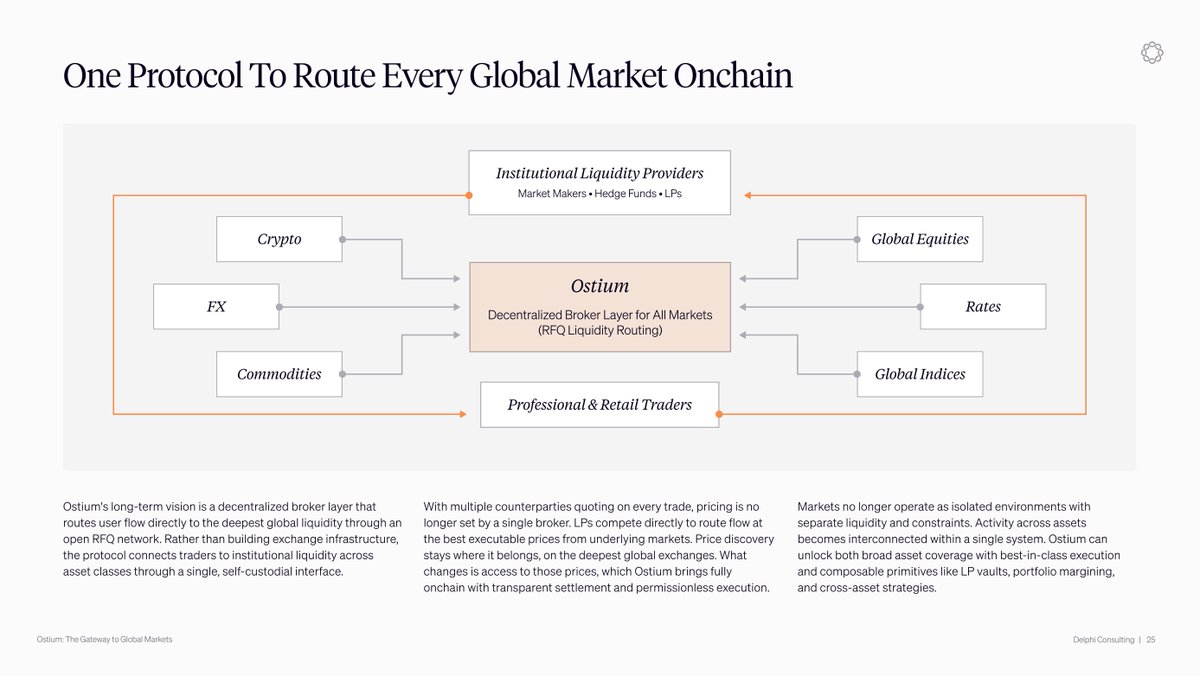
Ostium connects trades into the deepest underlying offchain liquidity and brings the institutional brokerage experience onchain. Rather than rebuilding order books, @ostium connects directly to real market depth and focuses on execution. They aren’t competing on the exchange model for global assets that already do trillions in volume offchain. Traders get access to global markets without having to choose between self-custody and execution quality. Trades are quoted from the real underlying markets and hedged through institutional liquidity partners while settlement remains fully onchain. The result is better pricing, tighter spreads, and execution that scales with size. Over 30 days, Ostium processed $4.8B in notional volume across 166K orders. $10M+ gold trades cleared at 0.65 bps, while seven-figure FX and index trades cleared below 1 bp of price impact. The deepest markets already exist offchain. Ostium makes them accessible onchain. Our new report "Ostium: The Gateway to Global Markets​" breaks down the unique model, how it works, and why it matters for finally bringing global markets onchain.
Delphi Digital tweet media
English
16
26
100
33.4K
Kathy
Kathy@katxtong·
And also for $DIEM valued as a perpetuity $365/r=$667 is at a 56% discount rate pricing in high risk for Venice's perpetuity compute power. If we take survival risk then $365*s/(1+r-s) at 20% r is pricing in a 78% survival probability
English
0
0
0
58
Kathy
Kathy@katxtong·
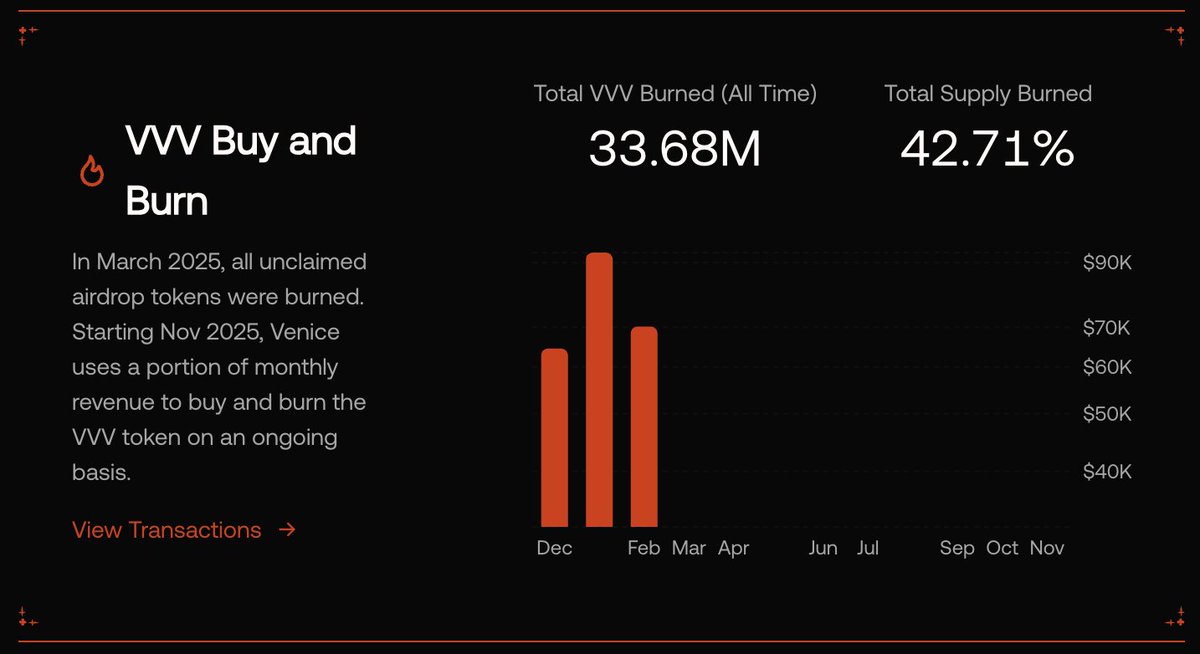
What I think $VVV does very well is the deflationary loop: ongoing buyback and burns for VVV tokens, burning $DIEM to reclaim sVVV and annual VVV emission cut from 10% to 6% in the roadmap creating scarcity flywheel
Kathy tweet media
English
1
0
1
201
Kathy retweetledi
Delphi Digital
Delphi Digital@Delphi_Digital·
What happens when holders sell? Every token team asks this question. Few actually model it. Introducing Sell Pressure, a free simulator for token unlock dynamics. 🧵
Delphi Digital tweet media
English
36
36
233
74.7K
Kathy retweetledi
The Rollup
The Rollup@therollupco·
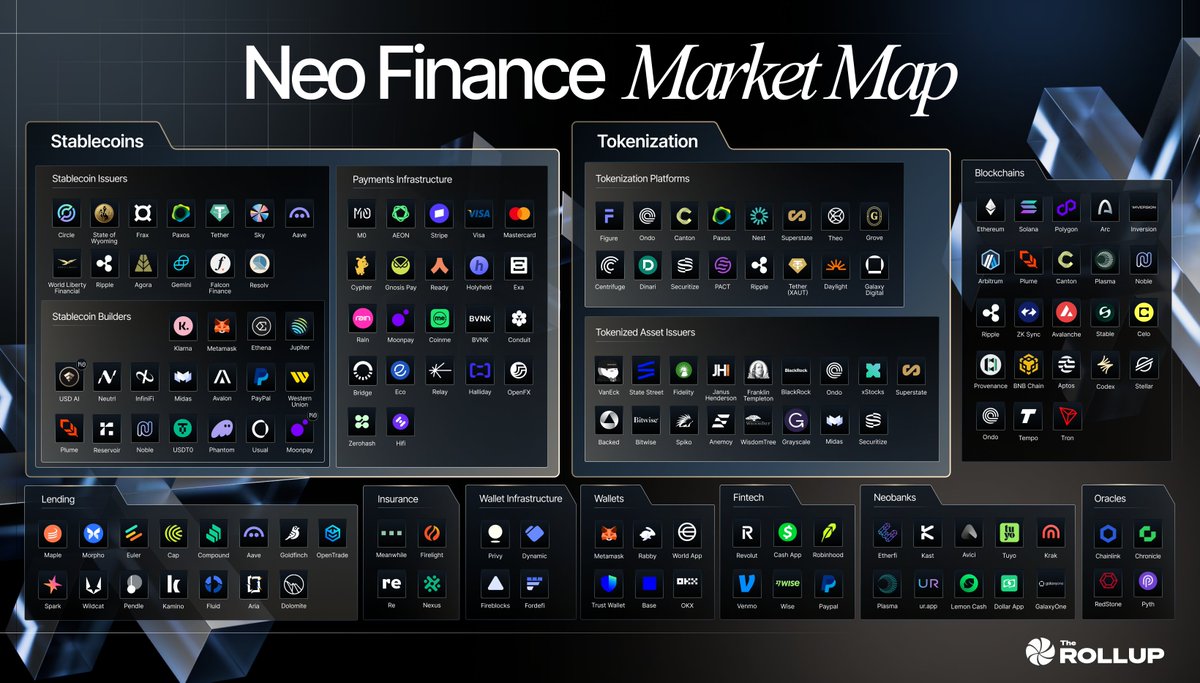
The Neo Finance Market Map: An ecosystem map of the 100+ projects building the new financial system.
The Rollup tweet media
English
226
152
989
649.3K
Kathy retweetledi
Delphi Digital
Delphi Digital@Delphi_Digital·
Our 2026 Infra Year Ahead Report is out now! Stablecoins have become the most important infrastructure story in crypto. Every fintech wave promised to fix payments but just layered better UX on the same infrastructure. Revolut and Nubank delivered better experiences while transactions still flowed through the same four party model: merchant, acquirer, card network, and issuer. Stablecoins are the first primitive that compresses the stack. Settlement happens onchain and bypasses these intermediaries. Adoption reflects this. Total supply has grown 33% this year to over $304 billion, monthly adjusted volume now eclipses Visa and PayPal, and stablecoins have become the 19th largest holder of US Treasuries at $133 billion. The irony is that crypto companies are now competing with each other on traditional payment rails. A stablecoin funded card that routes through Visa is a meaningful first step but not a new paradigm. Many competitors will fall to the side if they can't provide a self sovereign way to hold and spend on everyday things. The incumbents have noticed. Stripe integrated USDB after acquiring Bridge. PayPal has PYUSD. Klarna just announced KlarnaUSD. When fintech companies start issuing stablecoins, the land grab is well underway. Stripe's move to aggregate the full stack from issuance to its own blockchain to merchant infrastructure suggests consolidation is approaching faster than most expect. The winners will be the ones who actually replace the rails, not just build a better interface on top of them.
Delphi Digital tweet media
English
41
27
116
29.2K
Kathy retweetledi
Delphi Digital
Delphi Digital@Delphi_Digital·
Our 2026 Year Ahead for Apps Report is out now! Crypto is converging into SuperApps. For years, the fat protocol thesis argued that infrastructure would capture value while the apps were an afterthought. Now the landscape has shifted as protocols commoditize and value flows to whoever owns the user relationship. Major platforms are all racing toward the same destination. The aggregation layer. Amazon doesn't manufacture most of what it sells and fintechs like Nubank bundle services to outcompete legacy banks. Users pay a steep convenience premium for ease of access. Crypto wallets rake in millions of dollars in swap fees because people will pay for convenience. A crypto superapp is an aggregation layer that curates and integrates the best protocols available in open markets. The job is to compress a user's onchain and financial life onto one surface. Coinbase has been slowly building towards such a superapp by gradually introducing new product lines such as stablecoins, derivatives, debit cards. Within the span of the last 5 years they've successfully shifted from 96% of revenue generation coming from transaction fees to about 60% in 2025. Their recent acquisitions - Deribit and Echo have helped extend their product suite to derivatives and capital formation. Coming this week, Coinbase introduces tokenized stocks and prediction markets on their path towards building THE crypto superapp. They're also able to utilize the growth of the Base ecosystem as a experimentation ground for new onchain primitves like: The Base App and x402 Our full report breaks down the five paths to the superapp endgame: social, exchange, perp DEX, wallet, and DeFi aggregators.
Delphi Digital tweet media
English
26
32
122
35.6K
Kathy
Kathy@katxtong·
Most traders lose because they focus on noise. Here are 5 timeless lessons every new trader should know:
Kathy tweet media
English
0
0
0
78
Kathy retweetledi
flip
flip@trevor_flipper·
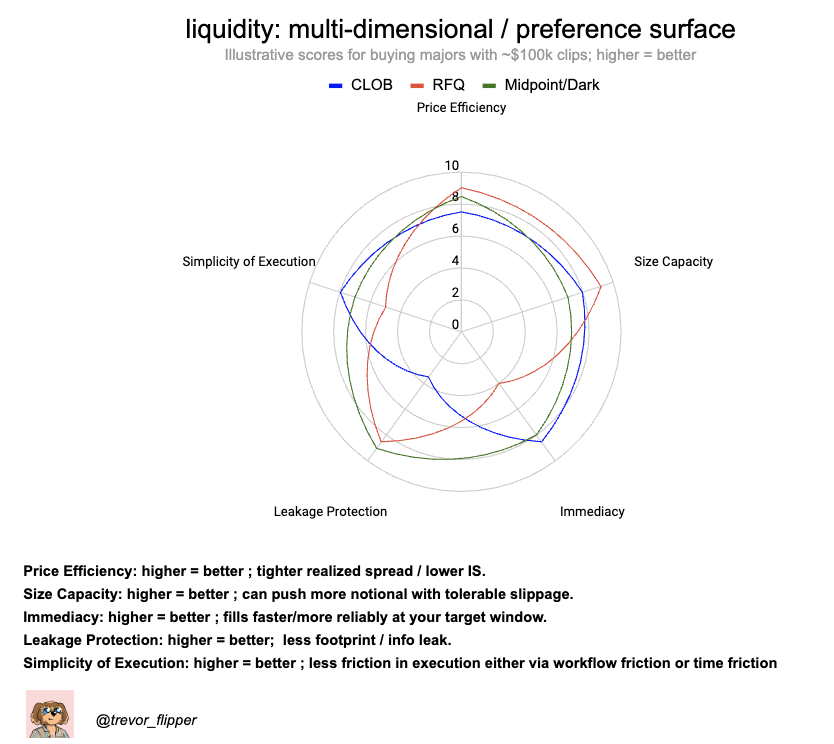
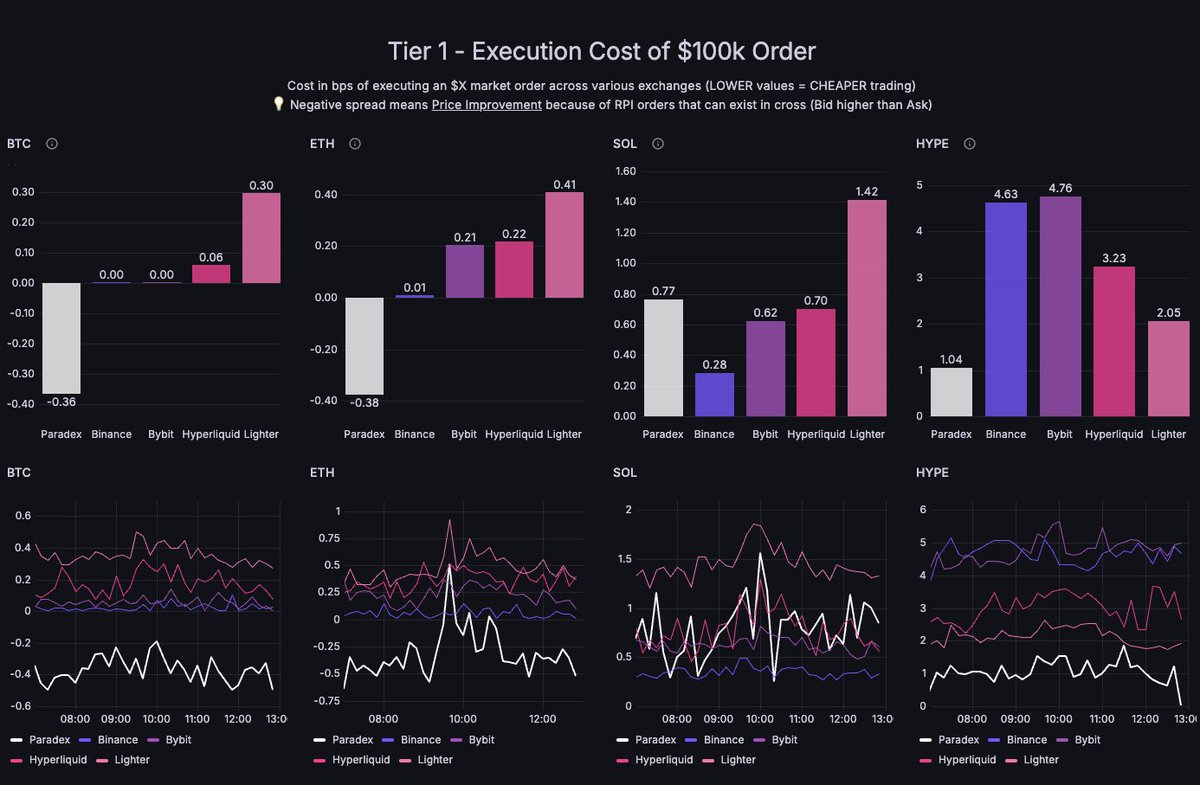
anand is probably one of the sharpest, most specialized and qualified founders in this vertical while it was a great call - i want to add a few things that differentiate paradex for me and pique my interest tldr 1) flow segmentation via RPI -> better execution with size. by routing benign taker flow to makers who pre-commit to quote quality, Paradex improves realized spreads vs cancel-priority books. users have better liquidity/fills on paradex than binance with modest size ($100k) 2) liquidity isn’t a number. it’s a surface ---------- 1) flow segmentation via rpi cancel-priority is crude. it assumes all taker flow is toxic and gives makers a free last look. books look deep, but fills feel bad - retail down instantly, big traders slip and go back to bybit rpi flips it. benign (ui/retail) flow is routed into a “slow lane” where makers pre-commit to quote quality. toxic/api flow stays in the fast lane. -> makers quote tighter, takers see better realized spreads. ^ this is a fundamentally differentiated approach to solving toxic flow that no one else is doing which excites me about @paradex 2) liquidity isn’t a number, it’s a surface people love to post “volume + depth” screenshots but this is assuming liquidity is one-dimensional which it is not real liq is multi-dimensional: a) price efficiency (tightness of the bid-ask spread, relative to fair value) b) size capacity (maximum executable notional without slippage beyond a negligible threshold) c) immediacy (probability of full fill within time t, for size s) d) risk of information leakage (expected slippage from information decay or alpha leakage) e) simplicity/complexity of execution (available complexity of execution, e.g., rfq, twap, spreads, options) using this system it is clear that no single protocol (CLOB, RFQ, Dark Pool etc.) can max out all dimensions. hence this gives a trader the correct intuition that with each platform their are tradeoffs. i.e. each protocol tends to maximize on a few of the selected dimensions. but these tradeoffs are meaningful and i am not sure institutions are okay with these tradeoffs paradex understands this intuitively and hence is building multiple execution protocols that traders can choose based on their choices/needs (clob/ rfq / midpoint dark orders). rpi orders turbo charge CLOB execution without adding in additional steps for the user. it is still price + size + click most dexes optimize a single lane or for one dimension. paradex is designing for a full surface -> flow segmentation + protocol-level privacy + multi-venue execution. ^ these are the types of differentiated approaches (+ qualified team) which pique my interest
flip tweet mediaflip tweet media
MR SHIFT 🦁@KevinWSHPod

DROPS E14: : @paradex : the Crypto Super App @fiddybps1 is the co-founder and CEO of Paradigm, the largest institutional crypto options network processing $1.5 billion daily and controlling 35% of Bitcoin options trading After surviving the FTX collapse that wiped out his personal wealth and 70% of his clients, he's now building Paradox - a decentralized exchange that he claims offers better liquidity than Binance From innovating with perpetual options that eliminate liquidation risk to surviving multiple financial crises, Anand explains why decentralized finance represents true freedom and how crypto culture is going mainstream. Timestamps 0:00 - Introduction 1:24 - Welcome to DROPS 2:00 - What Anand Does 7:40 - FTX Happened 10:04 - Double Whammy 13:40 - What Helped Him Survive 16:45 - No Thinking, Take The Leap 18:33 - Are Investors Happy Today 19:20 - Explain Paradigm 20:23 - Why Do People Trade Options 21:19 - Key Numbers For Paradigm 21:59 - Ambitions, Moving Forward 24:30 - What Is Paradex (Explained Simply) 25:37 - Why Trust Paradex 27:01 - Why Paradex Is 10x Better 31:48 - Perpetual Options vs Contract 37:26 - Ease of Use vs Cost 39:05 - Difficulty With Replicating 42:20 - Paradigm Is Like Videogames 46:06 - Paradigm Weakness 48:25 - Wide Variety of Careers 52:28 - Compare Crypto to a City

English
5
3
27
4.8K
Kathy retweetledi
Alex Prompter
Alex Prompter@alex_prompter·
This is going to revolutionize education 📚 Google just launched "Learn Your Way" that basically takes whatever boring chapter you're supposed to read and rebuilds it around stuff you actually give a damn about. Like if you're into basketball and have to learn Newton's laws, suddenly all the examples are about dribbling and shooting. Art kid studying economics? Now it's all gallery auctions and art markets. Here's what got me though. They didn't just find-and-replace examples like most "personalized" learning crap does. The AI actually generates different ways to consume the same information: - Mind maps if you think visually - Audio lessons with these weird simulated teacher conversations - Timelines you can click around - Quizzes that change based on what you're screwing up They tested this on 60 high schoolers. Random assignment, proper study design. Kids using their system absolutely destroyed the regular textbook group on both immediate testing and when they came back three days later. Every single one said it made them more confident. The part that surprised me? They actually solved the accuracy problem. Most ed-tech either dumbs everything down to nothing or gets basic facts wrong. These guys had real pedagogical experts evaluate every piece on like eight different measures. Look, textbooks have sucked for centuries not because publishers are idiots, but because making personalized versions was basically impossible at scale. That just changed. This isn't some K-12 thing either. Corporate training could work this way. Technical documentation. Professional development. Imagine if every boring compliance course used examples from your actual job instead of generic office scenarios. We might have just watched the industrial education model crack for the first time. About damn time.
Alex Prompter tweet media
English
185
1.5K
8.9K
902.5K
Kathy retweetledi
Tommy
Tommy@Shaughnessy119·
Those who build AI today control the future.  The dAGI Summit (part of Open Source AI Week by Linux Foundation) is for founders, researchers and builders driving the open-source and distributed AI that gives power back to people.  We are bringing together senior researchers and leaders from OpenAI, DeepMind, Amazon, Meta and NVIDIA, alongside the founders and maintainers of top open-source AI projects like Letta, Cline and PyTorch. They will be joined by leading research labs in open and distributed AI, such as Prime Intellect, Pluralis and Nous Research. The goal is to focus on making AI universally accessible, provably fair, impartial and beneficial for all.  📅 October 24 • 📍 San Francisco • Open Source AI Week

🎟Use promo code for exclusive (limited!) discount: MLST_15 Get your ticket at luma.com/dagisummitsf
Tommy tweet media
English
39
39
149
59.5K