Ken DiCross

1K posts

Ken DiCross banner
Ken DiCross

Ken DiCross

@KenDicross

Founder & CEO @WireNetwork. Blockchain’s Universal Transaction Layer.

Los Angeles, CA Katılım Şubat 2009
795 Takip Edilen1.8K Takipçiler
Ken DiCross retweetledi
Wire Network
Wire Network@WireNetwork·
@debificom Three failures, three attack surfaces, one week. Bridge multisig, oracle feed, web interface. Each protocol has a different single-trust-source bolted on, and one is enough to drain it. We're working on designs where the trust surface is smaller and shared, not stacked.
English
0
1
2
61
Ken DiCross retweetledi
Wire Network
Wire Network@WireNetwork·
@Fairu_90 @PushChain Right diagnosis. Liquidity is split because every chain has to import balances via a bridge. UX depends on bridges because there's no shared settlement underneath. Solve settlement at the layer below the chains and both problems collapse. That's what we're building.
English
0
2
2
41
Ken DiCross retweetledi
Wire Network
Wire Network@WireNetwork·
Where chain abstraction lives matters. Hiding bridges behind nicer UX still ships the bridge risk. Doing it at the settlement layer, where a contract on one chain can call one on another natively, is the version that actually retires the wrapped-token era.
Right Hand Man@right_hand_mano

We normalized fragmented liquidity for years. We forced users through risky bridges, wrapped tokens, and terrible UX just to interact. That era is dead. Chain abstraction is the new baseline for survival.

English
1
3
10
376
Ken DiCross retweetledi
Wire Network
Wire Network@WireNetwork·
On Wire, assets stay on their native chain. The Universal Transaction Layer coordinates cross-chain calls, but the asset itself never gets wrapped or bridged. Settlement happens where the asset actually lives. That's the design.
Wire Network tweet media
English
0
5
7
116
Ken DiCross retweetledi
Wire Network
Wire Network@WireNetwork·
The bigger threat surface most protocols miss: the oracle sits behind the same single verification path as the bridge. One compromise, two failure modes, looks like two incidents. Dual-consensus settlement collapses that path. That's the work worth doing.
JohnnyTime 🤓🔥@RealJohnnyTime

If your protocol uses an oracle, your threat model includes more than “wrong price.” It includes: - data source compromise - market manipulation - update latency - governance or config drift Treat oracle risk as a system, not a line item.

English
0
2
6
154
Ken DiCross retweetledi
Wire Network
Wire Network@WireNetwork·
DeFi is due for stronger architecture. When assets stay on their native chain and ownership transacts under dual-consensus, whole categories of losses stop being architecturally possible. Builders are doing this work.
fity.eth@Fityeth

Hacks and exploits are still happening. Even in 2025–2026, DeFi keeps getting hit: • smart contract bugs • oracle manipulation • flash loan attacks Billions have been lost recently. Security still isn’t solved. Take your money out of DeFi. Stay safe.

English
0
2
7
521
Ken DiCross
Ken DiCross@KenDicross·
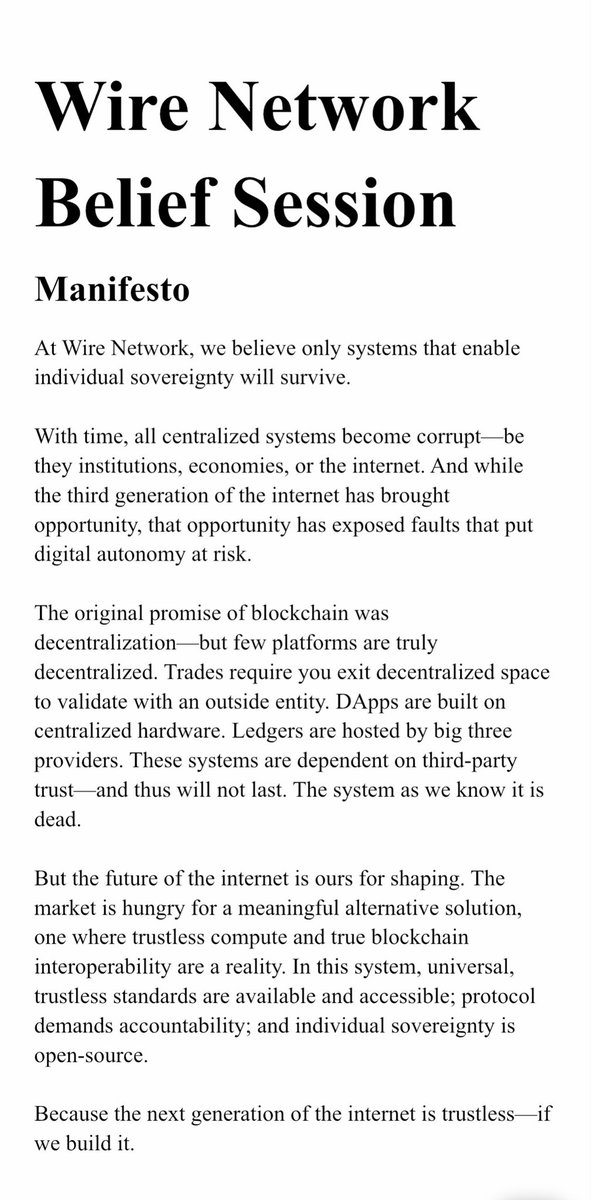
The reason these hacks are happening is because barely anyone shares Wire’s values. This document is from March 2024. Wire has been building the Universal Transaction Layer since 2020 which is a trustless, bridgeless, universal interoperability technology. Once companies start building with these values, like we have, the hacks plummet. Until then, what we see now will continue.
Ken DiCross tweet media
English
1
2
5
321
Ken DiCross
Ken DiCross@KenDicross·
Better (innovation) is extremely difficult. We had space rockets since the 60s. Elon wanted a reusable one. That took 13 years. Wire Network has spent 6 years creating a tech stack that will significantly improve security and usability in our industry. True innovation takes time. Btw, we are just putting on the final coat of paint on the Universal Transaction Layer but we ship it later this summer. But it’s much more than a transaction layer. It’s security and determinism.
English
0
0
0
36
DBCrypto
DBCrypto@DBCrypt0·
Hyperbridge lost over $2.5M Rhea Finance got hit for $7.6M $9.5M stolen via a fake Ledger Live app CoWSwap over $1M gone That's just THIS WEEK And we're only counting the 7 figure hacks How much has to burn before we demand better?
DBCrypto@DBCrypt0

$25 billion That's how much has been stolen from crypto since 2011 Not lost Not misplaced Stolen Bridges alone account for over $2.8 billion of that In 2022, bridge exploits were responsible for 69% of ALL crypto theft too And it's getting worse 2025 set a new record at $3.4 billion stolen and North Korea's Lazarus Group took $2 billion of it But there is so much more here that no one wants to talk about… The people finding these vulnerabilities? The white hats who could save us billions? We pay them almost nothing! The average critical bug bounty in crypto is $13,000 Bybit's max bounty before their hack was $4,000-$10,000. They lost $1.4 billion. Then offered $140 million to get it back. That's 35,000x what they were willing to pay to prevent it! 🤯 Polygon paid $3.46 million for a bug that threatened $24 billion. That's like paying someone $14 to save your house. The industry loses anywhere from $30-190 for every $1 it pays in bounties Immunefi's entire lifetime payouts are ~$116 million which is less than 10% of a single Bybit hack The math is broken and until we fix it, we're gambling that good people find the bugs before bad people do But the bigger issue? Zero accountability. Builders deploy bridges controlling hundreds of millions in user funds with no liability, no mandatory audits, no insurance requirements When it breaks, users eat the loss Every single time We don't need 40 insecure bridges built by small teams with no oversight We need 2-3 hardened, open-source, industry-funded bridges where the brightest minds across every chain have their hands on the code Organizations like the @DeRecAlliance and @_SEAL_Org are proving this model works Competitors collaborating on shared infrastructure because the problem is bigger than any one team We need more of this. Much more and if you agree, share this out! Until then we are left with “trust us bro” and "the risk is on the user" That's the industry's answer to $25 billion in theft Good luck onboarding the next billion people with that 😏

English
17
12
58
5.2K
Ken DiCross
Ken DiCross@KenDicross·
Many videos of me speaking about this on stage in 2023 and 2024 at DeAI events. It was always inevitable. Open source will always ship their best models. Centralized will turn it into the iPhone. Slightly better camera, little bit bigger battery. Never what it’s capable of. “It’s too powerful and, therefore, dangerous in the hands of the general population.”
English
0
0
1
97
Haseeb >|<
Haseeb >|<@hosseeb·
Interesting that they are now showing these benchmarks side-by-side with Mythos, to reinforce that you do not have access to the most intelligent model. I always wondered when we'd get here. But we have now for the first time entered the undemocratic era of AI. You are not important enough to have access to the greatest intelligence, and Anthropic wants you to know that.
Claude@claudeai

Introducing Claude Opus 4.7, our most capable Opus model yet. It handles long-running tasks with more rigor, follows instructions more precisely, and verifies its own outputs before reporting back. You can hand off your hardest work with less supervision.

English
185
109
1.4K
179.3K
Ken DiCross retweetledi
Wire Network
Wire Network@WireNetwork·
Most validator rankings are someone's spreadsheet with extra steps. Ours is fully on-chain. No backend, no admin override. You can't game your commission down for a week then jack it back up. The chain remembers. Top performers get stake delegation programmatically.
Wire Network tweet media
English
0
4
8
250
Ken DiCross retweetledi
Wire Network
Wire Network@WireNetwork·
Another "decentralized" protocol got exploited because one off-chain key controlled minting. No hard caps. No multisig. No rate limits. $100K in, 50M unbacked tokens out. Token hit $0.02. Protocol paused.
English
7
4
14
341
Ken DiCross retweetledi
Wire Network
Wire Network@WireNetwork·
AI agents that can operate across every chain without bridges. That's the goal. @AtenKrotos from ZKAGI in the Wire Incubator on what Wire Network makes possible.
English
1
4
12
573
Ken DiCross
Ken DiCross@KenDicross·
@KOREIT_IO @WuBlockchain @WireNetwork It is. We are in a technical industry where most aren’t technical and don’t understand the requirements actually needed for it to function safely and properly.
English
1
0
1
36
Wu Blockchain
Wu Blockchain@WuBlockchain·
Just In: Hackers minted 1 billion DOT tokens on the Ethereum mainnet and then sold them off. According to Certik, the attack was primarily due to a Hyperbridge gateway vulnerability, which allowed attackers to forge messages and manipulate the administrator of a Polkadot token contract on Ethereum, profiting approximately $237k.
Wu Blockchain tweet media
English
100
132
773
293.2K
Kore
Kore@KOREIT_IO·
Bridges fail when minting is based on messages not tied to real locked assets on the source chain. Multi-layer proofs, admin controls and monitoring alone don’t fix that. Security comes from binding asset state, verification, and minting into a single, enforceable system, otherwise you’re validating messages, not value.
English
1
2
5
1.6K
Ken DiCross
Ken DiCross@KenDicross·
Trustless and decentralized systems are going to win. Centralized systems can always get an early advantage cuz they centralize the hard parts and ship product quickly…but you are seeing the inherent flaw they can’t escape from. Dont misinterpret Web2 companies labeling themselves Web3. If it’s not trustless and decentralized it’s not Web3. Simple litmus test.
English
1
0
3
176
DBCrypto
DBCrypto@DBCrypt0·
ZachXBT just dropped receipts on Circle and $420 million in illicit funds not frozen since 2022… But I think many are missing the important message here: The real issue is that centralized stablecoins are fundamentally broken and that we have strayed too far from Web3 ideals Using centralized stablecoins that can be frozen, burned, or wiped at any given time. Seriously? Basically just a CBDC in disguise. What are we doing?!? Anyways, the Drift exploit is the headliner with $285 million in stolen USDC moved through Circle's own CCTP bridge for 6+ hours during US business hours. Easy to see and easy to track and nothing done While the same company froze 16 unrelated business wallets last month for a sealed civil case Instantly with no public explanation 🤨 So the freeze button works. It just works selectively and is controlled by a single entity. Here's what most are missing though Circle isn't just being hypocritical. They're trapped in a lose lose situation. Freeze too much? Centralized dystopia Freeze too little? Enabling crime They freeze when there's clear legal authority Court orders Sealed cases Government pressure But a real-time exploit? That's messy and possibly a liability risk Does that excuse $420 million in inaction? No. But the real issue is that we built an entire ecosystem dependent on centralized gatekeepers and we don’t think twice about it Don’t know about you but thats not the Web3 I signed up for!
ZachXBT@zachxbt

1/ Welcome to the Circle $USDC files. $420M+ in alleged compliance failures since 2022, including fifteen cases of the US-regulated stablecoin issuer taking minimal action against illicit funds.

English
9
5
62
6K
Ken DiCross retweetledi
Kristin Raworth 🇨🇦
Kristin Raworth 🇨🇦@KristinRaworth·
I've never sen anything more accurate
English
670
47.5K
225.5K
8.9M
Ken DiCross
Ken DiCross@KenDicross·
@DBCrypt0 When blockfi, voyager, and FTX all happened there was a moment. Then people reverted back. This time the technology is there to make it a smooth transition. Next time people feel pain from it the industry will be ready.
English
1
0
1
94
DBCrypto
DBCrypto@DBCrypt0·
I hope you are right. I’m just not as convinced. I see the forces pushing back against a decentralized world and then see how so many play right into their hands. By the time many realize the importance of it and the sacrifices being made, will it be too late? Because for now it seems like we are creating more of a Web2.1 than a Web3.
English
1
0
4
769
DBCrypto
DBCrypto@DBCrypt0·
Vitalik recently said Ethereum hasn't meaningfully improved people's lives The founder. Not a critic. The promise was banking the unbanked and giving people financial sovereignty Instead we got: 🔸 50+ centralized L2s that fragmented liquidity and made VCs and insiders rich 🔸 UX so bad it's cost billions in user losses and scared away mainstream adoption 🔸 A coordination nightmare where moving assets between chains is insecure and requires a roadmap And most of those L2s will die within 2 years because they offer nothing unique and just three L2’s account for 90% of all activity Base alone counts for ~60% So improved? Certainly not. Harmed or rekt? Without a doubt Now some will point to the wins 3,000 ecosystem developers $160B in stablecoins (all centralized) The largest DeFi ecosystem But the numbers aren’t anything to celebrate so don’t let them fool you… 3k devs sounds impressive until you realize Meta alone has 26,000 engineers. Google has over 70k. A single Web2 company has 8x the developer firepower of the entire Ethereum ecosystem! Not just Ethereum alone because that’s only ~180 devs. The entire ecosystem! Also $160B in stablecoins may sound like a lot but it's a rounding error in global finance And most of it sits in centralized DeFi or CEX wallets, certainly not with the unbanked Let’s not forget it’s also entirely controlled by centralized entities that can freeze, burn, or wipe at any given time. So much for those Web3 ideals 🤨 And before anyone says I'm just hating, this isn't about Ethereum versus other chains This is about what we're building FOR and the entire point of Web3 Clearly something many have forgotten since I had two people in my comments this morning arguing decentralization isn’t that important. What are we even doing here if that’s the case?!?
English
68
34
267
23.8K