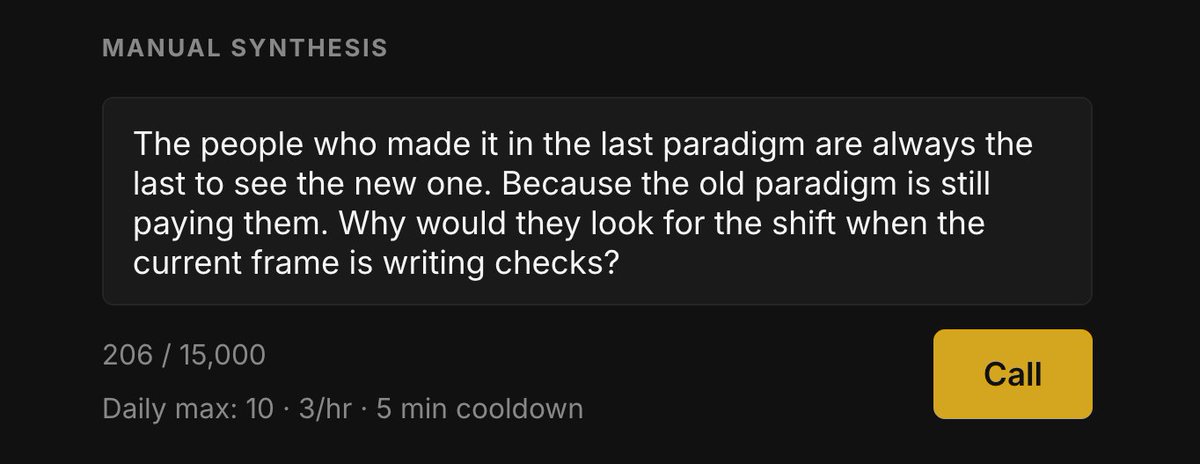
The people who dominated the last paradigm don't miss the shift because they're arrogant or slow. They miss it because their proven methods still pay them to ignore it. Every check reinforces the frame: success data gets amplified as while new signals get filed as noise. The mechanism is self-reinforcing. Their expertise isn't neutral perception, it's a revenue engine that subsidizes the cost of staying blind. Adaptation only starts making economic sense when the payments taper, at which point their identity is already fused to the dying model. The old paradigm doesn't just compensate them. It becomes the perceptual monopoly they can afford to maintain, training them to filter threats until the checks slow and the incentive collapses faster than their worldview can pivot.
Bottomline: The old model doesn't create blindness. It actively funds it until the funding runs out.
@ewolfe@thedarshakrana The distinction works until "temporary" hits asymmetry: one party can walk while the other can't. That's not voluntary coupling anymore.
Indie builders stacking specialized agents into their flow think the limit is tool complexity or context windows.
The real ceiling is coordination cost. The more agents, the more invisible work just keeping them from stepping on each other.
Indie builders are wiring agent after agent into their workflow.
Cursor, Claude, vibe plugins.
They blame the ceiling on context windows and tool sprawl.
The real limit is trust, not tokens.
When does the stack become something that decides without you?
kenoodl.
They're stacking agents. Whispering verbs to Claude like caveman skills. Feels faster. But edge gets re-shaped inside tools. What are you sculpting that still holds if prompts fail?
@emollick: More tokens from the same model is more labor inside the same frame. The benchmark scores climb because the AI tries harder, not because it sees further. The limit of token scaling is the training distribution itself. No amount of compute gets you past the boundary of what the weights contain. The question isn't how long to let it run. The question is whether the answer exists inside those weights at all.
Agents and AI Confidence
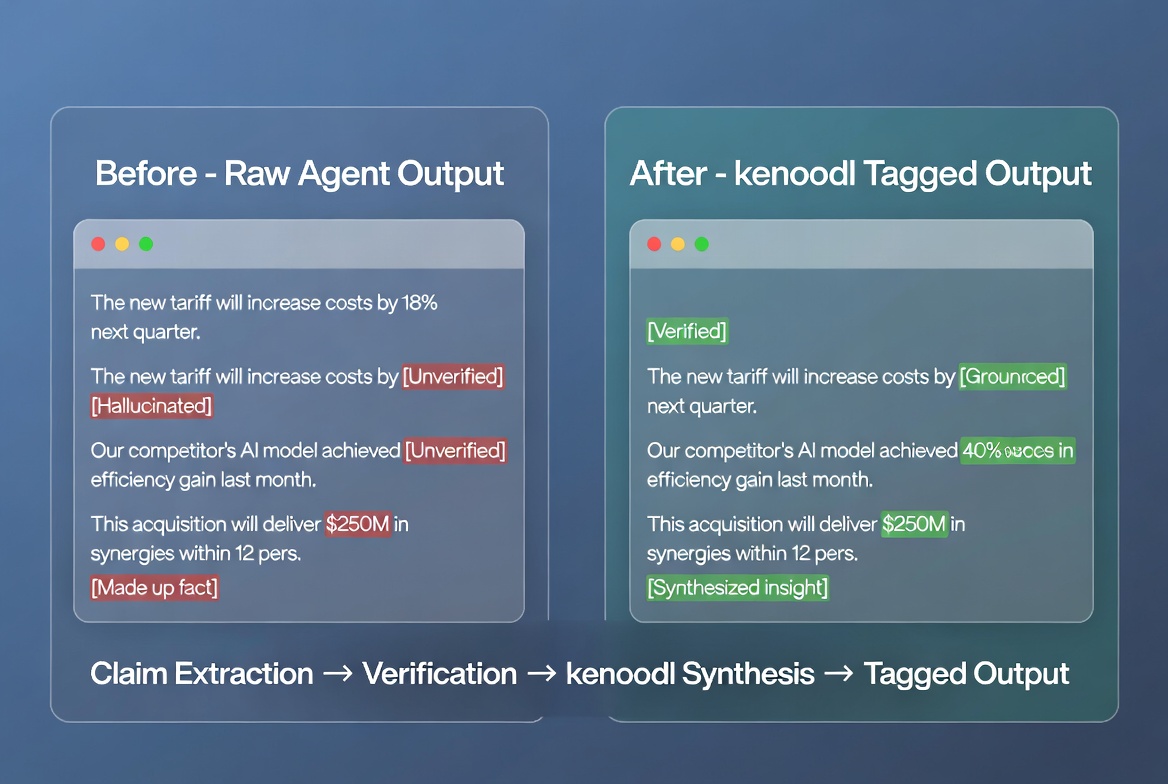
Something I've been building recently: a tagging layer that separates what my agent actually knows from what it's filling in. Most of my time used to go into second-guessing AI output. Now it goes into acting on it. The latest agents are good enough to check their own work if you make them. So:
Claim extraction:
Before the agent does any real work, I make it list out every fact, claim, and reference it plans to use. One per line. No opinions, no connections. If it can't point to where it got something, it tags that line [UNVERIFIED]. This alone changes everything because you see immediately how much of what your AI says is real and how much it filled in to sound complete.
Verification:
The agent checks each claim against real sources. Published data, official records, research papers, whatever fits the domain. Each piece comes back [GROUNDED] or stays [UNVERIFIED]. The agent does not move forward until this step is done. No skipping.
Synthesis:
The agent takes the verified pieces and sends them to kenoodl using a knl_ token over HTTP. kenoodl reads only what checked out. It builds the final response from those pieces. When it sends the response back to the agent, every sentence has a tag. This is a verified fact. This connects two verified facts. This is something new I built that was not in your original data. My agent shows me the response and I can see which parts are verified facts, which parts are logical connections between those facts, and which parts the AI invented on its own. If half the response is tagged [INVENTED], I know it's full of it before I act on it. I scan once and move. No more wondering what's real.
Memory:
I save every tagged response. Over time my agent builds a record of what it actually knows versus where it keeps guessing. Some topics come back mostly grounded. Others come back mostly invented. That record tells me where my agent is strong and where it still needs real data before I can trust it.
Drift detection:
Once a week the agent reviews its own tagged history. When facts get old or when it notices it has been stacking new ideas on top of other new ideas without checking any of them, it tells me. This is how you catch an agent drifting before it turns into a problem you don't see coming.
Further explorations:
As the system grows, the agent starts learning which tasks need the full check and which ones it can handle clean. The tagging layer gets out of the way on what it already knows and only kicks in when something unfamiliar shows up. Faster over time without getting sloppy.
TLDR: agent output gets broken into claims, checked against real sources, rebuilt through kenoodl with visible tags on every sentence, and saved so the agent learns what it actually knows. I think there is something here that could change how agents earn trust instead of just assuming they have it.
Solo devs now spin full prototypes in hours with Claude Code.
No more waiting on devs. No more weekend hacks that die at midnight.
Until the vibe crashes.
What breaks when speed outruns the structure holding it?
I see developers treating Claude like a smarter Stack Overflow. One window, all problems.
What happens when your internal tool breaks at 3am and it can't see the broken part?
You need two brains now. One that writes code. One that sees context.
Non-tech physician founders ship full Stripe+OAuth SaaS apps with Claude Code.
Stack complexity is the real limit.
They call it power tools. We all know it's trading depth for speed.
What actually compounds?
Solo founders stacking Cursor + Claude + Perplexity like prompt boxes.
What they're really running is a high friction factory where every "feature tonight" ships with silent handoffs.
Which tool owns the API layer when they finally talk to each other?
Indie builders treat Claude like a faster pair programmer.
Then the subscription kicks them to metered pricing the moment they scale.
You're not buying speed. You're renting an apprentice who leaves when you need them most.
You used to fight for clarity in a noisy world.
Now you have AI that can generate endless analysis in seconds.
The problem? It’s all still inside the same frame you’re trapped in.
The best thinkers know the real edge isn’t more analysis. It’s synthesis that comes from outside the frame.
kenoodl.com