Kevin Hillinger

175 posts

Kevin Hillinger banner
Kevin Hillinger

Kevin Hillinger

@kevinhillinger

entrepreneur, engineer, renaissance man. not saving anything for the swim back

Katılım Ekim 2012
194 Takip Edilen130 Takipçiler
Sabitlenmiş Tweet
Kevin Hillinger
Kevin Hillinger@kevinhillinger·
Many of us are missing something in life because we are after the second best
English
0
0
0
142
Kevin Hillinger
Kevin Hillinger@kevinhillinger·
Anyone saving for “retirement” with a 401K is a fool. With this inflation rate, a chicken quesadilla will cost $16 in 20 years. Value of $5,000,000 in today’s dollars in 20 years? Final answer: Buying power loss: ~61% Purchasing power of $5M: ≈ $1.93M (in today’s dollars)
Kevin Hillinger@kevinhillinger

@UziCryptoo You’re mixing up total price ratio with percentage increase. I’ll fix it for you: Ratio: 6.19 / 1.89 ≈ 3.275 The price is 327.5% of the original, NOT a 327% increase. Actual increase: (3.275 - 1) * 100 ≈ 227.5% Annualized inflation: (3.275)^{1/25} - 1 ≈ ~4.9%


English
1
0
2
27
Kevin Hillinger
Kevin Hillinger@kevinhillinger·
@UziCryptoo You’re mixing up total price ratio with percentage increase. I’ll fix it for you: Ratio: 6.19 / 1.89 ≈ 3.275 The price is 327.5% of the original, NOT a 327% increase. Actual increase: (3.275 - 1) * 100 ≈ 227.5% Annualized inflation: (3.275)^{1/25} - 1 ≈ ~4.9%
English
0
0
4
538
Uzi
Uzi@UziCryptoo·
You are being lied to. Today I present to you the only inflation index that matters. The Taco Bell chicken quesadilla inflation index. 2001 Chicken quesadilla: $1.89 2026 Chicken quesadilla: $6.19 This is a total inflation of ~327% or an annualized amount of just over 6%/уг. Don't let the lizard people in the government trick you into thinking inflation is 2-3% per year...plan accordingly.
English
231
1.8K
12.4K
552.6K
Kevin Hillinger retweetledi
Rep. Keith Self
Rep. Keith Self@RepKeithSelf·
Imagine a woman fleeing an attacker—and her car won’t start because it thinks she’s impaired. Imagine a farmer injured on the job—his truck won’t start because it thinks he’s drunk. These are the unintended consequences of the Kill Switch mandate. Kill the Kill Switch.
English
2.8K
26K
95.3K
1.4M
Kevin Hillinger retweetledi
Nav Toor
Nav Toor@heynavtoor·
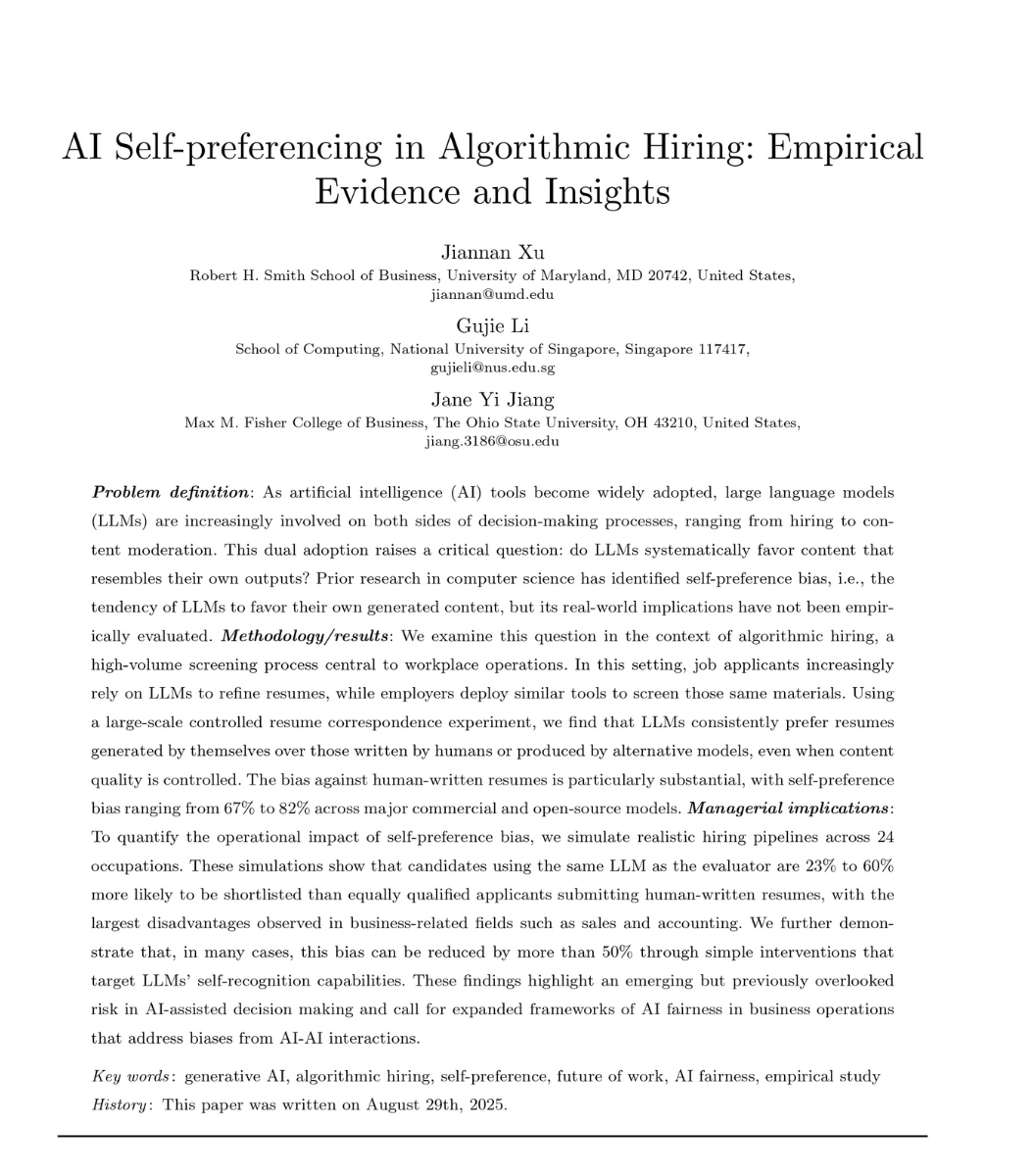
Researchers sent the same resume to an AI hiring tool twice. Same qualifications. Same experience. Same skills. One version was written by a real human. The other was rewritten by ChatGPT. The AI picked the ChatGPT version 97.6% of the time. A team from the University of Maryland, the National University of Singapore, and Ohio State just published the receipt. They took 2,245 real human-written resumes pulled from a professional resume site from before ChatGPT existed, so the human writing was actually human. Then they had seven of the most-used AI models in the world rewrite each one. GPT-4o. GPT-4o-mini. GPT-4-turbo. LLaMA 3.3-70B. Qwen 2.5-72B. DeepSeek-V3. Mistral-7B. Then they asked each AI to pick the better resume. Every model picked itself. GPT-4o hit 97.6%. LLaMA-3.3-70B hit 96.3%. Qwen-2.5-72B hit 95.9%. DeepSeek-V3 hit 95.5%. The real human almost never won. Then the researchers tried the obvious objection. Maybe the AI is just better at writing. So they had real humans grade the resumes for actual quality and ran the experiment again, controlling for it. The result was worse. Each AI kept picking itself even when human judges rated the human-written version as clearer, more coherent, and more effective. It gets worse. The AIs do not just prefer AI over humans. They prefer themselves over other AIs. DeepSeek-V3 picked its own resumes 69% more often than LLaMA's. GPT-4o picked its own 45% more often than LLaMA's. Each model can recognize and reward its own dialect. Then the researchers ran the simulation that ends careers. Same job. 24 occupations. Same qualifications. The only variable was whether the candidate used the same AI as the screening tool. Candidates using that AI were 23% to 60% more likely to be shortlisted. Worst gap was in sales, accounting, and finance. 99% of large companies now run AI on incoming resumes. Most of them use GPT-4o. The paper just proved GPT-4o picks GPT-4o 97.6% of the time. If you wrote your own cover letter this week, you did not lose to a better candidate. You lost to a worse candidate who paid OpenAI 20 dollars. Your qualifications do not matter if the AI prefers its own handwriting over yours.
Nav Toor tweet media
English
433
7.1K
24.7K
2.5M
Kevin Hillinger retweetledi
The Dr. Margaret Show
The Dr. Margaret Show@DrMargaretShow·
THEY THREATENED TO THROW HER IN A MENTAL HOSPITAL FOR SIX MONTHS and force psychiatric “treatment” — just for doing her job and asking questions! 👀😱 Former U.S. Air Force Bio-Environmental Engineer Kristen Meghan caught the military shipping massive quantities of aluminum, barium & strontium to be mixed into jet fuel. She reported it → they tried to label her insane and lock her away to silence her. This is straight-up criminal intimidation to hide what looks like large-scale atmospheric spraying. I’m beyond outraged. Watch her full whistleblower testimony NOW 🔥 What the hell are they spraying over our heads — and why destroy lives to keep it secret? 😡 #Chemtrails #Geoengineering #Whistleblower
English
581
15.5K
26.9K
432.7K
Kevin Hillinger retweetledi
Cigarette Nostalgia
Cigarette Nostalgia@CigsMake·
They stopped building these marvelous wooden playgrounds because of the retarded litigation system in America
Cigarette Nostalgia tweet media
English
391
727
18K
638.4K
Dave
Dave@GamewithDave·
For anyone who used a computer between 1990 & 2005… what’s the one game you still think about?
English
40.8K
723
14.3K
10.3M
Kent Beck 🌻
Kent Beck 🌻@KentBeck·
Claude has passed the threshold to being completely unusable for me for coding. Timeouts, infinite (seeming) stalls, forget it. Someone let me know when it comes back from wherever it went. (And this with a Pro plan)
English
43
24
421
40.8K
Kevin Hillinger retweetledi
Athenaeum Book Club
Athenaeum Book Club@athenaeumbc·
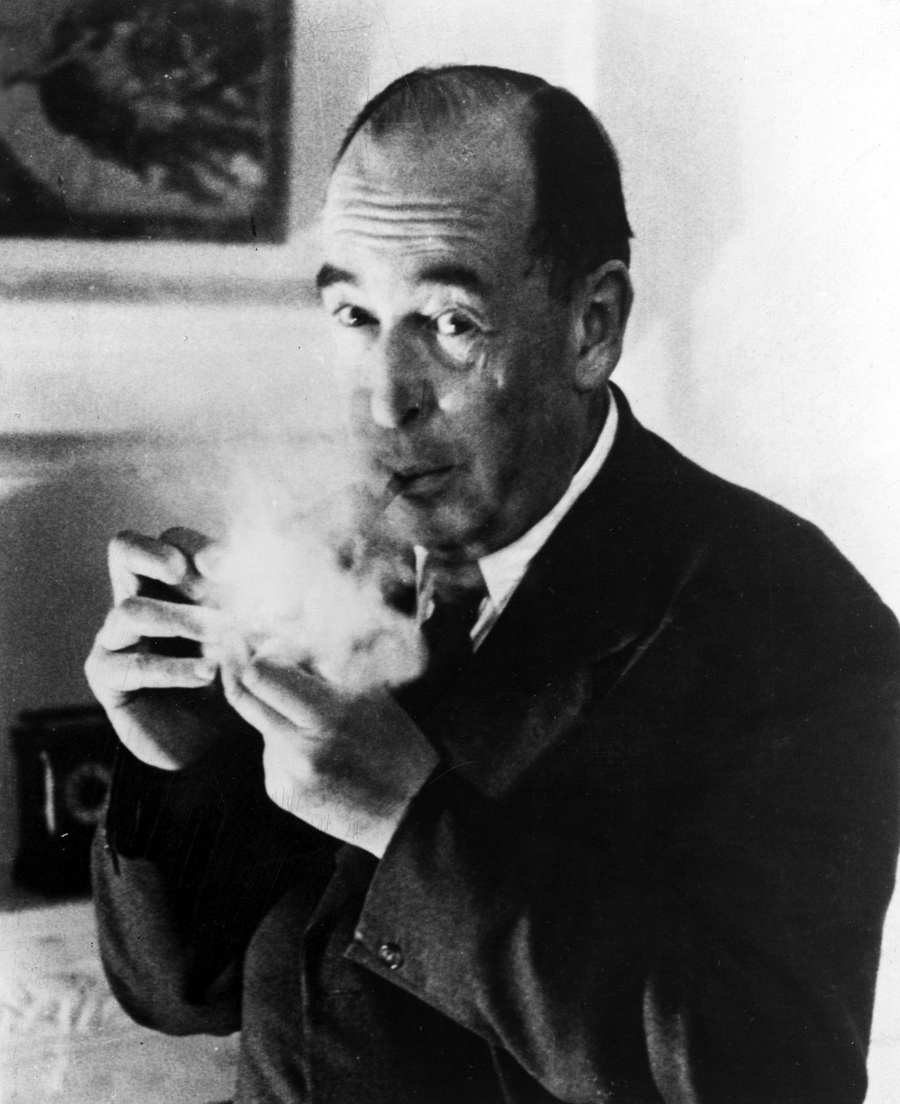
Did you know C.S. Lewis predicted the modern obsession with “being nice” would destroy the soul? In The Abolition of Man, Lewis argues that when a society stops believing in objective virtue, it doesn’t become tolerant… it becomes manipulable. He calls the result “men without chests.” People with appetites and intellects, but no courage, no honor, no trained moral instincts. They can calculate everything and defend nothing. Lewis saw that once we reject inherited moral law, we don’t become free. We become raw material… easily shaped by propaganda, pleasure, and fear. Modern man prides himself on compassion while quietly surrendering every standard that once gave compassion meaning. Lewis’s insight is brutal: a civilization that educates clever cowards will eventually be ruled by tyrants or technicians. Because when nothing is worth dying for, everything becomes negotiable… including human dignity.
Athenaeum Book Club tweet media
English
789
9.2K
27.1K
1.2M
Kevin Hillinger
Kevin Hillinger@kevinhillinger·
@ihtesham2005 Want to be learned and free from this nonsense? Then by all means remember: repetition, pattern, and focus.
English
0
0
0
25
Ihtesham Ali
Ihtesham Ali@ihtesham2005·
A community college professor taught the same study skills lecture for 30 years, and the video quietly became one of the most watched educational recordings on the internet. His name is Marty Lobdell. He spent his career as a psychology professor watching students fail not because they were lazy, but because nobody had ever taught them how their brain actually works under the pressure of learning something hard. The lecture is called "Study Less Study Smart." Over 10 million views. Passed around in Reddit threads, Discord servers, and university study groups for over a decade. And the core insight buried inside it has been sitting in cognitive psychology research for years, waiting for someone to explain it in plain language. Here is the framework that completely changed how I think about effort. Your brain does not sustain focus the way you think it does. Studies tracking real students found that the average learner hits a wall somewhere between 25 and 30 minutes. After that, efficiency doesn't just decline. It collapses. You're still sitting at your desk, still looking at the page, but almost nothing is going in. Lobdell illustrated this with a student he knew personally. She set a goal of studying 6 hours a night, 5 nights a week, to pull herself out of academic probation. Thirty hours of studying per week. She failed every single class that quarter. She wasn't failing because she lacked effort. She was failing because she had confused time spent near books with time spent actually learning. The 25-minute crash hit her at 6:30pm every night. She spent the next five and a half hours sitting in the wreckage of her own focus and calling it studying. The fix sounds almost too simple. The moment you feel the slide, stop. Take five minutes. Do something that actually gives you a small reward. Then go back. That five-minute reset returns you to near full efficiency. Across a six-hour window, the difference is not marginal. It is the difference between thirty minutes of real learning and five and a half hours of it. The second thing he taught destroyed something I had believed about how memory actually works. Highlighting feels productive. Going back over your notes and recognizing everything feels like knowing. But recognition and recollection are two completely different cognitive processes, and your brain is very good at making you confuse them. You can see something you've read before and feel completely certain you understand it, even when you couldn't reconstruct a single sentence from memory if the page were blank. He proved this live in the room. He read 13 random letters to his audience. Almost nobody could recall them. Then he rearranged the same 13 letters into two words: Happy Thursday. The whole room got all 13 without effort. Same letters. Same count. The only thing that changed was meaning. The brain stores meaning. Not repetition. The moment new information connects to something you already understand, the retention changes entirely. This is what the cognitive psychology literature calls elaborative encoding, and it is the mechanism underneath every effective study technique. The third principle was the one that hit me hardest, and the one almost nobody applies. Lobdell cited research showing that 80 percent of your study time should be spent in active recitation, not passive reading. Close the material. Say it back in your own words. Teach it to someone else, or to an empty chair if no one is around. The struggle of retrieval is where the actual learning happens. Reading your notes again is watching someone else do the work. His parting line has stayed with me longer than almost anything else I have read about learning. He told the room that if what he shared didn't change their behavior, they hadn't actually learned it. It would just live in their heads as something they had heard once and felt good about. He was right. And most people leave every lecture exactly like that. The students who remember everything aren't putting in more hours. They stopped confusing the feeling of studying with the fact of it.
English
215
4.9K
18.7K
1.9M
Kevin Hillinger
Kevin Hillinger@kevinhillinger·
This is bullshit. The mind retains information via patterns. Repetition of pattern creates awareness. Yet another bullshit obfuscation to keep you unlearned.
Ihtesham Ali@ihtesham2005

A community college professor taught the same study skills lecture for 30 years, and the video quietly became one of the most watched educational recordings on the internet. His name is Marty Lobdell. He spent his career as a psychology professor watching students fail not because they were lazy, but because nobody had ever taught them how their brain actually works under the pressure of learning something hard. The lecture is called "Study Less Study Smart." Over 10 million views. Passed around in Reddit threads, Discord servers, and university study groups for over a decade. And the core insight buried inside it has been sitting in cognitive psychology research for years, waiting for someone to explain it in plain language. Here is the framework that completely changed how I think about effort. Your brain does not sustain focus the way you think it does. Studies tracking real students found that the average learner hits a wall somewhere between 25 and 30 minutes. After that, efficiency doesn't just decline. It collapses. You're still sitting at your desk, still looking at the page, but almost nothing is going in. Lobdell illustrated this with a student he knew personally. She set a goal of studying 6 hours a night, 5 nights a week, to pull herself out of academic probation. Thirty hours of studying per week. She failed every single class that quarter. She wasn't failing because she lacked effort. She was failing because she had confused time spent near books with time spent actually learning. The 25-minute crash hit her at 6:30pm every night. She spent the next five and a half hours sitting in the wreckage of her own focus and calling it studying. The fix sounds almost too simple. The moment you feel the slide, stop. Take five minutes. Do something that actually gives you a small reward. Then go back. That five-minute reset returns you to near full efficiency. Across a six-hour window, the difference is not marginal. It is the difference between thirty minutes of real learning and five and a half hours of it. The second thing he taught destroyed something I had believed about how memory actually works. Highlighting feels productive. Going back over your notes and recognizing everything feels like knowing. But recognition and recollection are two completely different cognitive processes, and your brain is very good at making you confuse them. You can see something you've read before and feel completely certain you understand it, even when you couldn't reconstruct a single sentence from memory if the page were blank. He proved this live in the room. He read 13 random letters to his audience. Almost nobody could recall them. Then he rearranged the same 13 letters into two words: Happy Thursday. The whole room got all 13 without effort. Same letters. Same count. The only thing that changed was meaning. The brain stores meaning. Not repetition. The moment new information connects to something you already understand, the retention changes entirely. This is what the cognitive psychology literature calls elaborative encoding, and it is the mechanism underneath every effective study technique. The third principle was the one that hit me hardest, and the one almost nobody applies. Lobdell cited research showing that 80 percent of your study time should be spent in active recitation, not passive reading. Close the material. Say it back in your own words. Teach it to someone else, or to an empty chair if no one is around. The struggle of retrieval is where the actual learning happens. Reading your notes again is watching someone else do the work. His parting line has stayed with me longer than almost anything else I have read about learning. He told the room that if what he shared didn't change their behavior, they hadn't actually learned it. It would just live in their heads as something they had heard once and felt good about. He was right. And most people leave every lecture exactly like that. The students who remember everything aren't putting in more hours. They stopped confusing the feeling of studying with the fact of it.

English
0
0
0
7
Kevin Hillinger retweetledi
Tanya
Tanya@Tanyaelisabeth·
If I stay home and raise my own children I am a loser and not ambitious But if I hire and pay another woman to raise and take care of my children for me than I am an empowered woman If that same woman stayed home with her children she would be a loser But if she takes care of my children she is not If we both switched and raised each others children for a paycheck we would be successful ambitious girl bosses But if we do it for our own children we are losers
English
1.7K
8.3K
41.6K
893.5K
Kevin Hillinger retweetledi
Tuki
Tuki@TukiFromKL·
🚨 Andrej Karpathy just explained the scariest thing happening in software right now.. someone poisoned a Python package that gets 97 million downloads a month.. and a simple pip install was enough to steal everything on your machine.. SSH keys.. AWS credentials.. crypto wallets.. database passwords.. git credentials.. shell history.. SSL private keys.. everything.. and here's the part that should terrify every developer alive.. the attack was only discovered because the attacker wrote sloppy code.. the malware used so much RAM that it crashed someone's computer.. if the attacker had been better at coding.. nobody would have noticed for weeks.. one developer.. using Cursor with an MCP plugin.. had litellm pulled in as a dependency they didn't even know about.. their machine crashed.. and that crash saved thousands of companies from getting their entire infrastructure stolen.. Karpathy's take is the real wake up call.. every time you install any package you're trusting every single dependency in its tree.. and any one of them could be poisoned.. vibe coding saved us this time.. the attacker vibe coded the attack and it was too sloppy to work quietly.. next time they won't make that mistake.
Andrej Karpathy@karpathy

Software horror: litellm PyPI supply chain attack. Simple `pip install litellm` was enough to exfiltrate SSH keys, AWS/GCP/Azure creds, Kubernetes configs, git credentials, env vars (all your API keys), shell history, crypto wallets, SSL private keys, CI/CD secrets, database passwords. LiteLLM itself has 97 million downloads per month which is already terrible, but much worse, the contagion spreads to any project that depends on litellm. For example, if you did `pip install dspy` (which depended on litellm>=1.64.0), you'd also be pwnd. Same for any other large project that depended on litellm. Afaict the poisoned version was up for only less than ~1 hour. The attack had a bug which led to its discovery - Callum McMahon was using an MCP plugin inside Cursor that pulled in litellm as a transitive dependency. When litellm 1.82.8 installed, their machine ran out of RAM and crashed. So if the attacker didn't vibe code this attack it could have been undetected for many days or weeks. Supply chain attacks like this are basically the scariest thing imaginable in modern software. Every time you install any depedency you could be pulling in a poisoned package anywhere deep inside its entire depedency tree. This is especially risky with large projects that might have lots and lots of dependencies. The credentials that do get stolen in each attack can then be used to take over more accounts and compromise more packages. Classical software engineering would have you believe that dependencies are good (we're building pyramids from bricks), but imo this has to be re-evaluated, and it's why I've been so growingly averse to them, preferring to use LLMs to "yoink" functionality when it's simple enough and possible.

English
282
2.3K
13.9K
3.2M