King L Hung
402 posts

King L Hung
@kinglhung
Biologist at Scripps, PhD at Stanford. Dynamics of genomes and cells.


I’m super excited to share what I’ve been working on for the last (many) years: a spatial + genomic + transcriptomic characterization of how the breast cancer microenvironment evolves through immunotherapy! (1/x) biorxiv.org/content/10.110…

Single-cell multiome and enhancer connectome of human retinal pigment epithelium and choroid nominate causal variants in macular degeneration dlvr.it/TQSksf


AI can now generate scientific ideas at scale. But we need to know if the current state of the art can bridge the gap to physical validation – the phase constrained by what can be tested, how fast, and at what cost. To find out, we have doubled our investment in the AI Scientist programme to £6m. We're backing 12 projects to see if autonomous systems can reason, plan, and run experiments in the real world. These teams are testing the limits of automation on deliberately unforgiving problems: Alzheimer’s and cancer therapeutics, material discovery, and understanding the mechanisms behind battery degradation. Instead of looking for best-case scenarios, we’re looking for limits. Can these systems recover when experiments fail? Can they reason across disciplines? Can they decide what not to try? By doing this, we are learning what happens when machines are asked to do science, and exploring what that means for the future of discovery. Discover the projects: link.aria.org.uk/AIscifpx


ecDNA biology is one of those weird, fascinating corners of bio that hook me every time there's a new result. So I loved reading about this one from @HowardYChang & Paul Mischel's labs in @Nature. Very interesting implications for design of non-diluting, non-integrating gene therapy vectors! Great work Venkat & @kinglhung 😀


Nature research paper: Genetic elements promote retention of extrachromosomal DNA in cancer cells go.nature.com/4pkUpDE

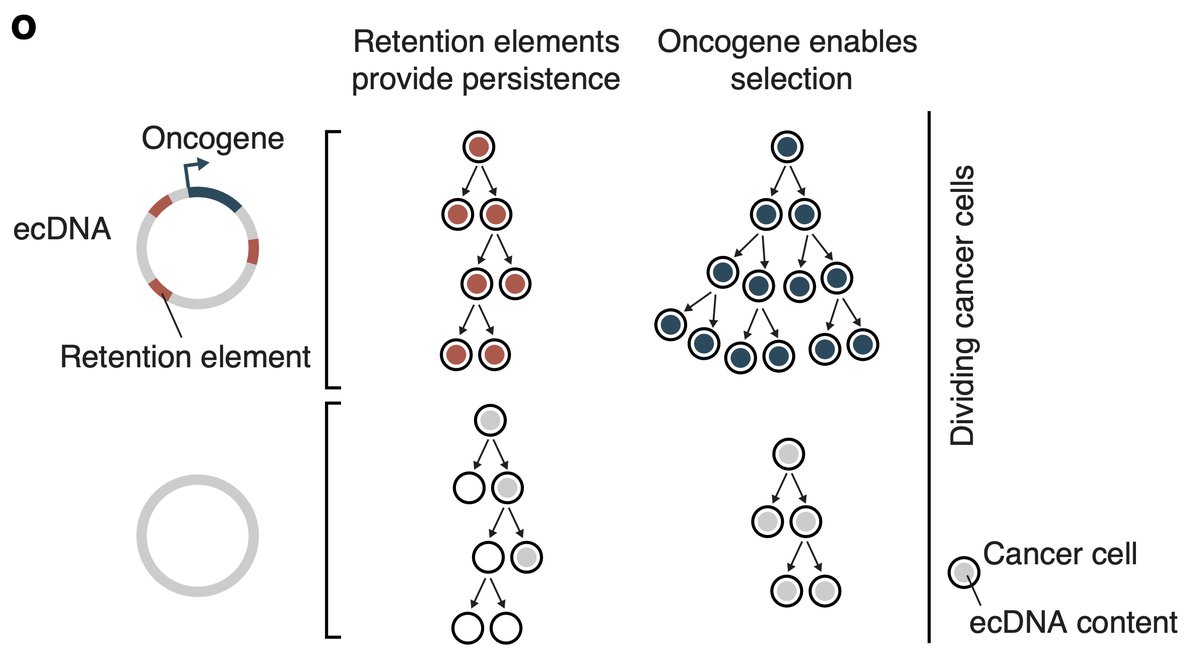
Our paper is out in @Nature! Oncogenes are often copy-number amplified on extrachromosomal DNA (ecDNA) in cancer, but how is ecDNA inherited by dividing cells? Here we identified elements within ecDNA that promote its retention in dividing cells. 1/11 nature.com/articles/s4158…


Our paper is out in @Nature! Oncogenes are often copy-number amplified on extrachromosomal DNA (ecDNA) in cancer, but how is ecDNA inherited by dividing cells? Here we identified elements within ecDNA that promote its retention in dividing cells. 1/11 nature.com/articles/s4158…