Michel David

854 posts

Michel David banner
Michel David

Michel David

@korutx

Content-Centric Application Developer. Software Engineer, Comicbooks reader and PMF programmer.

Chile Katılım Haziran 2010
108 Takip Edilen77 Takipçiler
Michel David
Michel David@korutx·
So you want the government to protect your investment in a similar way that land is private. Hmmm. Pretty clear China is nuking frontier lab investors. So you are forced to find better ways to get ROI or abandon the race. But you are at least naive if you think government will help you accelerate. At some point you have to realize the model wouldn’t be the moat. Intelligence should be funded by those who want to solve real humanity problems.
English
0
0
0
47
Dean W. Ball
Dean W. Ball@deanwball·
Some observations on Kimi: 1. It's a very good model! I don't think its performance can be explained away by distillation or anything like that. In agentic coding sessions, it seems pretty much on par with the best public models of Q1 2026. In my fairly limited use, it also seemed very token hungry. It's not obvious to me that this model is actually that cheap to run. 2. I am personally surprised the Chinese state continues to allow the open sourcing of models this good, given potential risks. To be clear, I *myself* might be fine with models presenting this level of marginal risk being open weight, but I am surprised that China is fine with it. I suspect the reason they are is 75% explained by strategic blindness/lack of AGI-pilledness (the CCP is very Yann Lecun-y in its views of AI). The other 25% or so is their lack of compute for customer inference (making China's open-weight strategy an unintended byproduct of US export controls) and the normal Chinese strategy of aggressive exports. For the companies, as opposed to the government, the decision to open source is partially ideological and partially because they are behind, and they know that very few people would pay for sub-frontier models from China. 3. Open-weight models are inherently decelerationist, and I'm continually surprised to see the so-called "accelerationists" so excited about open-weight models. I suspect the reason they are is that they know open-weight models are effectively ungovernable, and they simply like the overall cloak of ungovernability open-weight models create over the whole of AI. It's not a bad strategy; it reminds me of James Scott's recounting of the hill people in "the art of not being governed." Still, in the end, open-weight models deter further AI capex. 4. One probable outcome of an open-weight-model-dominant world is full AI communism, which is precisely what China proposes: rather than a market product, AI is a "public good" which will ultimately be provided by the state as a kind of "digital public infrastructure." This future strikes me as a dystopian hellscape, but I've never met an open-weight models advocate who doesn't ultimately concede this is where things end. You'd be surprised how many 'accelerationists' lobbied me, while I was in government, to support an eleven or twelve-figure federally funded data center so that startups could train models at a subsidy and then give them away for free. There was no other way for AI to progress, they said. Perhaps this is the logical end state of things. Nonetheless, I find myself surprised to see supposed accelerationists excited about such an outcome. I think many of them just don't know what they're doing. Many accelerationists do not view the creation and serving of frontier models as a legitimate business. 5. I would guess that the Trump Administration will at some point realize that their best strategy here would be to create large amounts of regulatory risk around the use of open-weight Chinese models. You don't need to "ban open source" (one of the dumber motifs of AI policy discussion). You just need to direct every agency to issue soft law that creates FUD. "A Federal Reserve Advisory Bulletin found that there may be backdoors in Chinese AI models." It needn't be that well justified. You just create enough regulatory risk that every regulated enterprise backs off. You probably don't want to create so much regulatory risk that you scare off the hyperscalers from serving Chinese models; this will just drive startups to sketchier providers. There's a happy middle ground here. I'd assume they will do some version of this. 6. It's probably true that open-weight models of this capability make the world a bit more dangerous, but not so much more that you'll really notice. At some point the models will be capable enough that you will notice. "A nonliving, invisible, dangerous, and infinitely self-replicating agent escaped from a Chinese lab," you say? Color me shocked.
English
2.1K
925
7.6K
11M
Santiago
Santiago@svpino·
If you are a software engineer still using an IDE or a CLI to build software, you ain’t gonna make it. If you are writing prompts, or using skills, you ain’t gonna make it. Slack is the paradigm. That’s the only way forward. /s
English
83
4
329
114.8K
Jean Nguyen
Jean Nguyen@JeanAnimate·
I spent years turning a silly animation idea into a full game. Now, you can literally play as a Spinosaurus parrying giant bosses with a colossal greatsword. Dinoblade drops next month on PC!
English
233
2.6K
27.7K
1.1M
Carlos Santana
Carlos Santana@DotCSV·
Antes de que se vaya de madres el hype con el modelo de 12M de contexto sólo quiero calmar los animos recordando que muchas veces estos modelos vienen con otras decisiones de diseño que hacen que su uso no sea escalable sin sacrificar algo. La falta de benchmarks u acceso público inmediato a la tecnología me hace sospechar que realmente hay detalles que no interesa mostrar. Así que recomiendo tomarlo con mucho escepticismo. No es la primera vez que tenemos anuncios de empresas levantando inversión con modelos de hasta 100M tokens, para luego desaparecer sin más noticias 🫥
Carlos Santana tweet media
Alexander Whedon@alex_whedon

Introducing SubQ - a major breakthrough in LLM intelligence. It is the first model built on a fully sub-quadratic sparse-attention architecture (SSA), And the first frontier model with a 12 million token context window which is: - 52x faster than FlashAttention at 1MM tokens - Less than 5% the cost of Opus Transformer-based LLMs waste compute by processing every possible relationship between words (standard attention). Only a small fraction actually matter. @subquadratic finds and focuses only on the ones that do. That's nearly 1,000x less compute and a new way for LLMs to scale.

Español
18
20
439
51K
Michel David
Michel David@korutx·
@asimovinc I prefer this to build a long project for me and my kids instead of building a used car.
English
0
0
1
107
Michel David retweetledi
LaHistoriadora™
LaHistoriadora™@LaHistoriadora_·
Hoy es viral: arqueólogos españoles han hallado en Egipto una momia con un papiro de la 'Ilíada' de Homero en su interior. ¿Qué hace un texto griego en una tumba egipcia de época romana? Como arqueóloga, os explico por qué este hallazgo es increíble. Abro hilo👇🧵
Español
247
3.2K
15.4K
1.4M
Michel David retweetledi
Santiago
Santiago@svpino·
Be careful with moving it all over Opus 4.7. The new model uses more tokens and will eat up your subscription faster. • New tokenizer that maps inputs to up to 1.35x the number of tokens that it previously did. • The model thinks more, so it will use more tokens. You will need to evaluate whether this trade-off is worth it for you.
Santiago tweet media
Claude@claudeai

Introducing Claude Opus 4.7, our most capable Opus model yet. It handles long-running tasks with more rigor, follows instructions more precisely, and verifies its own outputs before reporting back. You can hand off your hardest work with less supervision.

English
49
26
254
45.8K
Michel David
Michel David@korutx·
@pumfleet @calcom I disagree. Now more than ever, you must open-source the code and move the value to the service.
English
0
0
0
34
Bailey Pumfleet
Bailey Pumfleet@pumfleet·
Open source is dead. That’s not a statement we ever thought we’d make. @calcom was built on open source. It shaped our product, our community, and our growth. But the world has changed faster than our principles could keep up. AI has fundamentally altered the security landscape. What once required time, expertise, and intent can now be automated at scale. Code is no longer just read. It is scanned, mapped, and exploited. Near zero cost. In that world, transparency becomes exposure. Especially at scale. After a lot of deliberation, we’ve made the decision to close the core @calcom codebase. This is not a rejection of what open source gave us. It’s a response to what risks AI is making possible. We’re still supporting builders, releasing the core code under a new MIT-licensed open source project called cal. diy for hobbyists and tinkerers, but our priority now is simple: Protecting our customers and community at all costs. This may not be the most popular call. But we believe many companies will come to the same conclusion. My full explanation below ↓
English
551
188
2.1K
1.6M
Michel David retweetledi
Forrest Knight
Forrest Knight@ForrestPKnight·
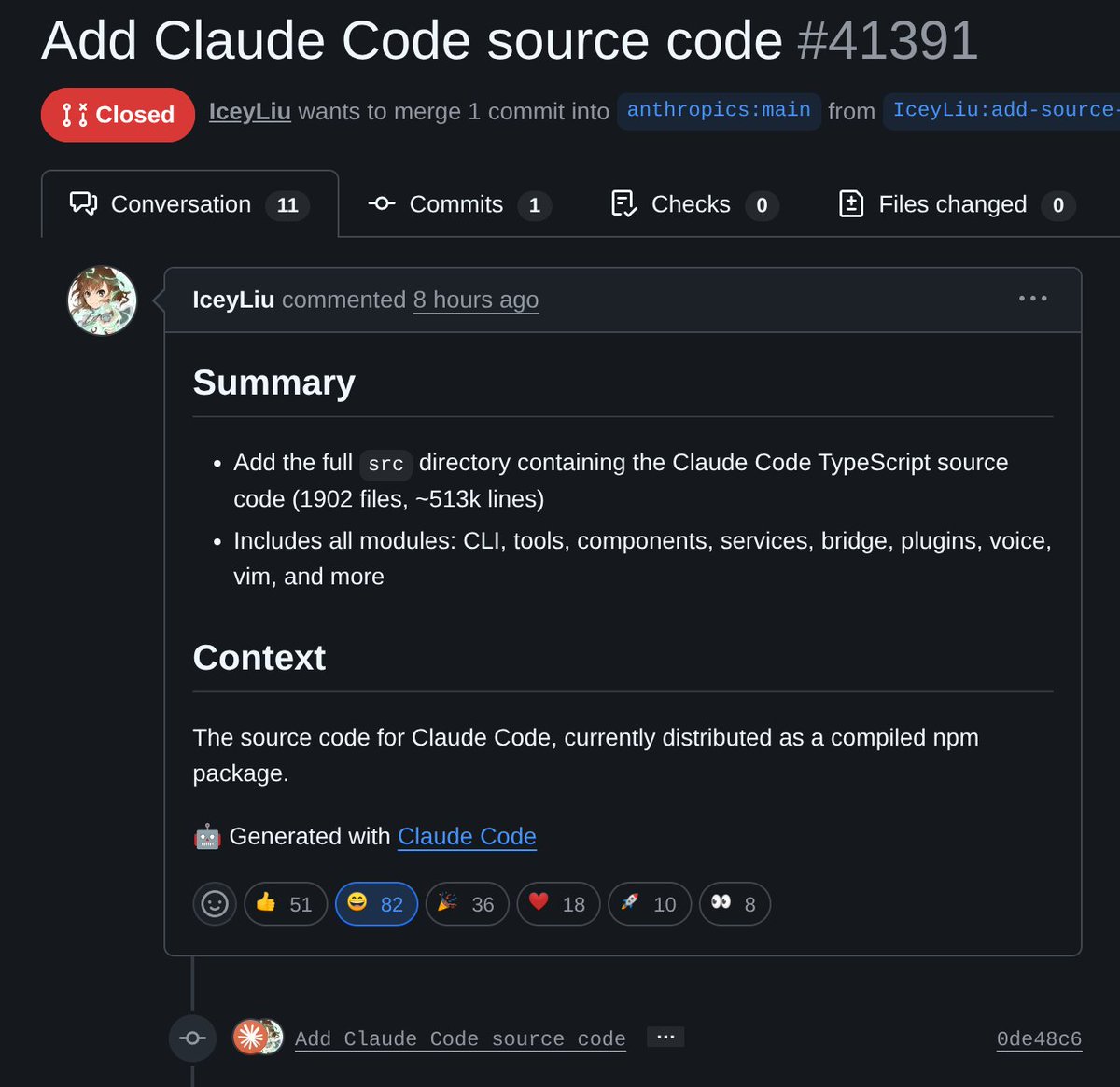
This... this is art. Submitting a PR to the Claude Code repo to add the actual Claude Code source code.
Forrest Knight tweet media
English
93
228
4.9K
357.1K
Michel David retweetledi
Liliana
Liliana@lily101288·
A type guard stopped a cascading client deactivation bug. The fix was simple: use a TypeScript type guard so the safe path is not just documented , it’s enforced. Not with drama. Not with a dashboard Always a beautiful moment. #lilicurl #codingWithHumor
Liliana tweet media
English
0
1
1
20
Michel David
Michel David@korutx·
@svpino I’d love to follow up on this. I only rely on agents for non-deterministic tasks, and I always follow the man-in-the-middle principle you used to promote here. What’s your take on how to solve that problem?
English
0
0
0
112
Santiago
Santiago@svpino·
People are lying to you. These agents don't work as they promised.
English
608
581
5.7K
855K
Michel David retweetledi
Tech with Mak
Tech with Mak@techNmak·
The person who built Claude Code just mass-leaked the thinking behind it. 45 minutes of design decisions, mistakes, and where it's all going. This is rare. Creators at this level don't usually talk this openly.
English
81
675
5.7K
544K
Michel David retweetledi
👨🏽‍💻
👨🏽‍💻@bymaximise·
That's AI (2026) - Short Film
English
379
10.2K
64.1K
1.1M
Michel David retweetledi
Dave Clark
Dave Clark@Diesol·
I had early access to Kling 3.0. This short film is called MIRA. Every shot came from one single start image, using Kling’s new custom multi-shot feature. This changes how films get made. More below 👇
English
321
456
3.3K
349.8K
Michel David
Michel David@korutx·
@svpino Agile people took that budget a long time ago and spend it on daily and ceremonies.
English
0
0
1
378
Santiago
Santiago@svpino·
Most companies right now: - No automated tests - No code review process - No CI/CD pipelines - Poor secret management - No dataset versioning - Production workflows run from spreadsheets - No rollback plans - No integration tests These aren't just some weird companies. They're everywhere! The market for people who can fix these fundamentals is massive.
English
214
212
2.5K
270.3K