Mickey Kosloff

571 posts

Mickey Kosloff banner
Mickey Kosloff

Mickey Kosloff

@koslofflab

Curiosity-driven scientist, deciphering interaction specificity in signal transduction, one amino acid at a time (G proteins rule!)

Haifa, Israel Katılım Ekim 2019
371 Takip Edilen332 Takipçiler
Sabitlenmiş Tweet
Mickey Kosloff
Mickey Kosloff@koslofflab·
New week, new paper from the lab. This time we go back to our favorite protein-protein interactions and their specificity - G proteins and RGS proteins: rdcu.be/cpHQI The following thread explains (1/7):
Mickey Kosloff tweet media
English
2
3
25
0
Mickey Kosloff retweetledi
DMM Journal
DMM Journal@DMM_Journal·
@koslofflab Don't miss the interview with the first author, Anna Fassler Bakhman. '... I volunteered ... as a first-aid ambulance responder, where I encountered a wide range of medical situations and saw how biological processes directly affect people's lives.' doi.org/10.1242/dmm.05…
English
0
1
0
17
Mickey Kosloff retweetledi
The Curious Tales
The Curious Tales@thecurioustales·
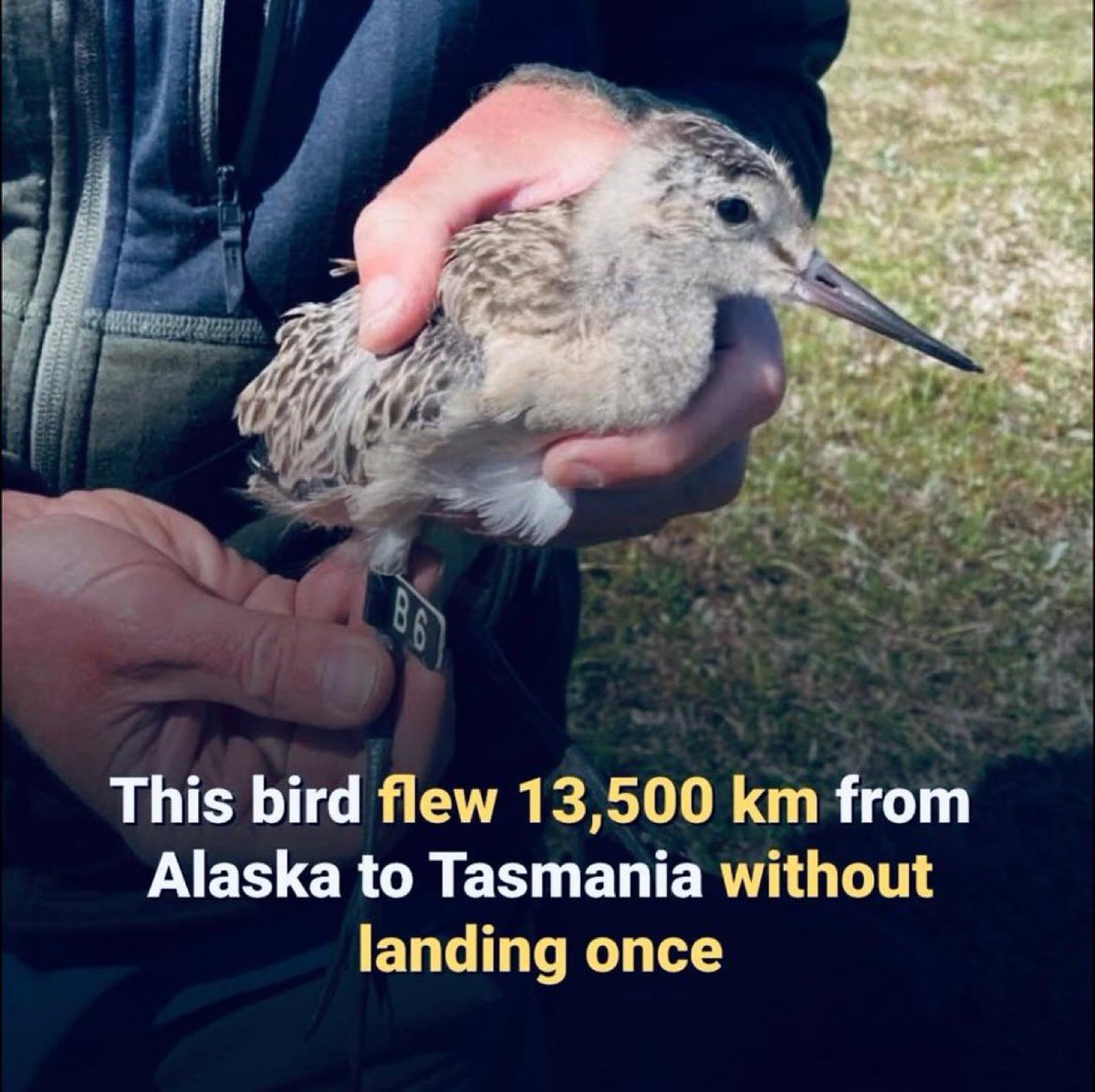
🚨 JUST IN: A migratory bird just shattered world records — flying 8,425 miles (13,560 km) NON-STOP across the Pacific without landing once. The bar-tailed godwit doesn’t stop to eat, drink, or sleep during its migration across the Pacific Ocean. Its journey from Alaska to Australia takes roughly 11 days of continuous flight, covering over 13,000 kilometers through storms, headwinds, and open ocean with zero land beneath it the entire time. Before departure, it does something almost surgical to its own body. It shrinks its digestive organs down to almost nothing, converting the stomach, intestines, and liver into raw fuel. The bird essentially eats its own gut to make room for fat reserves that will power its wings for nearly two weeks straight. The brain doesn’t fully sleep either. Half of it stays active while the other half rests, alternating in shifts mid-flight at altitude over the open Pacific. The godwit is simultaneously unconscious and navigating with magnetic field sensitivity that no human instrument in the 18th century could replicate. What makes this genuinely staggering beyond the physical record is the navigational precision involved. The bird leaves Alaska and arrives in New Zealand with accuracy that would embarrass early GPS systems. It reads Earth’s magnetic field, atmospheric pressure gradients, star positions, and potentially quantum-level compass mechanisms inside its eye that literally let it see magnetic field lines overlaid on its visual field. Evolution spent millions of years building an aerospace navigation system inside a 300 gram animal. We spend billions engineering machines that do what this bird does on instinct, fat reserves, and half a sleeping brain. The longest recorded non-stop flight by a commercial aircraft is around 20 hours. This bird does 11 days. Without a runway.
The Curious Tales tweet media
The Curious Tales@thecurioustales

🚨BREAKING: Scientists tracked a bird that flew 8,425 miles (13,560 km) without stopping even once — the longest non-stop flight ever recorded.


English
1.2K
9.6K
35.6K
2.4M
Mickey Kosloff retweetledi
Rachel Kolodny
Rachel Kolodny@rachelkolodny·
@LiamLongo ~20 years ago Holm & Sander said we should map the protein universe. Now AI can power the mapping, offering an unprecedent global look at protein similarities. Many more cool details in the pre-print, including sub-sequence embedding and comparisons to ESM3, ProstT5, and ProTrek
English
0
4
2
404
Mickey Kosloff retweetledi
Rachel Kolodny
Rachel Kolodny@rachelkolodny·
@LiamLongo We can map protein space to study its properties. Here are maps with structural class, metal, and co-factor binding. There is a striking split between the region of domains with few vs. those with many cofactor associations [but metal binding domains are all over space]
English
1
4
4
276
Mickey Kosloff retweetledi
Rachel Kolodny
Rachel Kolodny@rachelkolodny·
@LiamLongo Domains of the same architecture and even the same structural class are next to each other. This was all learned with self-supervision. No ECOD labels were used in training. The agreement with the structural labels is astonishing (for both structure and sequence modalities).
English
1
3
2
259
Mickey Kosloff retweetledi
Rachel Kolodny
Rachel Kolodny@rachelkolodny·
@LiamLongo We used it to create maps of protein space. Here is a map of ~30,000 ECOD representative domains colored by architecture (projected to 2D with tSNE). We’re flipping between structure, sequence (and subsequence) embeddings: the sequence/structure modalities co-embed very well.
English
1
4
5
806
Mickey Kosloff retweetledi
Rachel Kolodny
Rachel Kolodny@rachelkolodny·
Our new AI model CLSS that can co-embed protein sequences and structures is out at tinyurl.com/4wsvswut. We use a CLIP-like lean contrastive model (~35M million trained parameters!) and have super-exciting results. With Guy Yanai, Gaby Axel, @LiamLongo, and Nir Ben-Tal.
English
1
7
14
9.7K
Mickey Kosloff retweetledi
nature
nature@Nature·
Nature research paper: De novo designed proteins neutralize lethal snake venom toxins go.nature.com/4jt16RY
English
4
99
336
33K
Mickey Kosloff retweetledi
Arc Institute
Arc Institute@arcinstitute·
This is the first generative protein language model trained on three protein features: sequence, structure, and function. Using GFP as a test case, the model generated a bright functional protein with low sequence homology to known proteins – estimated to be equivalent to a simulation of five hundred million years of evolution. Congrats to the @pdhsu Lab for being part of this project! @tranvinq @BartieLiam @mnemeth101
Science Magazine@ScienceMagazine

An #AI model created to design proteins simulates 500 million years of protein evolution in developing a previously unknown bright fluorescent protein. Learn more in a new Science study: scim.ag/4jhJ9Wa
English
4
66
275
75.4K
Mickey Kosloff retweetledi
Rachel Kolodny
Rachel Kolodny@rachelkolodny·
Our paper doi.org/10.1073/pnas.2… just came out 🥳🥳🥳 We used a deep generative network to study codon usage in two eukaryotes: S. cerevisiae and S. pombe and two bacteria: E. coli and B. subtilis. This is what we did: 🧵 @TomerSidi197763
English
1
9
26
3.3K
Mickey Kosloff retweetledi
Kresten Lindorff-Larsen
Kresten Lindorff-Larsen@LindorffLarsen·
Predicting absolute protein folding stability using generative models More details 🦋👇
Kresten Lindorff-Larsen tweet media
English
0
13
80
7.2K
Eyal Privman
Eyal Privman@eyalprivman·
Here it is! This incredible result is the product of great work led by @AparnaLajmi with lots of contributions from the rest of the lab. Our best paper ever, by far. The discovery of the antiquity of the social chromosome opens the way for future studies in many other species.
Aparna Lajmi@AparnaLajmi

New preprint alert! Have you ever wondered how complex traits have evolved repeatedly across the tree of life? May be we have some answers biorxiv.org/content/10.110… #evolution #genomics #supergenes

English
1
1
8
597
Mickey Kosloff retweetledi
Gabriele Corso
Gabriele Corso@GabriCorso·
Thrilled to announce Boltz-1, the first open-source and commercially available model to achieve AlphaFold3-level accuracy on biomolecular structure prediction! An exciting collaboration with @jeremyWohlwend, @pas_saro and an amazing team at MIT and Genesis Therapeutics. A thread!
GIF
English
42
410
1.7K
405K
Mickey Kosloff retweetledi
Oded Rechavi
Oded Rechavi@OdedRechavi·
For a PhD student, choosing a good lab is 10 times more important than choosing a particular topic to study
English
87
596
5.2K
344.2K