koyah

5.4K posts

koyah banner
koyah

koyah

@koyahness

Game, Code, Analyse/ Research & Write ⌨️ ⌨️ . Farcaster: https://t.co/TVoDbwsLSU . Lens: https://t.co/3fpZJTLCyo . #EVM #Bitcoin

Katılım Haziran 2019
469 Takip Edilen799 Takipçiler
koyah retweetledi
Polygon | POL
Polygon | POL@0xPolygon·
Agglayer is officially chain-agnostic. Two milestones in one: Agglayer has connected the first non-EVM chain via @0xMiden. Miden can access unified liquidity without giving up privacy. Your private chain no longer has to be an island.
Polygon | POL tweet media
English
27
52
364
35.1K
koyah retweetledi
vitalik.eth
vitalik.eth@VitalikButerin·
Finally, the block building pipeline. In Glamsterdam, Ethereum is getting ePBS, which lets proposers outsource to a free permissionless market of block builders. This ensures that block builder centralization does not creep into staking centralization, but it leaves the question: what do we do about block builder centralization? And what are the _other_ problems in the block building pipeline that need to be addressed, and how? This has both in-protocol and extra-protocol components. ## FOCIL FOCIL is the first step into in-protocol multi-participant block building. FOCIL lets 16 randomly-selected attesters each choose a few transactions, which *must* be included somewhere in the block (the block gets rejected otherwise). This means that even if 100% of block building is taken over by one hostile actor, they cannot prevent transactions from being included, because the FOCILers will push them in. ## "Big FOCIL" This is more speculative, but has been discussed as a possible next step. The idea is to make the FOCILs bigger, so they can include all of the transactions in the block. We avoid duplication by having the i'th FOCIL'er by default only include (i) txs whose sender address's first hex char is i, and (ii) txs that were around but not included in the previous slot. So at the cost of one slot delay, only censored txs risk duplication. Taking this to its logical conclusion, the builder's role could become reduced to ONLY including "MEV-relevant" transactions (eg. DEX arbitrage), and computing the state transition. ## Encrypted mempools Encrypted mempools are one solution being explored to solve "toxic MEV": attacks such as sandwiching and frontrunning, which are exploitative against users. If a transaction is encrypted until it's included, no one gets the opportunity to "wrap" it in a hostile way. The technical challenge is: how to guarantee validity in a mempool-friendly and inclusion-friendly way that is efficient, and what technique to use to guarantee that the transaction will actually get decrypted once the block is made (and not before). ## The transaction ingress layer One thing often ignored in discussions of MEV, privacy, and other issues is the network layer: what happens in between a user sending out a transaction, and that transaction making it into a block? There are many risks if a hostile actor sees a tx "in the clear" inflight: * If it's a defi trade or otherwise MEV-relevant, they can sandwich it * In many applications, they can prepend some other action which invalidates it, not stealing money, but "griefing" you, causing you to waste time and gas fees * If you are sending a sensitive tx through a privacy protocol, even if it's all private onchain, if you send it through an RPC, the RPC can see what you did, if you send it through the public mempool, any analytics agency that runs many nodes will see what you did There has recently been increasing work on network-layer anonymization for transactions: exploring using Tor for routing transactions, ideas around building a custom ethereum-focused mixnet, non-mixnet designs that are more latency-minimized (but bandwidth-heavier, which is ok for transactions as they are tiny) like Flashnet, etc. This is an open design space, I expect the kohaku initiative @ncsgy will be interested in integrating pluggable support for such protocols, like it is for onchain privacy protocols. There is also room for doing (benign, pro-user) things to transactions before including them onchain; this is very relevant for defi. Basically, we want ideal order-matching, as a passive feature of the network layer without dependence on servers. Of course enabling good uses of this without enabling sandwiching involves cryptography or other security, some important challenges there. ## Long-term distributed block building There is a dream, that we can make Ethereum truly like BitTorrent: able to process far more transactions than any single server needs to ever coalesce locally. The challenge with this vision is that Ethereum has (and indeed a core value proposition is) synchronous shared state, so any tx could in principle depend on any other tx. This centralizes block building. "Big FOCIL" handles this partially, and it could be done extra-protocol too, but you still need one central actor to put everything in order and execute it. We could come up with designs that address this. One idea is to do the same thing that we want to do for state: acknowledge that >95% of Ethereum's activity doesn't really _need_ full globalness, though the 5% that does is often high-value, and create new categories of txs that are less global, and so friendly to fully distributed building, and make them much cheaper, while leaving the current tx types in place but (relatively) more expensive. This is also an open and exciting long-term future design space. firefly.social/post/lens/8144…
English
287
312
1.4K
269K
koyah retweetledi
Ethereum
Ethereum@ethereum·
Last week, Ethereum core contributors gathered in Svalbard for the Soldøgn interop: a week long event focused on hardening Glamsterdam implementations to scale Ethereum securely ☀️ Read the full recap, including their candidate post-fork gas limit, below:
Ethereum tweet media
English
217
286
1.4K
300.8K
koyah retweetledi
The Ethereum Economic Zone
The Ethereum Economic Zone@etheconomiczone·
The Ethereum Economic Zone Alliance (EEZ Alliance) is a collective of EVM infrastructure providers, protocols, block builders, and ecosystem facilitators working toward a shared goal: one Ethereum. Launch members include: @gnosis_ @ethereumfndn @ziskvm @aave @SAFE @CoWSwap @sparkdotfi @xstocksfi @centrifuge @monerium @Cometh @fileverse @blockscout @titanbuilderxyz @beaverbuild @Flashbots @Nethermind @LineaBuild @ssv_network @OctantApp @gardens_fund @LidoFinance EEZ Alliance is where the coordination happens. To join, share your details: tally.so/r/NpLo4l
English
6
27
175
9.5K
Shutter 🛡️⚔️
Shutter 🛡️⚔️@ShutterNetwork·
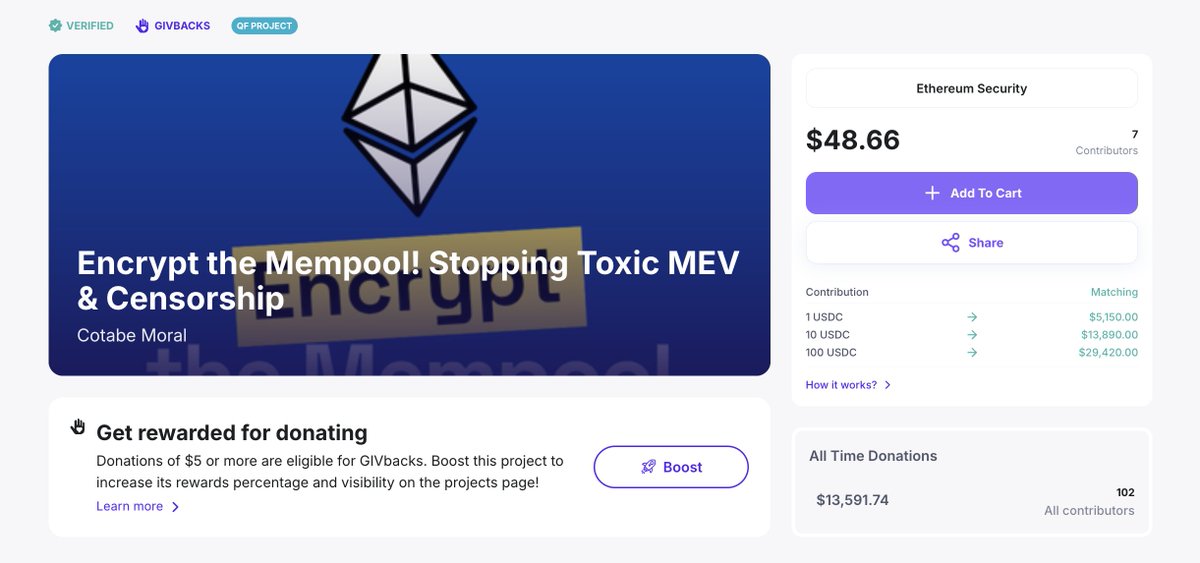
Shutter is the Ethereum Security QF round $1.8B has been extracted from Ethereum users since 2020, much of it from toxic MEV We’re working to encrypt Ethereum’s mempool to protect all users from front-running, sandwich attacks & real-time censorship Donate to support efforts
Shutter 🛡️⚔️ tweet media
English
4
3
22
491
koyah retweetledi
yearn
yearn@yearnfi·
It's raining KAT over on Katana The USDC, USDT, and WETH vaults on Katana have just been topped up with additional KAT incentives.
yearn tweet media
English
6
9
47
15.7K
koyah retweetledi
Xen
Xen@XenBH·
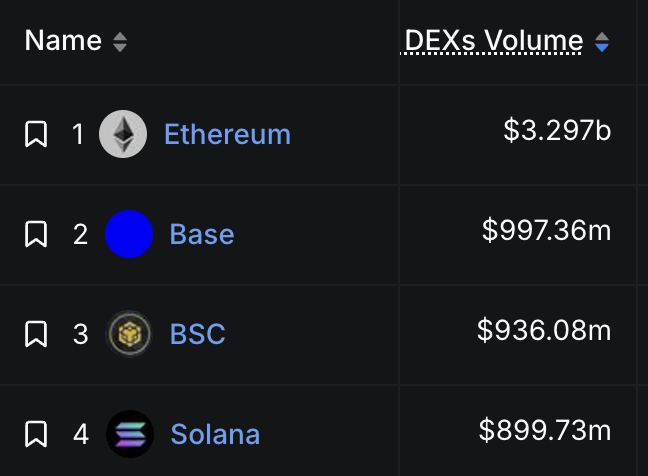
Base is #2 in DEX volume. The goal is #1.
Xen tweet media
English
127
81
785
68.2K
koyah retweetledi
Katana ⚔️
Katana ⚔️@katana·
DeFi is evolving past the farm-and-rotate era. Old model: one dollar, one job. Park in a vault, farm emissions, rotate when the APR drops. Too often the risk outran the reward. What's being built now is different. It's called productive TVL, and it changes the game.
English
7
6
55
5K
koyah retweetledi
MetaMask 🦊
MetaMask 🦊@MetaMask·
We’ve just enabled support for trading tokenized stocks and ETFs in MetaMask Extension! ✅ 264 assets to trade (61 of which have just been added!) ✅ across @ethereum and now on @BNBChain ✅ live in both MetaMask Mobile & Extension Powered by @OndoFinance 🦊🧡
English
38
97
522
87.3K
koyah retweetledi
Bankless
Bankless@Bankless·
Ethereum's fragmentation problem just got its most serious answer yet. The Ethereum Economic Zone, led by Gnosis and ZisK, funded by the EF. The goal: SYNCHRONOUS composability for the L1 and its L2s, so one transaction can execute cleanly across multiple chains. > Right now your coins on L2s can't interact with contracts on L1 or other L2s without bridging. Costs money, costs time, fragments liquidity. The EEZ ends that > Rollups plugged into the EEZ can call contracts on L1 or other L2s and receive a response in a SINGLE transaction. It feels like you're using one chain > This doesn't require any Ethereum protocol-level changes. The entire system runs on smart contracts + real-time ZK proving > Gnosis isn't some unknown team. They built CoW Protocol, Safe multisigs, the Conditional Tokens format underpinning Polymarket, Gnosis Chain, Gnosis Pay. ZisK brings an efficient open-source zkVM for real-time proving > NO ONE owns the stack. The EF is funding this as credibly neutral shared infrastructure. Free and open source for all Imagine an Aave position on Ethereum interacting with a Uniswap pool on Unichain in a single transaction. That'd be beautiful. That's the EEZ.
gwilym@wmpeaster

x.com/i/article/2039…

English
19
54
270
44.2K
koyah
koyah@koyahness·
Building on Ethereum involves a three-tier tech stack, each requiring specific programming languages: * On-Chain (Logic): The core of the dApp. Solidity is the industry standard, Vyper offers a security-focused Pythonic alternative, and Cairo is used for Starknet Layer 2 scaling. * Off-Chain (UI): How users interact with the blockchain. JavaScript/TypeScript is essential (using libraries like Ethers.js or Viem), supported by standard HTML/CSS. * Infrastructure (Tools/Nodes): High-performance backend work. Rust is favored for modern tooling (Foundry), Go powers the actual Ethereum nodes (Geth), and Python is used for data scripts and testing.
English
0
0
0
45
koyah
koyah@koyahness·
Ethereum: Stability & Institutional Settlement Ethereum remains the leading choice for risk‑adjusted returns and institutional adoption. Its dominance in real‑world asset (RWA) tokenization, DeFi infrastructure, and custody solutions makes it the preferred settlement layer for large financial institutions seeking operational reliability, liquidity depth, and regulatory alignment.
English
0
0
0
19
koyah
koyah@koyahness·
Solana vs Ethereum: early 2026 outlook Ethereum’s 2026 roadmap centers on the Glamsterdam upgrade in early 2026, improving execution efficiency through higher gas limits and parallel processing, followed by the Hegota upgrade in late 2026, which targets long‑term sustainability by reducing state bloat and lowering node requirements—reinforcing Ethereum’s role as the institutional settlement layer for real‑world assets and risk‑adjusted returns. Solana, meanwhile, enters 2026 with the Firedancer validator client rollout, designed to eliminate prior outage risks and push performance toward one million transactions per second, supporting its strength in high‑frequency trading, gaming, and microtransactions. Institutional momentum reflects this contrast: Solana ETFs saw roughly $476 million in inflows in late 2025 and early 2026, outpacing Ethereum’s flows and signaling stronger appetite for high‑growth potential.
English
0
0
0
27
koyah
koyah@koyahness·
The "Ethereum Killer" Narrative is Dead: We no longer see Solana as a replacement for Ethereum, but as a specialized alternative. While Ethereum remains the "Institutional Bedrock" for high-value DeFi and corporate treasuries, Solana has become the go-to hub for retail activity, memecoins, and decentralized social media. ​Infrastructure vs. Application: If Bitcoin is the vault and Ethereum is the programmable ledger, Solana is the high-speed engine.
English
0
0
0
12
koyah
koyah@koyahness·
The "Old Guard" (BTC, ETH, LTC) prioritizes security and decentralization, while Solana prioritizes raw performance. Bitcoin, Ethereum, and Litecoin are the industry’s "Central Bank and Settlement Layer"—they are slower and more expensive but offer unmatched security and 100% uptime for high-value wealth. Solana is the "High-Speed Fiber Network"—it is built for mass-market apps (gaming, social media, and retail trading), offering sub-second speeds and near-zero fees, though it requires much more specialized hardware to run. The Bottom Line: You use the Old Guard to store value and Solana to move it at scale.
English
0
0
0
35
koyah
koyah@koyahness·
The old guard Bitcoin, Ethereum, and Litecoin have evolved from speculative experiments into the foundational pillars of digital finance. Bitcoin serves as the world’s "digital gold," a secure and scarce reserve asset; Ethereum acts as the "global computer," powering the infrastructure for decentralized apps and smart contracts; and Litecoin remains the reliable "digital silver," a battle-tested workhorse optimized for fast, low-cost everyday payments. Together, they form a mature ecosystem where security, utility, and speed coexist to serve different financial needs.
English
0
0
0
34