
Krishna Sarma retweetledi
Krishna Sarma
2.5K posts

Krishna Sarma
@krishnasarma68
Lawyer | Policy Wonk | Author Illustrative Book on Assamese Weaves & Tribes
New Delhi, India Katılım Mart 2018
966 Takip Edilen745 Takipçiler
Krishna Sarma retweetledi

The people Muslims conquered (Persians, Spaniards, Indians etc) exist as their respective ethnic groups after 1000+ years of interaction.
Europeans had barely 500 years of contact with Native Americans and wiped out 95% of them.
Silver Spoon🇺🇸@SpoonieSexer
If Muslims colonized the Americas, all natives would've been castrated and died off as the last of their generation.
English
Krishna Sarma retweetledi

Isfahan is 2,700 years older than Washington. Some of its most impressive features:
• Naqsh-e Jahan Square – one of the largest squares on Earth, surrounded by insane architectural power
• Safavid mosques (Imam & Sheikh Lotfollah) – some of the most intricate tilework and domes ever created
• Bridges like Si-o-se-pol & Khaju – not just bridges, but social life, poetry, and atmosphere in stone
• Grand Bazaar of Isfahan – centuries-old commercial network still alive, selling carpets and craft mastery
• Overall Persian–Islamic architecture – the entire city feels like a living museum of empire-level design
Once again American leaders choose to destroy what American civilization cannot produce.

English
Krishna Sarma retweetledi

BREAKING: More than 100 US-based international law experts have signed an open letter condemning US and Israeli military strikes on Iran as a violation of the UN Charter and potentially amounting to “war crimes.”
🔗: aje.news/v6smu4

English
Krishna Sarma retweetledi

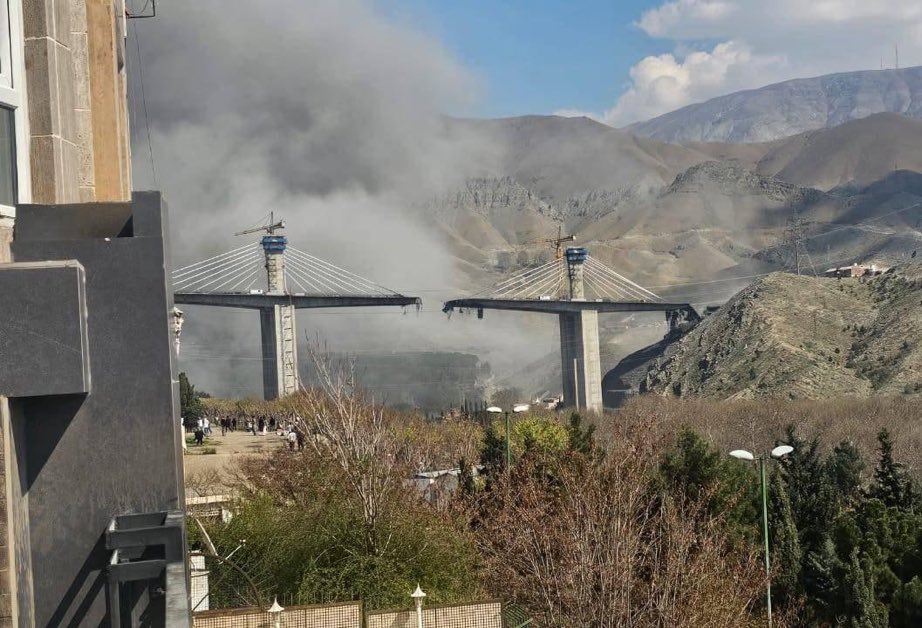
The U.S. and Israeli regimes have assassinated our leaders, killed schoolchildren, and attacked hospitals, universities, energy facilities, and desalination plants. They have now struck the Pasteur Vaccine Institute and key road bridges. They openly threaten to bomb our power infrastructure and “return Iran to the Stone Age.” It seems these realities do not reach Australian and EU officials, or they are unwilling to condemn them. Instead, they criticize Iran’s self-defense. The world and history will judge you. Do not stand on the side of Nazis.


Senator Penny Wong@SenatorWong
Ahead of tonight’s meeting with international counterparts, I spoke with @AnitaAnandMP about the conflict and its impact on global energy markets. We all want to see safe passage restored through the Strait of Hormuz and an end to it being held hostage by the Iranian regime.
English
Krishna Sarma retweetledi

There is a certain genre of writing that substitutes accusation for argument. It begins by assigning motive, then arranges facts,real, distorted, or imagined, to fit that conclusion. The recent commentary on my views on India-Pakistan relations follows that familiar script.
Let me state the essentials clearly. To argue that India must combine deterrence with engagement is NOT to diminish the reality of terrorism, nor to excuse it. It is to recognise how serious nations manage adversaries. India has, across governments and decades, done precisely this, responding firmly to terror while retaining channels of communication where necessary to prevent escalation and miscalculation. This is not sentimentality. It is statecraft.
The suggestion that engagement grants “impunity” rests on a false binary, that one must either talk or act. In practice, states do both. To collapse that complexity into a moral accusation may make for forceful prose, but it does not make for sound policy.
The caricature of a women’s caucus is equally misplaced. It is not proposed as a substitute for national policy, nor as a solution to entrenched conflict. It is a modest Track II initiative, one of many possible avenues, to widen dialogue, reduce hostility, and explore areas where cooperation may still be possible. Such efforts do not require approval from those who see every form of engagement as capitulation.
Invoking the suffering of victims of terrorism to argue against any form of dialogue is particularly troubling. Their loss demands seriousness, not rhetorical deployment. Accountability is not strengthened by narrowing the space for thought.
The claim that an idea is discredited because it is welcomed by a Pakistani voice is also a curious standard. If the merit of an argument is to be judged by who agrees with it, then independent judgment itself is surrendered. Ideas must stand or fall on their own logic.
Beyond the rhetoric lies a more fundamental question: what is India’s end game with Pakistan?
If it is to reduce Pakistan to rubble, that is fantasy dressed up as toughness. It is not going to happen, and any attempt to move in that direction would risk catastrophe for the entire region, not least for India. Nuclear geography is a stern schoolmaster. It does not indulge chest-thumping.
The real end game has to be containment, deterrence, internal strengthening, and selective engagement.
In plain words:
India’s objective should be to make Pakistan’s use of terror too costly to sustain, while preventing the relationship from sliding into permanent uncontrolled escalation. That means four things.
First, raise the cost of terrorism. Through intelligence, border management, diplomatic isolation where warranted, calibrated military response when necessary, and relentless exposure of the infrastructure of proxy violence. No illusions there.
Second, deny Pakistan veto power over India’s future. We should not let our growth, our diplomacy, our regional ambitions, or our internal confidence be held hostage by a single hostile neighbour. The greatest strategic answer to Pakistan is a stronger, more cohesive, more prosperous India.
Third, manage the conflict, not romanticise it. There will be no grand reconciliation in the near term. But neither can every interaction be reduced to rage. Ceasefire mechanisms, back channels, water safeguards, crisis hotlines, and limited functional engagement are not signs of softness. They are instruments of control.
Fourth, keep open the possibility of a different future without betting on it. That is where dialogue belongs. Not as wishful thinking, not as “aman ki asha” balloon releases, but as disciplined statecraft. You talk not because you trust, but because you must understand, signal, warn, probe, and occasionally de-escalate.
So the end game is not rubble.
It is a Pakistan that is deterred, constrained, denied easy success, and unable to derail India’s future.
Fury is a mood. It is not a policy.
English
Krishna Sarma retweetledi

Stone Age?
At a time when you were still in caves searching for fire, we were inscribing human rights on the Cyrus Cylinder.
We endured the storm of Alexander and the Mongol invasions and remained; because Iran is not just a country, it is a civilization.
Pete Hegseth@PeteHegseth
Back to the Stone Age.
English
Krishna Sarma retweetledi

“5 years ago, in the top 10 would be 8 U.S. universities, 1 from France, and 1 from Germany and/or the UK, depending on the count. Right now, if you see the same index in 2025, 8 of the top are Chinese and only 1—Harvard—remains,” says Albert Bourla, chairman and CEO of Pfizer, Inc. Bourla refers to the Nature Index, a ranking of universities and institutions by their contributions to high-quality scientific research in the natural sciences.
🔗 Watch the full conversation: on.cfr.org/4bIWMw3
English
Krishna Sarma retweetledi