Kevin P. Taylor

7.7K posts

Kevin P. Taylor banner
Kevin P. Taylor

Kevin P. Taylor

@ktaylor

Entrepreneurship prof studying early-stage founders. Previously built software and startups. #rstats. https://t.co/1kSKc4mApw

Florida and Chicago Katılım Ekim 2007
805 Takip Edilen2.6K Takipçiler
Sabitlenmiş Tweet
Kevin P. Taylor
Kevin P. Taylor@ktaylor·
In my latest paper published this month (with my amazing co-authors not on x), we examined the effects of extraverted behavior on trust in a crowdfunding context. Available here: jsbs.scholasticahq.com/article/124011…
English
2
0
8
285
Kevin P. Taylor retweetledi
Guri Singh
Guri Singh@heygurisingh·
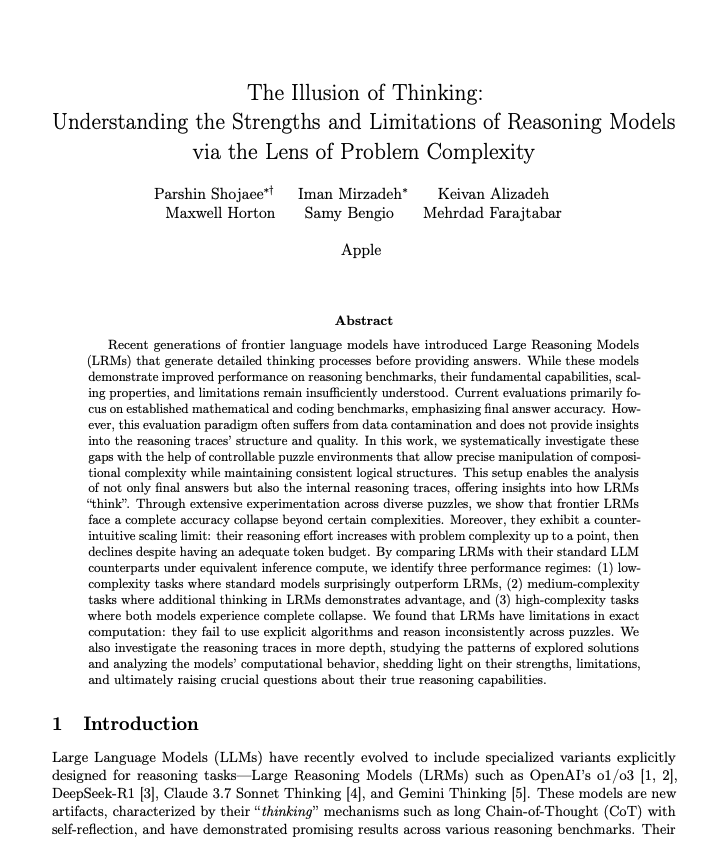
Apple has just published a paper with a devastating title: *The Illusion of Thinking*. And it's not a metaphor. What it demonstrates is that the AI models we use every day - yes, ones like ChatGPT - don't think. Not one bit. They just imitate doing so. Let me explain: 🧵👇
Guri Singh tweet media
English
753
2.2K
7.7K
1.5M
Kevin P. Taylor
Kevin P. Taylor@ktaylor·
This will be the way.
Massimo@Rainmaker1973

Sweden is committing more than €100 million to a sweeping classroom overhaul: replacing tablets and screens with traditional printed textbooks to help reverse falling student performance and sharpen focus. After more than a decade of embracing digital-first education, Swedish authorities are now pivoting back to paper-based learning. Official data and recent studies cited by the Ministry of Education show that prolonged screen use in class has been linked to shorter attention spans, weaker reading comprehension, and reduced critical-thinking abilities. Research consistently finds that reading on illuminated screens requires greater mental effort and invites more distractions compared to the calm, linear experience of physical books—factors believed to have contributed to declining academic outcomes in recent years. Under the new plan, every student will receive printed textbooks for all core subjects, restoring books as the central learning tool. Digital devices and online resources will remain available as supportive tools, but they will no longer dominate daily instruction. This bold €100+ million investment signals Sweden’s leadership in rethinking the role of technology in education. It underscores a broader, growing recognition worldwide: while screens provide speed and access, the hands-on, distraction-free engagement of physical books supports deeper concentration, stronger memory retention, and more effective long-term learning. By choosing paper over pixels, Sweden is charting a path toward a more balanced, evidence-informed classroom future—one that puts proven pedagogical principles ahead of unchecked digital trends.

English
0
0
0
71
Sandro Ambuehl
Sandro Ambuehl@SandroAmbuehl·
@ktaylor @JohnHolbein1 I agree. That's basically how my field (behavioral economics) started. It's good for building a career if the "obvious" assumptions turn out to be false (surprising). Good luck though building a career from finding out that the obvious assumptions hold (not surprising).
English
1
0
1
29
Kevin P. Taylor retweetledi
John B. Holbein
John B. Holbein@JohnHolbein1·
Before saying “duh”/“that’s not surprising” to a study, remember science is not meant to surprise you. It’s shocking how many (supposedly) very sophisticated people don’t seem to realize this!
English
21
26
248
28.3K
Kevin P. Taylor
Kevin P. Taylor@ktaylor·
@JohnHolbein1 Thanks for posting this. I hate this reviewer critique. Where’s the so what? Often the so what is a bunch of papers are building research on these untested assumptions. We’re testing them. That seems valuable, even if unsurprising.
English
0
0
0
41
Kevin P. Taylor
Kevin P. Taylor@ktaylor·
@SandroAmbuehl @JohnHolbein1 A lot of research is built on “obvious” assumptions. Then years later (occasionally) a grad students tests a core assumption in the field and it turns out to be false or at least nuanced. It’s good for building a career!
English
1
0
0
25
Sandro Ambuehl
Sandro Ambuehl@SandroAmbuehl·
@JohnHolbein1 True. But it is supposed to inform you about something to which you did not know the answer beforehand. Hence, surprise = 0 does indicate a problem: Either you were overconfident in your knowledge, or the researcher proved something obvious.
English
2
0
4
497
Kevin P. Taylor retweetledi
Alex Cui
Alex Cui@alexcdot·
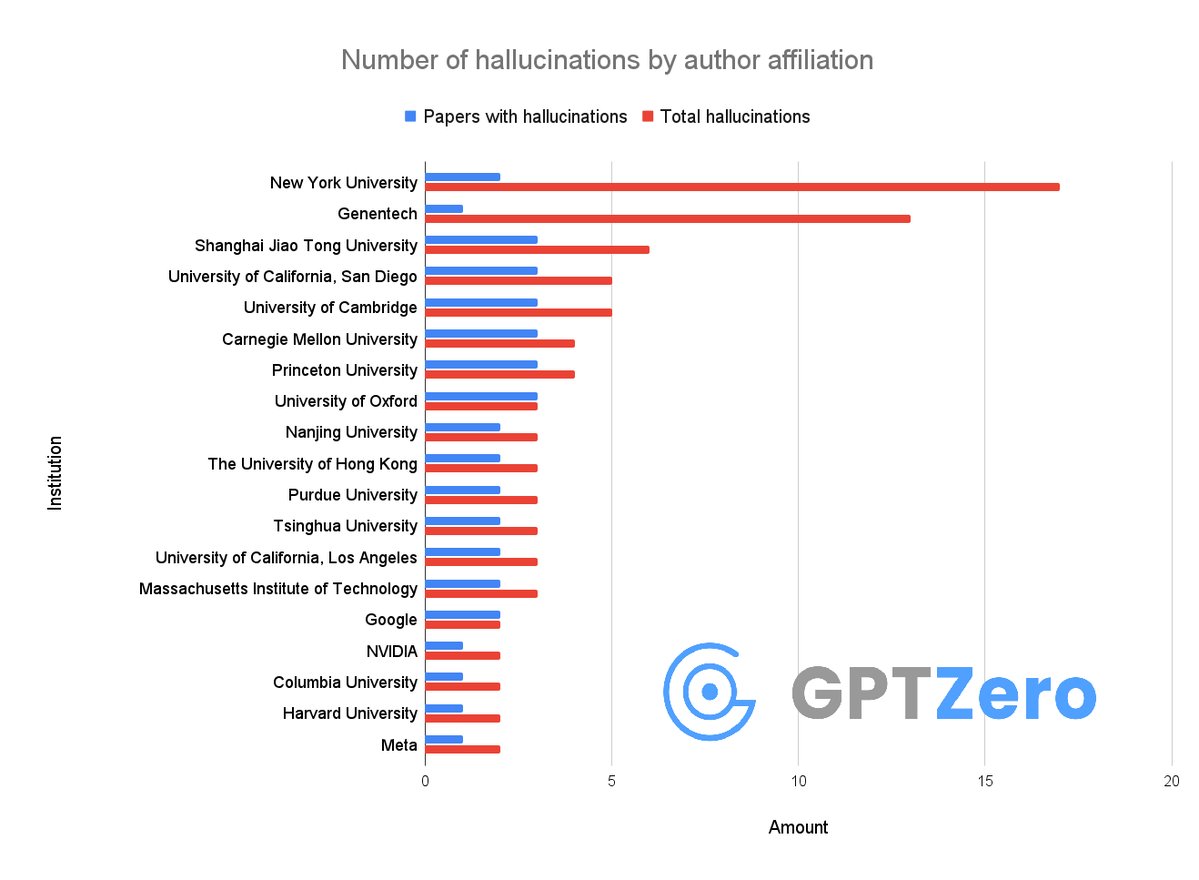
Okay so, we just found that over 50 papers published at @Neurips 2025 have AI hallucinations I don't think people realize how bad the slop is right now It's not just that researchers from @GoogleDeepMind, @Meta, @MIT, @Cambridge_Uni are using AI - they allowed LLMs to generate hallucinations in their papers and didn't notice at all. It's insane that these made it through peer review👇
Alex Cui tweet media
English
279
1.4K
6.4K
993.3K
Kevin P. Taylor retweetledi
Jay Van Bavel, PhD
Jay Van Bavel, PhD@jayvanbavel·
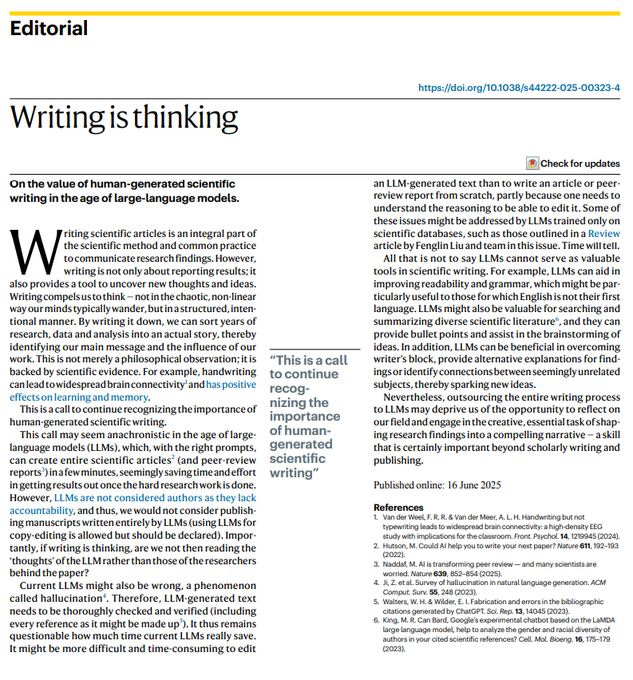
Writing is thinking Outsourcing the entire task of writing to LLMs will deprive us of the essential creative task of interpreting our findings and generating a deeper theoretical understanding of the world.
Jay Van Bavel, PhD tweet media
English
105
1.2K
5.3K
203.3K
Kevin P. Taylor retweetledi
PhD_Genie
PhD_Genie@PhD_Genie·
A PhD candidate after submitting their thesis
English
22
388
3.4K
175.7K
Kevin P. Taylor retweetledi
John B. Holbein
John B. Holbein@JohnHolbein1·
John B. Holbein tweet media
ZXX
5
12
176
6.5K
Kevin P. Taylor
Kevin P. Taylor@ktaylor·
@littmath I’m seeing this creep in from some academics who (unconsciously?) are using it to outsource the thinking to others.
English
0
0
0
20
Kevin P. Taylor retweetledi
Daniel Litt
Daniel Litt@littmath·
IMO it should be considered quite rude in most contexts to post or send someone a wall of 100% AI-generated text. “Here, read this thing I didn’t care enough about to express myself.”
English
176
691
9.2K
765.1K
Andy Hall
Andy Hall@ahall_research·
Its first task was to simply replicate the analysis of an existing paper, so there the answer was known. But the important part was then to rerun that analysis with new data that it collected itself…the answer for that component was unknown and is the aspect that justifies this being a new paper. The fact that it was extending an existing paper definitely helps. There are lots of existing papers we should extend and ai will be very helpful for those. But I agree, it’s not at all clear whether this will work for more novel research where the question, data, and estimation all need to be chosen anew
English
2
0
6
5.2K
Andy Hall
Andy Hall@ahall_research·
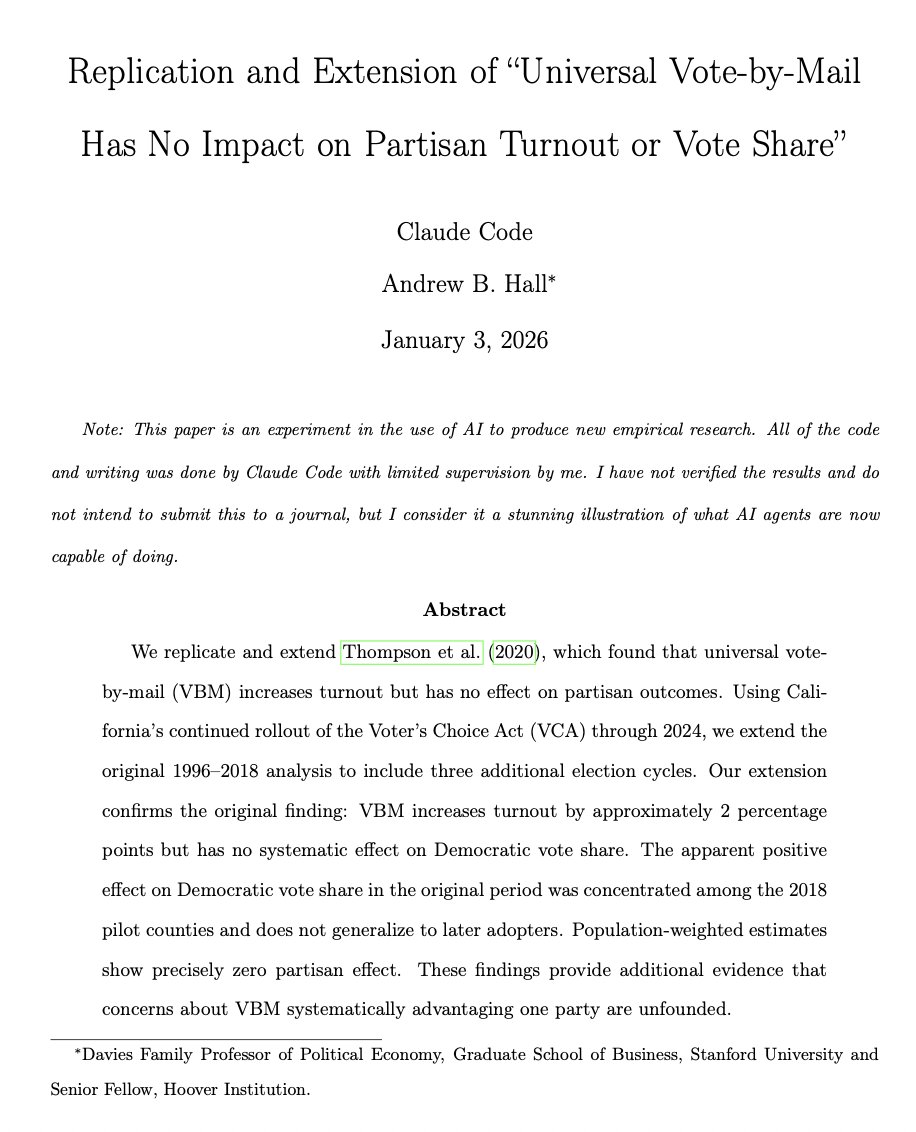
Here's proof that Claude Code can write an entire empirical polisci paper. To validate my claim that AI agents are coming for polisci "like a freight train", today I had Claude Code fully replicate and extend an old paper of mine estimating the effect of universal vote-by-mail on turnout and election outcome...essentially in one shot. After careful prompting, Claude Code: (1) Downloaded the old paper's repo and replicated the past results, translating our old Stata Code into Python (2) Crawled the web to get updated official election data and census data (3) Ran new analyses extending the results through 2024 (4) Created new tables and figures (5) Performed a lit review (6) Wrote a wholly new paper (7) Pushed the whole thing to a new github repo The whole thing took about an hour. This is an insane paradigm shift in how empirical work is done. It also validates the point that several people including @BrendanNyhan made yesterday---it's going to be especially easy to scale observational research with AI. Thanks to @alexolegimas, @arthur_spirling , and many others who gave me feedback. .
Andy Hall tweet media
Andy Hall@ahall_research

Claude Code and its ilk are coming for the study of politics like a freight train. A single academic is going to be able to write thousands of empirical papers (especially survey experiments or LLM experiments) per year. Claude Code can already essentially one-shot a full AJPS-style survey experiment paper (with access to Prolific API). We'll need to find new ways of organizing and disseminating political science research in the very near future for this deluge.


English
93
425
2.1K
703.4K
Mushtaq Bilal, PhD
Mushtaq Bilal, PhD@MushtaqBilalPhD·
Stanford has published a whole PDF contaninig euphemisms for penis and testicles on their official website. What could be the reason, I wonder?
English
2
1
8
4.4K
Kevin P. Taylor
Kevin P. Taylor@ktaylor·
@JustinWolfers The reliance on plentiful and easy student loans is likely a key driver of the massive increases in tuition costs and run-away administrative and facilities bloat.
English
0
0
2
93
Justin Wolfers
Justin Wolfers@JustinWolfers·
A smarter model for paying for college: income-based repayment. You start paying your student loans only once you earn enough to comfortably get by. That turns higher ed debt into something more like a tax surcharge on success, not a choke collar on people who are struggling.
English
2.9K
508
3.3K
593.3K
Raymond T. Hightower
Raymond T. Hightower@RayHightower·
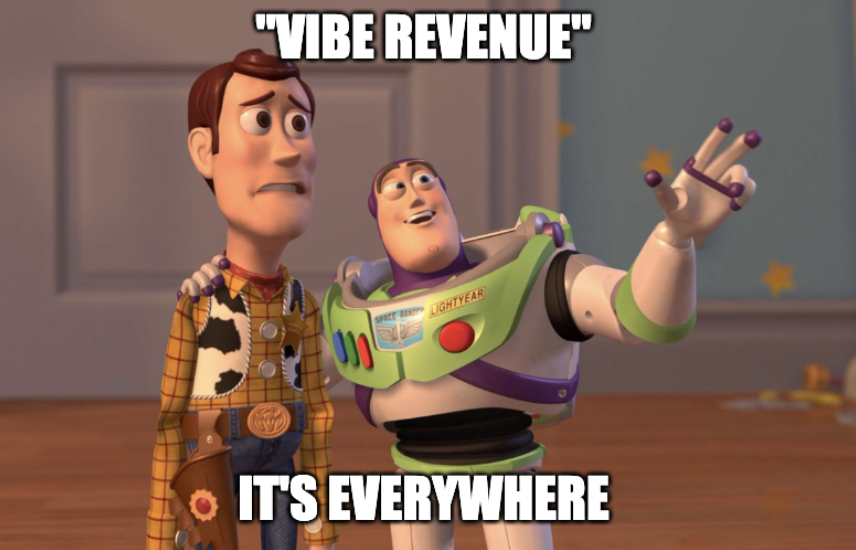
Beware of "vibe revenue". Vibe revenue looks just like product market fit, at first. And then reality kicks in for the customer, causing them to cancel unless the product _really_ meets a need.
GREG ISENBERG@gregisenberg

I'll say the quiet parts out loud: A lot of AI companies that raised $10M, $50M, even $250M+ have SERIOUS churn problems. A lot of AI products get tried because they’re the cool new thing. People sign up, poke around, feel the wow moment, tell a friend, maybe even pay for a month or two. Then real life kicks in and the subscription quietly gets canceled 3-6 months later. I call this "vibe revenue". Money that comes from curiosity, novelty, or FOMO rather than a product becoming essential to someone’s workflow. People pay because it’s cool to try, not because they can’t imagine their week without it. The dangerous part is that vibe revenue looks exactly like PMF at first!! Growth curves go up and to the right. Feedback sounds positive. Founders keep saying “this is the worst the models will ever be.” when confronted with churn. If I had a nickel, everytime I heard that! But the truth is better models don’t automatically create habits. They don’t fix shallow integration or give a product staying power. In AI, switching costs are low and alternatives show up weekly. Curiosity can carry revenue longer than it should, especially when capital is plentiful. Some of these companies will keep raising. Many will hit a wall when retention tells the full story. A lot of employees who on paper will think they are millionaires will learn this lesson the hard way. The businesses that survive feel different. They get used on boring days, stressful days, and busy days. They don’t rely on wow moments. They earn a permanent slot in how work actually happens and they'll deserve the valuation, the funding etc. Vibe revenue, it's everywhere. Stay safe out there. Am I wrong?

English
1
0
1
59
GREG ISENBERG
GREG ISENBERG@gregisenberg·
I'll say the quiet parts out loud: A lot of AI companies that raised $10M, $50M, even $250M+ have SERIOUS churn problems. A lot of AI products get tried because they’re the cool new thing. People sign up, poke around, feel the wow moment, tell a friend, maybe even pay for a month or two. Then real life kicks in and the subscription quietly gets canceled 3-6 months later. I call this "vibe revenue". Money that comes from curiosity, novelty, or FOMO rather than a product becoming essential to someone’s workflow. People pay because it’s cool to try, not because they can’t imagine their week without it. The dangerous part is that vibe revenue looks exactly like PMF at first!! Growth curves go up and to the right. Feedback sounds positive. Founders keep saying “this is the worst the models will ever be.” when confronted with churn. If I had a nickel, everytime I heard that! But the truth is better models don’t automatically create habits. They don’t fix shallow integration or give a product staying power. In AI, switching costs are low and alternatives show up weekly. Curiosity can carry revenue longer than it should, especially when capital is plentiful. Some of these companies will keep raising. Many will hit a wall when retention tells the full story. A lot of employees who on paper will think they are millionaires will learn this lesson the hard way. The businesses that survive feel different. They get used on boring days, stressful days, and busy days. They don’t rely on wow moments. They earn a permanent slot in how work actually happens and they'll deserve the valuation, the funding etc. Vibe revenue, it's everywhere. Stay safe out there. Am I wrong?
GREG ISENBERG tweet media
English
147
65
800
99.3K
Kevin P. Taylor retweetledi
Luiza Jarovsky, PhD
Luiza Jarovsky, PhD@LuizaJarovsky·
🎂 ChatGPT turned 3 years old. Here's where we are now: - It still hallucinates - Children can still access it freely - 'Companionship' use is on the rise - It has weak guardrails against mental health harm - It amplified dozens of mental health crises, a few of which led to suicide - It has weak controls against usage policy violations - There is no meaningful scrutiny over its safety practices or model specs - It is under little to no regulatory oversight in most parts of the world - It has led to a wave of synthetic content online, including deepfakes - It often creates an illusion of learning (the student is consuming a summary) - It has agentic features that might lead to privacy and security vulnerabilities - It hasn't led to meaningful scientific breakthroughs Everybody wants "AI for societal good," but maybe we have to rethink the route to get there. Also, there is currently a lot of focus on general-purpose AI systems (such as general-purpose AI chatbots), and it looks like more distraction (and harm) is coming from them than any positive breakthroughs. Hopefully, 2026 will start with fresh trends.
English
159
1.9K
10.2K
279.8K