Kevin Werbach

18.8K posts

Kevin Werbach banner
Kevin Werbach

Kevin Werbach

@kwerb

Wharton prof, accountable AI guy, crypto nerd, tech policy maven, game thinker, MOOC teacher, Jewish panentheist, pescatarian.

Philly, USA Katılım Mart 2007
1.3K Takip Edilen26.8K Takipçiler
Kevin Werbach
Kevin Werbach@kwerb·
@ahall_research In one section last term, I gave students the choice of a written submission or AI-built tool for a focused audit of ChatGPT. Evaluating the built submissions was challenging. But I hope it will help inform the next round of experiments.
English
0
0
0
35
Kevin Werbach
Kevin Werbach@kwerb·
@ahall_research No question experiments are what's needed! At Wharton, most classes are capped at 60 (or 78 for the core); mine are usually full. I suspect the only way to assess AI-built tools at that scale is by using AI. Which shouldn't be off the table. But how to do so authentically?
English
1
0
0
44
Andy Hall
Andy Hall@ahall_research·
My new piece: instead of banning AI in teaching, we need to create an army of citizens who've learned how to build their own personal evals measuring whether AI fits their values. A new kind of distributed system that holds AI accountable to each of us. This is what I've experimented with in the classroom @StanfordGSB this quarter. My students have gone from no experience with code to building their own evals for AI using Claude Code. Every student designed their evals, got results, and created a leaderboard in a single three-hour class session with no structure or help. These ranged from studying how AI handles Brazilian elections or Burmese translation to how it solves logic puzzles and the extent to which it sticks to consequentialist philosophical values. It is mindboggling what it's possible to do in the classroom with AI now. My argument: every new technology raises concerns about how to update the way we teach and learn. Old wisdom from Aristotle to Bacon to Tocqueville to Dewey argues that the best way to learn is by *doing*. AI gives us new ways to learn by doing, and we need to embrace these as part of our toolkit. By building evals, students don't just gain experience managing coding agents, which will be essential to their post-college lives. --They turn AI into an object of study rather than a tool that passively guides them. --They get to engage their curiosity and their personal interests. --They experience what it will be like to be a member of a new kind of democratic society in which helping to hold AI systems accountable will be key --They have fun! There's a lot of pessimism about AI and the teaching experience right now, but this experiment has given me some reasons for optimism. Check out all the projects the students came up with, and more about the experiment and my argument, in the post here: freesystems.substack.com/p/an-army-of-c…
Andy Hall tweet media
English
29
46
279
115.6K
Kevin Werbach
Kevin Werbach@kwerb·
@ProfArbel Agreed. My worry is that so much of teaching is idiosyncratic. (Like, I don't know what an exam memo is. Maybe law schools are more uniform in teaching methods?) But that's OK; we're all going to have to be builders thanks to AI, so we professors should all learn too.
English
0
0
0
10
Yonathan Arbel
Yonathan Arbel@ProfArbel·
I think it's an exciting point. Some of us like to build stuff, and then others can adopt these tools without much know-how. To give a concrete example: a platform that takes your past exam memos, and then let students get feedback when they take practice exams. One person can build it, and then others can easily&freely reuse it. (solving the willingness-to-try-new-methods problem is much harder)
English
1
0
0
22
Yonathan Arbel
Yonathan Arbel@ProfArbel·
This is a bad policy. Lots of people are calling it unenforceable. They're almost right, but that's not the real issue. It's a bad policy because it's bad pedagogy. First, a prediction: Berkeley walks this back within three years. If you disagree, be brave enough to stake your position now. On enforceability. Technically it's enforceable, in the same way prohibitions on apostasy are enforceable: you collect testimony and you punish people. Detection here hinges on the professor's gut. Too many em dashes? F. You don't have the occasional typo? Sus! The pro-enforcement camp implicitly assumes professors possess some innate AI-detection power. They don't. The result is a regime saturated with Type 1 and Type 2 errors. oh, and if you mess up your bluebooking? a citation to a non-existent source automatically "raise[s] a presumption of prohibited AI use." But I care more about the pedagogy. Tucked into the rule is a prohibition on uploading "course materials, including assignments, readings, slides, class recordings, or other class content" into generative AI systems. That means a Berkeley student can't ask ChatGPT to quiz them before an exam. Can't ask it to explain voir dire at a tractable level. Can't use it as a patient, infinite, on-demand tutor on the vagaries of the rule against perpetuities These are extraordinary tools, and we're building more of them (wait for it). Students at competing schools will have them. Berkeley students won't. Beyond the competitive disadvantage, the harder question is this: how do faculty explain that this isn't about protecting professorial IP, real or imagined, but about serving students? The motte defenders retreat to is this: we need to build Core Competencies(TM), and you can't do that by letting students reach for AI on day one. The motte's true. But it is vastly narrower than the bailey that the policy creates. The policy rests on the assumption that the core competencies of a 1990 lawyer will remain the core competencies of a 2029 lawyer, that the AI revolution will be no bigger than the move from print reporters to Boolean searching on Westlaw. That's wild! Practice is already changing. If you don't have an agentic swarm running in the background right now, you're behind. Push defenders on which competencies, exactly, and the answers fall into three buckets. First, skills heading for obsolescence: manual bluebooking, drafting boilerplate from scratch, first-pass document review, summarizing depositions by hand. Second, skills that are real but almost certainly better trained with AI than against it: issue spotting drilled against an infinite supply of hypotheticals, brief feedback in seconds rather than weeks, writing improved through structured iteration with a tireless reader. Third, skills so vague they can't be measured. "Thinking like a lawyer." "Professional judgment." For these we have no way to know whether AI helps or hurts, yet the policy assumes it must hurt. But it's only a default, right? Well defaults matter, and this one's sticky. Professors have to opt out in writing. Even when they do, students *must* disclose every instance of AI use, which today already implicates using Google. Any ambiguity resolves against the student. The structural message is legible and loud: AI use is presumptively cheating. That message is wrong about almost everything. It's wrong about the technology, which isn't a shortcut but a new kind of cognitive partner. It's wrong about practice, where AI is already pervasive in the firms students are about to enter. It's wrong about teaching, by suggesting pedagogy needs no innovation in the face of the most powerful educational tool in a generation. And it's wrong about students, by casting those who use AI thoughtfully as people who lack fundamental skills, rather than as the lawyers Berkeley should be proudest to graduate. The best legal careers of the next decade will belong to lawyers who know when to use AI, when not to, how to verify it, how to weave it into legal reasoning, and how to supervise it in client matters. Policies like this one belong to those who resigned themselves to sit out this future.
Chris Hoofnagle@hoofnagle

Berkeley law has introduced a new, much stricter AI policy law.berkeley.edu/wp-content/upl…

English
21
17
75
15.9K
Kevin Werbach retweetledi
Andrew Ng
Andrew Ng@AndrewYNg·
The new White House policy requiring green card applicants to apply from outside the US is a capricious attack on legal immigration. It will hurt families, leave us with fewer doctors, teachers and scientists, and hurt American competitiveness in AI.
English
2.7K
1.6K
12.1K
1.3M
Kevin Werbach
Kevin Werbach@kwerb·
Holistic AI co-CEO @EmreKazim_ joined me on The Road to Accountable AI to discuss the evolution of AI governance, and why technical research and evaluation capacity are increasingly essential. Listen on your favorite podcast platform, or visit: accountableai.net
English
1
2
0
273
Kevin Werbach
Kevin Werbach@kwerb·
On The Road to Accountable AI, I spoke with Rumman Chowdhury about responsible AI in 2026, Independent Verification Org legislation, why AI evals are still immature, the risks of cutting entry-level hiring, and why discernment is the word of the year. 🎧 accountableai.net
English
0
1
0
255
Inside The Birds
Inside The Birds@InsideBirds·
The #Eagles have stockpiled offensive line depth over the past two years, mainly through the draft. @caplannfl and @GeoffPMosher go inside the competition this spring and summer that will determine which OL grab the top backup spots, and which could be eventual starters, on the latest "Inside The Birds" pod. Pod: tinyurl.com/2rup5fxc
Inside The Birds tweet media
English
2
13
17
17K
Kevin Werbach
Kevin Werbach@kwerb·
@wstv_lizzi What do Chinese authorities see as their country's structural advantages in agentic AI?
English
1
0
1
285
Kevin Werbach
Kevin Werbach@kwerb·
Most AI governance guidance is built for large enterprises. But half of American workers are in firms under 500 employees. On The Road to Accountable AI, Var Shankar breaks down how to give smaller organizations access to AI governance tools. Listen now: accountableai.net
English
0
1
0
253
Kevin Werbach
Kevin Werbach@kwerb·
New episode of The Road to Accountable AI: I talk with Katie Fowler of the @TR_Foundation about their new report analyzing AI governance practices at 3,000 companies worldwide. The findings are striking. Check it out at accountableai.net.
English
0
1
2
274
Kevin Werbach
Kevin Werbach@kwerb·
Is seeing (or hearing) no longer believing? @HenryAjder, my guest this week on The Road to Accountable AI, is one of the world’s leading experts on deepfakes and synthetic media. Listen on your favorite podcast platform, or visit: accountableai.net
English
0
1
1
254
Kevin Werbach
Kevin Werbach@kwerb·
Apple, Google, Oracle, and xAI down. My master plan to have Penn grads running every major tech company is proceeding well. The non-Quakers suspect nothing.
English
0
1
6
646
Kevin Werbach
Kevin Werbach@kwerb·
And everyone will talk about AJ being disgruntled and Russini helping out Vrabel, when it's really all about the upcoming extensions for Quinyon, DeJean, and Carter to extend the Eagles' Superbowl window. This seems obvious, no?
English
0
0
0
262
Kevin Werbach
Kevin Werbach@kwerb·
So am I understanding correctly that the handshake deal with the Pats for AJ Brown is a 2027 3rd and a 2028 1st? The Eagles will say they got their asking price, and NE will say they got their guy for nothing this year.
English
1
0
0
381
Kevin Werbach
Kevin Werbach@kwerb·
My guest this week on The Road to Accountable AI, @PhilipDawson of Armilla AI, makes the case for AI insurance as a tool for accountability. Listen to the full episode on your favorite podcast platform, or visit: accountableai.net
English
0
1
0
218
Kevin Werbach
Kevin Werbach@kwerb·
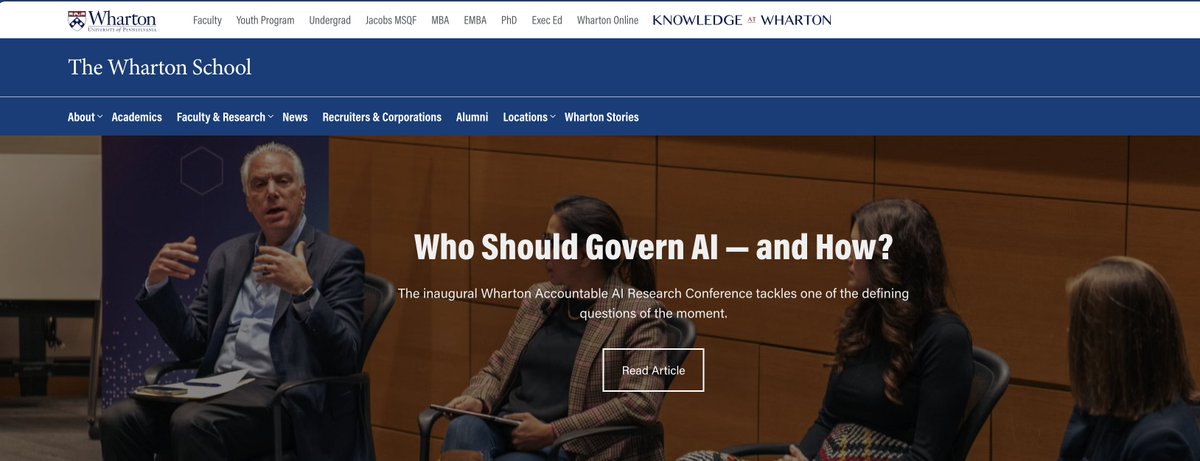
Delighted to see the home page for my distinguished institution, the Wharton School of the University of Pennsylvania, lead today with coverage of the Accountable AI Research Conference that my Accountable AI Lab hosted in February: ai-analytics.wharton.upenn.edu/news/the-whart…
Kevin Werbach tweet media
English
0
2
2
317
Kevin Werbach
Kevin Werbach@kwerb·
Could something with the mind-numbing name of ISO 42001 be one of the most exciting developments in AI governance? On The Road to Accountable AI, @Walter_Haydock and I talk AI certification standards. Listen on your favorite podcast platform, or visit: accountableai.net
English
0
1
0
220