Kyle Davidson

9.4K posts

Kyle Davidson banner
Kyle Davidson

Kyle Davidson

@kylejdavidson

Wreck it buy a new one.

Los Angeles Katılım Şubat 2009
263 Takip Edilen240 Takipçiler
Kyle Davidson
Kyle Davidson@kylejdavidson·
@glcarlstrom @BenjySarlin Isn’t he just listing off the “three” violations? Violation #1, #2, #3? I don’t think he was actually numbering the clauses in his post.
English
1
0
7
989
Gregg Carlstrom
Gregg Carlstrom@glcarlstrom·
Just to show how much of a shitshow this whole thing is: Qalibaf says that restraining Israel from attacks in Lebanon was the "first clause" of the 10-point proposal, but it wasn't the first clause in versions published by Iran's state news agency or IRGC-affiliated Tasnim Normally when you do a diplomatic deal you put stuff down on paper, but this whole thing appears to be some kind of vibes-based text-message diplomacy
محمدباقر قالیباف | MB Ghalibaf@mb_ghalibaf

English
69
213
828
273.2K
Kyle Davidson retweetledi
GeoConfirmed
GeoConfirmed@GeoConfirmed·
GeoConfirmed IRN. Disinformation. "Footage shows whatever hit the school was a failed rocket launch from IRGC, it wasn't Israel or US." This claim, with almost 11k likes, 5k retweets and 750.000+ views is WRONG based on GeoConfirmed geolocations. (link of the claim: x.com/Tarikh_Eran/st…) Left picture is the school in Minab, Hormozgan Province, Iran 27.109834, 57.084748 (GeoLocation: x.com/GeoConfirmed/s…) Right picture is from a misfire in Zanjan, Zanjan Province, Iran Point of view - 36.684951, 48.488164 "There is no possible way this could have hit the school, 1,300 kilometers in the opposite direction." Great work by @Stinky915846091 and @talhagin.
GeoConfirmed tweet media
English
266
2.1K
8.4K
1.4M
Dave Portnoy
Dave Portnoy@stoolpresidente·
I DID IT AGAIN! ANOTHER W FOR PORTNOY! EVERYTHING COMING UP PAGEVIEWS! @drink_phx
English
3.5K
67
5.8K
8.3M
Kyle Davidson
Kyle Davidson@kylejdavidson·
@CBSNews Internal bleeding lmao. Guy didn’t even drop his fucking phone. He’s got a vest and plenty of…cushion. Basically skipped away from the scene.
English
0
0
0
3
CBS News
CBS News@CBSNews·
BREAKING: The ICE agent who fatally shot Renee Good on Jan. 7 in Minneapolis, Jonathan Ross, suffered internal bleeding to the torso following the incident, according to two U.S. officials briefed on his medical condition.
English
34K
13K
92.2K
101M
Kyle Davidson
Kyle Davidson@kylejdavidson·
@JoshpHaywood @amandaorson Elon’s “relevant” algorithm made me scroll down WAY too far until I saw a comment like this. Perfect summation. Cap it rates, cap the massive profits, an if they don’t loan to people they used to, fine the fuck out of them. I dgaf about the points I get
English
0
0
0
153
Josh Haywood
Josh Haywood@JoshpHaywood·
@amandaorson This is a very long way of saying “poor people are paying for my credit card points”.
English
74
88
2.3K
297.5K
Amanda Orson
Amanda Orson@amandaorson·
Your credit card rewards exist because someone else is paying 25% APR. Cap that at 10% and the points don’t survive. I spent years working inside fintech and card programs. That interest margin is the invisible buffer that makes rewards, lounges, and credits pencil out. Capping credit card APRs at 10% sounds like an obvious consumer win. Cards charge 20 to 30%, many consumers revolve balances, and the system feels punitive. But credit card economics are not just about interest rates. They are a cross-subsidized system where revolvers subsidize transactors, rewards rely on behavioral inefficiency, and risk-based pricing subsidizes access. Remove one leg of that stool and the system does not become fairer; it rebalances. And the costs show up where consumers notice most. Lets look at how this would impact 3 programs 1. AMEX Platinum A 10% credit card APR cap would not make your card cheaper or better. You would still have access, but you would almost certainly get less value for the same or higher price. The Platinum brand survives because its customers are affluent, pay in full, and tolerate high annual fees. What quietly supports that ecosystem is portfolio-level profitability, which allows AMEX to tolerate loss, overuse, and inefficiency in premium benefits. When that margin shrinks, the cost shows up directly in your (lesser) benefits. In a world where: - Rewards economics tighten - Devaluations become more likely - Flexibility is reduced Points become a liability to the issuer, and liabilities get repriced. So what this likely means for you as a Platinum cardholder: - Lounges do not expand to fix crowding. Instead, access tightens or amenities are reduced. - Statement credits become harder to use, more fragmented, or less generous. - Annual fees go up - New approvals become more selective, even for high earners. Your card still works, but the value proposition shifts. Platinum becomes more explicitly pay-to-play, with fewer hidden subsidies propping up premium perks. You pay the same or more, and you get a little less in return. Which is why some people are already warning that points devaluations become more likely in this environment (like @BowTiedBull this morning saying "Dump ALL your credit card points. All of them.") 2. Bilt Card This program is the canary in the coal mine for what to expect. Bilt’s super popular rent rewards worked because Wells Fargo was willing to subsidize them. The card offered 1 point per dollar on rent with no fees because Wells Fargo paid Bilt roughly 0.8 percent (80 bps) of each rent payment to fund rewards... despite earning little or no interchange on those transactions. But that is some actuarial level math with a number of variables at risk that proved wrong/ unsustainable. Wells Fargo was getting hosed $10 million a month on the program, so they exited the partnership years before the original end date and forced Bilt to restructure its rewards with a different bank What does that teach us? - When interest and interchange margins shrink, banks stop tolerating loss-leading reward programs. - Interest income does not fund every reward directly, but it provides the buffer that allows experiments like Bilt to exist at all. - Remove that buffer and rewards must be paid for explicitly. Bilt’s shift to a three-tier lineup with annual fees is not an anomaly. It is the direction rewards go when credit stops quietly absorbing losses. Pay-to-play rewards. What feels like consumer protection will shows up as fewer perks, pay-to-play rewards, and less room for innovation. 3. Credit One & other Subprime Cards Now the least glamorous corner. Subprime cards get criticized for high APRs, annual fees, low limits, minimal rewards. But they exist for a reason. They serve thin-file borrowers, damaged credit, people shut out of conventional loans, households using cards for liquidity not perks... but they charge high APRs because charge-offs exceed 8-10%, fraud and servicing costs are higher, and credit limits are small while fixed costs remain significant. A 10% cap makes these products mathematically impossible. These cards don't become cheaper. They cease to exist. As @sytaylor noted this morning - "You realize this will push many more customers towards loan sharks?" The demand for credit doesn't disappear... it migrates to BNPL with opaque effective APRs, chronic overdraft usage, fee-heavy installment loans, and less regulated lenders like loan sharks/ payday loans. So who WOULD win? Debit-First Fintechs One of the least discussed consequences: where would reward customers migrate? I think 1% cashback programs are an obvious winner. Chime, Varo, Current and niche cards like Greenlight and Privacy. (If you have not worked in a fintech or a bank you probably don't know what the Durbin Amedment is - but the TL;DR is that very large banks (BoA, Wells, JPMC) have capped interchange rates of around 27 bps on debit swipes. Small banks with < $10B AUM, however, do not - they can earn 1-2% on interchange (avg was 160 bps or so last I checked). Which is why all of the debit card fintech companies you've heard of are partnered with these smaller banks - they can offer rewards like 1% cashback programs and still have margin sufficient to build a business around.) In a world where credit rewards shrink, access tightens, and annual fees rise, debit-based fintechs look better by comparison. But consumers lose: credit protections, payment float, stronger dispute rights, credit-building opportunities. TL;DR An APR cap feels like consumer protection. In practice it reshapes the market in ways that are easy to miss: - It will shrink access to credit - Eliminate rewards programs that aren't tied to high annual fees - Force risk into less regulated channels - Unintentionally advantages debit over credit - Help affluent transactors more than vulnerable borrowers Credit doesn't become cheaper. It becomes scarcer, less flexible, less transparent. But banks will adapt. Fintechs will adapt. Consumers caught in the middle do not get protected. They get fewer choices, worse products, and priced out.
Rapid Response 47@RapidResponse47

🚨 BREAKING

English
3.8K
1.1K
8.8K
5.7M
Acyn
Acyn@Acyn·
Doocy: How much money are you thinking of giving people in Greenland to get them on board?  Trump: I'm not talking about money for Greenland yet. Right now we are going to do something on Greenland, whether they like it or not. If we don’t do it the easy, we’ll do it the hard way.
English
515
578
1.2K
528.3K
Kyle Davidson retweetledi
nikki mccann ramírez
nikki mccann ramírez@NikkiMcR·
If having “a boat land there 500 years ago” isn’t a basis to claim ownership of the land boy do i have some news for the self proclaimed “Heritage Americans”
Acyn@Acyn

Trump on Greenland: If we do not do it the easy way, we will do it the hard way. By the way, I am a fan of Denmark. The fact they had a boat land there 500 years ago does not mean they own the land. We will be doing something with Greenland—the nice way, or the more difficult way

English
95
2.5K
17.3K
375.1K
Kyle Davidson retweetledi
jasper nathaniel
jasper nathaniel@infinite_jaz·
Remember this
English
117
1.6K
13.9K
531.8K
Kyle Davidson retweetledi
Justin Kanew
Justin Kanew@Kanew·
Everyone should be watching and sharing this NYT analysis, because it undercuts the from above angle Trump and others have used to make it seem like the ice agent was in more danger than he was. We all know what happened here.
English
104
984
2.3K
102.5K
Organist1022
Organist1022@organist1022·
You don't KNOW exactly what he said, or how he said it, because all you have is a NYT article and her CNN footage. If he said "the threats on your son are no one's fault but your own", straight up, just like that - she needs to put it out there. Because that's crazy talk. Unless/until she does, I don't buy it.
English
12
0
6
3.5K
Mel
Mel@Villgecrazylady·
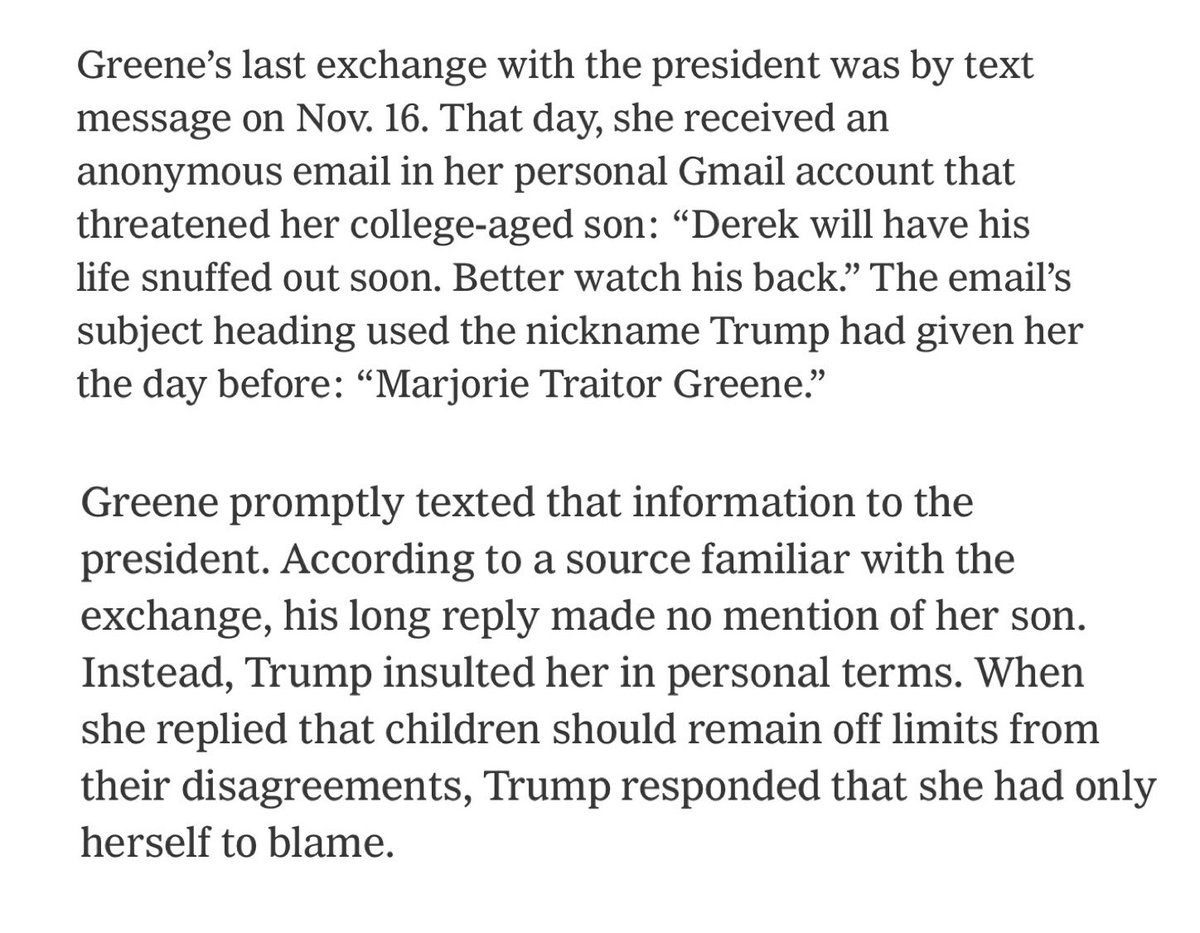
MTG got an email in her private Gmail explicitly threatening her son’s life and when she sent it to Trump he ultimately replied that “she had only herself to blame.” Five days later she announced she was leaving the House. “Hurr durr why would they* khill Charlie???” Looks like the intended message has been received by just about everyone: get out, get in-line or get ran over.
Mel tweet media
English
574
3.5K
13.1K
341.3K
Bill Madden
Bill Madden@maddenifico·
Whoa! Trump's ICE Nazis getting brutally pelted with snowballs by New Yorkers is fucking epic. 😂🤣😂🤣😂🤣👇
English
780
2K
11.7K
236K
Kyle Davidson
Kyle Davidson@kylejdavidson·
@TrueManBearPig @mountainwesttax @XFreeze lol dude your insistence on this is really telling. I found it funny, others did too. Go sit for like 10 min and try to think about the absurdity of the scenario you’ve concocted in your head. then go say something nice to someone you’re not trying to fuck 🥱
English
0
0
4
39
X Freeze
X Freeze@XFreeze·
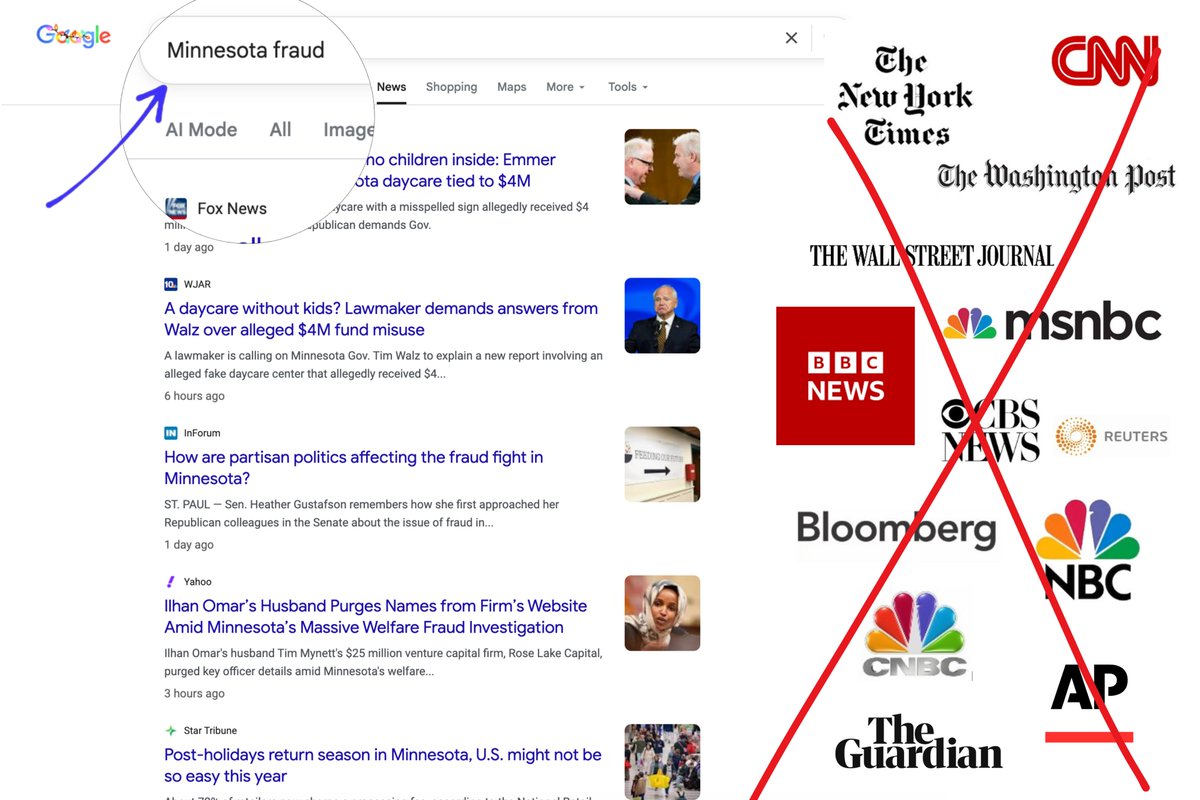
You literally can’t find a single mainstream article about the Minnesota fraud... Not even one... How is it that a simple guy with a camera can uncover over $110,000,000 in fraud in a single day, but giant billion‑dollar media organizations behind the glass doors somehow “miss” it for years? It’s not that they couldn’t find it. It’s that they wouldn’t They are desperate to bury this, protect their ideological allies, and smear anyone who exposes how rotten the system is with “it’s not as bad as it looks” think‑pieces or by turning it into a race‑based narrative to shut people up This is as clear as it gets in broad daylight The story isn’t just the fraud... The story is the massive cover‑up....
X Freeze tweet media
Nick shirley@nickshirleyy

🚨 Here is the full 42 minutes of my crew and I exposing Minnesota fraud, this might be my most important work yet. We uncovered over $110,000,000 in ONE day. Like it and share it around like wildfire! Its time to hold these corrupt politicians and fraudsters accountable We ALL work way too hard and pay too much in taxes for this to be happening, the fraud must be stopped.


English
1.7K
8.1K
26.9K
9.1M
Kyle Davidson
Kyle Davidson@kylejdavidson·
@Mykesssc @jaron95 The camera makes it seem blind, it’s not, the camera just can’t keep up. In real life you can see very well out of the tunnel.
English
0
0
1
38
Mad Mykes
Mad Mykes@Mykesssc·
@jaron95 This shit looks like a death trap. If this was in Miami you’d have people dead everyday.
English
2
0
14
1.6K
Jaron
Jaron@jaron95·
That car crash video is horrible. It definitely looks like Angeles Crest, even down to the tree placement, but why does it feel like AI? Where does this guy come from? He walks into frame where there was no one just seconds before. I doubt it's truly related to Vince Zampella.
Jaron tweet media
English
67
8
215
474.9K
Kyle Davidson
Kyle Davidson@kylejdavidson·
@jaron95 Also, he almost certainly would’ve driven into that tunnel from the other direction, looped around and come back to make this speed run. Not trying to argue just seeing a lot of people trying to argue the road is dangerous and it’s not.
English
0
0
0
42
Kyle Davidson
Kyle Davidson@kylejdavidson·
@jaron95 The camera struggles toe keep up with changing light but this isn’t reflective of what a human sees in the tunnel. If this is your video I’m sure you know you can see the exit of the tunnel and the wall from a ways back
English
1
0
1
386