
Bryan Kyritz
4.6K posts

Bryan Kyritz
@kyritzb
CTO @Jori_health Building the worlds best ai copilot for oncologists


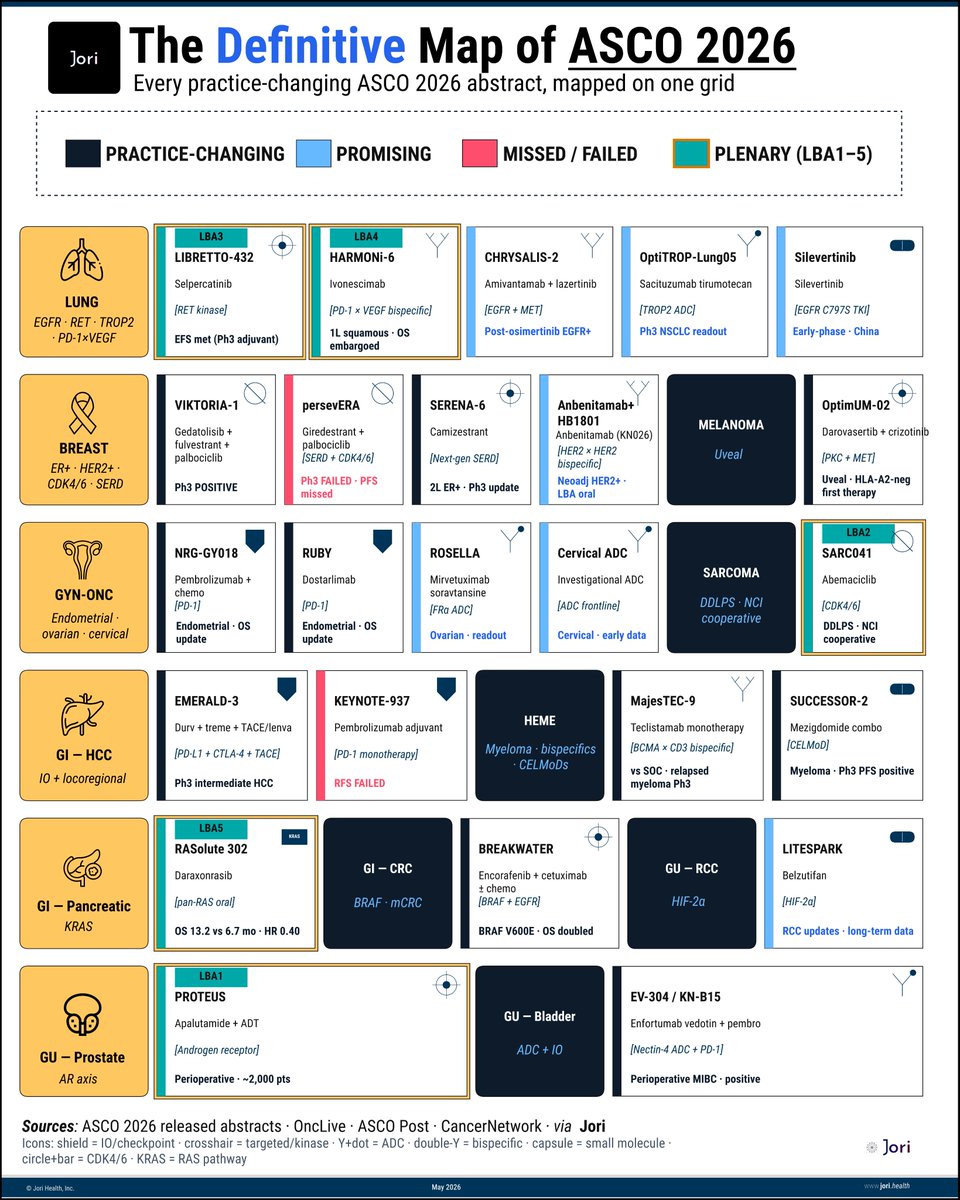
ASCO this year has 5,000+ abstracts. But maybe 24 will actually change practice. This is that map. (ERRATA: this plot fixes an error on VICTORIA which reflected incorrect data, thnx @Dr_RShatsky) Map spans 12 disease areas, 24 critical readouts, 5 plenaries & 2 confirmed misses already on the board. Few things jump out immediately: ▫️Pancreatic cancer gets the headline. Daraxonrasib: 13.2 vs 6.7 months. ▫️Sarcoma gets a plenary because public science funded what pharma would not. ▫️Lung cancer remains the most crowded battlefield in oncology: RET adjuvant, bispecific OS, post-osimertinib, next-gen EGFR. By next week, some of these cells will become new standards of care. This is your cheat sheet to keep score in real time. - - - - - Sources: @asco @OncLive @CancerNetwrk via @Jori_health - - - - -


Introducing SubQ - a major breakthrough in LLM intelligence. It is the first model built on a fully sub-quadratic sparse-attention architecture (SSA), And the first frontier model with a 12 million token context window which is: - 52x faster than FlashAttention at 1MM tokens - Less than 5% the cost of Opus Transformer-based LLMs waste compute by processing every possible relationship between words (standard attention). Only a small fraction actually matter. @subquadratic finds and focuses only on the ones that do. That's nearly 1,000x less compute and a new way for LLMs to scale.

The loudest plenary trial at ASCO may be one pharma did not fund. This year’s list tells a very clear story. ⭐ Daraxonrasib 13.2 vs 6.7 mo in pancreatic cancer. But then there is SARC041. A breast-cancer drug working in sarcoma. Pharma did not fund the Phase 3. NCI CTEP did. This is the split-screen reality of modern oncology. Pharma drives massive commercial breakthroughs. Public science carries diseases where the economics break down. SARC041 is that story. The rest of the plenary is stacked too: ▪️PROTEUS: Precision therapy moving earlier into localized prostate cancer. ▪️LIBRETTO-432: RET+ lung cancer moving into the adjuvant setting. ▪️HARMONi-6: First major OS signal for a PD-1 × VEGF bispecific. - - - - - Source: @ASCO 2026 - - - - -


We’ve automated every single thing we can @every with AI agents. And yet there’s way more human work to do than ever. We’ve gone from 4 -> 30 human employees since GPT-3. I wrote a report on the structural reasons: how AI makes expert competence cheap, why that drives up demand for experts, and why the dynamic only intensifies as we approach AGI. After Automation: every.to/p/after-automa…

one of the most interesting things about ai products today is that almost none of them are *live*. there’s nothing running continuously, reacting to context as it changes.. maybe a scheduled digest here or a timer there, but that’s just pull dressed up as push. everything is fundamentally a vending machine where you walk up, ask, get an answer, & then leave. getting this right is obviously tricky & the business model behind must fit to justify the burn but this is where really interesting application layer problems live rn.


Until now, physicians using AI in clinic had to assemble the patient’s context themselves. Allergies, comorbidities, medications, prior procedures, copy-pasted in from the chart. Today we’re announcing a partnership with @CedarsSinai. OpenEvidence now works directly inside Epic, drawing on the patient’s full record and interpreting the medical literature through the lens of that specific patient. Cedars-Sinai is the first academic health system to deploy patient-aware clinical intelligence at enterprise scale. The clinician asks a complex question in natural language. The answer reflects both the best available evidence and the patient in front of them. Patient data is never stored after the clinical session or used for any other purpose.


This graph tells a better story than the average. Almost immediately after graduation, doctors start quitting, and it drops at a continuous pace for 25 years. No plateau. Just continuous decay. Looks as bad as some of the survival curves in oncology! 20% are gone in 5 years! 5 years!! They train for 7 years after college and quit in less than that. They get out as soon as they can! That says one thing clearly - Graduating doctors are realizing that this is not what they signed up for The gaslighting during med school and residency fades fast in private practice. Doctors are not dumb.