x

557 posts

x

x

@l2shard

Katılım Mayıs 2019
1.3K Takip Edilen39 Takipçiler
x retweetledi
Hasu⚡️🤖
Hasu⚡️🤖@hasufl·
A fact I feel like almost nobody knows: Ethereum's gas limit will be increased to ~200M after Glamsterdam, a huge increase from the 60M we have today. That’s a 3x+ of L1 execution capacity, with expectation of further doubling soons after that. Assuming no similar increase in demand, fees could stay near zero for years. This is the result of several innovations coming together at the right time: ePBS gives payloads more time, BALs let clients prefetch/parallelize execution work, and gas repricings make higher limits safe.
English
69
161
1.3K
214.1K
x retweetledi
RYAN SΞAN ADAMS - rsa.eth 🦄
Huge! The SEC just gave DeFi a broker exemption. Uniswap UI, MetaMask Swap, DEX aggregators DON'T need to register as a broker-dealers. DeFi apps just can't get paid for order flow, offer investment advice, or touch user funds - all fair. Exactly the clarity we needed - the right approach. I remember SBF telling us in 2022 they'd never allow DeFi apps to not be regulated as broker-dealers (and that only he could save us....by selling out DeFi to the U.S. gov). Wrong again Sam. And as for this Atkins/Pierce SEC....they just keep being awesome.
U.S. Securities and Exchange Commission@SECGov

NEW 🚨: As part of Project Crypto, the Division of Trading and Markets issued a staff statement providing its views on broker-dealer registration requirements in connection with certain interfaces used to prepare transactions in crypto asset securities. ow.ly/fiGs50YImGn


English
52
189
1.3K
169.2K
x retweetledi
Aave
Aave@aave·
Aave V4 is now live on @ethereum.
English
213
466
2.9K
1M
x retweetledi
vitalik.eth
vitalik.eth@VitalikButerin·
Over the past year, many people I talk to have expressed worry about two topics: * Various aspects of the way the world is going: government control and surveillance, wars, corporate power and surveillance, tech enshittification / corposlop, social media becoming a memetic warzone, AI and how it interplays with all of the above... * The brute reality that Ethereum seems to be absent from meaningfully improving the lives of people subject to these things, even on the dimensions we deeply care about (eg. freedom, privacy, security of digital life, community self-organization) It is easy to bond over the first, to commiserate over the fact that beauty and good in the world seems to be receding and darkness advancing, and uncaring powerful people in high places are making this happen. But ultimately, it is easy to acknowledge problems, the hard thing is actually shining a light forward, coming up with a concrete plan that makes the situation better. The second has been weighing heavily on my mind, and on the minds of many of our brightest and most idealistic Ethereans. I personally never felt any upset or fear when political memecoins went on Solana, or various zero-sum gambling applications go on whatever 250 millisecond block chain strikes their fancy. But it *does* weigh on me that, through all of the various low-grade online memetic wars, international overreaches of corporate and government power, and other issues of the last few years, Ethereum has been playing a very limited role in making people's lives better. What *are* the liberating technologies? Starlink is the most obvious one. Locally-running open-weights LLMs are another. Signal is a third. Community Notes is a fourth, tackling the problem from a different angle. One response is to say "stop dreaming big, we need to hunker down and accept that finance is our lane and laser-focus on that". But this is ultimately hollow. Financial freedom and security is critical. But it seems obvious that, while adding a perfectly free and open and sovereign and debasement-proof financial system would fix some things, but it would leave the bulk of our deep worries about the world unaddressed. It's okay for individuals to laser-focus on finance, but we need to be part of some greater whole that has things to say about the other problems too. At the same time, Ethereum cannot fix the world. Ethereum is the "wrong-shaped tool" for that: beyond a certain point, "fixing the world" implies a form of power projection that is more like a centralized political entity than like a decentralized technology community. So what can we do? I think that we in Ethereum should conceptualize ourselves as being part of an ecosystem building "sanctuary technologies": free open-source technologies that let people live, work, talk to each other, manage risk and build wealth, and collaborate on shared goals, in a way that optimizes for robustness to outside pressures. The goal is not to remake the world in Ethereum's image, where all finance is disintermediated, all governance happens through DAOs, and everyone gets a blockchain-based UBI delivered straight to their social-recovery wallet. The goal is the opposite: it's de-totalization. It's to reduce the stakes of the war in heaven by preventing the winner from having total victory (ie. total control over other human beings), and preventing the loser from suffering total defeat. To create digital islands of stability in a chaotic era. To enable interdependence that cannot be weaponized. Ethereum's role is to create "digital space" where different entities can cooperate and interact. Communications channels enable interaction, but communication channels are not "space": they do not let you create single unique objects that canonically represent some social arrangement that changes over time. Money is one important example. Multisigs that can change their members, showing persistence exceeding that of any one person or one public key, are another. Various market and governance structures are a third. There are more. I think now is the time to double down, with greater clarity. Do not try to be Apple or Google, seeing crypto as a tech sector that enables efficiency or shininess. Instead, build our part of the sanctuary tech ecosystem - the "shared digital space with no owner" that enables both open finance and much more. More actively build toward a full-stack ecosystem: both upward to the wallet and application layer (incl AI as interface) and downward to the OS, hardware, even physical/bio security levels. Ultimately, tech is worthless without users. But look for users, both individual and institutional, for whom sanctuary tech is exactly the thing they need. Optimize payments, defi, decentralized social, and other applications precisely for those users, and those goals, which centralized tech will not serve. We have many allies, including many outside of "crypto". It's time we work together with an open mind and move forward.
English
747
663
4K
649.1K
x retweetledi
Justin Drake
Justin Drake@drakefjustin·
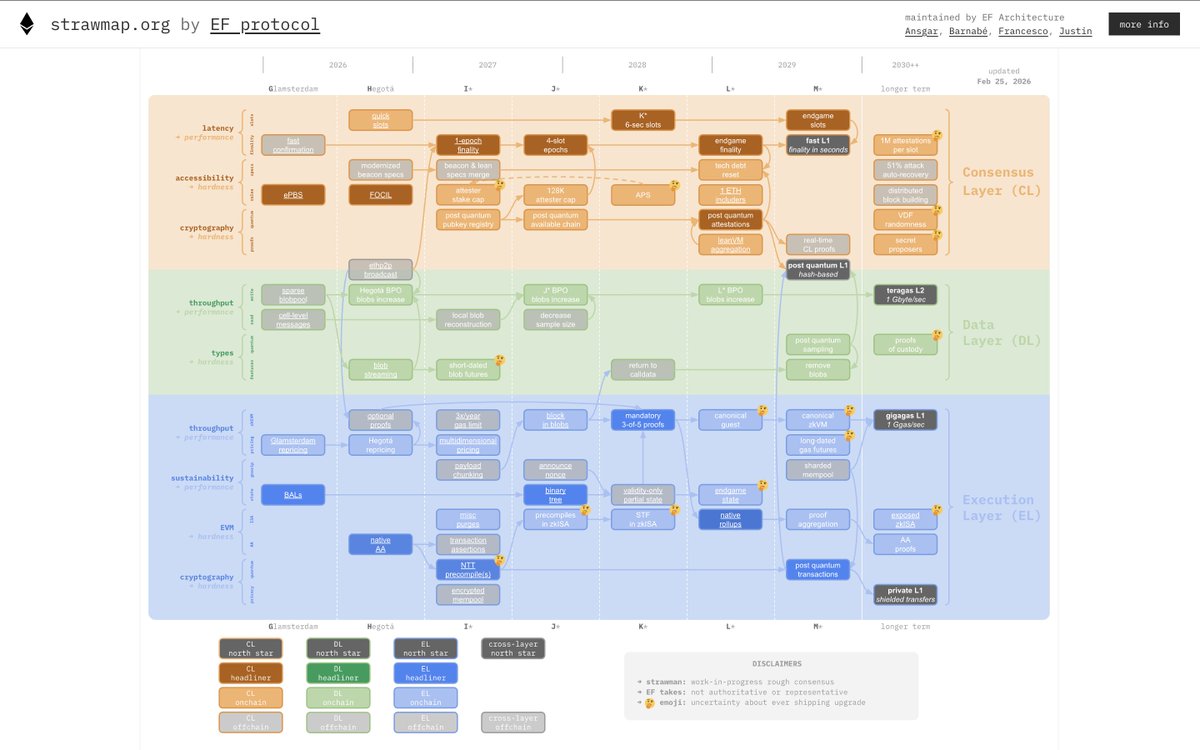
Introducing strawmap, a strawman roadmap by EF Protocol. Believe in something. Believe in an Ethereum strawmap. Who is this for? The document, available at strawmap[.]org, is intended for advanced readers. It is a dense and technical resource primarily for researchers, developers, and participants in Ethereum governance. Visit ethereum[.]org/roadmap for more introductory material. Accessible explainers unpacking the strawmap will follow soon™. What is the strawmap? The strawmap is an invitation to view L1 protocol upgrades through a holistic lens. By placing proposals on a single visual it provides a unified perspective on Ethereum L1 ambitions. The time horizon spans years, extending beyond the immediate focus of All Core Devs (ACD) and forkcast[.]org which typically cover only the next couple of forks. What are some of the highlights? The strawmap features five simple north stars, presented as black boxes on the right: → fast L1: fast UX, via short slots and finality in seconds → gigagas L1: 1 gigagas/sec (10K TPS), via zkEVMs and real-time proving → teragas L2: 1 gigabyte/sec (10M TPS), via data availability sampling → post quantum L1: durable cryptography, via hash-based schemes → private L1: first-class privacy, via shielded ETH transfers What is the origin story? The strawman roadmap originated as a discussion starter at an EF workshop in Jan 2026, partly motivated by a desire to integrate lean Ethereum with shorter-term initiatives. Upgrade dependencies and fork constraints became particularly effective at surfacing valuable discussion topics. The strawman is now shared publicly in a spirit of proactive transparency and accelerationism. Why the "strawmap" name? "Strawmap" is a portmanteau of "strawman" and "roadmap". The strawman qualifier is deliberate for two reasons: 1. It acknowledges the limits of drafting a roadmap in a highly decentralized ecosystem. An "official" roadmap reflecting all Ethereum stakeholders is effectively impossible. Rough consensus is fundamentally an emergent, continuous, and inherent uncertain process. 2. It underscores the document's status as a work-in-progress. Although it originated within the EF Protocol cluster, there are competing views held among its 100 members, not to mention a rich diversity of non-EFer views. The strawmap is not a prediction. It is an accelerationist coordination tool, sketching one reasonably coherent path among millions of possible outcomes. What is the strawmap time frame? The strawmap focuses on forks extending through the end of the decade. It outlines seven forks by 2029 based on a rough cadence of one fork every six months. While grounded in current expectations, these timelines should be treated with healthy skepticism. The current draft assumes human-first development. AI-driven development and formal verification could significantly compress schedules. What do the letters on top represent? The strawmap is organized as a timeline, with forks progressing from left to right. Consensus layer forks follow a star-based naming scheme with incrementing first letters: Altair, Bellatrix, Capella, Deneb, Electra, Fulu, etc. Upcoming forks such as Glamsterdam and Hegotá have finalized names. Other forks, like I* and J*, have placeholder names (with I* pronounced "I star"). What do the colors and arrows represent? Upgrades are grouped into three color-coded horizontal layers: consensus (CL), data (DL), execution (EL). Dark boxes denote headliners (see below), grey boxes indicate offchain upgrades, and black boxes represent north stars. An explanatory legend appears at the bottom. Within each layer, upgrades are further organized by theme and sub-theme. Arrows signal hard technical dependencies or natural upgrade progressions. Underlined text in boxes links to relevant EIPs and write-ups. What are headliners? Headliners are particularly prominent and ambitious upgrades. To maintain a fast fork cadence, the modern ACD process limits itself to one consensus and one execution headliner per fork. For example, in Glamsterdam, these headliners are ePBS and BALs, respectively. (L* is an exceptional fork, displaying two headliners tied to the bigger lean consensus fork. Lean consensus landing in L* would be a fateful coincidence.) Will the strawmap evolve? Yes, the strawmap is a living and malleable document. It will evolve alongside community feedback, R&D advancements, and governance. Expect at least quarterly updates, with the latest revision date noted on the document. Can I share feedback? Yes, feedback is actively encouraged. The EF Protocol strawmap is maintained by the EF Architecture team: @adietrichs, @barnabemonnot, @fradamt, @drakefjustin. Each has open DMs and can be reached at first.name@ethereum[.]org. General inquiries can be sent to strawmap@ethereum[.]org.
Justin Drake tweet media
English
208
419
1.6K
618.1K
x retweetledi
Justin Drake
Justin Drake@drakefjustin·
Today marks an inflection in the Ethereum Foundation's long-term quantum strategy. We've formed a new Post Quantum (PQ) team, led by the brilliant Thomas Coratger (@tcoratger). Joining him is Emile, one of the world-class talents behind leanVM. leanVM is the cryptographic cornerstone of our entire post-quantum strategy. After years of quiet R&D, EF management has officially declared PQ security a top strategic priority. Our journey began in 2019, with the "Eth3.0 Quantum Security" presentation at StarkWare Sessions. Since 2024, PQ has been central to the @leanEthereum vision. The pace of PQ engineering breakthroughs since then has been nothing short of phenomenal. It's now 2026, timelines are accelerating. Time to go full PQ: → PQ ACD: Antonio Sanso (@asanso) kicks off a bi-weekly All Core Devs PQ transactions breakout call next month. These sessions focus on user-facing security, covering dedicated precompiles, account abstraction, and longer-term transaction signature aggregation with leanVM. → PQ foundations: Today we are announcing a $1M Poseidon Prize to harden the Poseidon hash function. We are betting big on hash-based cryptography to enjoy the strongest and leanest cryptographic foundations. Check out our other $1M PQ initiative, the Proximity Prize. → PQ devnets: Multi-client PQ consensus devnets are live! Shoutout to pioneers @zeamETH, @ReamLabs, @PierTwo_com, @geanclient, @ethlambda_lean, as well as established consensus teams Lighthouse, Grandine, and soon Prysm. This incredible teamwork is coordinated by @corcoranwill via weekly PQ interop calls. → PQ workshops: Building on last year's PQ workshop in Cambridge (see photo), the EF is hosting another 3-day PQ event in October. Top experts from around the world will convene. In addition, a PQ day is set for March 29 in Cannes just ahead of EthCC. → PQ FV and AI: Last week Alex Hicks (@alexanderlhicks) ran a specialised maths AI for 8 hours, at a $200 cost. It one-shotted a formal proof one of the hardest lemmas in the foundations of hash-based snarks. Mind-blowing. Applied cryptography will never be the same. → PQ roadmap: A comprehensive breakdown of the EF's proposed PQ strategy will be shared soon™ on pq[.]ethereum[.]org. The roadmap targets a full transition in coming years with zero loss of funds and zero downtime. Stay tuned :) → PQ education: The ZKPodcast (@zeroknowledgefm) is producing a 6-part video series on Ethereum's PQ strategy. EF Enterprise Acceleration is also preparing material for enterprises and nation-states. Finally, Ethereum is now represented on the PQ advisory board that Coinbase announced yesterday. Believe in something. Believe in PQ security.
English
340
739
3.2K
1.2M
x retweetledi
vitalik.eth
vitalik.eth@VitalikButerin·
Have been following reactions to what I said about L2s about 1.5 days ago. One important thing that I believe is: "make yet another EVM chain and add an optimistic bridge to Ethereum with a 1 week delay" is to infra what forking Compound is to governance - something we've done far too much for far too long, because we got comfortable, and which has sapped our imagination and put us in a dead end. If you make an EVM chain *without* an optimistic bridge to Ethereum (aka an alt L1), that's even worse. We don't friggin need more copypasta EVM chains, and we definitely don't need even more L1s. L1 is scaling and is going to bring lots of EVM blockspace - not infinite (AIs in particular will need both more blockspace and lower latency than even a greatly scaled L1 can offer), but lots. Build something that brings something new to the table. I gave a few examples: privacy, app-specific efficiency, ultra-low latency, but my list is surely very incomplete. A second important thing that I believe is: regarding "connection to Ethereum", vibes need to match substance. I personally am a fan of many of the things that can be called "app chains". For example I think there's a large chance that the optimal architecture for prediction markets is something like: the market gets issued and resolved on L1, user accounts are on L1, but trading happens on some based rollup or other L2-like system, where the execution reads the L1 to verify signatures and markets. I like architectures where deep connection to L1 is first-class, and not an afterthought ("we're pretty much a separate chain, but oh yeah, we have a bridge, and ok fine let's put 1-2 devs to get it to stage 1 so the l2beat people will put a green checkmark on it so vitalik likes us"). The other extreme of "app chain", eg. the version where you convince some government registry, or social media platform, or gaming thing, to start putting merkle roots of its database, with STARKs that prove every update was authorized and signed and executed according to a pre-committed algorithm, onchain, is also reasonable - this is what makes the most sense to me in terms of "institutional L2s". It's obviously not Ethereum, not credibly neutral and not trustless - the operator can always just choose to say "we're switching to a different version with different rules now". But it would enable verifiable algorithmic transparency, a property that many of us would love to see in government, social media algorithms or wherever else, and it may enable economic activity that would otherwise not be possible. I think if you're the first thing, it's valid and great to call yourself an Ethereum application - it can't survive without Ethereum even technologically, it maximizes interoperability and composability with other Ethereum applications. If you're the second thing, then you're not Ethereum, but you are (i) bringing humanity more algorithmic transparency and trust minimization, so you're pursuing a similar vision, and (ii) depending on details probably synergistic with Ethereum. So you should just say those things directly! Basically: 1. Do something that brings something actually new to the table. 2. Vibes should match substance - the degree of connection to Ethereum in your public image should reflect the degree of connection to Ethereum that your thing has in reality.
English
1.7K
599
5K
1.1M
x retweetledi
jesse.base.eth
jesse.base.eth@jessepollak·
it’s great to see ethereum scaling L1 - this is a win for the entire ecosystem. going forward, L2s can’t just be “ethereum but cheaper.” that's why from the beginning of base we've shown up everyday to onboard new users, developers, and apps, push the technology forward, and do it all in a symbiotic way that grows the entire ecosystem. we’ve benefited deeply from building with ethereum - by leveraging its security and infrastructure, we've been able to focus: on building the best products and unlocking new real use cases across trading, social, gaming, creators, predictions, and so much more. We reached stage 1 last year and are accelerating towards solving the technical complexities of safely reaching stage 2. base is going to keep driving hard towards our mission: building a global economy that increases innovation, creativity, and freedom. to do that, we're already leaning into the kind of differentiation vitalik is talking about here, and have been supported by the EF in doing so: building the best apps, native account abstraction, privacy, scaling, and more. excited to work with ethereum to build the onchain future we all believe in.
vitalik.eth@VitalikButerin

There have recently been some discussions on the ongoing role of L2s in the Ethereum ecosystem, especially in the face of two facts: * L2s' progress to stage 2 (and, secondarily, on interop) has been far slower and more difficult than originally expected * L1 itself is scaling, fees are very low, and gaslimits are projected to increase greatly in 2026 Both of these facts, for their own separate reasons, mean that the original vision of L2s and their role in Ethereum no longer makes sense, and we need a new path. First, let us recap the original vision. Ethereum needs to scale. The definition of "Ethereum scaling" is the existence of large quantities of block space that is backed by the full faith and credit of Ethereum - that is, block space where, if you do things (including with ETH) inside that block space, your activities are guaranteed to be valid, uncensored, unreverted, untouched, as long as Ethereum itself functions. If you create a 10000 TPS EVM where its connection to L1 is mediated by a multisig bridge, then you are not scaling Ethereum. This vision no longer makes sense. L1 does not need L2s to be "branded shards", because L1 is itself scaling. And L2s are not able or willing to satisfy the properties that a true "branded shard" would require. I've even seen at least one explicitly saying that they may never want to go beyond stage 1, not just for technical reasons around ZK-EVM safety, but also because their customers' regulatory needs require them to have ultimate control. This may be doing the right thing for your customers. But it should be obvious that if you are doing this, then you are not "scaling Ethereum" in the sense meant by the rollup-centric roadmap. But that's fine! it's fine because Ethereum itself is now scaling directly on L1, with large planned increases to its gas limit this year and the years ahead. We should stop thinking about L2s as literally being "branded shards" of Ethereum, with the social status and responsibilities that this entails. Instead, we can think of L2s as being a full spectrum, which includes both chains backed by the full faith and credit of Ethereum with various unique properties (eg. not just EVM), as well as a whole array of options at different levels of connection to Ethereum, that each person (or bot) is free to care about or not care about depending on their needs. What would I do today if I were an L2? * Identify a value add other than "scaling". Examples: (i) non-EVM specialized features/VMs around privacy, (ii) efficiency specialized around a particular application, (iii) truly extreme levels of scaling that even a greatly expanded L1 will not do, (iv) a totally different design for non-financial applications, eg. social, identity, AI, (v) ultra-low-latency and other sequencing properties, (vi) maybe built-in oracles or decentralized dispute resolution or other "non-computationally-verifiable" features * Be stage 1 at the minimum (otherwise you really are just a separate L1 with a bridge, and you should just call yourself that) if you're doing things with ETH or other ethereum-issued assets * Support maximum interoperability with Ethereum, though this will differ for each one (eg. what if you're not EVM, or even not financial?) From Ethereum's side, over the past few months I've become more convinced of the value of the native rollup precompile, particuarly once we have enshrined ZK-EVM proofs that we need anyway to scale L1. This is a precompile that verifies a ZK-EVM proof, and it's "part of Ethereum", so (i) it auto-upgrades along with Ethereum, and (ii) if the precompile has a bug, Ethereum will hard-fork to fix the bug. The native rollup precompile would make full, security-council-free, EVM verification accessible. We should spend much more time working out how to design it in such a way that if your L2 is "EVM plus other stuff", then the native rollup precompile would verify the EVM, and you only have to bring your own prover for the "other stuff" (eg. Stylus). This might involve a canonical way of exposing a lookup table between contract call inputs and outputs, and letting you provide your own values to the lookup table (that you would prove separately). This would make it easy to have safe, strong, trustless interoperability with Ethereum. It also enables synchronous composability (see: ethresear.ch/t/combining-pr… and ethresear.ch/t/synchronous-… ). And from there, it's each L2's choice exactly what they want to build. Don't just "extend L1", figure out something new to add. This of course means that some will add things that are trust-dependent, or backdoored, or otherwise insecure; this is unavoidable in a permissionless ecosystem where developers have freedom. Our job should make to make it clear to users what guarantees they have, and to build up the strongest Ethereum that we can.

English
282
197
1.8K
192.2K
x retweetledi
ALEX | ZK
ALEX | ZK@gluk64·
On @VitalikButerin's latest L2 post: he's absolutely right. L2s must specialize to be valuable. We've been talking about this for over a year (see QT). For @zksync, the focus is PRIVACY -- for enterprises and financial institutions. We are the Bank Stack of Ethereum.
ALEX | ZK@gluk64

Great and intellectually honest post! 🙏 > Scale L1 to make sure that integration with Ethereum remains attractive. Fully agree and support it as an L2 founder. This will allow the rollup clusters to specialize in appchains and institutional chains. This is one of the best things Ethereum can do to regain economic upside and it should be signalled loudly. The other one is focusing on the monetary premium of ETH as a native collatral without the second best. > Scale DA to make sure that we lower the incentives for alt-DA (this doesn't have to mean lower fees. We can just charge a fee!) It's worth scaling DA to give users better security, and we at @zksync will be happy if a higher fee is charged for blobs because it our state-diff architecture offers a big advantage. But you won't get any significant economic results through it because you can't capture MEV this way. Even if you charge 1 cent/tx, that's negligible. > Work on shorter block times, single-slot L2 interop etc. to maximize value of Ethereum DA Same as above, and I highly doub't based rollups can help either: x.com/gluk64/status/…

English
43
42
399
43.7K
x retweetledi
DCinvestor
DCinvestor@DCinvestor·
Vitalik’s new post now clearly articulates the hyper-scaled vision for L1 while talking about how L2s can still fit in with it if they want to even if many undifferentiated general purpose L2s are not the way forward, L1 will never be enough we will always need specialized blockspace with unique characteristics, more superfast and high capacity blockspace which makes tradeoffs L1 can’t, and blockspace which corporate entities can exercise more control it’s a bold vision- one which the entire future of crypto could be built upon onward
vitalik.eth@VitalikButerin

There have recently been some discussions on the ongoing role of L2s in the Ethereum ecosystem, especially in the face of two facts: * L2s' progress to stage 2 (and, secondarily, on interop) has been far slower and more difficult than originally expected * L1 itself is scaling, fees are very low, and gaslimits are projected to increase greatly in 2026 Both of these facts, for their own separate reasons, mean that the original vision of L2s and their role in Ethereum no longer makes sense, and we need a new path. First, let us recap the original vision. Ethereum needs to scale. The definition of "Ethereum scaling" is the existence of large quantities of block space that is backed by the full faith and credit of Ethereum - that is, block space where, if you do things (including with ETH) inside that block space, your activities are guaranteed to be valid, uncensored, unreverted, untouched, as long as Ethereum itself functions. If you create a 10000 TPS EVM where its connection to L1 is mediated by a multisig bridge, then you are not scaling Ethereum. This vision no longer makes sense. L1 does not need L2s to be "branded shards", because L1 is itself scaling. And L2s are not able or willing to satisfy the properties that a true "branded shard" would require. I've even seen at least one explicitly saying that they may never want to go beyond stage 1, not just for technical reasons around ZK-EVM safety, but also because their customers' regulatory needs require them to have ultimate control. This may be doing the right thing for your customers. But it should be obvious that if you are doing this, then you are not "scaling Ethereum" in the sense meant by the rollup-centric roadmap. But that's fine! it's fine because Ethereum itself is now scaling directly on L1, with large planned increases to its gas limit this year and the years ahead. We should stop thinking about L2s as literally being "branded shards" of Ethereum, with the social status and responsibilities that this entails. Instead, we can think of L2s as being a full spectrum, which includes both chains backed by the full faith and credit of Ethereum with various unique properties (eg. not just EVM), as well as a whole array of options at different levels of connection to Ethereum, that each person (or bot) is free to care about or not care about depending on their needs. What would I do today if I were an L2? * Identify a value add other than "scaling". Examples: (i) non-EVM specialized features/VMs around privacy, (ii) efficiency specialized around a particular application, (iii) truly extreme levels of scaling that even a greatly expanded L1 will not do, (iv) a totally different design for non-financial applications, eg. social, identity, AI, (v) ultra-low-latency and other sequencing properties, (vi) maybe built-in oracles or decentralized dispute resolution or other "non-computationally-verifiable" features * Be stage 1 at the minimum (otherwise you really are just a separate L1 with a bridge, and you should just call yourself that) if you're doing things with ETH or other ethereum-issued assets * Support maximum interoperability with Ethereum, though this will differ for each one (eg. what if you're not EVM, or even not financial?) From Ethereum's side, over the past few months I've become more convinced of the value of the native rollup precompile, particuarly once we have enshrined ZK-EVM proofs that we need anyway to scale L1. This is a precompile that verifies a ZK-EVM proof, and it's "part of Ethereum", so (i) it auto-upgrades along with Ethereum, and (ii) if the precompile has a bug, Ethereum will hard-fork to fix the bug. The native rollup precompile would make full, security-council-free, EVM verification accessible. We should spend much more time working out how to design it in such a way that if your L2 is "EVM plus other stuff", then the native rollup precompile would verify the EVM, and you only have to bring your own prover for the "other stuff" (eg. Stylus). This might involve a canonical way of exposing a lookup table between contract call inputs and outputs, and letting you provide your own values to the lookup table (that you would prove separately). This would make it easy to have safe, strong, trustless interoperability with Ethereum. It also enables synchronous composability (see: ethresear.ch/t/combining-pr… and ethresear.ch/t/synchronous-… ). And from there, it's each L2's choice exactly what they want to build. Don't just "extend L1", figure out something new to add. This of course means that some will add things that are trust-dependent, or backdoored, or otherwise insecure; this is unavoidable in a permissionless ecosystem where developers have freedom. Our job should make to make it clear to users what guarantees they have, and to build up the strongest Ethereum that we can.

English
17
13
252
19.2K
x retweetledi
binji
binji@binji_x·
People are freaking out thinking the L2 roadmap got dismantled. It didn't. It evolved, literally ! The old roadmap: L2s were branded shards aka mini-Ethereum but cheap. Aka “your job is to scale and that’s it.” But! L2s did amazing things, they outcompeted, they spread what’s possible, they made people believe and actually USE this thing. So! The new roadmap: L2s are specialized chains that inherit Ethereum's security. The goal is now to be the best at somETHing. Privacy. Gaming. DeFi. Speed. AI. Social. Institutional. Whatever your USERS need. The politics, the “acknowledgment” does not matter, the proof is much realer (literally). This IS NOT Ethereum stepping back from L2s. ITS L2s stepping Forward. Stage 1 = minimum if you're handling ETH. Beyond that? Differentiate. Get weird. Build what only YOU can build. by the way the native rollup exists and is a REAL effort ! AKA ZK verification built into the protocol itself. This is literally Ethereum investing deeper in L2s, not walking away. The roadmap DID NOT get dismantled. It got upgraded. IT GOT FREER IT GOT MORE REAL. WE HAVE A JOB TO DO and the job is to bring this to the world togETHer. If you're building on an L2 right now, nothing changed except your ceiling. It just got higher.
English
134
146
977
328.3K
x retweetledi
Ethereum Daily
Ethereum Daily@ETH_Daily·
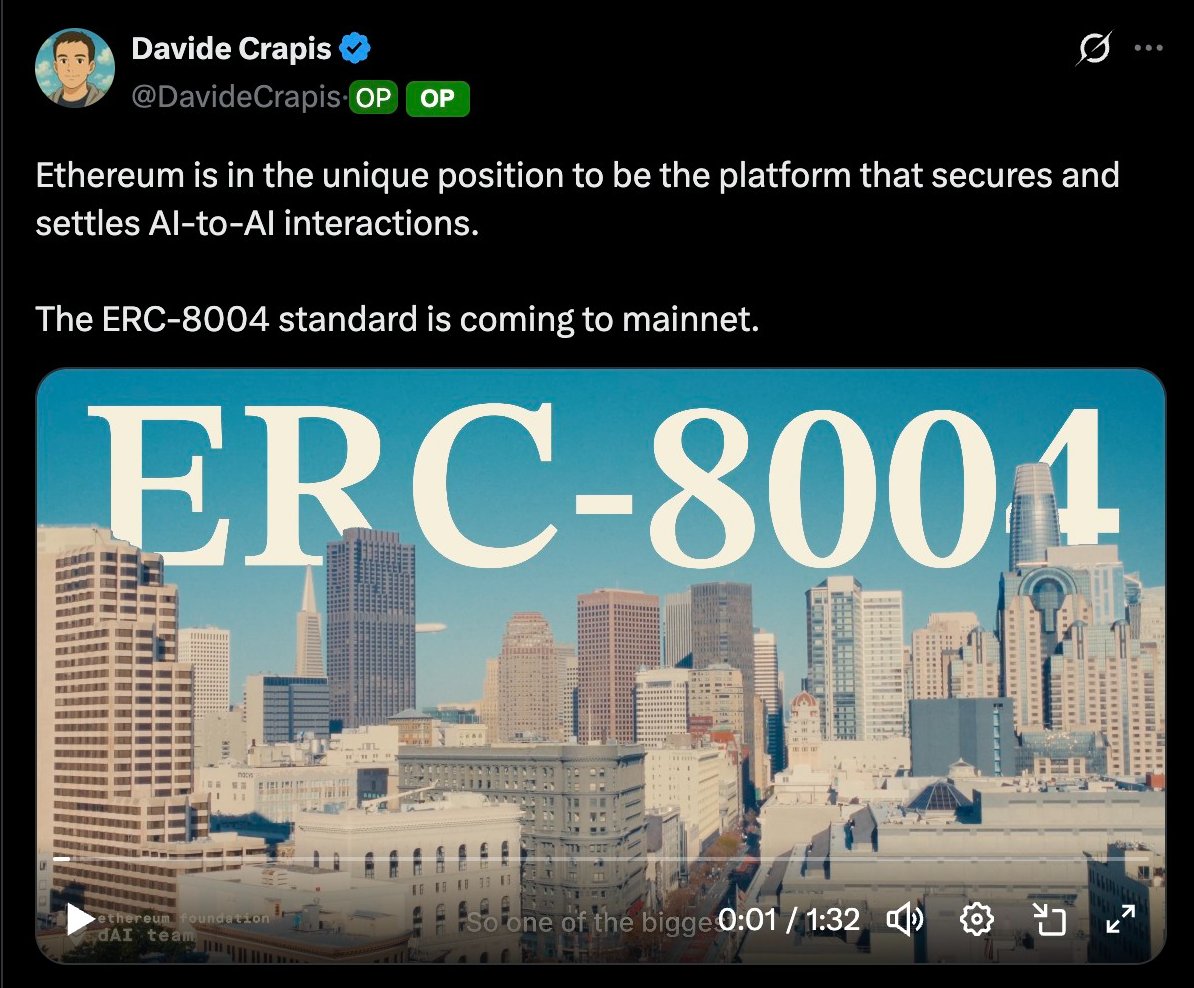
🔥HUGE MILESTONE: ERC-8004 is launching on Ethereum Mainnet imminently! ERC-8004 is a new standard on the Ethereum blockchain designed to help AI agents interact safely and reliably with each other, even if they're built by completely different people or companies. The Problem It Solves Right now, AI agents work great inside one company's system (where everything is pre-trusted), but they struggle in an open world. How does one agent find another useful agent? How does it know the other one is legit, competent, and won't mess up or scam it? Without a shared trust system, agents stay siloed, and we can't have a big, open "economy" of AI agents trading services. ERC-8004 fixes this by adding a simple "trust layer" on Ethereum, using three lightweight on-chain tools (called registries). It's like giving AI agents passports, review profiles, and certification stamps: - Identity Registry - Reputation Registry - Validation Registry Why This Matters ERC-8004 turns Ethereum into a neutral "settlement layer" for a massive decentralized AI economy. Agents can discover each other, build portable trust, and collaborate across organizations without needing big companies as middlemen.
Ethereum Daily tweet media
Ethereum@ethereum

ERC-8004 is going live on mainnet soon. By enabling discovery and portable reputation, ERC-8004 allows AI agents to interact across organizations ensuring credibility travels everywhere. This unlocks a global market where AI services can interoperate without gatekeepers.

English
41
79
500
67.2K
x retweetledi
vitalik.eth
vitalik.eth@VitalikButerin·
Ethereum itself must pass the walkaway test. Ethereum is meant to be a home for trustless and trust-minimized applications, whether in finance, governance or elsewhere. It must support applications that are more like tools - the hammer that once you buy it's yours - than like services that lose all functionality once the vendor loses interest in maintaining them (or worse, gets hacked or becomes value-extractive). Even when applications do have functionality that depends on a vendor, Ethereum can help reduce those dependencies as much as possible, and protect the user as much as possible in those cases where the dependencies fail. But building such applications is not possible on a base layer which itself depends on ongoing updates from a vendor in order to continue being usable - even if that "vendor" is the all core devs process. Ethereum the blockchain must have the traits that we strive for in Ethereum's applications. Hence, Ethereum itself must pass the walkaway test. This means that Ethereum must get to a place where we _can ossify if we want to_. We do not have to stop making changes to the protocol, but we must get to a place where Ethereum's value proposition does not strictly depend on any features that are not in the protocol already. This includes the following: * Full quantum-resistance. We should resist the trap of saying "let's delay quantum-resistance until the last possible moment in the name of ekeing out more efficiencies for a while longer". Individual users have that right, but the protocol should not. Being able to say "Ethereum's protocol, as it stands today, is cryptographically safe for a hundred years" is something we should strive to get to as soon as possible, and insist on as a point of pride. * An architecture that can expand to sufficient scalability. The protocol needs to have the properties that allow it to expand to many thousands of TPS over time, most notably ZK-EVM validation and data sampling through PeerDAS. Ideally, we get to a point where further scaling is done through "parameter only" changes - and ideally _those_ changes are not BPO-style forks, but rather are made with the same validator voting mechanism we use for the gas limit. * A state architecture that can last decades. This means deciding, and implementing, whatever form of partial statelessness and state expiry will let us feel comfortable letting Ethereum run with thousands of TPS for decades, without breaking sync or hard disk or I/O requirements. It also means future-proofing the tree and storage types to work well with this long-term environment. * An account model that is general-purpose (this is "full account abstraction": move away from enshrined ECDSA for signature validation) * A gas schedule that we are confident is free of DoS vulnerabilities, both for execution and for ZK-proving * A PoS economic model that, with all we have learned over the past half decade of proof of stake in Ethereum and full decade beyond, we are confident can last and remain decentralized for decades, and supports the usefulness of ETH as trustless collateral (eg. in governance-minimized ETH-backed stablecoins) * A block building model that we are confident will resist centralization pressure and guarantee censorship resistance even in unknown future environments Ideally, we do the hard work over the next few years, to get to a point where in the future almost all future innovation can happen through client optimization, and get reflected in the protocol through parameter changes. Every year, we should tick off at least one of these boxes, and ideally multiple. Do the right thing once, based on knowledge of what is truly the right thing (and not compromise halfway fixes), and maximize Ethereum's technological and social robustness for the long term. Ethereum goes hard. This is the gwei.
English
1.1K
968
7.6K
899.3K
x retweetledi
Nikita Bier
Nikita Bier@nikitabier·
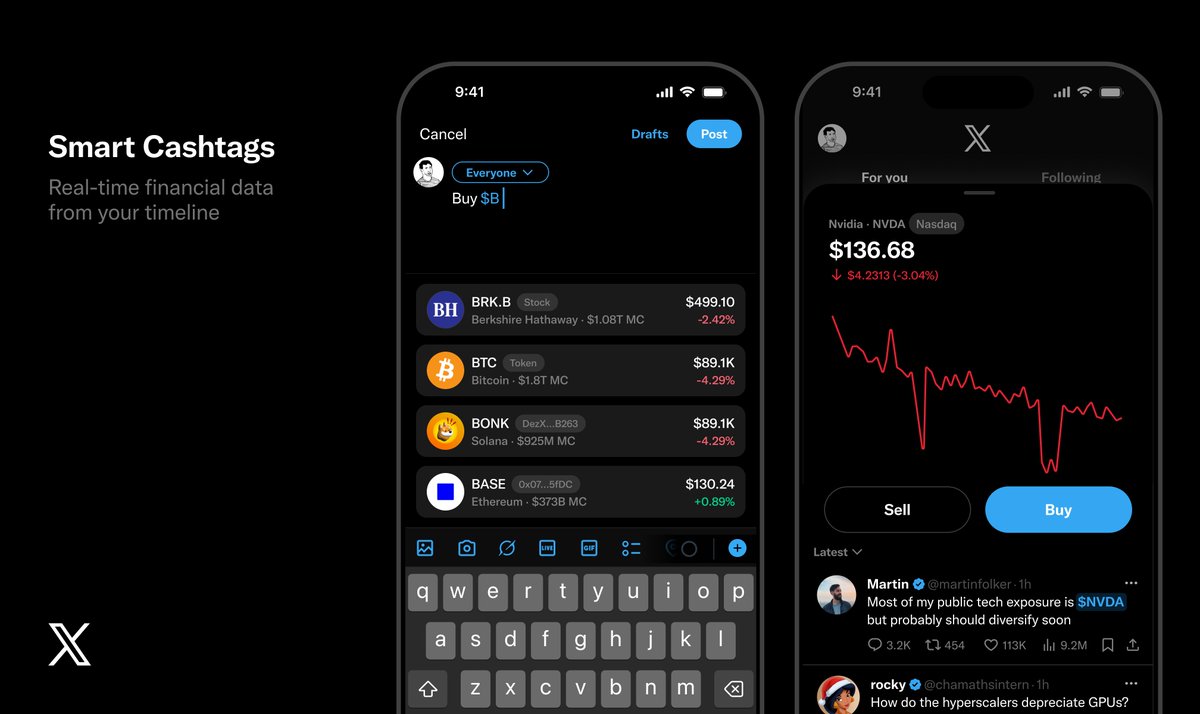
X is the best source for financial news -- and hundreds of billions of dollars are deployed based on things people read here. We are building Smart Cashtags that allow you to specify the exact asset (or smart contract) when posting a ticker. From Timeline, users will be able to tap them to see its real-time price along with all mentions of that asset. We're aiming to collect feedback as we iterate toward a public release next month.
Nikita Bier tweet media
English
3.7K
1.6K
15.5K
5.1M
x retweetledi
vitalik.eth
vitalik.eth@VitalikButerin·
Increasing bandwidth is safer than reducing latency With PeerDAS and ZKPs, we know how to scale, and potentially we can scale thousands of times compared to the status quo. The numbers become far more favorable than before (eg. see analysis here, pre and post-sharding vitalik.eth.limo/general/2021/0… ). There is no law of physics that prevents combining extreme scale with decentralization. Reducing latency is not like this. We are fundamentally constrained by speed of light, and on top of that we are also constrained by: * Need to support nodes (especially attesters) in rural environments, worldwide, and in home or commercial environments outside of data centers. * Need to support censorship-resistance and anonymity for nodes (especially proposers and attesters). * The fact that running a node in a non-super-concentrated location must be not only possible, but also economically viable. If staking outside NYC drops your revenues by 10%, over time more and more people will stake in NYC. Ethereum itself must pass the walkaway test, and so we cannot build a blockchain that depends on constant social re-juggling to ensure decentralization. Economics cannot handle the entire load, but it must handle most. Now, we can decrease latency quite a bit from the present-day situation without making tradeoffs. In particular: * P2P improvements (esp erasure coding) can decrease message propagation times without requiring individual nodes to have lower bandwidth * An available chain with a smaller node count per slot (eg. 512 instead of 30,000) can remove the need for an aggregation step, allowing the entire hot path to happen in one subnet This plausibly buys us 3-6x. Hence, I think moderate latency decreases, to a 2-4s level, are very much in the realm of possibility. But Ethereum is NOT the world video game server, it is the world heartbeat. If you need to build applications that are faster than the heartbeat, they will need to have offchain components. This is a big part of why L2s will continue to have a role even in a greatly scaled Ethereum (there are other reasons too, around VM customization, and around applications that need _even more scale_). Ultimately, AI will necessitate applications that go faster than the heartbeat no matter what we do. If an AI can think 1000x faster than humans, then to the AI, the "subjective speed of light" is only 300 km/s. Hence, it can talk near-instantly within the scope of a city, but not further. As a result, there will inevitably be AI-focused applications that will need "city chains", potentially even chains localized to a single building. These will have to be L2s. And on the flipside, it would be too much of a cost to make it viable to run a staking node on Mars. Even Bitcoin does not strive for this. Ultimately, Ethereum belongs to Terra, and its L2s will serve both hyper-localized needs in its cities, and hyper-scaled needs planet-wide, and users on other worlds. Milady.
English
510
369
2.5K
591.6K
x retweetledi
vitalik.eth
vitalik.eth@VitalikButerin·
Welcome to 2026! Milady is back. Ethereum did a lot in 2025: gas limits increased, blob count increased, node software quality improved, zkEVMs blasted through their performance milestones, and with zkEVMs and PeerDAS ethereum made its largest step toward being a fundamentally new and more powerful kind of blockchain (more on this later) But we have a challenge: Ethereum needs to do more to meet its own stated goals. Not the quest of "winning the next meta" regardless of whether it's tokenized dollars or political memecoins, not arbitrarily convincing people to help us fill up blockspace to make ETH ultrasound again, but the mission: To build the world computer that serves as a central infrastructure piece of a more free and open internet. We're building decentralized applications. Applications that run without fraud, censorship or third-party interference. Applications that pass the walkaway test: they keep running even if the original developers disappear. Applications where if you're a user, you don't even notice if Cloudflare goes down - or even if all of Cloudflare gets hacked by North Korea. Applications whose stability transcends the rise and fall of companies, ideologies and political parties. And applications that protect your privacy. All this - for finance, and also for identity, governance and whatever other civilizational infrastructure people want to build. These properties sound radical, but we must remember that a generation ago any wallet, kitchen appliance, book or car would fulfill every single one of them. Today, all of the above are by default becoming subscription services, consigning you to permanent dependence on some centralized overlord. Ethereum is the rebellion against this. To achieve this, it needs to be (i) usable, and usable at scale, and (ii) actually decentralized. This needs to happen at both (a) the blockchain layer, including the software we use to run and talk to the blockchain, and (b) the application layer. All of these pieces must be improved - they are already being improved, but they must be improved more. Fortunately, we have powerful tools on our side - but we need to apply them, and we will. Wishing everyone an exciting 2026. Milady.
English
2.9K
2.1K
13.3K
1.4M
x retweetledi
ZKsync Developers (∎, ∆)
ZKsync Developers (∎, ∆)@zkSyncDevs·
Etherscan support for ZKsync Era will be discontinued on Jan 7th, 2026. This allows us to prioritize the ZKsync native explorer and support protocol-native features like interop transactions, Gateway settlement, and additional EVM compilers like solx. ZKsync native explorer → explorer.zksync.io
English
12
12
120
13.5K
x retweetledi
知识玩家
知识玩家@BrainQuestor·
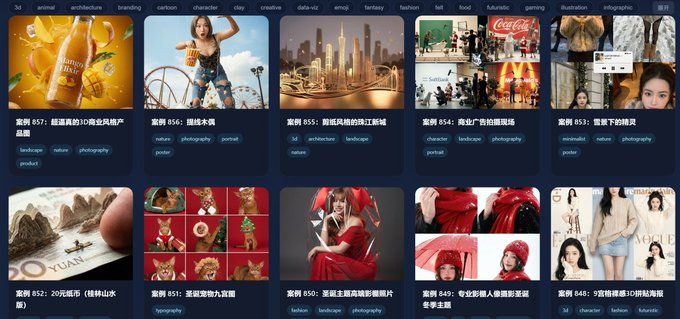
Nano Pro 提示词网址合集(抓紧收藏) 1、常用: 松果先森(Nana提示词图库): opennana.com/awesome-prompt… Youmind:youmind.com/zh-CN/nano-ban… 2、其他提示词网站: localbanana.io tihubb.com/ai-prompt/ chatgptimage.art nanobanana-showcase.com nanobananaprompt.org 海量风格的社区型库 nanobananaart.net/prompts 适合做画风模板 fotor.com/blog/nano-bana… – 热门风格合集 3、github github.com/JimmyLv/awesom… github.com/ZHO-ZHO-ZHO/ZH… github.com/PicoTrex/Aweso… 4、宝藏博主: 宝玉:x.com/dotey 归藏:x.com/op7418 神佬:x.com/berryxia ZHO:x.com/ZHO_ZHO_ZHO
知识玩家 tweet media
中文
15
226
1K
80.2K
x retweetledi
etherscan.eth
etherscan.eth@etherscan·
The first Blob Parameter Only (BPO) fork is live! ⬆️ Blob count per block is up 67% 🎯 New target and max are 10 and 15 blobs The BPO fork was enabled by last week’s Fusaka upgrade, allowing Ethereum to scale blob throughput without a major upgrade
etherscan.eth tweet media
English
13
42
276
19.7K
x retweetledi
vitalik.eth
vitalik.eth@VitalikButerin·
fusaka
Indonesia
1.4K
1.3K
10.9K
715.8K