Lakshman Dhasarathan

3.4K posts

Lakshman Dhasarathan

Lakshman Dhasarathan

@lakshmann

Reader, Son, Husband, Father and a CEO of QBrainX Inc

Orlando, FL Katılım Eylül 2008
1.2K Takip Edilen293 Takipçiler
Lakshman Dhasarathan retweetledi
Animesh Koratana
Animesh Koratana@akoratana·
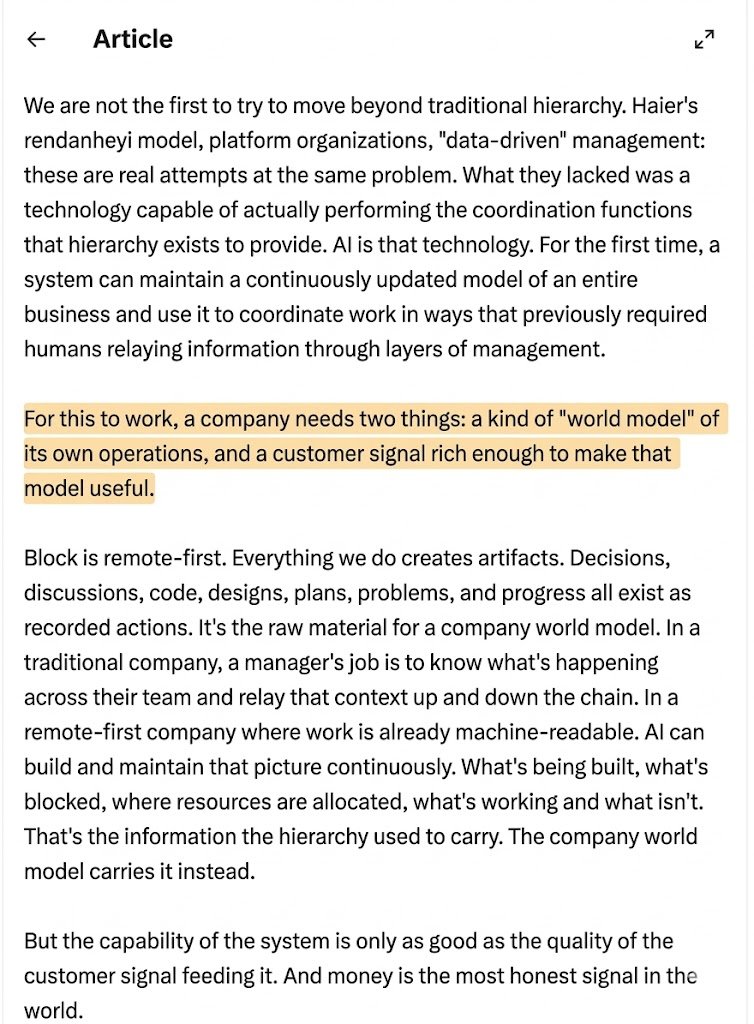
Context graphs will be to the 2030s what databases were to the 2000s. Within a year, every frontier lab will be building one and here's why: At 10 people, coordination is free. Everyone knows what everyone else is doing. You never hold a meeting to "align." At 100 people, you spend maybe 20% of your payroll on coordination. Managers, syncs, standups, planning sessions, status reports. At 10,000 people, that number approaches 60%. The majority of your headcount exists not to produce anything but to make sure the people who produce things are producing the right things in the right order. This is the dirty secret of large organizations: output scales linearly with headcount, but coordination cost scales exponentially. Every person you add creates new information pathways that must be maintained. The hierarchy is the protocol that manages this, and it's brutally expensive. Hierarchy is a compression algorithm for organizational knowledge. At every layer, a manager compresses the reality of their team into a summary that fits in a 30-minute meeting with their boss. Their boss compresses eight of those summaries into one for their boss. By the time information reaches the CEO, it's been lossy-compressed through five or six layers of human interpretation. This is why CEOs make bad decisions. The information they receive has been compressed, filtered, and distorted at every layer. The hierarchy is high-latency, low-bandwidth, and lossy. Jack didn't fire 4,000 producers but cut 4,000 compression nodes. Block's "world model" is a replacement algorithm. Zero latency, high bandwidth, lossless. Every person at the edge gets the full picture without waiting for information to travel through human relays. The infrastructure that makes this possible is the context graph. A living, continuously updated representation of how the organization actually works. Not just data, but decision traces: the reasoning connecting observations to actions. Not what's true now, but why it became true. The shift from "give agents memory" to "give agents organizational judgment" will define the next platform war
Animesh Koratana tweet media
jack@jack

x.com/i/article/2038…

English
96
199
1.7K
388.9K
Lakshman Dhasarathan
Lakshman Dhasarathan@lakshmann·
This is absolutely heart-melting. Every Neuralink update shows the same thing: people who've been trapped inside their own bodies getting a little bit of themselves back. This one hits me deeply. I live with my dad, who has been living with Parkinson's for 17 years. It has slowly stolen his movements and everyday independence. The medication often feels like it's playing with his senses, emotions, and memories more than it's helping. He's a man who worked his ass off his entire life, raising two boys in a simple Indian town, carrying huge emotional stress and never really slowing down. To watch his own body betray him now is brutal. It's a nightmare so many Parkinson's families know too well. That's why breakthroughs like this matter. If AI and brain-computer interfaces can restore even a slice of autonomy, communication, or dignity, they don't just change one life — they lift entire families. This is the kind of future I want: technology used by the right people, for the right reasons, to help humans truly live the one precious life they've been given.
Neuralink@neuralink

ALS has gradually taken away Kenneth’s ability to speak. Through Neuralink’s VOICE clinical trial, he’s exploring how a brain-computer interface designed to translate thought to speech could help restore autonomy in his daily life. Watch to learn more:

English
0
0
1
35
Lakshman Dhasarathan retweetledi
Shruti
Shruti@heyshrutimishra·
5. NVIDIA NemoClaw: Two shell commands to deploy enterprise AI agents. Built-in security: RBAC, audit logs, data residency. Out-of-box integrations: Salesforce, Cisco, Google, Adobe, CrowdStrike. OpenClaw just went from viral demo to enterprise infrastructure.
English
8
4
33
4.6K
Lakshman Dhasarathan
Lakshman Dhasarathan@lakshmann·
two shell commands to deploy enterprise AI agents with RBAC, audit logs, and Salesforce integration out of the box. Nvidia is making the enterprise AI infrastructure layer look dangerously easy. game changer for IT teams.
Shruti@heyshrutimishra

5. NVIDIA NemoClaw: Two shell commands to deploy enterprise AI agents. Built-in security: RBAC, audit logs, data residency. Out-of-box integrations: Salesforce, Cisco, Google, Adobe, CrowdStrike. OpenClaw just went from viral demo to enterprise infrastructure.

English
0
0
0
97
Lakshman Dhasarathan
Lakshman Dhasarathan@lakshmann·
@minchoi the SOP training angle is key. most AI tools fail because they don't learn YOUR specific workflow. once it knows your process, the compounding returns are real. seeing similar results with enterprise automation.
English
0
0
0
7
Lakshman Dhasarathan retweetledi
Min Choi
Min Choi@minchoi·
AI just fixed your life and business. Claude Cowork is the $20/month AI employee everyone was afraid of 🤯 Train it once on your workflow + SOPs and it just runs... 24/7. 10 wild results (🧵👇) 1. Match up 1000s of day trades for tax season
English
71
120
1.5K
363.8K
Lakshman Dhasarathan
Lakshman Dhasarathan@lakshmann·
the $20/month AI employee framing understates what's happening. this isn't about replacing a person. it's about giving every knowledge worker a tireless operations partner. the ROI math changes everything for small and mid-size businesses.
Min Choi@minchoi

AI just fixed your life and business. Claude Cowork is the $20/month AI employee everyone was afraid of 🤯 Train it once on your workflow + SOPs and it just runs... 24/7. 10 wild results (🧵👇) 1. Match up 1000s of day trades for tax season

English
0
0
0
18
Lakshman Dhasarathan
Lakshman Dhasarathan@lakshmann·
@EcZachly great list. would add ServiceNow's agent workspace and Databricks' agent SDK to this. the enterprise agent stack is forming fast and these tools are becoming table stakes for any serious AI deployment.
English
0
0
0
19
Lakshman Dhasarathan retweetledi
Zach Wilson
Zach Wilson@EcZachly·
Here’s the AI tech you should know in 2026: - AdaL - AI coding agent that easily switches between Opus, Gemini and Codex - OpenClaw - run AI agents that do stuff on your laptop - n8n - run AI workflows in the cloud - LangChain - AI agent building framework - Pinecone / Milvus, created by Zilliz - vector databases for RAG - Notebook LM - summarize and synthesize any complex document - AgentBricks - build AI agents easily on Databricks platform - AdalFlow - prompt optimization framework that is better than dspy - Claude Code - our loving lord and savior who will take us to the promised land - Nano Banana Pro - make the best images that bring you tears What else would you include?
English
25
71
403
21.8K
Lakshman Dhasarathan retweetledi
Lakshman Dhasarathan
Lakshman Dhasarathan@lakshmann·
data centers in orbit. Jensen isn't just scaling compute, he's redefining where compute lives. GTC 2026 might be the most consequential tech keynote of the decade. the implications for enterprise AI infrastructure are massive.
Ricardo@Ric_RTP

Nvidia just mass-produced a computer so powerful they're sending it to space. Jensen Huang stood on stage yesterday at GTC 2026 in front of 30,000 people and revealed Nvidia is building data centers in orbit. Vera Rubin Space-1. AI compute floating above the planet. But that wasn't even the BIGGEST announcement... Jensen literally DOUBLED his own forecast. Last year he projected $500 billion in orders through 2026. Yesterday, he told the crowd: "Right here where I stand, I see through 2027, at least $1 trillion." Doubled in 12 months. And his finance team already confirmed actual growth will EXCEED even that number. But the real thing isn't what Jensen said. It's what he showed: Vera Rubin isn't just a chip. It's literally an entire AI supercomputer. - 7 different chips - 5 rack-scale computers - 100% liquid cooled - Hot water at 45 degrees, no chillers needed What used to take two days to install now takes two hours. The performance numbers are stupid: - 3.6 exaflops of compute - 260 terabytes per second of bandwidth - 10x MORE inference throughput per watt than Blackwell - One-tenth the token cost - 40 million times more compute than what existed 10 years ago But here's the move that should have EVERY competitor terrified... Jensen bought his biggest threat and turned it into a feature. In December, Nvidia paid $20 billion for Groq, the startup everyone said would dethrone Nvidia in AI inference. Their Language Processing Unit was genuinely faster at generating tokens than anything Jensen had. Real technology. Real threat. Jensen's response? Hired their founder. Hired their president. Hired their senior engineers. Took their chip. And integrated it DIRECTLY into Vera Rubin as the Groq 3 LPX rack. "We unified two processors of extreme differences, one for high throughput, one for low latency." The results: - 35x more inference throughput per megawatt - New premium token tiers that didn't exist before - Services that can generate tokens at speeds the previous architecture physically couldn't reach The thing that was supposed to kill Nvidia now makes Nvidia untouchable. And Jensen wasn't done. Autonomous driving partnerships with BYD, Hyundai, Nissan, and Geely. 18 million cars per year on Nvidia's platform. A deployment deal with Uber across multiple cities. 110 robots on the show floor. A walking, talking Olaf robot from Frozen powered by Nvidia's physics engine. NemoClaw, an enterprise-ready agentic AI framework. And DLSS 5, which fuses 3D graphics with generative AI so game worlds look indistinguishable from reality. This literally isn't a chip company anymore. Jensen said it himself on stage: "Nvidia went from a chip company to a factory company, an infrastructure company, a computing company." He's building the operating system for physical reality. Autonomous cars. Humanoid robots. AI agents that reason and act. Space-based compute. Digital twins of entire factories before they're built. Every single layer runs on Nvidia's stack. But this also has a lot of RISK for Nvidia... The entire $1 trillion forecast assumes AI spending accelerates from here. That every hyperscaler keeps writing checks. That inference demand grows exponentially. Jensen told the crowd computing demand increased "1 million times in the last two years." So he's betting the whole company on the idea that this curve never flattens. 60% of Nvidia's revenue comes from just 5 hyperscalers. If even ONE builds their own chips fast enough, that trillion dollar number starts looking very different. What's your take on Nvidia?

English
0
0
1
14
Lakshman Dhasarathan retweetledi
Lee Robinson
Lee Robinson@leerob·
I built an app to simulate the 2026 NCAA tournament! It uses historical data, KenPom rankings, game locations, and more to determine the win probability. ...but then has an AI model review the results and prompt for the reality of March Madness, unpredictable!
English
100
34
2.3K
427.2K
Lakshman Dhasarathan
Lakshman Dhasarathan@lakshmann·
this is a perfect example of AI making data analysis accessible. historical data + AI reasoning + real world unpredictability = the future of decision support. March Madness from Florida is always better with data.
Lee Robinson@leerob

I built an app to simulate the 2026 NCAA tournament! It uses historical data, KenPom rankings, game locations, and more to determine the win probability. ...but then has an AI model review the results and prompt for the reality of March Madness, unpredictable!

English
0
0
0
45
Rohan Paul
Rohan Paul@rohanpaul_ai·
ServiceNow CEO Bill McDermott's argument why AI can not replace them.🤔 AI identifies issues but cannot fix it. Says with 80B workflows across legacy systems, ServiceNow is the "do-it" layer, the "last mile". Says the market is missing this execution gap
English
25
10
209
148.1K
Lakshman Dhasarathan
Lakshman Dhasarathan@lakshmann·
@rohanpaul_ai McDermott is right about the execution gap. AI finding problems is table stakes now. the real value is in orchestrating the fix across legacy systems. that last mile is where ServiceNow's moat actually lives.
English
0
0
0
9
Aakash Gupta
Aakash Gupta@aakashgupta·
The market is pricing in something more specific than “AI kills software.” The death of the middleman. ServiceNow, Salesforce, SAP. They all built billion-dollar businesses on the same bet: enterprises are too incompetent to build their own tools, so they’ll pay $50K/seat for someone else to do it. That bet worked for 20 years because custom development was expensive. A SaaS vendor could spread R&D across 10,000 customers and offer better tools than any single company could build alone. AI just inverted the math. Now one engineer with Claude or Cursor can ship features in days that used to take a vendor months. The “build vs buy” calculation that made enterprise software work just flipped from “always buy” to “probably build.” Klarna didn’t pull Salesforce because they hate Salesforce. They pulled it because their AI team shipped a replacement in 3 weeks. The real tell in these earnings calls: every CEO said “AI is our future” while investors heard “our moat is disappearing.” ServiceNow’s pitch that they’re the “gateway to AI workflow orchestration” is the same pitch every middleman makes right before they get cut out. The gateway to workflow orchestration is now a prompt. The stocks that rallied (Nvidia, semicap) sit at the hardware layer. They sell shovels. The stocks that cratered sit at the abstraction layer. They sell convenience. Convenience just got commoditized to near-zero. The abstraction layer collapses. That’s what $500B in a single day represents. The market realizing enterprise software stopped being a growth story. A margin compression story with a countdown clock. The irony runs deeper than these companies investing in AI. They thought investment would save them. AI doesn’t care who bought the most AI companies. AI cares who needs the fewest seats.
Ricardo@Ric_RTP

This is the biggest irony in tech history. Microsoft beat revenue estimates. Stock plunged 11%, wiped out $400 BILLION in market cap. Salesforce reported growth. Stock fell 5.6%. ServiceNow beat earnings. Stock crashed 11%. SAP beat projections. Stock dropped 16%. Entire software sector entered bear market territory. Down 22% from peak. These are the companies everyone said would WIN from AI. They spent billions BUYING AI companies. ServiceNow: $7.75 billion for Armis. Salesforce: $8 billion for Informatica. They launched AI products. Built AI workflows. Hired AI teams. And the market said: You're all dead. Because investors just realized something nobody wanted to admit: AI doesn't make software companies stronger. AI makes software companies OBSOLETE. Morgan Stanley: "In an environment of heightened investor skepticism, stable growth falls short of shifting the narrative." Good earnings aren't enough anymore. The market is pricing in a world where AI replaces the software these companies sell. ServiceNow CEO tried defending on the earnings call: "AI needs workflow orchestration. ServiceNow is the gateway to this shift." Market response: 11% crash. Because here's what he didn't say: If AI can write code, automate workflows, and generate apps at a fraction of the cost, why would anyone pay $50,000 per year for enterprise software licenses? The per-seat pricing model that made SaaS companies rich is getting murdered by AI efficiency. One AI agent replaces 10 seats. One prompt replaces months of custom development. One LLM call replaces entire software categories. Klarna already proved it. CEO said they pulled Salesforce out of their stack. Built everything themselves using AI. And that's just the beginning. The software apocalypse hit hardest on companies that INVESTED IN AI: Atlassian: down 12.6% Intuit: down 7.8% HubSpot: down 11.5% Zscaler: down 6.3% Meanwhile, the companies ENABLING AI made money: Nvidia: up Semiconductor stocks: surging Memory firms: rallying The divide is brutal. Hardware companies print cash. Software companies get destroyed. Because in an AI-first world, you need GPUs to build the models. But you don't need software subscriptions when the AI builds the software for you. Jim Cramer called it the "P/E multiple compression crisis." Translation: Investors don't care about earnings anymore. They care about whether your business model survives the next 5 years. And right now software business models look doomed. They're literally stuck: If they DON'T invest in AI, they fall behind. If they DO invest in AI, they cannibalize their own products. It's a death spiral with no exit. ServiceNow spent $12 BILLION on acquisitions in 2025 alone. Trying to buy their way into relevance. And yesterday the market cooked them. The craziest thing to me tho... Most software companies beat earnings. Revenue was solid. Growth was fine. But it didn't matter. Because the market stopped pricing software on what it earns TODAY. It's pricing software on what it's worth in a world where AI does the job for free. And in that world these companies are worth nothing. This is the biggest sector repricing since 2008. $500 billion in market value gone in ONE DAY. And it's not stopping. Because every company watching this is thinking the same thing: "If I can replace ServiceNow with 3 AI agents and save $10 million per year, why wouldn't I?" The answer used to be: "Because you need enterprise-grade reliability." But now? AI agents are getting reliable. Fast. Software companies just realized they're competing with open-source models that cost $0.02 per 1,000 tokens. You can't win a pricing war against free. The companies that spent BILLIONS preparing for AI are getting killed BY AI. What an irony.

English
76
61
415
133.3K
Lakshman Dhasarathan
Lakshman Dhasarathan@lakshmann·
@aakashgupta the middleman thesis is partially right but ServiceNow and Salesforce aren't just middlemen. they're workflow orchestrators. AI will force them to evolve into agent-native ecosystems. the ones that adapt fast will be stronger.
English
0
0
0
10
Lakshman Dhasarathan
Lakshman Dhasarathan@lakshmann·
unpopular take: the 30% grad unemployment prediction is overblown. what's actually happening is role transformation. the grads who learn to work WITH AI agents will be 5x more productive than their predecessors. the gap is skills, not jobs.
Autopilot@joinautopilot

Just in: ServiceNow CEO says AI could push new grad unemployment to 30%+ Stocks to watch if this plays out: • $NOW: automates workflows that used to require junior hires • $UPWK: when full-time jobs dry up, freelance job postings increase • $WDAY: companies need HR tools to manage mass restructuring

English
0
0
0
9
Lakshman Dhasarathan retweetledi
Y Combinator
Y Combinator@ycombinator·
Congratulations to @sreai_team on their $7.2M seed! SRE.ai is an AI-native DevOps platform for enterprise apps, like Salesforce, ServiceNow, and more, that power mission-critical systems but have desperately needed a modern tooling refresh. techcrunch.com/2025/08/20/sre…
Y Combinator tweet media
English
19
17
100
17.8K