Langflow

881 posts

Langflow banner
Langflow

Langflow

@langflow_ai

Langflow is a powerful tool for building and deploying AI-powered agents, workflows and MCP servers.

Katılım Mart 2023
482 Takip Edilen11K Takipçiler
Sabitlenmiş Tweet
Langflow
Langflow@langflow_ai·
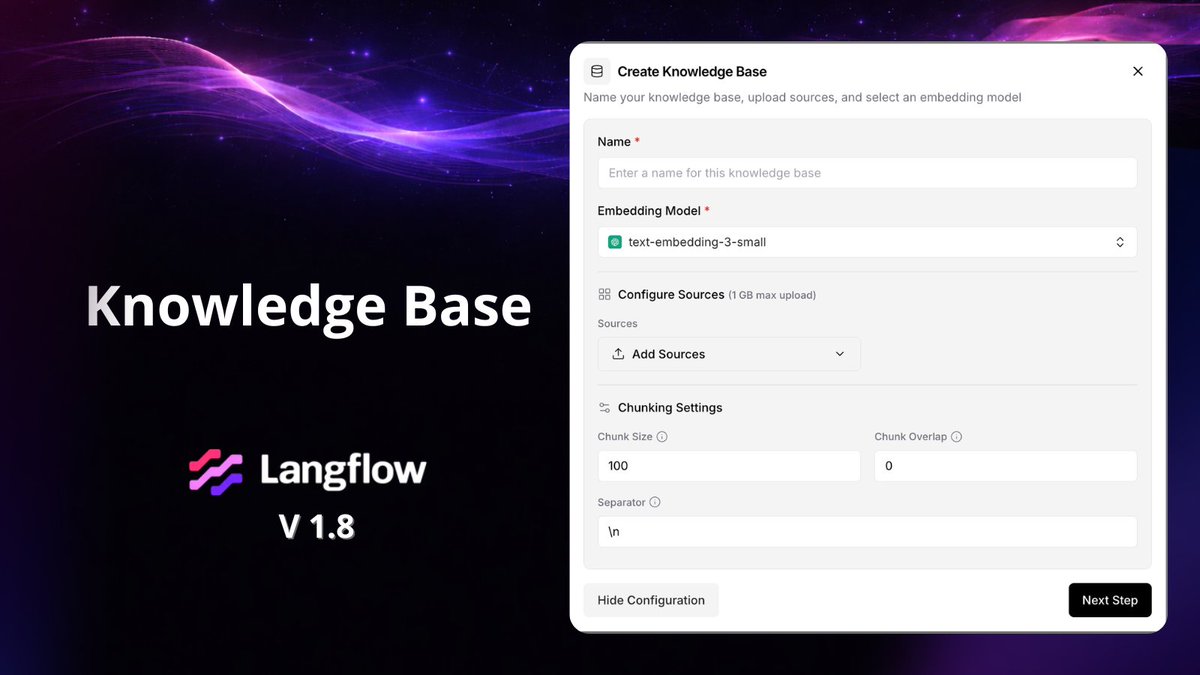
🚀 Langflow V 1.8 is live Langflow 1.8 represents a structural leap in how AI solutions are built, integrated, and scaled. This release makes Langflow more mature, more powerful, and ready for intelligent agents in production, going beyond prototypes and experiments. With 1.8, Langflow is simpler to configure, easier to integrate, faster to use, and prepared for the next generation of AI agents, from visual workflows to production code. What’s new in this release: 🔹 Model Provider Setup Model configuration now follows a single, reusable standard, reducing manual setup, configuration drift, and errors when scaling projects. 🔹 API Redesign (Phase 1) Flows can now be consumed via standardized APIs, making Langflow a more predictable and robust part of applications, systems, and backends. 🔹 Chat Refactor (Playground Improvements) Improved session and message management delivers more stable interactions and a smoother experience when working with long or complex conversations. 🔹 Inspection Panel Direct access to component configuration, parameters, and optional inputs directly from the workspace panel, reducing context switching and accelerating debugging and iteration. 🔹 Knowledge Bases Built-in knowledge bases act as local vector databases inside Langflow, making it easier to store and retrieve documents and datasets while enabling retrieval-augmented workflows. 🔹 Traces Trace support provides deeper visibility into workflow execution, helping developers follow execution paths, measure latency, track token usage, and debug complex flows more easily. 🔹 Agentics Adds structured data workflow components, including N→N transformations (aMap), N→1 aggregations (aReduce), 0→N generation (aGenerate), and DataFrame merging without LLM calls, unlocking practical use cases like data enrichment and aggregation. 👉 Explore Langflow 1.8 and start building production-ready AI agents: langflow.org/blog/langflow-…
Langflow tweet media
English
0
4
8
2.2K
Langflow
Langflow@langflow_ai·
Langflow Use Case: Marketing Content Generator Turn a single brief into high-quality, research-backed marketing content across channels. This Langflow workflow uses an AI agent to gather real-time insights, understand your audience, and generate tailored content for social media, blogs, emails, and more. Combine structured briefings with live research to create more relevant, consistent, and scalable marketing outputs. Ready for real production use. 🔗 Template: langflow.org/templates/use-…
Langflow tweet media
English
0
0
1
152
Langflow
Langflow@langflow_ai·
🔹 Chat Refactor (Playground Improvements) - Langflow 1.8 Faster, more reliable chat for real-world workflows. Working with long conversations, streaming responses, and rich metadata shouldn’t slow down the interface or break the experience. With the launch of Langflow 1.8, the chat and playground experience has been refactored with a new messaging architecture designed for performance and reliability: - Improved session and message lifecycle management; - Better handling of long histories and complex message data; - Reduced UI lag during streaming and extended conversations; Example: Running long, multi-turn conversations with continuous streaming now feels smooth and responsive, even as message history and metadata grow. You can also keep building your flow while testing it in parallel. Why it matters: - More stable interactions during development and testing - Faster iteration with real-time feedback inside the builder - Better performance for long and complex chat workflows 👉 Upgrade to Langflow 1.8 and experience a faster, more responsive chat and playground. langflow.org/blog/langflow-…
Langflow tweet media
English
0
0
4
319
Langflow
Langflow@langflow_ai·
🔹 Agentics — Langflow 1.8 Building workflows that coordinate tools, transform structured data, and run multi-step operations shouldn’t require complex external frameworks or custom orchestration layers. With the launch of Langflow 1.8, IBM’s open-source Agentics framework is integrated directly into the platform, introducing a structured and typed approach to AI workflows: - Tool-driven execution across multiple steps - Typed data transformations and generation across structured workflows - LLM-powered transformations (transductions) applied directly to structured data - Parallel execution through async batching and map/reduce-style operations How the core operations work: aMap (N → N) Transforms each row independently using an LLM. Ideal for tasks like classification, enrichment, or extracting structured fields from unstructured text. aReduce (N → 1) Aggregates multiple rows into a single structured output. Useful for summarization, grouping insights, or generating reports from datasets. aGenerate (0 → N) Creates new rows based on a defined schema. Enables synthetic data generation, structured outputs, or dataset expansion. Example: A workflow can process thousands of product reviews, classify sentiment per row (aMap), aggregate key insights (aReduce), and generate structured reports (aGenerate), all inside a single pipeline. Why it matters: - More predictable and controlled data transformations - Built-in validation and structured outputs (no fragile parsing) - Higher throughput with async batching and parallel execution - Better traceability and reliability for AI-driven data workflows ⭐ If you liked it, consider starring the Agentics repository: github.com/IBM/Agentics
English
1
1
18
1.1K
Langflow
Langflow@langflow_ai·
Knowledge Bases - Langflow 1.8 Store and query knowledge directly inside Langflow. Building AI workflows that rely on documents, datasets, or internal knowledge shouldn’t require complex custom retrieval pipelines. With the launch of Langflow 1.8, Knowledge Bases introduce local vector databases inside Langflow, making it easier to store, retrieve, and reuse information across workflows: - Documents and datasets can be indexed and stored as vector data; - Workflows can retrieve relevant context directly from the knowledge base; - Multiple flows can access the same knowledge source; Example: A workflow can query a knowledge base of documents, retrieve relevant context, and use that information to generate more accurate responses. Why it matters: - Simplifies building retrieval-augmented workflows; - Makes it easier to work with documents and datasets; - Keeps vector data accessible directly within Langflow; 👉 Upgrade to Langflow 1.8 and start building workflows powered by your own knowledge. langflow.org/blog/langflow-…
Langflow tweet media
English
0
0
0
419
Langflow
Langflow@langflow_ai·
🔹 Inspection Panel - Langflow 1.8 Working with visual workflows shouldn’t require switching between the builder and external logs just to inspect component behavior. With the launch of Langflow 1.8, the new Inspection Panel makes it easier to inspect how individual components behave during execution: - Direct access to component inputs, outputs, parameters, and internal state; - Inspection during or after execution without leaving the flow builder; - Clearer visibility into how data moves between nodes; Example: When a flow produces an unexpected result, you can click a component and inspect the data it received and produced directly in the workspace. Why it matters: - Better visibility into component behavior; - Faster understanding of data flow between nodes; - Less reliance on external logs or print statements; 👉 Upgrade to Langflow 1.8 and inspect component behavior directly in the workspace. langflow.org/blog/langflow-…
Langflow tweet media
English
0
0
3
414
Langflow
Langflow@langflow_ai·
🔹 API Redesign (Phase 1) - Lanflow 1.8 Integrating Langflow into applications shouldn’t require working around inconsistent endpoints or hard-to-predict request formats. With the launch of Langflow 1.8, workflow execution moves toward a more standardized and predictable API structure: - Introduction of V2 workflow endpoints (beta); - More consistent REST-style request and response schemas; - Cleaner foundation for running workflows via API in real applications; Example: Instead of embedding the flow ID directly in the endpoint path, workflows are now executed through the /api/v2/workflows endpoint using a structured request body, making integrations easier to read, maintain, and scale. Why it matters: - Reduces integration complexity - Improves reliability for programmatic integrations - Makes Langflow a more predictable part of application and backend architectures 👉 Explore Langflow 1.8 and start building production-ready AI agents: langflow.org/blog/langflow-…
Langflow tweet media
English
0
0
3
383
Langflow
Langflow@langflow_ai·
Global Model Provider - Langflow 1.8 Configure model providers once reuse across your canvas. Configuring AI models shouldn’t require repeating API keys and provider settings across every component in a workflow. With the launch of Langflow 1.8, model provider configuration becomes centralized and reusable: - Providers are configured once at the platform level; - Smart components reference a shared provider instead of raw credentials; - Updating credentials or switching providers becomes a single change; Example: Rotating an API key or switching providers can now be done in one place, without reconfiguring credentials across multiple components. Why it matters: - Reduces setup time - Eliminates configuration drift - Improves security by centralizing secret management Learn more about this release: langflow.org/blog/langflow-…
GIF
English
0
1
3
389
Langflow
Langflow@langflow_ai·
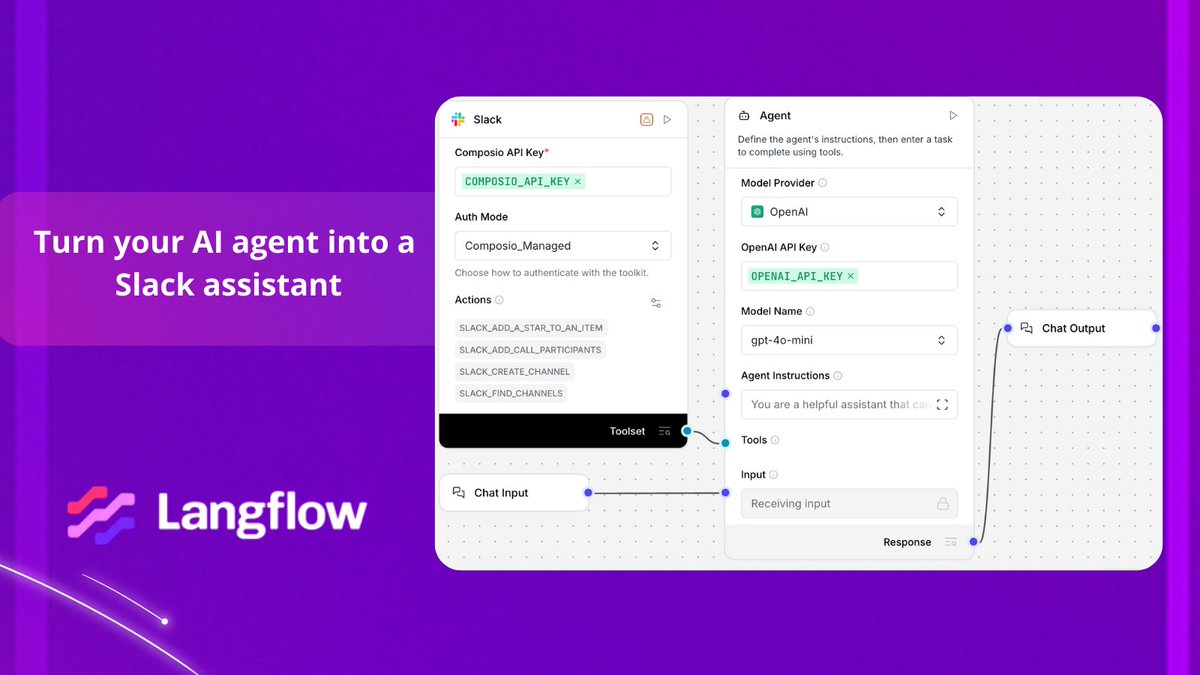
Turn your AI agent into a Slack assistant Most agents answer prompts. This one can work with your team. With @composio components in Langflow, you can connect Slack directly into your flow and let your agent: - Read messages from channels or threads - Understand requests from conversations - Generate responses or summaries - Trigger actions and workflows automatically All visually. All with drag and drop. One powerful example is conversation-driven task automation. Your agent can monitor a Slack channel and detect requests like “schedule a meeting with the client tomorrow” or “summarize this discussion”. From there, the agent can trigger workflows such as creating a meeting in Google Calendar, drafting follow-ups, or generating summaries for the team automatically. This is how agents stop answering questions and start participating in real team workflows. 👉 Learn more about Langflow: langflow.org/?utm_source=x&…
Langflow tweet media
English
0
0
3
404
Langflow
Langflow@langflow_ai·
Langflow gives you the building blocks to design that system visually, but without losing engineering control. Start with real foundations: 🔹 API Integration Connect external services directly into your flows. Turn APIs into callable tools inside your agent architecture. 🔹Agent Combine prompts + tools + reasoning into decision-making agents that can act, not just respond. 🔹 Basic Prompting Prototype fast. Iterate visually. Refine behavior without rewriting everything. 🔹 Doc Assistant (RAG) Build assistants that retrieve precise information from large knowledge bases, grounding responses in real data. And when you need more control? There’s Python under the hood. Langflow isn’t just about building flows. It’s about designing modular, extensible AI systems that can evolve from prototype to production. Build visually. Think architecturally. Scale confidently. Learn more about Langflow: langflow.org/?utm_source=x&… #Langflow #AIEngineering #Agents #LLMDev #OpenSourceAI
Langflow tweet media
English
1
1
6
571
Langflow
Langflow@langflow_ai·
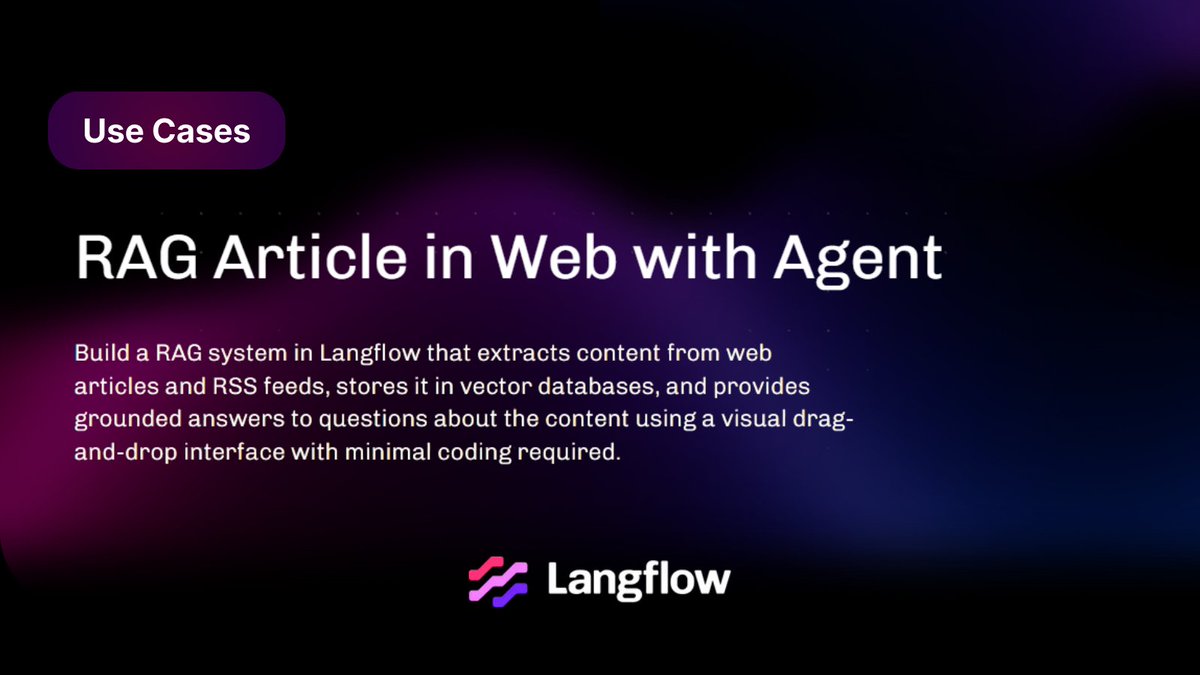
Langflow Use Case: RAG Article in Web with Agent Turn web content into a searchable, AI-powered knowledge system. This Langflow workflow extracts content from URLs or RSS feeds, chunks and embeds it into a vector database, and delivers grounded answers based only on retrieved context. Build production-ready RAG pipelines using a visual, drag-and-drop interface, without complex backend code. Perfect for research assistants, compliance monitoring, competitive intelligence, and documentation Q&A. Ready for real production use. 🔗 Template: langflow.org/templates/use-…
Langflow tweet media
English
0
2
7
384
Langflow
Langflow@langflow_ai·
How to Retrieve Relevant Chunks in a RAG Workflow with Langflow RAG (Retrieval-Augmented Generation) is a method that allows language models to answer questions using external documents. In a RAG workflow, documents are first processed and stored in a vector database. When a user asks a question, the system searches that database to retrieve the most relevant pieces of information before generating a response. After documents are stored in a vector database, the next step is retrieval, finding the most relevant chunks based on a user query. What this flow solves Stored embeddings alone are not enough. You need to convert the user query into an embedding, search the vector database semantically, retrieve only the most relevant chunks, and send grounded context to the language model. Step-by-step Setup Chat Input Receives the user question. Embedding Model Generates an embedding representation of the query. Astra DB (Search Query) The query embedding is sent to Astra DB. The database performs a similarity search and returns the closest matching chunks as a DataFrame. Parser Processes the returned DataFrame and formats the retrieved chunks so they can be used as context. Language Model Uses the parsed retrieval results as input to generate a grounded response. Chat Output Returns the final answer to the user. How It Works Instead of keyword search, the system compares vector similarity between embeddings. The closest semantic matches are retrieved and passed to the model, reducing hallucinations and improving response accuracy. Key Takeaway RAG is not just about storing data. It’s about retrieving the right context at query time. That’s how you build grounded and production-ready AI workflows. Learn more about Langflow: langflow.org/?utm_source=x&…
Langflow tweet media
English
0
0
3
326
Langflow
Langflow@langflow_ai·
Hey everyone! Our latest episode of "The Flow" just dropped. 🥳 📫 👨 We thought @getpostman was all about #API's. Turns out they've taken APIs to a new level with the latest in #AI tech. @SonicDMG and @gethackteam speak with @RubenCasas from Postman to hash it all out. We jump into Postman #AI, the latest on #MCP, and #GenerativeUI. Have a listen, links in reply:
Langflow tweet media
English
2
3
8
343
Langflow
Langflow@langflow_ai·
Building AI workflows shouldn’t mean fighting complexity. With Langflow, you stay in control from model behavior to how components connect behind the scenes. ⚙️ Control the complexity Fine-tune models, adjust parameters, and shape responses without losing flexibility. 🔄 Swap and compare Test different models, prompts, and paths visually. Iterate faster and see what actually works. 🐍 Python under the hood Visual where you want it. Code where you need it. Extend components and customize logic without breaking your flow. Design faster. Experiment smarter. Ship real AI systems with Langflow. Learn more about Langflow: langflow.org/?utm_source=x&… #Langflow #AIEngineering #OpenSourceAI
Langflow tweet media
English
0
0
3
445
Langflow
Langflow@langflow_ai·
Langflow Use Case: Meeting Preparation An AI assistant that analyzes your calendar, researches attendee companies, and delivers structured briefings packed with actionable business insights, so you can walk into every meeting fully prepared. This Langflow workflow connects to your calendar, gathers company intelligence, maps participants to their organizations, and suggests relevant talking points before every meeting. Reduce manual prep time, stay informed, and help sales teams enter conversations with stronger context and confidence. Ready for real production use. 🔗 Template: langflow.org/templates/use-…
Langflow tweet media
English
0
0
1
318
Langflow
Langflow@langflow_ai·
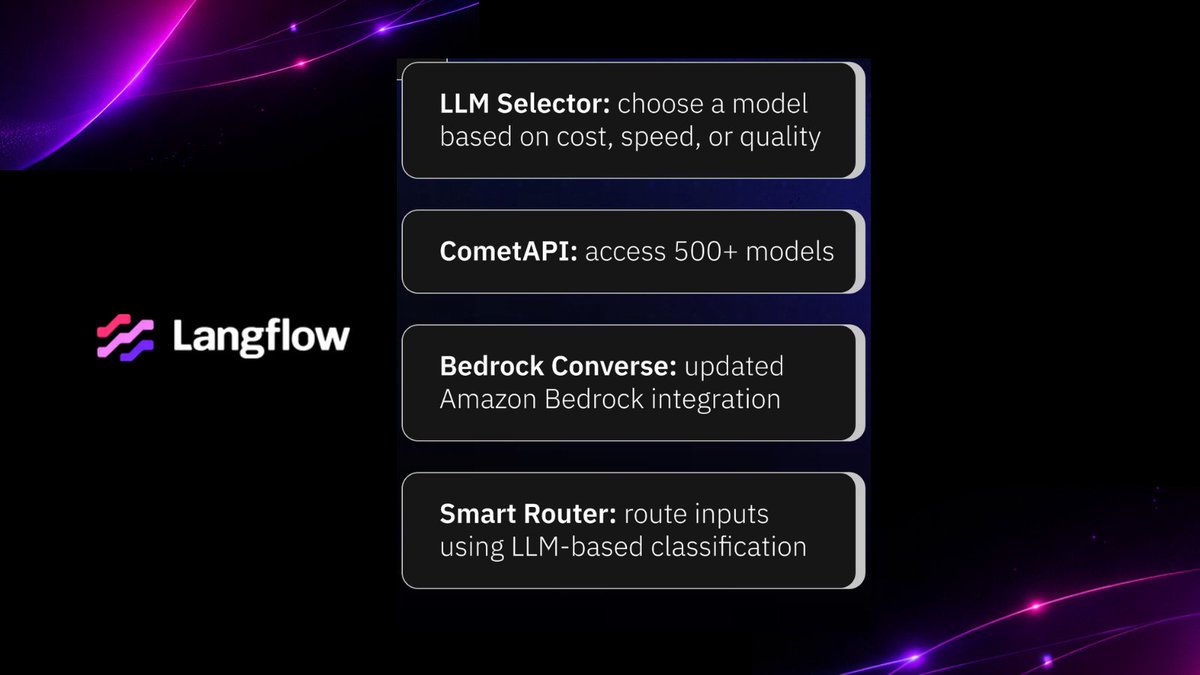
Designing agent workflows is no longer just about connecting models, it’s about choosing the right tools, optimizing performance, and building flows that adapt to real-world scenarios. Langflow brings together powerful components to help you build smarter AI systems: 🔹 LLM Selector: lets your flow decide which model to use based on cost, speed, or quality, helping you balance performance and efficiency without hardcoding decisions. 🔹 Comet API: unlock access to 500+ models, giving you flexibility to experiment, compare capabilities, and scale agents across different providers. 🔹 Bedrock Converse: an updated Amazon Bedrock integration designed for smoother enterprise workflows and more consistent model interactions. 🔹 Smart Router: use LLM-based classification to dynamically route inputs through different paths in your flow, enabling more adaptive and context-aware automation. Whether you're building experimental agents or production-ready systems, Langflow helps you design workflows that are flexible, scalable, and ready for complex AI use cases. Learn more about Langflow: langflow.org/?utm_source=x&…
Langflow tweet media
English
0
1
1
427