@hosseeb @variational_io Didn’t @chameleon_jeff talk about RFQ not being good if there’s no KYC, couple years ago now?
English
lempire
429 posts

I heard Variational spread isn't good so I built this and checked 240 tokens to debunk it If you take the average across all listings, at any trade size, @variational_io is by far the best, especially on RWAs You just can't beat RFQ execution costs, especially on exotic pairs That's a new tool I just built, you can check it in the comments




7.300% YTW


Ethereum is the federal government and instead of charging 30% tax it charges 1% and lets states and counties charge the bulk of the tax Security is the most mispriced asset in blockchain land federal states can make it hard for citizens to leave and few (ie US) can enforce worldwide tax - as a US citizen you pay the tax because they can use violence against you blockchains can’t and never will they are by design open source and easy to leave, so they will always struggle to grow GDP via taxation Users (builders and user aggregators) will always have an incentive to leave and go to a tax friendly jurisdiction once you get taxed any amount because they control the user. So Ethereum and others can’t tax too much I don’t see an easy solution to this problem other than being an integrated chain that owns the user relationship and can monetize the flow and enforce some control of who enters and leaves Robinhood can do this Stripe can do this Infra crypto-native providers can’t And if that’s the case then what’s the point of blockchains if you have a single entity that controls it. Databases all the way down. Robinhood is simply replacing citadel and monetizing the flow themselves via robinhood chain - as they should

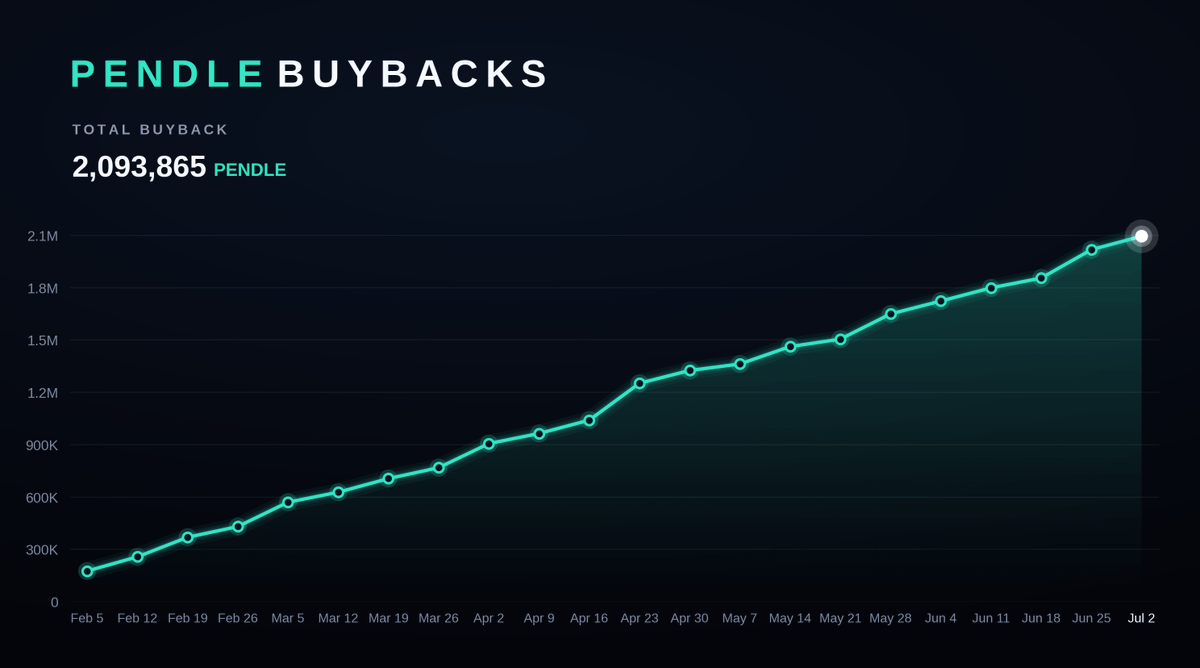
New ATH milestone - total $PENDLE staked surpassed 100M (~36% of total supply) Since the launch of sPENDLE: 🔹 Emissions cut by 71%, more than double the original 30% target 🔹 1.96M+ PENDLE bought back from the open market, passed to stakers in full 🔹 Further ~$1.5M in airdrops distributed to stakers Your PENDLE, working hard 💪🏻


The next major feature upgrade to @PhoenixTrade will finally leverage @solana DeFi's greatest asset: spot liquidity. Traders will soon be able to post SOL and other tokens as collateral for their positions. A few caveats before I dive in: - I hate announcing things before they ship. Talk is cheap, and execution is hard. And nobody cares that the execution is hard. - Phoenix is not the fully on-chain perps venue to have spot collateral. This was one of the best features offered by Drift and Mango. As with everything we build, Phoenix's approach will never be a blind copy-paste of our predecessors. I'm excited about this feature for many reasons. 1. Solana users with SOL and other tokens but no USDC no longer need to sell their assets to deposit and trade on Phoenix. 2. Users and vaults who want to run long spot, short perp basis strategies no longer need to think about manually rebalancing. 3. Sophisticated users who trade both spot and perps can keep their capital on Phoenix and simultaneously trade spot while margining their perps positions. I'll write more about this in a future post. I think it's one of the coolest things that no other perps platform can do. And it is only possible because Phoenix is fully on-chain. There are 2 questions I get asked often that I often find challenging to answer: 1. Why does it matter that Phoenix is fully on-chain? 2. Why should I trade on Phoenix over [X]? Here is my definitive answer. Being on-chain gives Phoenix access to Solana's capital, users, and liquidity in a way no off-chain venue can. Most people think that Phoenix is the exchange and Solana is the infrastructure platform, but they have that backwards. Solana is a programmable exchange, and Phoenix is infrastructure that taps into everything Solana offers. You shouldn't trade on Phoenix; you should trade on Solana, because Solana will be the decentralized protocol that houses the world's financial assets. Phoenix is simply the best window into that on-chain future. This is how the composability thesis will finally play out, a couple of years late.