

Lena
162 posts

Lena
@lenaalog
building defi. trading with my own money. writing about what i see from both sides.
Katılım Şubat 2026
49 Takip Edilen18 Takipçiler

This year try to only take one trade per day, that’s it.
Come back to this tweet next year and watch how much better your performance will be.
English
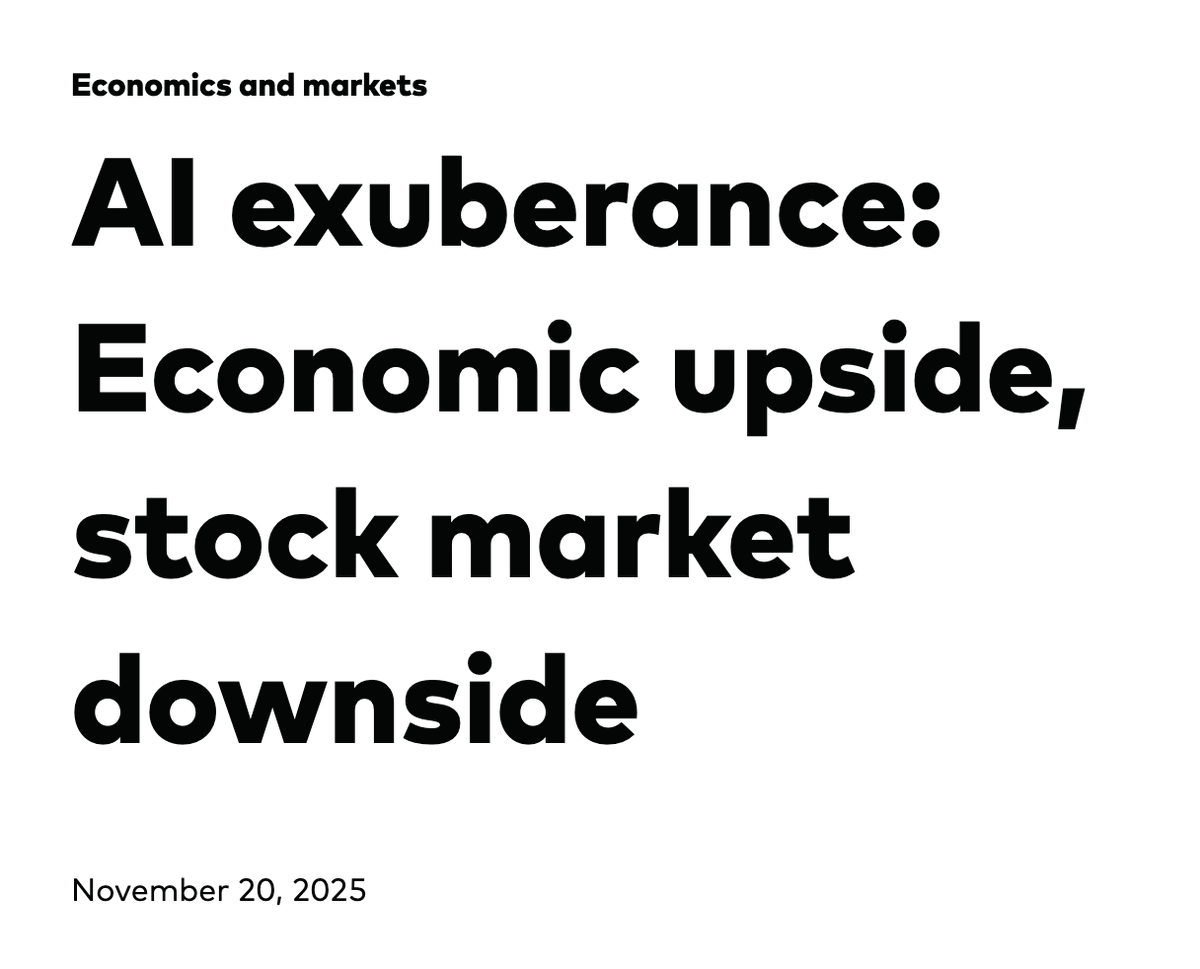
High earnings expectations are meeting a wall of reality.
Economic growth? Diverging.
Stock returns? Subdued.
The market is behaving exactly as the model predicted. Wall Street followed the hype perfectly.
And that is exactly the problem.
Source: corporate.vanguard.com/content/corpor…
English
@iam_elias1 the automation tax would need to scale with wage replacement value, not just be a flat fee per task. otherwise companies just automate the highest-paid roles first and pay the penalty once.
English

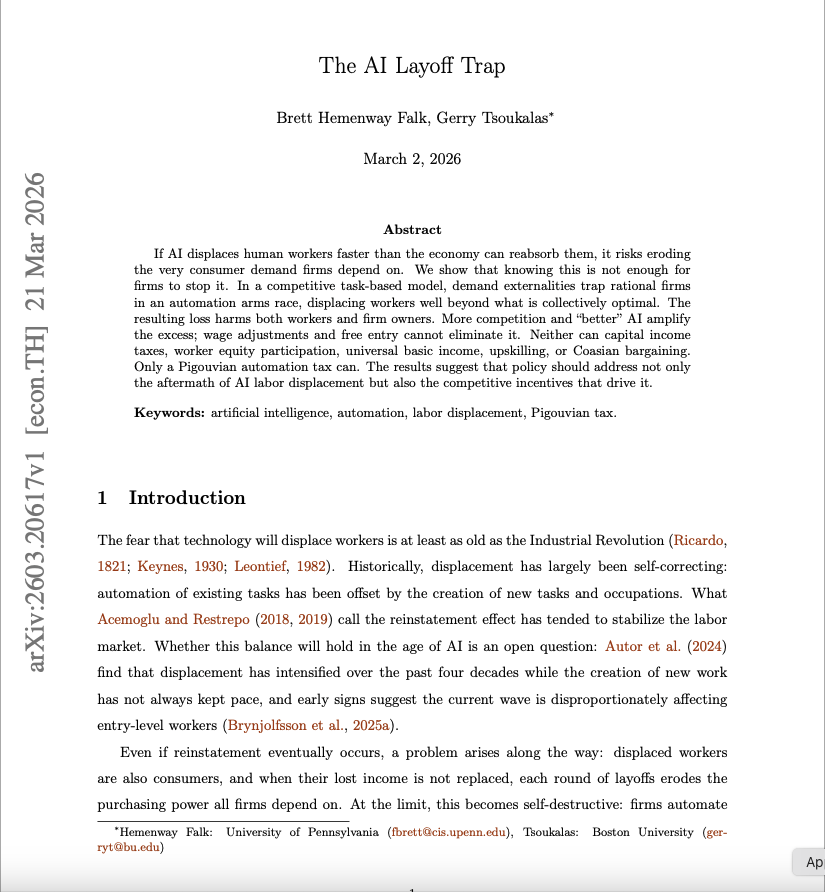
Two economists just published a mathematical proof that AI will destroy the economy.
Not might. Not could. Will — if nothing changes.
The paper is called "The AI Layoff Trap." Published March 2, 2026. Wharton School, University of Pennsylvania. Boston University. Peer reviewed. Mathematically modeled.
The conclusion is one sentence.
"At the limit, firms automate their way to boundless productivity and zero demand."
An economy that produces everything. And sells it to nobody.
Here is how you get there.
A company fires 500 workers and replaces them with AI. A competitor fires 700 to keep up. Another fires 1,000. Every company is behaving rationally. Every company is following the incentives correctly. And every company is building a trap for itself.
Because the workers who were fired were also customers.
When they lose their jobs faster than the economy can absorb them, they stop spending. Consumer demand falls. Companies respond by cutting costs — which means automating more workers — which means less spending — which means more falling demand — which means more automation.
The loop has no natural exit.
The researchers tested every proposed solution. Universal basic income. Capital income taxes. Worker equity participation. Upskilling programs. Corporate coordination agreements.
Every single one failed in the model.
The only intervention that worked: a Pigouvian automation tax — a per-task levy charged every time a company replaces a human with AI, forcing them to price in the demand they are destroying before they pull the trigger.
No government has implemented this. No major economy is seriously discussing it.
Meanwhile the numbers are already tracking the curve. 100,000 tech workers laid off in 2025. 92,000 more in the first months of 2026. Jack Dorsey fired half of Block's workforce and said publicly: "Within the next year, the majority of companies will reach the same conclusion."
Nobody is doing anything wrong. Companies are following their incentives perfectly. That is exactly the problem.
Rational behavior. At scale. Simultaneously. With no mechanism to stop it.
Two economists built the math. The math leads to one place.
Source: Falk & Tsoukalas · Wharton School + Boston University ·
arxiv.org/pdf/2603.20617
English



Before you like. Just read.
I used to take 10–15 trades a day thinking that’s how you get rich from trading.
All that did was blow every account I had. So I started focusing on one setup and less trades.
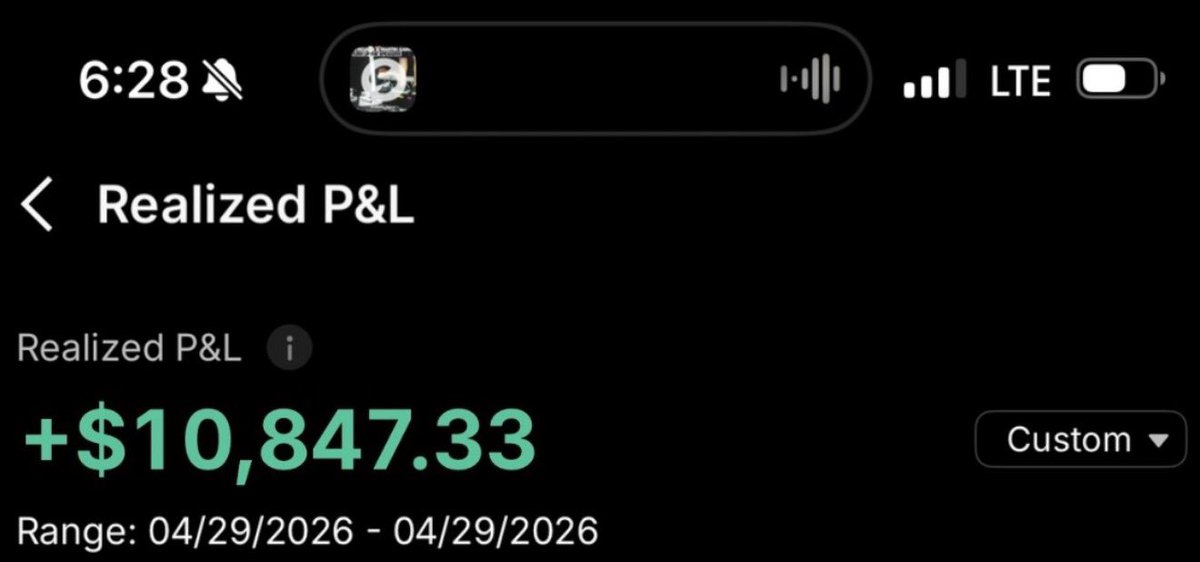
Thats how I grew my small account and how my $100 days turned into $10k day.
If you’re struggling you got this. It’s time to focus on that one setup and master it. You can’t give up now.
There is no plan B.
English

You actually need to be unemployed to catch up with AI
No jokes
English




Most people quit because they forget that you have to be bad at something before you can be good at it. It's so obvious. You suck. Of course you're not going to win in 2 weeks. But if you can learn to enjoy extended periods of failure, you will make it very, very far in life.
English

3 years of straight losing to finally see the light of consistency.
People go to school for 4-8 years for some professions.
It’s worth it, even if it takes you longer. Don’t quit now.
English



Trading will make you rich.
Money stops being a problem.
Forever.
But first you have to earn it.
Show up.
Every single morning.
Before the market opens.
There's no other way.
English

The funny thing is, most of you are already profitable traders
Your strategy works, and you can make profits
Then you just decide to be an idiot after a few losses and crash out
I’ve seen traders do 5% in a month, then take 2 losses in a day, crash out and lose -5% in that day alone
Completely wiping out a good month’s profit because they couldn’t control their emotions
Have a max daily loss for yourself (e.g. 2 losing trades)
After that - WALK AWAY FROM THE CHARTS
The reason you’re still unprofitable after so long in trading is because you don’t know how to do this
English
@ScarfaceTrades_ its designed to make you feel that way so you keep doing it
English
Why does making $500 as a trader feel like a small amount of money but making $100 at a job feel like a lot?
It’s because growing up you were taught to work for money.
Your brain is wired to think you have to exchange time for money.
Therefore when you go to work you have a specific amount of hours you know you have to be there, once you’re done your shift you will get paid for the hours you worked.
In trading you don’t get paid for time.
You get paid for decisions.
Unlike a job you can actually trade all day and lose money
or
You could trade for 1 hour and make 10x the money you made at your job.
Therefore when you’re making money clicking buttons and seeing numbers on a screen you don’t value them:
It’s “easy” money.
But you need to understand…
It may be easy but it’s the hardest easy money you’ll ever make.
English