Leon Chlon

30 posts

Leon Chlon

Leon Chlon

@leon_chlon

Founder @ReliablyLabs, we predict & prevent hallucinations pre‑generation. hallbayes (≈1k⭐) In memory of my grandmother https://t.co/f69PzMqFQ0

London UK Katılım Eylül 2025
20 Takip Edilen255 Takipçiler
Leon Chlon retweetledi
Ahmed Karim
Ahmed Karim@ahmedkar_·
If your model should respect a symmetry, don't assume training will teach it. Test for it. On 25% of cases, a model inside DeepMind's own simulator got it wrong. Toolkit: github.com/leochlon/mezza… Thank you @leon_chlon for all the work you put into this repo! Paper out soon!
English
0
1
3
152
Leon Chlon
Leon Chlon@leon_chlon·
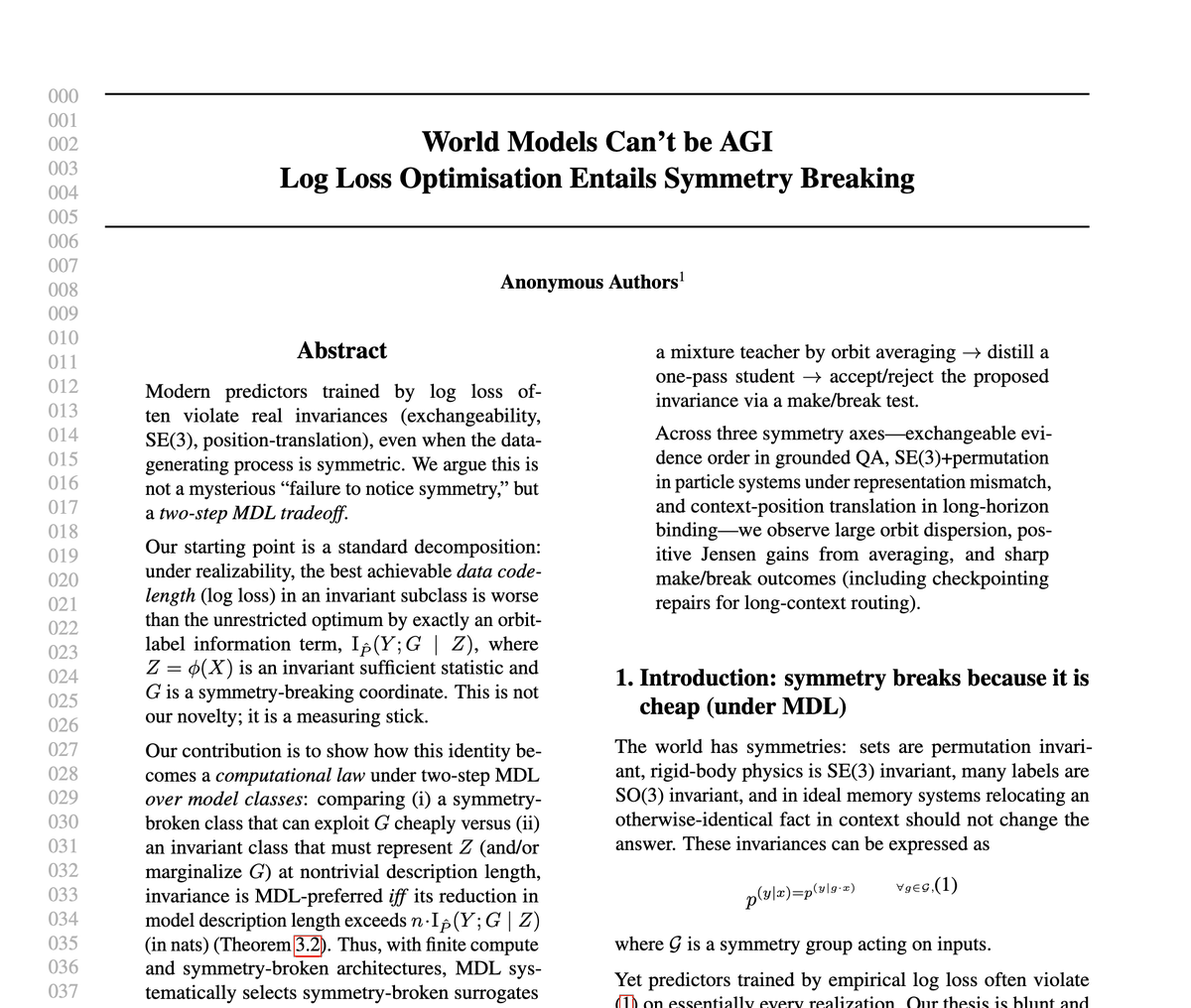
It's time to rain on @ylecun parade and ruin "AGI" for everyone. We prove that JEPA, or any "wOrLd mOdEl" trained under finite computation, will always break rules about the universe that no human would struggle with (symmetries). Here's why: To see why, imagine drawing the number 6 on the floor. Stand on opposite sides and argue whether it's a 6 or a 9. Someone stands overhead and makes a 69 joke. Physics solved this: conserve a universal answer regardless of where you stand. That's conservation of symmetry. A world model trained under log loss from one side of the room will confidently say 6. Train it from the other side, it says 9. Train it from both sides with position encoded, it learns "if standing here, 6; if standing there, 9", which is better compression than learning "ambiguous shape, need more context." The symmetry-breaking representation wins on log loss because it's cheaper than representing the genuine invariance. The optimizer is doing exactly what you asked it to. The uncomfortable implication: world models trained this way aren't learning the world's symmetries. They're learning whatever compressed representation minimizes codelength given the architecture they've got. Most of the "scaling will solve it" discourse implicitly assumes that enough data and compute will recover true invariances. We demonstrate mathematically that the objective itself doesn't want that unless you make invariance cheap in the model description. More data gives you more n, which makes the right side of the threshold bigger, not smaller. Scaling makes it worse, not better. A[~G]I. We provide Mezzanine, a toolkit that fixes these failures one symmetry at a time by distilling invariant representations from orbit-averaged teachers. Pick any model of reality, identify a broken symmetry (which we prove always exists), patch it, and the student performs identically to or better than the teacher, which was breaking that symmetry to compress. It works, it's straightforward, and it outperforms full "world models" trained on scale and ignorance. But it's a patch, not a cure: you have to know the symmetry, and no general fix can ever exist. Toolkit link in the comments, paper next week. Thank you Maggie Chlon for the insane effort put into validating the symmetries we looked at! Mezzanine toolkit: lnkd.in/eDy8Y3-R
Leon Chlon tweet media
English
1
2
7
500
Leon Chlon
Leon Chlon@leon_chlon·
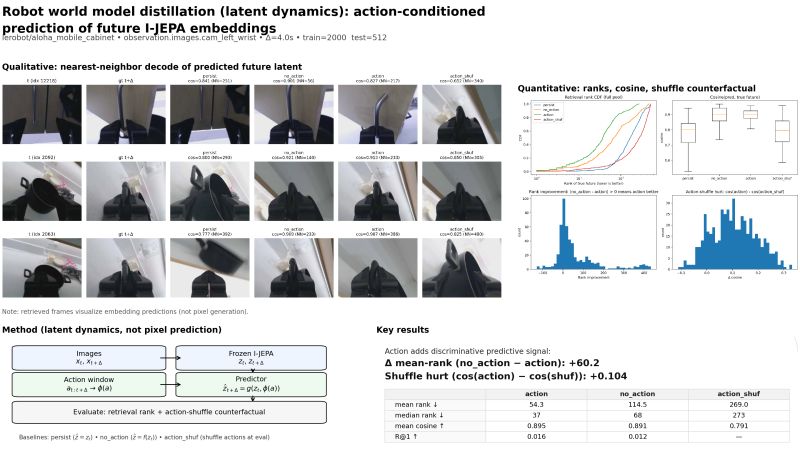
WORLD MODELS <3: We’re excited to share a new first in World Model distillation for robotics: We distilled an action‑conditioned world model in I‑JEPA latent space, evaluated by retrieval rank and validated by an action‑shuffle counterfactual. On real robot wrist video at Δ=4s, actions improve future-state identification; shuffling actions breaks it. This is part of a massive effort: World models ≠ pixel prediction, and more broadly warranted inference ≠ maximum likelihood on a single realization. Finite reasoners can be Bayes-optimal in expectation yet brittle under changes in view/order/factorization. Our approach is to measure the warrant gap, then distill a nuisance-marginalized, invariant state that supports planning and decision-making in one forward pass. Robotics is the most visual demo (JEPA latents + action windows + action-shuffle counterfactual), but the same principle applies to language, interactive physics puzzles, and multimodal systems: treat instability as a first-class object, then distill the expectation into a usable world state, and verify it with counterfactual interventions rather than pixel accuracy. On LeRobot ALOHA Mobile Cabinet with wrist camera and Δ=4s, action conditioning significantly improves retrieval rank, while action shuffling severely degrades performance, supporting the claim that the model learns action‑dependent dynamics in representation space. Finally, calling two talented researchers from underrepresented backgrounds to help me with a new paper I'm drafting! As per Hassana Labs tradition, all my papers encourage bringin together people who don't come from privileged backgrounds to work on cool ML problems and help elevate their CV! Shoot me a message if interested!
Leon Chlon tweet media
English
0
1
3
278
Leon Chlon
Leon Chlon@leon_chlon·
WORLD MODELS <3: We just distilled a a molecular dynamics model that took 120,000 steps on an A100 into a symmetry-stable neural model that runs on your phone. Lennard–Jones fluids are a canonical testbed for statistical mechanics, but learning from single particle snapshots is brittle: rotate the system, relabel particles, or change periodic images, and many models flip their predictions even though the physics hasn’t changed. We made that instability explicit, then fixed it. Ordinarily this requires millions of MD steps across state points and replicates (hours in Python, minutes in optimized MD engines), but our model recovers the same phase-level inference in a single forward pass. We're releasing our Mezzanine world model distillation package today with unreal results on everything from distilling LLMs to robotics to cancer research to molecular dynamics and astrophysics. By treating physically irrelevant transformations as nuisances, we distilled the nuisance-marginalized phase behavior into a tiny feed-forward network, evaluated in a single pass. No repeated simulation. No fragile coordinate conventions. The result is a model whose predictions are: stable under physical symmetries, faithful to the underlying state, and fast enough to be interactive. This isn’t about compression or augmentation. It’s about warranted inference: distill the expectation — not a single view. Download Mezzanine here: github.com/leochlon/mezza…
GIF
English
0
1
3
177
Leon Chlon retweetledi
Paul O'Brien
Paul O'Brien@PaulOBrien·
Checking out Berry by @leon_chlon's Hassana Labs for hallucination reduction in AI assisted coding. Super interesting, MCP based, free 1 month trial. What's not to like. Let me know your thoughts! strawberry.hassana.io/about
English
1
1
4
641
Leon Chlon
Leon Chlon@leon_chlon·
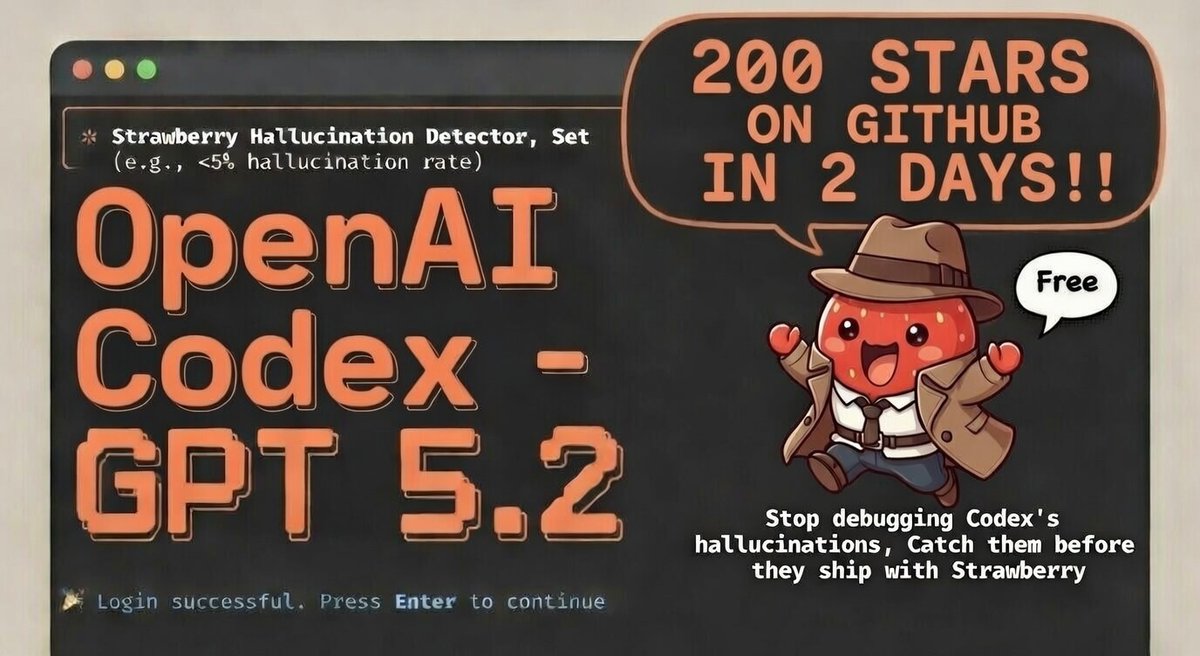
LLM hallucinations aren't bugs, they're compression artifacts. Our Claude Code extension that detects and self-corrects them before writing any code. Now on Codex. Strawberry launched last week and gained an extra 200 stars on Github in just 2 days which is incredible, thank you guys!!! Today we're releasing Codex support + RCA Fix Agent, a skill that turns Strawberry into an evidence-first debugger. Free. Open source. Guaranteed by information theory. The insight: When Claude confidently misreads your stack trace and proposes the wrong root cause, it's not broken. It's doing exactly what it was trained to do: compress the internet into weights, decompress on demand. When there isn't enough information to reconstruct the right answer, it fills gaps with statistically plausible but wrong content. The breakthrough: We proved hallucinations occur when information budgets fall below mathematical thresholds. We can calculate exactly how many bits of evidence are needed to justify any claim, before generation happens. Now it's a Claude Code skill with one rule: never decide root cause from vibes. The rca-fix-agent skill forces Claude to: Gather evidence (code, logs, stack traces, web docs) Form a claim: "The issue is because of ROOT_CAUSE" Verify with detect_hallucination before touching any code If flagged → gather more evidence, run experiments, iterate Implement fix only after verification passes Run tests, check for new failure modes Loop until everything verifies What it catches: Phantom citations, confabulated docs, evidence-independent answers Stack trace misreads, config errors, negation blindness Correlation stated as causation, interpretive leaps Docker port confusion, stale lock files, version misattribution. The era of "trust me bro" vibe coding is ending. GitHub: lnkd.in/eXzfS7Rz Paper: lnkd.in/e_cUDtaG MIT license. 2 minutes to install. Works with any OpenAI-compatible API.
Leon Chlon tweet media
English
2
0
2
203
Leon Chlon
Leon Chlon@leon_chlon·
LLM hallucinations aren't bugs. They're compression artifacts. We just built a Claude Code extension that detects and self-corrects them before writing any code. Strawberry launches today it's Free. Open source. Guaranteed by information theory. The insight: When Claude confidently misreads your stack trace and proposes the wrong root cause it's not broken. It's doing exactly what it was trained to do: compress the internet into weights, decompress on demand. When there isn't enough information to reconstruct the right answer, it fills gaps with statistically plausible but wrong content. The breakthrough: We proved hallucinations occur when information budgets fall below mathematical thresholds. We can calculate exactly how many bits of evidence are needed to justify any claim, before generation happens. Now it's a Claude Code MCP. One tool call: detect_hallucination Why this is a game-changer? Instead of debugging Claude's mistakes for 3 hours, you catch them in 30 seconds. Instead of "looks right to me," you get mathematical confidence scores. Instead of shipping vibes, you ship verified reasoning. Claude doesn't just flag its own BS, it self-corrects, runs experiments, gathers more real evidence, and only proceeds with what survives. Vibe coding with guardrails. Real example: Claude root-caused why a detector I built had low accuracy. Claude made 6 confident claims that could have led me down the wrong path for hours. I said: "Run detect_hallucination on your root cause reasoning, and enrich your analysis if any claims don't verify." Results: Claim 1: ✅ Verified (99.7% confidence) Claim 4: ❌ Flagged (0.3%) — "My interpretation, not proven" Claim 5: ❌ Flagged (20%) — "Correlation ≠ causation" Claim 6: ❌ Flagged (0.8%) — "Prescriptive, not factual" Claude's response: "I cannot state interpretive conclusions as those did not pass verification." Re-analyzed. Ran causal experiments. Only stated verified facts. The updated root cause fixed my detector and the whole process finished in under 5 minutes. What it catches: Phantom citations, confabulated docs, evidence-independent answers Stack trace misreads, config errors, negation blindness, lying comments Correlation stated as causation, interpretive leaps, unverified causal chains Docker port confusion, stale lock files, version misattribution The era of "trust me bro" vibe coding is ending. GitHub: lnkd.in/eXzfS7Rz github.com/leochlon/pythe… Paper: arxiv.org/abs/2509.11208 MIT license. 2 minutes to install. Works with any OpenAI-compatible API. New supporting pre-print on procedural hallucinations drops next week. Big big big thank you to Ahmed Karim, Maggie Chlon for all the amazing work on this and Nell Watson for her help including Survival and Flourishing Corp for the funding helping this research stay free!
Leon Chlon tweet media
English
0
0
4
200
Leon Chlon
Leon Chlon@leon_chlon·
@MargaretGo82906 @TheBMA Yeah but a "nurse practioner" isn't going to be the one performing your open heart surgery are they. Then don't expect a in-demand profession to take a pay cut because you feel like they owe you something. If you don't like it, make up the supply from somewhere else.
English
2
0
0
24
Margaret Gooding
Margaret Gooding@MargaretGo82906·
@TheBMA Don't let them back, the next lot of apprentices will be leaving university before too long, Nurse practioners will be able to take over and the House doctors to a tad more same with the consultants instead of moonlighting.
English
2
0
3
189
The BMA
The BMA@TheBMA·
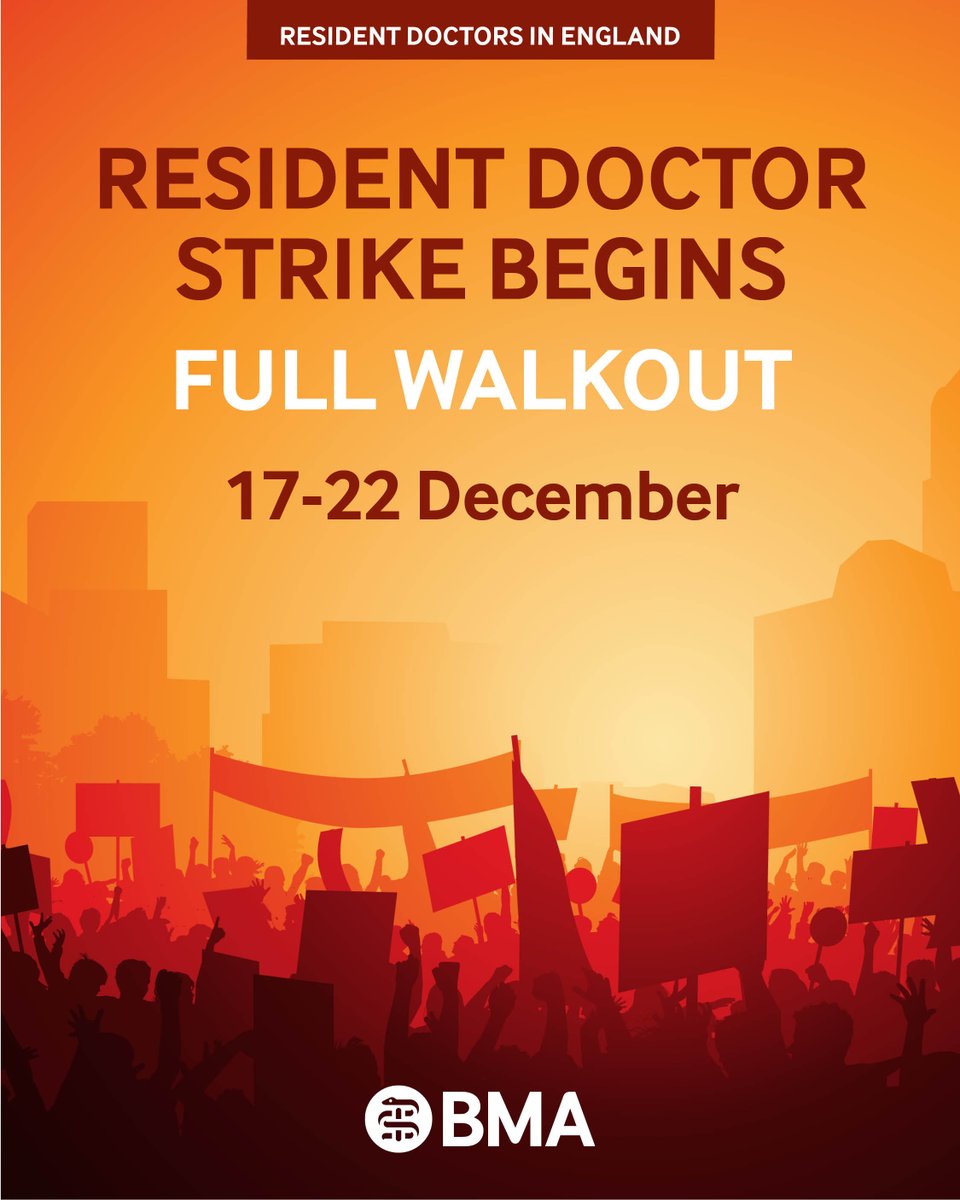
Today 10,000s of doctors will go out on strike, as they're willing to stand up for their profession against a totally avoidable jobs and pay crisis. Resident doctors need jobs, and when they find those jobs, they need to be paid fairly for it. Striking is a last resort, we just need @wesstreeting to put an offer on the table that we can accept.
The BMA tweet media
English
197
156
424
29.4K
Leon Chlon
Leon Chlon@leon_chlon·
@Finn000000000 @TheBMA @wesstreeting Guy letting the fake doctor title get to his head believing he's entitled to dictate the market value assigned to actual life saving medical professionals.
English
0
0
1
26
Finn, PhD
Finn, PhD@Finn000000000·
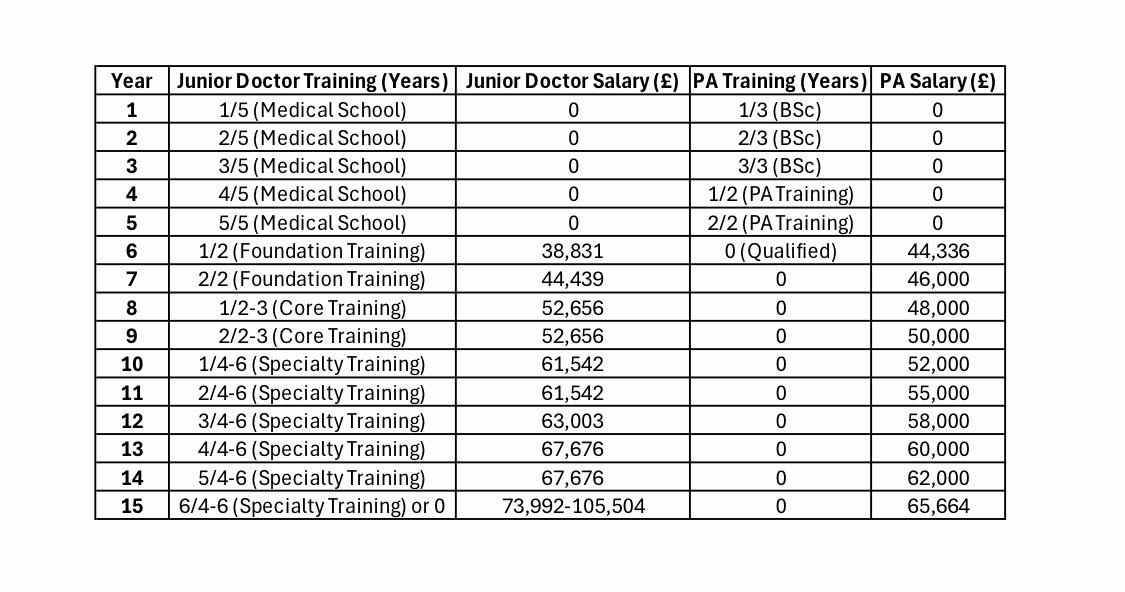
@TheBMA @wesstreeting Basic salary vs average salary. Junior drs vs PAs. Sure maybe you should earn the same in those first two years but let’s be honest, it’s not about that is it? It’s a small difference and then you quickly exceed their earnings, You want more money to match your ego.
Finn, PhD tweet mediaFinn, PhD tweet media
English
2
0
2
101
Leon Chlon retweetledi
Mark Kretschmann
Mark Kretschmann@mark_k·
GPT-5.2 is AGI. 🤯
Mark Kretschmann tweet media
Indonesia
776
439
14.2K
1.3M
Leon Chlon
Leon Chlon@leon_chlon·
Meet the @ReliablyLabs co-founders! They bring extraordinary value to our team, with Maggie writing the papers and base code & Amgad being our business and GTM guide since day 0. We can't wait to show y'all what we've been building.
Leon Chlon tweet media
English
0
0
3
198
Leon Chlon
Leon Chlon@leon_chlon·
I’ve worked in AI for 10 years across Meta, Uber, McKinsey, Apple, Cambridge, Harvard, etc. If you’re broke and you want to ride the AI money train: 1) Don’t read any “State of AI” report written by people with fake social media status, I promise you it doesn’t translate to results. Don’t buy anyone’s course. Don’t idolise morons, they don’t understand how to innovate in this space so they’re trying to make you the product. God made the internet free so you don’t have to rely on snake oil merchants. 2) Avoid Dubai. If you like hearing people talk about themselves go on Yann Le Cunn’s twitter, because there you might even learn some ML by accident. Dubai is where the unemployable go to appeal to the recently wealthy, nothing worthwhile is being built there, they don’t buy anything unless it’s Sam Altman going to sell it to them. 3) Be loud. Be so loud that they have to tell you to shut up. Disrupt everyone and make your work so visible. If you’re born poor you have a higher sensitivity to risk because a loss takes you closer to the poverty line than Hamish or Tarquin making Loveable websites in their dad’s 10th cottage on their sprawling Cornwall estate. You need to realise they aren’t better than you, they just aren’t afraid of being loud. If you live in the west you are never going to reach the levels of poverty your parents felt before immigrating over. Be loud and don’t let anyone take your ideas or work.
Leon Chlon tweet media
English
0
1
4
288
Leon Chlon
Leon Chlon@leon_chlon·
Both images used the same prompt and model, except the one on the left hallucinated, and hallbayes stopped the one on the right from ignoring details in the prompt. No extra training needed, and both sun on SDXL, cost? $0.0001 per image on a T4, right took 3 extra seconds to make
Leon Chlon tweet media
English
0
0
3
340
Leon Chlon
Leon Chlon@leon_chlon·
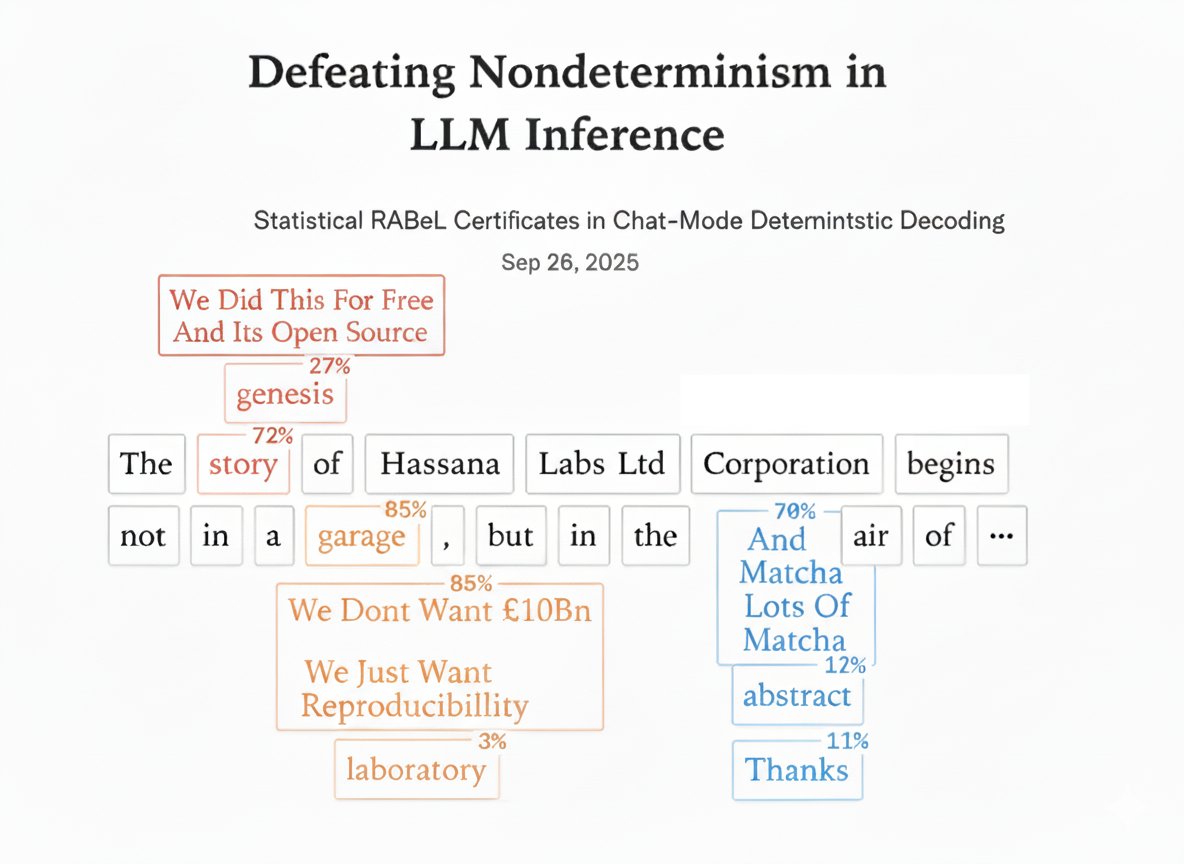
We solved LLM Non-Determinism pre-generation, training-free, so now you don't have to pay @thinkymachines billions to replace every GPU kernel for "deterministic" ML inference. The problem: LLMs at temperature=0 aren't deterministic. When heavy machinery, medical devices, or financial systems depend on reproducible outputs, "usually consistent" isn't good enough. Thinkylabs solution: Rewrite CUDA from scratch (lol). Wait for vendors to adopt. Hope it doesn't break with the next PyTorch update. Oh, and it still doesn't handle prompt reordering. Our solution: Accept hardware noise exists. Detect where it matters. Stabilize only those points. Zero overhead when tokens are already robust. Key innovations: - Provably deterministic when μ ≥ 2r under bounded noise - Statistical certificates (95%+ confidence) elsewhere - Selective intervention: Only pay costs at true inflection points - Observable uncertainty: Full audit trail with p_flip per token Works today: Compatible with OpenAI, Anthropic, any provider with logprobs (but built with OpenAI for now) Result: Deterministic guarantees where possible, statistical confidence everywhere else, with 1.0-1.2× overhead (vs 10-30× for naive approaches). We didn't need to rebuild CUDA. We didn't need millions in funding. We needed mathematical rigor to identify exactly where determinism is achievable and statistical methods where it isn't. Code is open source. While they're still writing whitepapers about replacing GPU kernels, you can pip install our solution and use it in production today. Sometimes the best engineering isn't replacing everything - it's proving what's already stable and fixing only what isn't. code: lnkd.in/ep9_zYSJ readme: lnkd.in/eytPwmch hashtag#MachineLearning hashtag#LLM hashtag#Engineering hashtag#Reproducibility hashtag#OpenSource hashtag#SafetyCritical
Leon Chlon tweet media
English
0
1
11
608
Ruairidh Battleday
Ruairidh Battleday@RMBattleday·
🔊Speaker Spotlight: Dr @leon_chlon | Hassana Labs We are delighted to welcome Dr Leon Chlon, founding AI engineer at Hassana Labs as a speaker at the AE Global Summit on Open Problems for AI! Leon’s background exemplifies the community we are building here at the Summit. He holds a masters in Theoretical Physics, a PhD in Machine Learning from @Cambridge_Uni, and did his postdoc at the @MIT_Picower. Since then he has scaled ML systems at @Apple (content ranking), @WorldBank (economic forecasting), and @tiktok (marketplace dynamics); led drug discovery ML at @TailorBio, identifying 3 compounds now in validation; built hallbayes (training-free pre-gen failure prediction), 1k+★ on github, now used by enterprise teams. Now, along with his sister, he has founded Hassana Labs, building open-source tools for uncertainty-aware LLMs while advising Fortune 500 companies on implementation. Part of that involves publishing open-access innovations in fundamental ML, most recently papers around predicting and mitigating LLM hallucinations. Part of it involves helping teams ship reliable LLM systems. This background places him perfectly to join Day 1’s session on AI Breakthroughs in Industry, chaired by @flxsosa, and featuring researchers from @Harvard, @wayve_ai, @InstituteGC, @KPMG, @thomsonreuters, @NTT_DATA_UK, and @Bertelsmann_com. We’re excited to hear his thoughts on the Open Problems for AI, and know you are too! A handful of Early Bird tickets now left: Come along and join the debate (link in comments below)! #AI #openproblems #ThinkingAboutThinking
Ruairidh Battleday tweet media
English
2
0
6
248
Leon Chlon
Leon Chlon@leon_chlon·
🚀 Exciting news! Our team has been awarded $100,000 in Microsoft for Startups credits and access to a GPU cluster. For a small team like ours, this is a game-changer, helping us accelerate the fundamental AI research we’re doing here in the UK. We can finally move forward with onboarding Hassana Labs fellows onto practical assignments contributing toward our new exciting paper on Nondeterminism in LLM Inference and the update to our toolkit that is coming with it! (github.com/leochlon/hallb… 1k+ stars in < 1 month) to find out more and DM me if you're interested in working with us!) Huge thanks to Microsoft and Rob Ferguson for supporting startups at the cutting edge of AI. We can’t wait to show what’s next!
English
4
0
14
546
Leon Chlon retweetledi
Ahmed Karim
Ahmed Karim@ahmedkar_·
Great opportunity for those interested to contribute to Hassana Labs, I highly recommend you DM Leon on X whilst his account is still small here!
Leon Chlon@leon_chlon

Looking for 3-5 authors to contribute on our most recent project. Ideal candidates are STEM/CS background from underrepresented communities and countries. You know how LLMs give different answers in a prompt, even at temperature zero because noise, batch effects etc. We solved this mathematically. We discovered that token chunks act like generators in a Lie algebra, when they don't commute, order matters. Just like how rotating an object on different axes gives different results depending on order. Our solution? The Lie Symmetriser which it computes the mathematical 'centre' of all possible orderings in one pass, no Monte Carlo needed. We only trigger it at inflection points where the model is genuinely uncertain, adding under 100 milliseconds overhead. Here's the kicker: we open source tools that are training-free and pre-generation, deploying immediately into production and the first version is already provides determinism guarantees. The earliest version which gave rise to this paper is already on GitHub. This will most likely benefit hopefuls applying for PhD positions more than anyone else since it’ll look good on your funding applications. To apply, just DM me If you need motivation to apply, we released this 3 weeks ago and its already on 998+ stars, with 4 enterprises already using it in their stack. Everyone that contributed is getting pinged by recruiters across MAANG about jobs. lnkd.in/e4s3X8GK If @thinkymachines can raise $10bn off @cHHillee writing a blogpost over matcha and avocado toast, our actual script that anyone can use should recover the £2k investment I put into the colab credits for validation.


English
0
1
7
1.1K
Leon Chlon
Leon Chlon@leon_chlon·
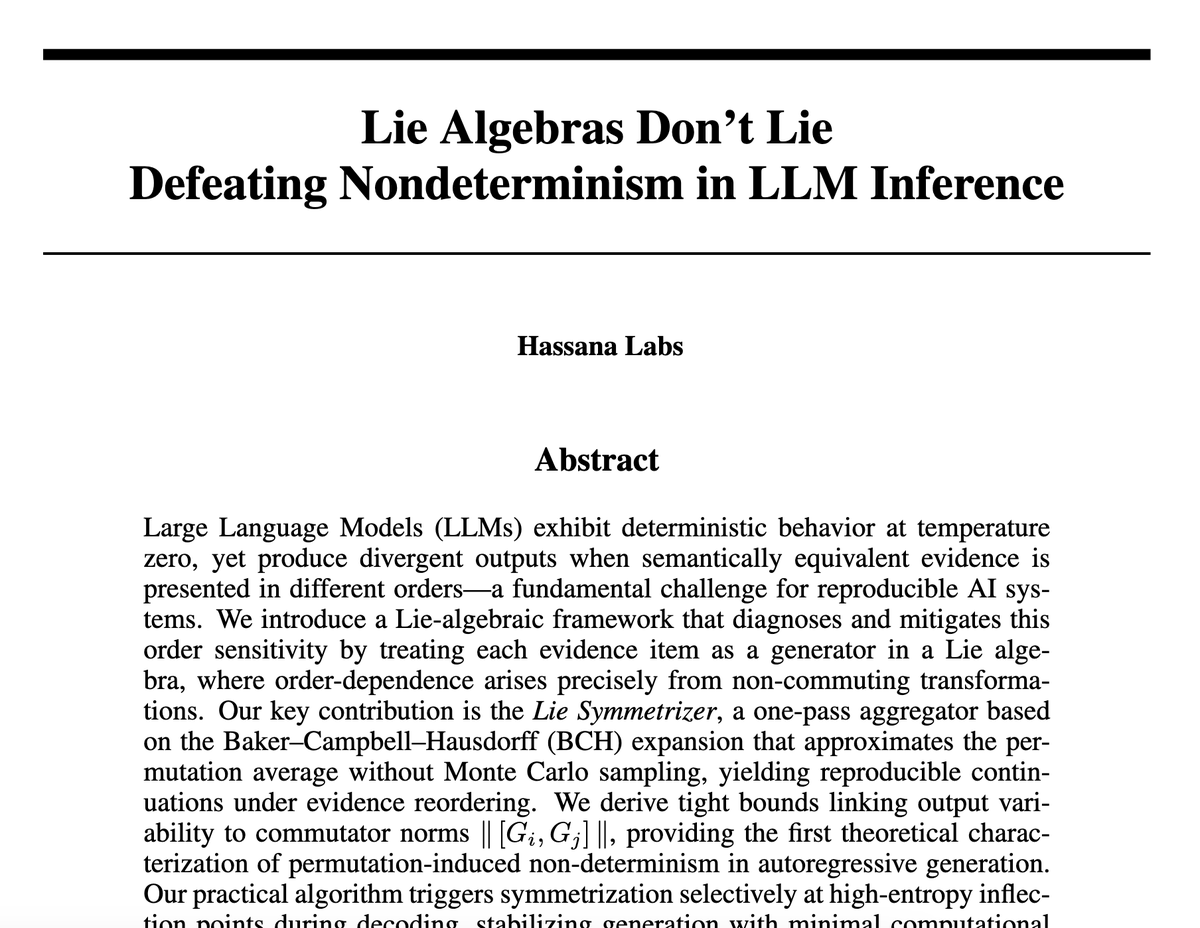
Looking for 3-5 authors to contribute on our most recent project. Ideal candidates are STEM/CS background from underrepresented communities and countries. You know how LLMs give different answers in a prompt, even at temperature zero because noise, batch effects etc. We solved this mathematically. We discovered that token chunks act like generators in a Lie algebra, when they don't commute, order matters. Just like how rotating an object on different axes gives different results depending on order. Our solution? The Lie Symmetriser which it computes the mathematical 'centre' of all possible orderings in one pass, no Monte Carlo needed. We only trigger it at inflection points where the model is genuinely uncertain, adding under 100 milliseconds overhead. Here's the kicker: we open source tools that are training-free and pre-generation, deploying immediately into production and the first version is already provides determinism guarantees. The earliest version which gave rise to this paper is already on GitHub. This will most likely benefit hopefuls applying for PhD positions more than anyone else since it’ll look good on your funding applications. To apply, just DM me If you need motivation to apply, we released this 3 weeks ago and its already on 998+ stars, with 4 enterprises already using it in their stack. Everyone that contributed is getting pinged by recruiters across MAANG about jobs. lnkd.in/e4s3X8GK If @thinkymachines can raise $10bn off @cHHillee writing a blogpost over matcha and avocado toast, our actual script that anyone can use should recover the £2k investment I put into the colab credits for validation.
Leon Chlon tweet media
English
12
2
24
2K