

Lesley Jacobs ☮️
8.5K posts
Lesley Jacobs ☮️
@lesleyjacobs
on Post at @lesleyjacobs on Mastodon @[email protected]
Seattle, Washington Katılım Aralık 2008
387 Takip Edilen234 Takipçiler

🎶Guess who's back
Back again
Nissan's back
Tell your friends
English
@jason_kint That segment in 2008 lead to the creation of the Seattle King County Clinic. RAM helped. The 11th annual clinic is April 23-26. It has become the largest free med/dental/vision clinic in the country. It is critical support for the community. seattlecenter.org/skcclinic/
English
60 Minutes still reaches as many as 10mil viewers on Sundays. So when you see an incredible and emotional segment like the first one tonight told by Scott Pelley bridging a segment 18yrs ago, it's a good reminder as to its impact informing the public. /1
English
@TriumphICDHQ @nbcsnl It would have been epic if they'd gone on for 1/2 the show. Break from that skit directly to Jack White's performance. It would have been more and more funny. As it was it was funny as heck.
English

@60Minutes Come visit the Seattle King County Clinic in Seattle from April 23-26. We serve several thousand patients at the 4 day clinic that offers free medical, dental and vision care. The need is still there, and growing. This will be the 11th clinic this year. seattlecenter.com/events/event-c…
English
Marty Tankersley drove 200 miles and slept in his car to get treatment for an infected tooth. He said it was killing him for weeks. Scott Pelley spoke with him in 2008 outside a Remote Area Medical clinic, which offers free health care.
RAM founder Stan Brock, who died in 2018, told 60 Minutes the number of people coming to the pop-up clinics was rising. cbsn.ws/4v9HKXN
English
Lesley Jacobs ☮️ retweetledi
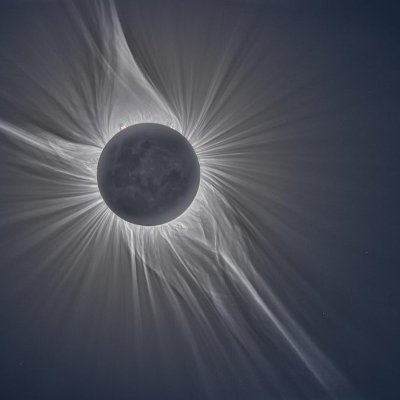
What will the Artemis-2 astronauts do during the entire 10-day mission?
Day by day overview:
Day 1. Launch.
Launch on the SLS rocket, stage separation, orbital insertion. Maneuvers around the spent stage, initial system checks, change from spacesuits to everyday clothing.
Day 2. Beginning the journey to the Moon:
Simulator exercises, then the main maneuver—translunar injection (TLI), which places Orion on a trajectory to fly around the Moon and return to Earth.
Day 3. Preparation
Rehearsals for lunar observations in zero gravity, corrective maneuver, emergency procedures training (e.g., CPR).
Day 4. Course correction
Second minor maneuver, communication with Mission Control, media sessions, photography of Earth and the Moon at the midpoint.
Day 5. Lunar Entry
For the first time since 1972, humans will be in cislunar space. Spacesuit tests: rapid pressurization, life support systems checks. Another course correction.
Day 6. Lunar Flyby
The main day: The Orion spacecraft will fly at an altitude of 6,400–9,650 km above the lunar surface.
This distance is approximately 15–24 times greater than the orbital altitude of the ISS. Plus, the Moon itself is smaller. Visually, the Moon will look like a basketball at arm's length to the astronauts. There will be only three hours for observations during closest approach. The astronauts will take photographs and record geological data. Depending on the launch time, the Artemis 2 crew could break the record for the longest distance from Earth.
Day 7. Lunar Exit
Data transfer to scientists, psychological and physical debriefings. Symbolic call with the ISS crew. First maneuver of the return trajectory.
Day 8. Demonstrations
Radiation protection training (using water and thermal protection as barriers). Testing the Orion attitude control systems in various modes.
Day 9. Preparing for reentry
The last full day of the flight. Technological demonstrations, course corrections, fitting of compression suits to help the body adapt to weightlessness.
Day 10. Return
Final maneuver, atmospheric reentry, during which the temperature will reach 1650°C. Parachute deployment, splashdown in the Pacific Ocean off San Francisco. Crew pickup by US Navy ships.

English
@PacoOnPause Thank you for these videos! They reinforce my commitment to masking. I have a lot of respect and admiration for you and thank you for educating us.
English

@MariaMGillespie @ParentMishmash Thank you for the excellent tutorial!
English
Lesley Jacobs ☮️ retweetledi

First tip: On omnimask.com, order the adapters to install 3M pancake filters on the sides rather than the filters that come with the OmniMask. Big improvement to safety. 4/23
English
Been giving research talks in my clear front respirator setup! Keeps me healthy, allows for facial expressions for better communication and lip reading, and the mic amplifies the sound well. A detailed video thread on the setup... 1/23 #CovidIsAirborne #MaskUp

English
Lesley Jacobs ☮️ retweetledi

The Torch 2 is more expensive per milliwatt than the Original Torch and Lantern because it has replaceable bulbs and batteries and should last 5-10 years instead of 1-2. It is still almost 10% of the cost per milliwatt of output of any other portable Far-UVC device- all of which have non-replaceable bulbs and batteries.
We don't make claims about effectiveness until we have hard data from pathogen chamber testing, but initial indications are that one Torch 2 might offer meaningful protection in a 50m3 space, with two being better, of course. But again, no claims without data, which will be ready at launch.
English
Lesley Jacobs ☮️ retweetledi

Lesley Jacobs ☮️ retweetledi

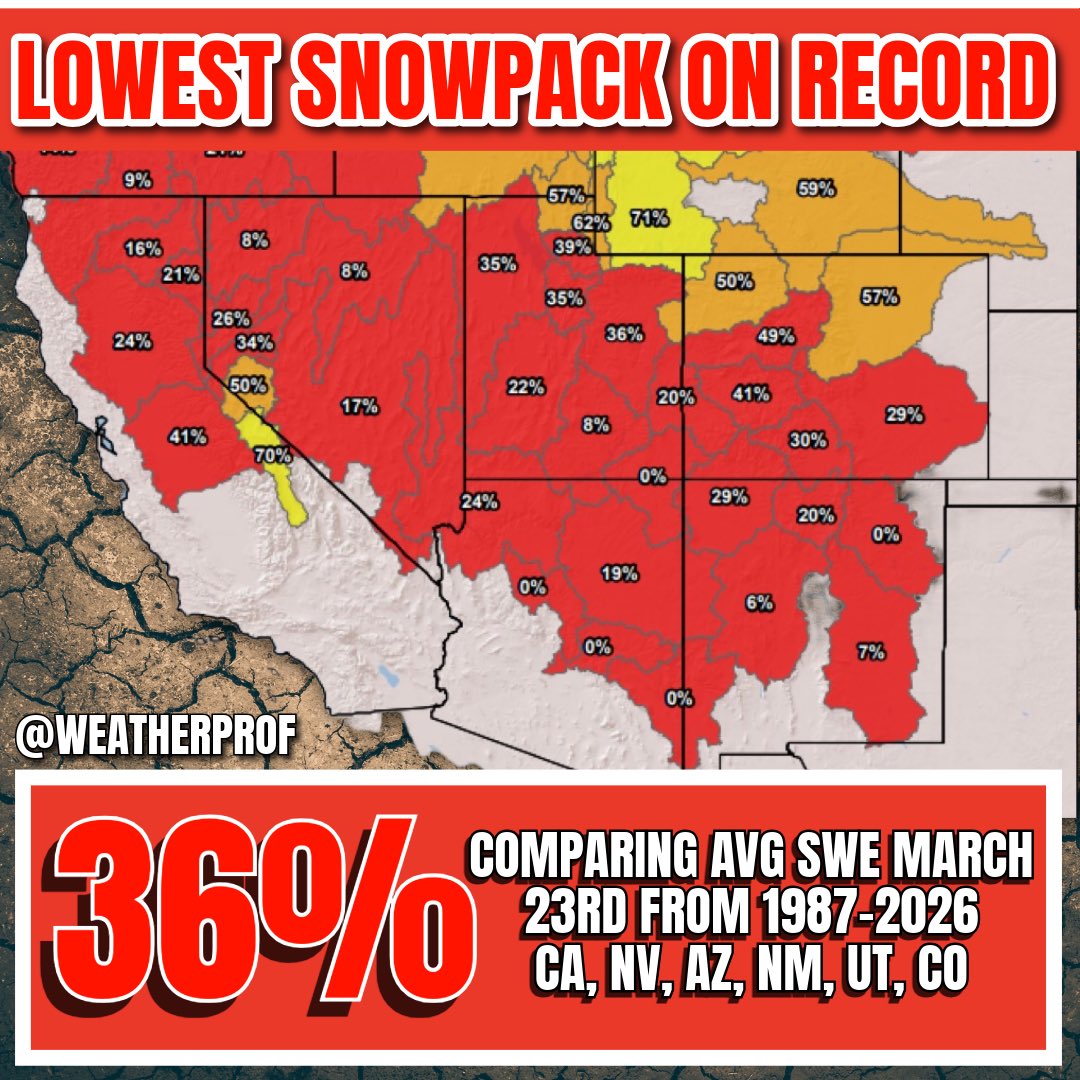
Lowest snowpack on record in the Southwest by longgg shot!
Only 36% of normal currently. Much lower in spots. Former record 57% in 2015 going back to 1987. Obviously this can have huge implications for water availability and fire season. Research shows low snowpack leads to more severe fires.
(This calculation applies to CA, NV, AZ, NM, UT & CO since 1987. The average is not weighted by geographic area, it’s a strict average of the states. By my calculations the lowest are… 2015: 57% of normal, 2018: 72%, 2007: 73%, 2012: 77%, 2013: 79%
English
@NukitToBeSure Thank you Nukit for helping Edderic with his work. I appreciate you both so much. Thank you for your consistent excellence and work to help the public stay safe. I was proud to be a mask tester in this project, and it helped me and my narrow face find good mask fits.
English
Extremely important work. The better fitting your mask, the better protected you are from those who won't wear masks.
Edderic Ugaddan 💜@eddericu
Happy to publicly announce that MasqFit is now available in the iOS App Store! apps.apple.com/ca/app/masqfit…
English
Happy to publicly announce that MasqFit is now available in the iOS App Store! apps.apple.com/ca/app/masqfit…

English
@eddericu Thank you for your work on this project! It will help people find better fitting masks.
English
@ThatEricAlper I have one of those step stools in my garage!
English

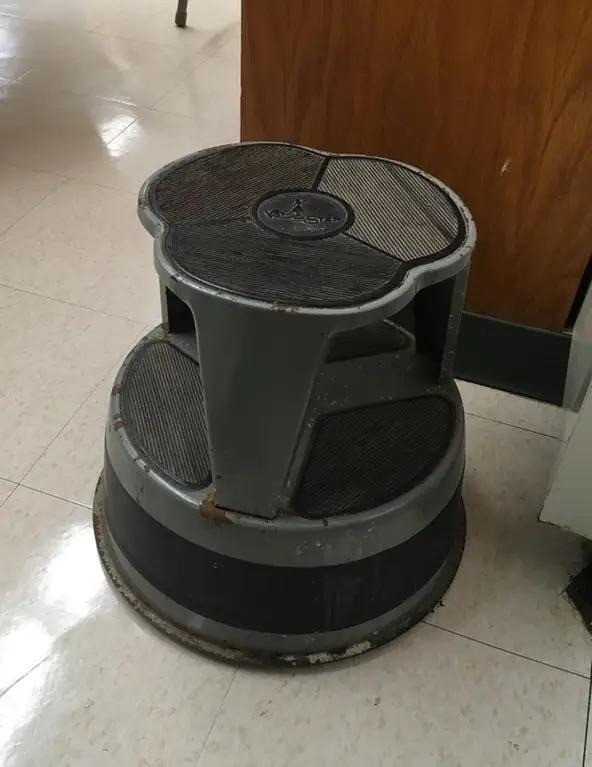
@ThatEricAlper Me too, that’s where I got my love of things that glow in the dark. My siblings and I used to run around the basement holding glow in the dark spiders for feeble lights
English

Lesley Jacobs ☮️ retweetledi

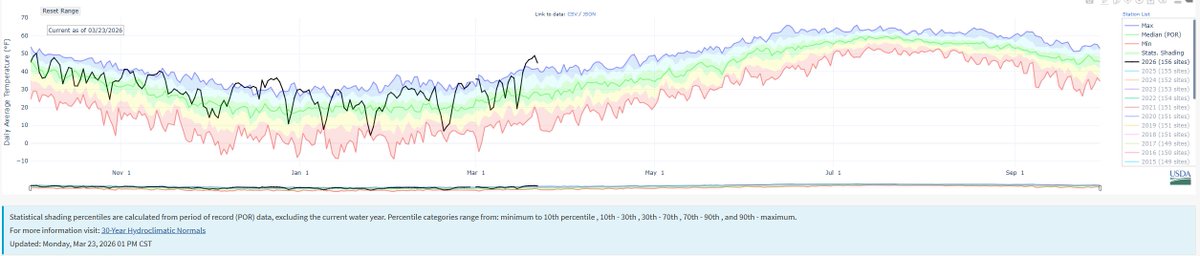
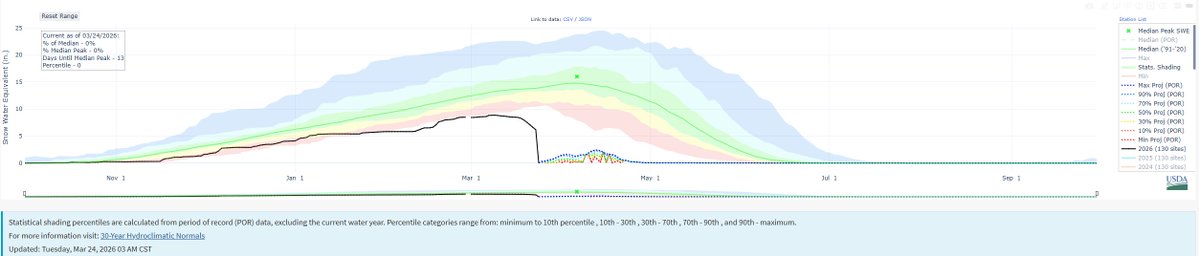
The historic warmth even in the overnight lows has exacerbated and already horrible Snow Water Equivalent (SWE) situation is in the west. The Upper Colorado literally has none left to measure and the average daily temperatures have touched what is normal for June here.
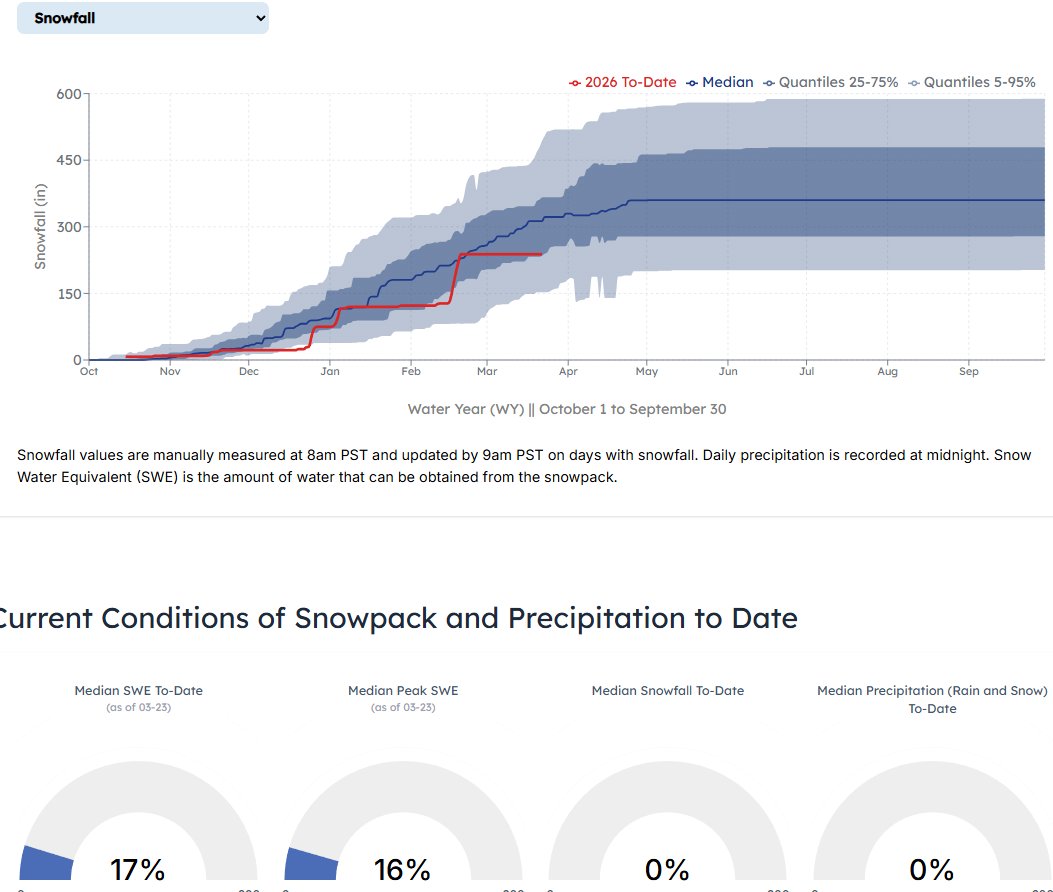
Even with 2 big dumps of snow this winter, recent warmth and the light, fluffy snow experienced with the second big snow a few weeks ago has literally evaporated from the Sierra snowpack. SWE here is abysmal at best.
The first 2 graphs are from the Upper Colorado site from USDA. Future water and fire ramifications will be the topics of discussion going forward.
English
Lesley Jacobs ☮️ retweetledi

BREAKING: The nitrogen trap just closed. Three locks snapped shut simultaneously. The planting window is closing behind them. And the food the world eats next year is now being decided by molecules that cannot reach the soil in time.
Lock one: the Strait of Hormuz. The IRGC permissioned corridor allows oil tankers from friendly nations to pay $2 million in yuan and pass. It does not allow fertiliser vessels to pass at any price. Zero approved fertiliser transits in 24 days. The Gulf supplies 49 percent of the world’s exported urea and roughly 30 percent of traded ammonia. That supply is not delayed. It is denied. The gate opens for molecules that fund the gatekeeper. It stays closed for molecules that feed the planet.
Lock two: Russia. The world’s largest exporter of ammonium nitrate just halted all AN exports until after April 21. Three to four million tonnes per year, gone from global markets at the exact moment the Northern Hemisphere needs it most. The official reason is “domestic priority.” The strategic effect is leverage. Russia earns windfall revenue from the oil price spike its ally’s war created, then removes the fertiliser that farmers need to plant through the crisis. The disease and the cure, again, from the same address.
Lock three: China. Beijing has banned exports of nitrogen-potassium blends and phosphate fertilisers through August 2026. China is the world’s largest phosphate producer and a major nitrogen supplier. The ban removes the last alternative source that could have compensated for Hormuz and Russia. Three locks. Three countries. Three deliberate decisions timed to the same biological calendar.
The biological calendar does not negotiate. Corn requires nitrogen at the V6 to VT growth stage or kernel set is permanently reduced. Wheat requires it at tillering and jointing or grain fill collapses. Rice requires it at transplanting or yield drops 20 to 40 percent in low-input systems. These are not economic models. They are cellular processes. The plant either receives nitrogen during the window or it does not. If it does not, no subsequent application, no price increase, no policy reversal can recover what was lost. The damage is written into the biology of the seed.
The US Corn Belt window closes mid-April. European top-dressing is happening now. Indian Kharif preparation begins in May. Bangladeshi Boro rice transplanting is underway this week. Every one of these windows is closing while the three largest sources of nitrogen on Earth are simultaneously locked: Hormuz by military blockade, Russia by export decree, China by trade ban.
The USDA Prospective Plantings report arrives March 31. The FAO Food Price Index publishes April 3. These will quantify what the molecules already know: the nitrogen did not arrive. The yield loss is locked in. The 5 to 10 percent global drag will concentrate where the buffers are thinnest: subsistence farms in Bangladesh, Sub-Saharan Africa, South Asia, where a 20 percent shortfall does not mean lower profits. It means hunger.
Sri Lanka banned synthetic fertiliser in 2021. Rice yields collapsed 40 percent. The government fell. In 2008, fertiliser and oil spiked simultaneously and food riots erupted across 30 countries. In 2026, the strait blocks fertiliser while Russia and China withdraw the alternatives, and the planting windows close on a planet with nowhere else to turn.
The war is fought with missiles. The famine is fought with molecules. The molecules are trapped behind three locks on three continents, timed to the one calendar that cannot be paused, extended, or negotiated: the calendar written into the DNA of every seed in the soil.
Full analysis: open.substack.com/pub/shanakaans…

Shanaka Anslem Perera ⚡@shanaka86
JUST IN: The most irreversible consequence of this war is not happening in Tehran. It is happening in a barn in Iowa. A farmer is standing over a kitchen table looking at two seed catalogues. One is corn. One is soybeans. Corn needs 180 pounds of nitrogen per acre. Nitrogen costs $610 per ton on the CBOT March futures settlement as of yesterday, up 35 percent in a month. Soybeans fix their own nitrogen from the atmosphere through root bacteria called rhizobia. They need nothing from the Strait of Hormuz. The farmer is choosing soybeans. Millions of acres are choosing soybeans. And once the planter rolls into the field, the choice cannot be reversed until next year. USDA projected corn at roughly 94 million acres for 2026, down from 98.8 million. Soybeans at 85 million, up from 81.2 million. Those projections were published February 19, before urea surged past $683 at New Orleans. The actual shift will be larger. USDA Prospective Plantings reports March 31. By then the seeds will be in the ground. This is the transmission channel the world is not watching. A 21-mile strait enforced by provincial commanders with sealed radio orders just rewrote the planting economics of 90 million acres of the most productive farmland on Earth. Not through sanctions. Not through diplomacy. Through the price of a single molecule that corn cannot grow without and soybeans do not need. Now follow the cascade. The Renewable Fuel Standard mandates 15 billion gallons of corn ethanol annually. That consumes roughly 43 percent of the entire US corn crop. The mandate is set by the EPA. It does not flex when corn acres shrink. It is inelastic demand consuming a fixed share of a declining supply. When supply tightens against a fixed mandate, the remaining corn reprices upward. Corn above $5 per bushel compresses every margin downstream. The US cattle herd stands at 86.2 million head, a 75-year low per USDA NASS. Poultry and pork operations face compression from higher corn prices. Feed is the single largest cost in livestock production. When feed reprices, protein reprices. When protein reprices, every grocery shelf in America absorbs the increase. This is the protein cascade. Corn to feed to meat to eggs to dairy to the checkout counter. Each link tightens because the link before it tightened. The originating cause is a urea molecule that cannot transit a strait because a provincial commander’s sealed orders say it cannot. The farmer did not start this war. The farmer cannot end it. The farmer responds to the price on the screen and the biology of the two crops in front of him. Corn needs the molecule. Soybeans do not. At $610 the arithmetic is settled. The planter rolls. The season is locked. Israel just authorised the assassination of every Iranian official on sight. The US has spent $16.5 billion. South Pars is burning. The Fed is holding rates because oil inflation will not break. Gold touched $5,000. Bitcoin is bleeding. China is running exercises near Taiwan. Sri Lanka shut down on Wednesdays. And underneath all of it, a man in a barn is making the decision that determines whether four billion people pay more for food this year. He has never heard of the Mosaic Doctrine. He does not know what a sealed contingency packet is. He knows what nitrogen costs. And he is planting soybeans. Full analysis - open.substack.com/pub/shanakaans…
English
Lesley Jacobs ☮️ retweetledi
BREAKING: South Korea just announced mandatory fuel rationing. Government vehicles at public institutions barred from operating one day each week on a five-day licence plate rotation.
The world’s 10th largest economy, a G20 member, a semiconductor superpower, home to Samsung and SK Hynix, the country that fabricates a quarter of the world’s memory chips, is rationing fuel like Sri Lanka.
South Korea imports 73 to 87 percent of its oil from the Middle East. Every barrel transits the Strait of Hormuz. The strait is closed and mined. There is no alternative route for Korean crude imports at scale. The Kospi crashed 4.9 percent on Monday before Trump’s “productive conversations” post briefly eased the panic. The won is weakening. Inflation is accelerating. And now the Energy Minister is telling government workers which days they cannot drive.
Count the dominoes. Sri Lanka rationed first: Wednesdays off, QR codes at pumps, LPG vanished from southern shelves. Bangladesh followed with public holidays to conserve fuel. Pakistan imposed restrictions. India tightened allocations. Slovenia became the first EU country with QR codes and odd-even plates. Now South Korea. The rationing is no longer a developing-world phenomenon. It is migrating up the GDP ladder. The 10th largest economy. The 12th largest military budget. A US treaty ally hosting 28,500 American troops. Rationing.
Those 28,500 troops run on fuel. USFK operates bases across the peninsula that require continuous diesel, aviation fuel, and generator capacity. Joint exercises with the ROK military consume thousands of tonnes of fuel annually. Every barrel of that fuel traces back to the same Middle Eastern supply chain that South Korea’s Energy Minister just acknowledged cannot sustain civilian demand. If civilian vehicles are being restricted, military logistics are under pressure. If military logistics are under pressure, deterrence against North Korea erodes. If deterrence erodes, Pyongyang and Beijing calculate. The Strait of Hormuz is 7,500 kilometres from the Korean DMZ. The fuel that deters Kim Jong Un transits a chokepoint held closed by Iran’s 140 remaining missile launchers.
Kim Jong Un is watching. Every day that South Korea rations fuel is a day that North Korea’s calculus shifts. Not toward war, not yet, but toward the conclusion that the American alliance system has a fuel dependency that a single regional conflict can exploit. The US cannot simultaneously secure the Strait of Hormuz with carrier groups, deploy 82nd Airborne paratroopers to the Iran theater, accelerate the 11th MEU from San Diego, AND maintain full deterrence posture on the Korean Peninsula. Something gives. The fuel rationing in Seoul is the first visible signal of what is giving.
Taiwan is watching too. TSMC’s fabrication plants in Hsinchu are counting LNG reserves in single-digit days. Taiwan imports virtually all of its energy. If South Korea, with its larger strategic reserves and diversified economy, is already rationing, Taiwan’s timeline is shorter. The chips that power every Nvidia GPU, every Apple processor, every AI training run on Earth depend on a gas supply that depends on a strait that depends on a 5-day pause that depends on a Truth Social post that Iran says corresponds to nothing.
Sri Lanka. Bangladesh. Pakistan. India. Slovenia. South Korea. Six countries rationing. Three continents. One strait. The molecules do not check GDP rankings. The molecules check whether the chokepoint is open.
It is not.
open.substack.com/pub/xerion/p/a…

English
Lesley Jacobs ☮️ retweetledi
I think that in some cases, the better someones grasp of science, the stronger their need to reject aerosol transmission. Because if they accept that it's a dominant mode of transmission and really understand what that means, the implications are far-reaching and incredibly frightening.
For the layperson, it's just "Oh, so like coughs but further yeah? Well I'll take extra vitamins LOL" and they get on with their life of episodic illness, possibly debilitating, but with (to them) unclear vectors.
For someone with a good grasp of science, if they really understand what almost every respiratory infection having airborne potential means, than they understand that if true, almost all of the modern indoor spaces we have would be unsafe without massive IAQ upgrades- and in many cases those upgrades might not even be physically possible.
If airborne transmission is dominant = Nearly all of our indoor physical infrastructure is dangerous and obsolete without costly upgrades.
That is a massive, massive social, political, and financial upheaval to contemplate- and people able to see the big picture implications, rejecting it at a visceral level, when a comfortable, nostalgic paradigm of handwashing and coughing into their elbow is right there for them to cling to, is somewhat understandable.
It will take a long time, and a great deal more work before many come around- and many never will. Semmelweis's findings were not accepted during his lifetime- and those were a comparatively minor upheaval.
English