leung

11 posts

leung

leung

@leungh22

Liang HONG, PhD@CUHK, BioFM pretraining

Katılım Mart 2022
1K Takip Edilen16 Takipçiler
leung retweetledi
Zaixiang Zheng
Zaixiang Zheng@zaixiang_zheng·
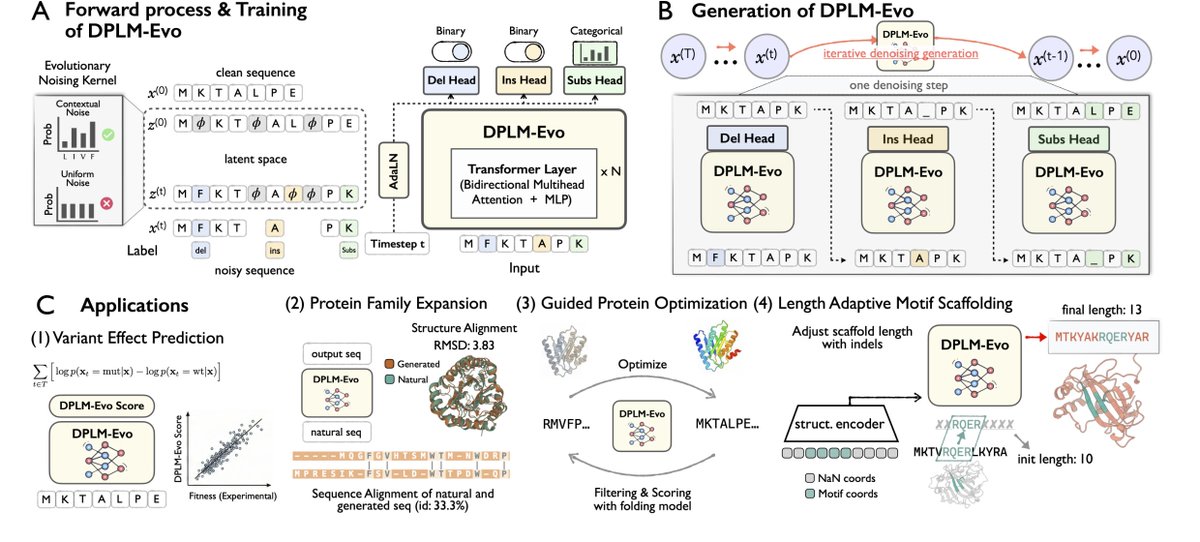
Introducing DPLM-Evo, an edit-based discrete diffusion towards a generative protein evolution machine, from ByteDance Seed, NJU, CUHK and Fudan, to be presenting at @icmlconf #ICML 2026. Paper link: arxiv.org/pdf/2605.00182 (somehow not selected as a spotlight despite 5/5/5/4 reviews :(. Feels like a great time to be working on language modeling for life sciences. The ESM Family has been the OG and foundational for protein language modeling: from learning evolutionary sequence representations at scale, to emerging structure prediction from sequence alone with ESM-2 and ESMFold, and now @biohub's ESMC / ESMFold2 / ESM Atlas release pushing open protein structure prediction and design to a new scale. On the generative side, EvoDiff (from @SarahAlamdari and @KevinKaichuang) and the DPLM family explore discrete diffusion for protein sequences, introducing diffusion language modeling for proteins; ESM3 and DPLM-2 extend discrete diffusion into multimodal protein modeling with structure and other modalities. More recently, AMix-2 from @hello_gensi team, bringing block diffusion together with a protein-language LLM formulation. Masked dLLMs have made impressive progress, but the underlying statistical data structure of languages and proteins should not be "mask-then-predict", hence the best generative modeling for them. For proteins in particular, a more biologically faithful generative story should involve edits over variable-length sequences: substitutions, insertions, and deletions. In DPLM-Evo, proteins are learned and generated via insert & delete (indels) and mutation/substitution (both token2token & mask2token), aiming to better simulate the evolutionary dynamic of biological sequences, and better distinguishing predictive mutation effects including indels on proteingym. If you are at ICML and interested in language models, diffusion, or more broadly, generative modeling proteins & life sciences, go chat with Xinyou and Liang on Wednesday! Grateful to be working with Xinyou Wang* (@Xinyou_NJU), Liang Hong* (@leungh22), Jiasheng Ye (@jsye588986), Yu Li, Shujian Huang, and Quanquan Gu (@QuanquanGu)!
Xinyou Wang@Xinyou_NJU

1/9 Excited to share DPLM-Evo, the latest member of the DPLM family, in our ICML 2026 paper: Towards A Generative Protein Evolution Machine with DPLM-Evo. 📍 Come find us at Hall A #3512 🗓️ Wed, Jul 8, 10:30 AM - 12:15 PM KST Paper: arxiv.org/abs/2605.00182 This is joint work by *Xinyou Wang(@Xinyou_NJU), *Liang Hong(@leungh22), Jiasheng Ye(@jsye588986), Zaixiang Zheng(@zaixiang_zheng), Yu Li, Shujian Huang, and Quanquan Gu(@QuanquanGu), with collaborators from ByteDance Seed, Nanjing University, CUHK, and Fudan University. DPLM-Evo targets a central gap in protein diffusion: protein engineering is rarely just "generate a protein-like sequence from scratch." In practice, we use evolutionary information to score mutations and to improve or reprogram existing scaffolds while preserving structure and function. Many successful diffusion PLMs, including the original DPLM line, use mask recovery as the denoising interface. DPLM-Evo asks: can the denoising steps instead be the edit operations of evolution itself: substitution, insertion, and deletion?

English
0
4
25
4K
leung retweetledi
Xinyou Wang
Xinyou Wang@Xinyou_NJU·
1/9 Excited to share DPLM-Evo, the latest member of the DPLM family, in our ICML 2026 paper: Towards A Generative Protein Evolution Machine with DPLM-Evo. 📍 Come find us at Hall A #3512 🗓️ Wed, Jul 8, 10:30 AM - 12:15 PM KST Paper: arxiv.org/abs/2605.00182 This is joint work by *Xinyou Wang(@Xinyou_NJU), *Liang Hong(@leungh22), Jiasheng Ye(@jsye588986), Zaixiang Zheng(@zaixiang_zheng), Yu Li, Shujian Huang, and Quanquan Gu(@QuanquanGu), with collaborators from ByteDance Seed, Nanjing University, CUHK, and Fudan University. DPLM-Evo targets a central gap in protein diffusion: protein engineering is rarely just "generate a protein-like sequence from scratch." In practice, we use evolutionary information to score mutations and to improve or reprogram existing scaffolds while preserving structure and function. Many successful diffusion PLMs, including the original DPLM line, use mask recovery as the denoising interface. DPLM-Evo asks: can the denoising steps instead be the edit operations of evolution itself: substitution, insertion, and deletion?
Xinyou Wang tweet media
English
2
7
20
6.2K
leung retweetledi
Biology+AI Daily
Biology+AI Daily@BiologyAIDaily·
Towards a Generative Protein Evolution Machine with DPLM-Evo 1. DPLM-Evo reframes protein diffusion generation around explicit evolutionary edits: substitutions, insertions, and deletions (indels). This addresses a mismatch in prior DPLMs where proteins “emerge from masks,” despite real evolution proceeding via accumulated edits. 2. Core idea: decouple a fixed-size latent alignment space from the variable-length observed sequence. Indels become gap ↔ residue transitions in the latent space, making variable-length diffusion tractable while keeping compute close to fixed-length models. 3. Architecture: the model denoises in observed sequence space but predicts three edit signals per position via separate heads: (i) amino-acid distribution for substitution, (ii) deletion probability, and (iii) insertion probability (insert to the right; residue identity comes from the substitution head). 4. A key innovation is the contextualized evolutionary noising kernel for substitutions. Instead of uniform random corruption, substitutions are corrupted using a context-dependent distribution derived from the model’s own predictions (after a warmup), producing more biologically plausible mutation patterns during training. 5. This contextualized corruption materially matters: an ablation replacing it with uniform corruption drops ProteinGym average Spearman from 0.42 to 0.295; a static BLOSUM-based kernel lands in-between (~0.35), supporting the claim that context-aware mutation noise better matches evolutionary constraints. 6. Understanding task highlight: DPLM-Evo achieves state-of-the-art mutation effect prediction on ProteinGym among single-sequence foundation models (217 DMS assays). Scoring is “substitution-native”: it directly reads substitution probabilities at mutated sites without masking them, avoiding an artificial mask-token scoring mismatch. 7. Indel effect prediction: on the ProteinGym indel benchmark, DPLM-Evo reaches 0.495 Spearman, outperforming strong single-sequence baselines (e.g., ProGen2 M 0.464) and approaching MSA-based methods (PoET 0.517, ProFam ensemble 0.530), suggesting explicit indel modeling transfers to indel fitness estimation. 8. Generation: DPLM-Evo enables variable-length unconditional protein generation via evolutionary denoising (sub/ins/del), starting from a learned prior rather than an all-mask state. It maintains strong foldability (ESMFold pLDDT ~83.6, comparable to DPLM) while improving diversity and reducing repetition/mode collapse. 9. Conditional design: in motif scaffolding, DPLM-Evo can dynamically adjust scaffold length during sampling (via insertion/deletion heads) while keeping motif residues fixed, avoiding manual enumeration of scaffold lengths required by fixed-length generators; it improves solved motif counts and success rate in zero-shot and further with continued finetuning. 10. Edit-trajectory applications: the model supports post-editing and optimization as explicit evolutionary trajectories. Case studies include in-silico “family expansion” (large sequence divergence while preserving fold) and directed evolution of GFP, where enabling indels improved structural scores faster and higher than substitution-only and an ESM-2 baseline under the same search/filtering protocol. 📜Paper: arxiv.org/abs/2605.00182 #ComputationalBiology #ProteinDesign #ProteinLanguageModels #DiffusionModels #GenerativeAI #MachineLearning #Bioinformatics #DirectedEvolution #ProteinEngineering #VariantEffectPrediction
Biology+AI Daily tweet media
English
1
6
26
2.5K
leung retweetledi
Lei Dai
Lei Dai@leidai_CAS·
Our work is on the cover of Cell Host&Microbe! With human Gut Microbial Protein Structure database gmpsdb.cn and AI, we demonstrate the power of structure-guided approach in discovering functional dark matter (e.g. phage protein, isozyme). doi.org/10.1016/j.chom…
Lei Dai tweet media
English
0
4
15
747
leung retweetledi
早見沙織 Official
早見沙織 Official@hayami_official·
受賞おめでとうございます! 「はたらく細胞」という作品で制御性T細胞 役で出演させていただいておりました。これを機に、あらためて制御性T細胞について知っていきたいと思います!(早)
大阪大学@UOsaka_ja

【ニュース】 【速報】坂口志文先生 ノーベル生理学・医学賞受賞決定!!! bit.ly/4nCAn6U #阪大 #ニュース

日本語
303
22.8K
158.5K
14.6M
leung retweetledi
攻殻機動隊【公式】GHOST IN THE SHELL official
本日8月8日は、『GHOST IN THE SHELL / 攻殻機動隊』『イノセンス』の押井守監督( @oshii_mamoru )の誕生日です!おめでとうございます!🎂 皆さんからも押井守監督へのお祝いメッセージをお願いします🐶 Today, August 8, is the birthday of Mamoru Oshii, director of “GHOST IN THE SHELL” and “Innocence”! Happy birthday!🎂 Please send words of congratulations to Director Mamoru Oshii from everyone🐶 Portait: Taro Hirano ©2004士郎正宗/講談社・IG,ITNDDTD ©2004 Shirow Masamune/KODANSHA・IG, ITNDDTD #攻殻機動隊 #ghostintheshell #イノセンス #innocence #押井守
攻殻機動隊【公式】GHOST IN THE SHELL official tweet media攻殻機動隊【公式】GHOST IN THE SHELL official tweet media
日本語
46
694
3.4K
124.1K
leung retweetledi
攻殻機動隊【公式】GHOST IN THE SHELL official
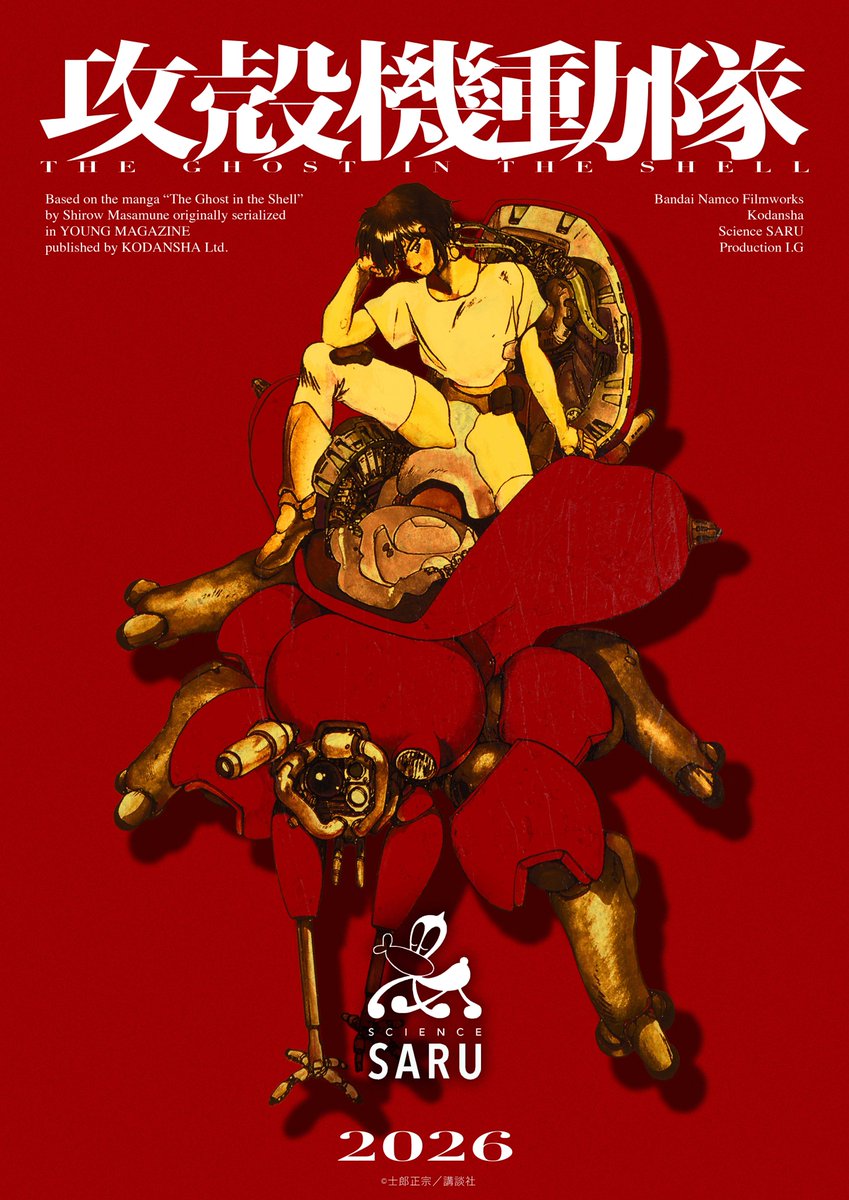
士郎正宗による サイバーパンクSFの金字塔 「攻殻機動隊」 新作TVアニメシリーズ始動――!! アニメーション制作:サイエンスSARU 2026年放送 TV Animation“The Ghost in the Shell” Animation Production: Science SARU New Series 2026 詳細はこちら↓ theghostintheshell.jp/news/new-anime… youtu.be/Ix7QURhM7jE #攻殻機動隊 #theghostintheshell
YouTube video
YouTube
攻殻機動隊【公式】GHOST IN THE SHELL official tweet media
日本語
143
15.7K
24.7K
2.9M
leung
leung@leungh22·
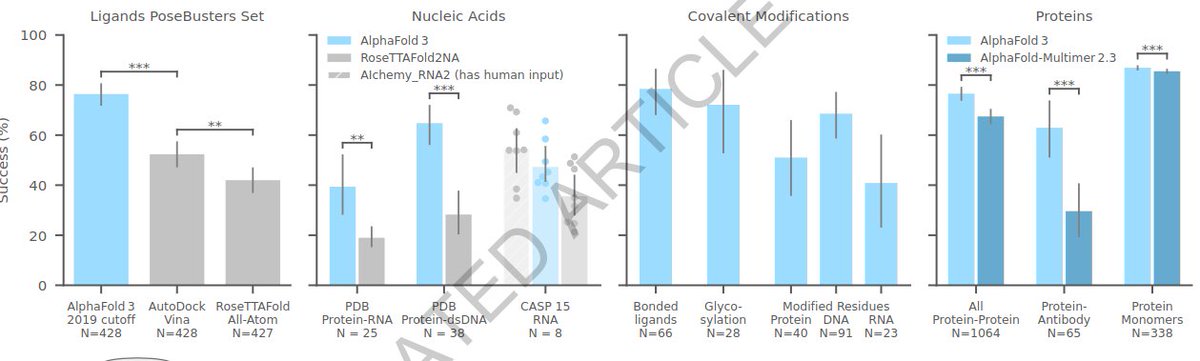
@arneelof It seems to work very well on most of casp15 RNA targets except R1126 and R1136. What surprised me was the performance on 28 and 38, two human designed targets. It got most of junctions/kissing loops correct.
English
0
0
1
1.4K
Pedro Beltrao
Pedro Beltrao@pedrobeltrao·
AlphaFold3 is out with improvements on structural models that include DNA/RNA and small molecules. Unfortunately, there is no code, no binary to run at scale and only a limited webserver. Why even publish? nature.com/articles/s4158…
Pedro Beltrao tweet media
English
9
107
516
114.9K
leung retweetledi
Chenxin Li, PhD (@chenxinli2.bsky.social)
I took this color palette from an anime "Bocchi the Rock". The colors look nice, and the set is red/green colorblind friendly.
Chenxin Li, PhD (@chenxinli2.bsky.social) tweet mediaChenxin Li, PhD (@chenxinli2.bsky.social) tweet media
English
2
45
159
23.2K