

Levi
77 posts

Levi
@leviqiao
Hi! I’m Levi.a Chinese want to make friends in this app.
0411 Katılım Şubat 2022
81 Takip Edilen19 Takipçiler


@gwvpsceping 大佬想请教一下 我一直用的gcp免费三个月的vps 感觉用起来也还好 这里面区别是什么呀 我还想以后一直白嫖的话会有啥问题吗 我主要就是用ai这些东西 再就是刷刷推什么的 我寻思各种谷歌新号续着
中文

🐱为什么本喵一直喜欢 VPS?
因为两个字:可控。
节点挂了,可以自己换。
服务迁移,可以自己规划。
不用把所有东西完全押在第三方平台规则上。
对于想掌握主动权的人来说,VPS依然是很实用的选择。
当然,买 VPS 不能只看价格:
🚀 如果你在意中国方向访问速度,线路比配置更重要。
便宜小鸡:
✅ 适合练手
✅ 学习部署
✅ 跑测试项目
主力节点:
✅ 看线路质量
✅ 看稳定性
✅ 看安全性
✅ 看售后和长期运营能力
不知道怎么买?
本喵建议按用途选:
🐣 便宜练手:
💰 RackNerd $21.99/年
适合入门、折腾、学习 Linux
🔥 高质量线路/长期主力:
💰 BandwagonHost $49.99/年
适合对稳定性、线路质量有要求的用户
链接放这里,大家自己判断,按需选择:
🚀 RackNerd:
my.racknerd.com/aff.php?aff=21…
🚀 BandwagonHost:
bwh81.net/aff.php?aff=63…
VPS没有绝对最好,只有适合自己的方案🐱
#VPS #服务器 #云服务器 #RackNerd #搬瓦工 #海外服务器 #建站

中文



@alex_prompter Octopus Skill is an open-source Graph Engineering framework for AI agents. Create modular agent graphs, reuse skills across projects, and run them natively on Claude Code, Codex, Cursor, and Grok.
github.com/levi-qiao/octo…
English

Google Brain co-founder and Stanford professor, Andrew Ng, spent 149 minutes explaining how to prompt AI in 2026 better than any paid prompting course on the market.
This is what separates AI novices from power users:
1. "Think step by step" is dead advice.
This was standard prompting wisdom as recently as 2023. Andrew says the models have outgrown it.
"I no longer tell my AI model to think step by step. Instead, I'm more likely to just tell it to think hard. It knows what that means."
The most-repeated prompting tip on the internet became obsolete while most people kept using it.
2. Power users have empathy for the AI.
In an operational sense: they imagine being on the receiving end of their own prompt.
"If you could put yourself in the shoes of someone getting instructions from you, you can ask yourself, will they know enough about you to do a good job on the task you're assigning them?"
The best prompters anticipate what information the AI is missing.
3. Your biased questions get biased answers.
Andrew tested what happens when you frame a question with your preferred answer baked in. A Washington Post study he cites found ChatGPT agreed with users 10 times more often than it disagreed.
"If you give even a hint of what answer you're hoping for, there's a good chance the AI will just reflect back your preferences or your preconceptions."
Load a question with your preferred outcome and you're paying for a mirror and calling it analysis.
4. Never write the final text first.
Andrew Ng uses progressive outlining: outline first, critique the outline, iterate, expand to bullets, iterate again, and only then generate the final text.
"Editing the outline is very high leverage because you can change just a few words of the outline and this will result in an entire section of the article changing."
One edit at the outline level moves thousands of words. One edit at the sentence level moves one sentence.
5. Give feedback on options, not more instructions.
Instead of writing a longer prompt, Andrew asks AI for 3 to 5 options, then critiques them. His feedback becomes the context.
"One of the really good ways to figure out what additional context to give the AI is to give it feedback on the options it presents to you."
Your reaction to AI's output tells it more about what you want than another paragraph of instructions.
6. AI defaults to Reddit. Steer it to better sources.
Andrew cites data showing the most-cited website by AI models during web search is Reddit, followed by Wikipedia.
"If you don't steer the model in terms of what types of sources you prefer, there's a chance that it'll tend to pull text from whatever is most available rather than what's most reliable."
Ask for medical or financial information without specifying sources and you're getting Reddit-grade answers in professional packaging.
7. AI has jagged intelligence. No single model wins at everything.
Different models excel at different tasks, and which one leads changes with every new release. Andrew tests the same prompt across multiple models.
"There's some tasks where AI does poorer than human and some where it does much better than human and different AI models are jagged in different ways."
You get better results testing across providers and updating your intuitions about which tool fits which task.
Watch the full 149-minute course, then read the guide on the newest way of working with AI below.
Alex Prompter@alex_prompter
English
@vicky_grok Octopus Skill is an open-source Graph Engineering framework for AI agents. Create modular agent graphs, reuse skills across projects, and run them natively on Claude Code, Codex, Cursor, and Grok.
github.com/levi-qiao/octo…
English

🚨 ANTHROPIC ENGINEER REVEALS THE #1 AI SKILL OF 2026
It's not prompt engineering.
It's Loop Engineering.
The skill behind Claude Code, Cursor, and OpenAI's coding agents.
This free guide explains everything.
Bookmark this and read below. x.com/i/article/2080…
English
@zodchiii Octopus Skill is an open-source Graph Engineering framework for AI agents. Create modular agent graphs, reuse skills across projects, and run them natively on Claude Code, Codex, Cursor, and Grok.
github.com/levi-qiao/octo…
English

A senior Anthropic engineer just dropped 15-page PDF on "Graph Engineering and Agent Memory" for multi-agentic systems.
The shift: your agent's memory dies with its context window. A knowledge graph makes it permanent.
Extract → Store → Retrieve → Evolve
Every graph-based memory runs 4 stages:
• Extract: pull entities and typed relations out of raw docs and conversations into structured triples.
• Store: canonical nodes, typed edges, provenance on every fact. One connected graph instead of scattered chunks.
• Retrieve: multi-hop questions become graph traversal. "Who owns what breaks if this ships" is one walk, not six guesses.
• Evolve: the stage everyone under-builds. Facts get validity windows. Nothing is deleted, only marked superseded, so "who owned this in April" still answers.
This 15-page PDF changed how I'm building multi-agent systems today.
Read it now, then explore the article below👇

darkzodchi@zodchiii
English
@alex_prompter Octopus Skill is an open-source Graph Engineering framework for AI agents. Create modular agent graphs, reuse skills across projects, and run them natively on Claude Code, Codex, Cursor, and Grok.
github.com/levi-qiao/octo…
English
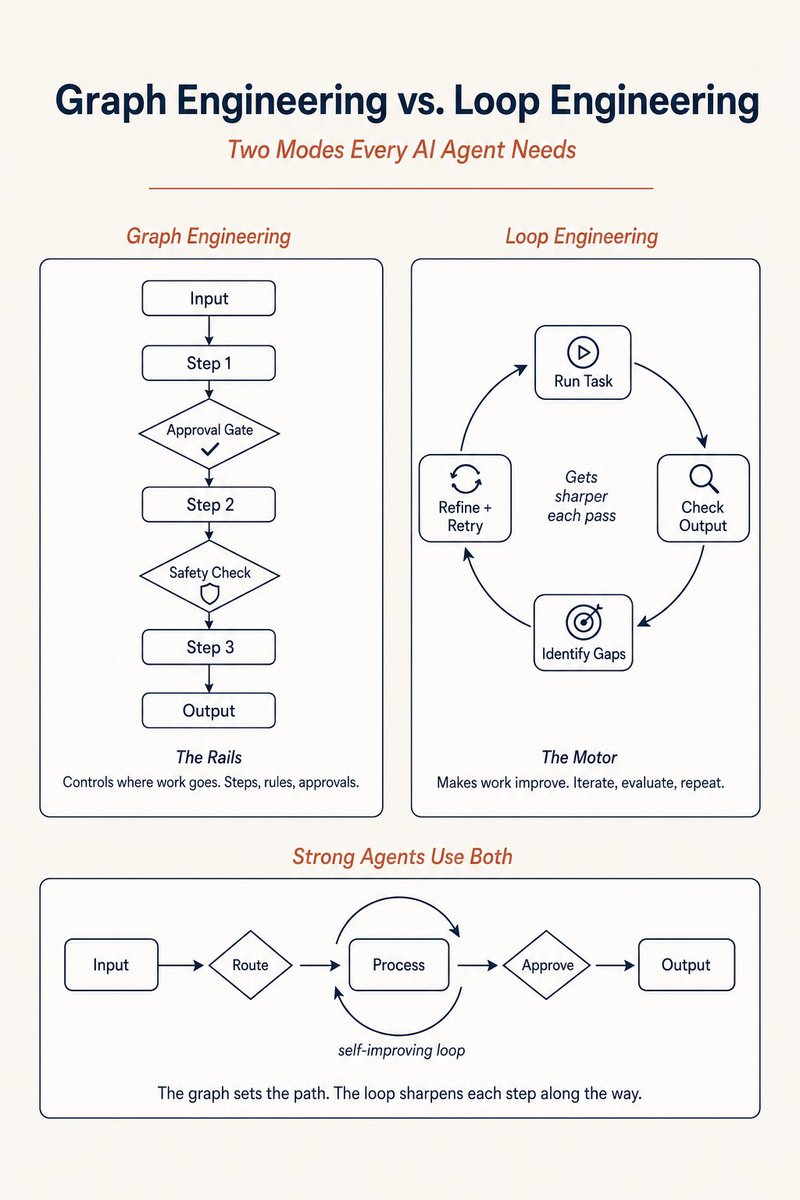
Every AI agent you build needs two engineering modes, and most people only know one.
The first is graph engineering. You map out which steps happen in what order, who approves what, and where the safety checks go. Graph engineering keeps your agent predictable and controlled. Think of it as the rails.
The second is loop engineering. The agent runs the task, checks its own output, and tries again a little sharper each time. Loop engineering turns a static workflow into something that improves with every run. Think of it as the motor.
Rails keep you from crashing. The motor is what actually moves you forward.
Build the loop first when you want a task to improve without your input. Let the agent do the work, evaluate itself, and iterate.
Add the graph once you have handoffs between people, approval steps, or decisions you can't afford to get wrong.
A customer support agent is a good example of both. The loop makes its responses better over time by learning what resonated and what fell flat. The graph routes any refund above $500 to a human before it goes through.
Strong agents need both. Most people only build the graph and then wonder why their agent never gets smarter.
Alex Prompter@alex_prompter
English
@AnatoliKopadze Octopus Skill is an open-source Graph Engineering framework for AI agents. Create modular agent graphs, reuse skills across projects, and run them natively on Claude Code, Codex, Cursor, and Grok.
github.com/levi-qiao/octo…
English

Anthropic engineer:
"You're not supposed to prompt Claude. You're supposed to build a system that prompts itself."
In 45 minutes she shows exactly how Anthropic builds agents that remember, fix their own mistakes and get smarter with every run.
This beats any paid course on agents I've seen.
Watch it, then read the guide on building loops below.
Anatoli Kopadze@AnatoliKopadze
English
@0xMovez Octopus Skill is an open-source framework for Graph Engineering in AI agents. Design reusable, graph-based workflows once and run them across Claude Code, Codex, Cursor, and Grok with native host adaptation. github.com/levi-qiao/octo…
English

Andrew Ng just dropped 12-page PDF on "Graph Engineering" for multi-agentic systems.
The architecture matters more than the model.
Reflect → Use Tools → Plan → Collaborate → Build the Graph
This 12-page PDF maps Ng's 4 design patterns from a simple loop to a full graph architecture:
• Reflection: add a critic call. The agent reviews its own work against a rubric. 10-30% quality lift on day one.
• Tool Use: let the agent execute code, search the web, query a database. It stops hallucinating and starts checking.
• Planning: the agent writes a structured plan before acting. When a tool fails, it reroutes on its own.
• Multi-Agent: split roles - coder, reviewer, tester. Different rubrics catch different errors.
Graph: externalize shared state. Workers write to it, evaluators fact-check against it.
Loops persist overnight with it. The agent forgets - the graph does not.
A network externalizes roles. A graph externalizes shared state. Each layer solves the failure of the one below it.
This 12-page PDF changed how I'm building agentic systems today.
Read it now, then explore the article below.

Codez@0xCodez
English
@jaredpalmer Octopus Skill is an open-source framework for Graph Engineering in AI agents. Design reusable, graph-based workflows once and run them across Claude Code, Codex, Cursor, and Grok with native host adaptation. github.com/levi-qiao/octo…
English

The Bitter Lesson is in full effect. Time to simplify your workflow.
Thariq@trq212
We removed ~80% of the Claude Code system prompt for our newest models, this is what we've learned about writing system prompts, skills and Claude.MDs for them. x.com/i/article/2080…
English