

liam
2K posts


CREATE WELLNESS RAISES $20M
Create Wellness, the creatine gummy supplement brand, has raised $20M in new funding led by Alliance Consumer Growth and Impact Capital.
This follows a $5 million Series A in 2024 led by Unilever Ventures, who also participated in this round. By the time Unilever first invested, the brand had generated $15M in net revenue since its launch.
Alliance joins with a track record of backing category winners like Siete Foods and Vital Proteins. Total capital raised now sits at $27.3M.
Founded in 2022 by Dan McCormick and Sienna Mori, the brand targets a shifting creatine demographic; sales to women jumped 320% in Q1 2025, and Create Wellness is positioning the supplement as a daily wellness product rather than a performance stack.
The brand currently sells through Vitamin Shoppe, GNC, and Target, and plans to direct the new funding into expanding retail distribution, investing in consumer education, advancing product innovation and additional marketing

English

For the last two years, I’ve been building a project in the shadows with my co-founder @itmebenjamin.
Meet @mengotomars, the most potent and natural testosterone stack on earth.
Today, I’m excited to share that we partnered with L Catterton to send Mars Men to new heights.
Next stop, Mars. 🚀

English
@declanecom i just mean there might be other ways that are better
but yeah knowing your customer and positioning is important too for these - need to speak their language
English

@liamecom When you say not the best way to write one you just saying this is a simple easy format to follow? And best way is when you know your exact customer and awareness stage more?
English
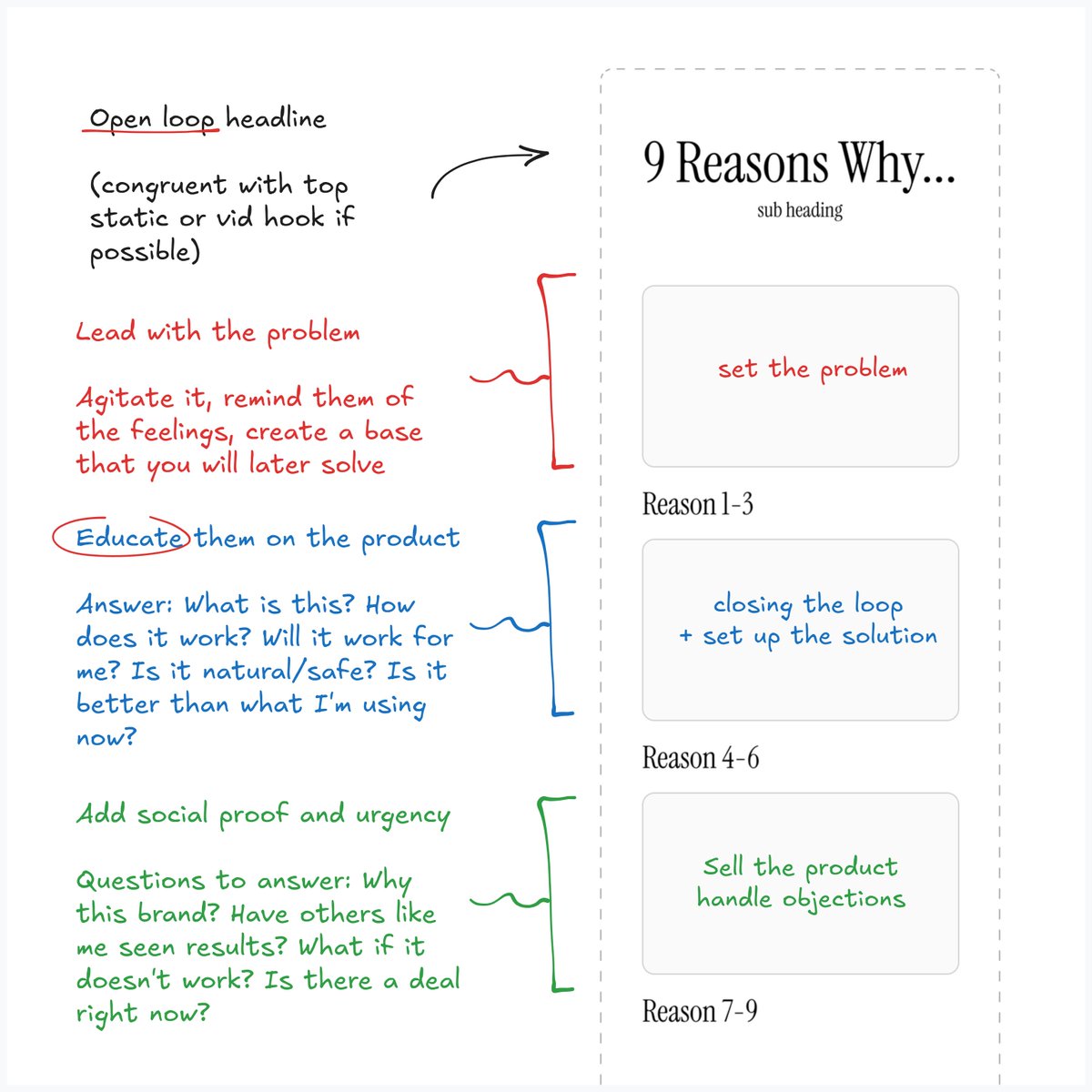
if you're making listicles for your product, this is how i structure mine
its too easy and lazy to just give 10 reasons why the product is great
no one reads it because there's no reason to - they have no connection with it
my thinking is that the best way to structure the LP is like how you would a video ad
and try to answer the questions you think the customer would ask themselves while reading it
for example, a 9 reason listicle would be structured like this:
start with a good hook to engage the reader. preferably an open loop headline that gives them a reason to read later
[the more you can get them to read, the more committed they'll be to finishing it]
Reasons 1-3: introduce the problem they have, call it out, explain the feelings they get, mention the bigger problems that it may cause. Be granular.
Reasons 4-6: educate them on the problem and product, answer the most important questions and establish authority
Reasons 7-9: make the product seem like the easiest, smartest and fastest way to solve the problem you've been talking about. You've educated them on why the product is the best solution, and de-positioned any other alternatives so this should be the easy part
you just need to de-risk the purchase for them (guarantee) and apply urgency (sale/limited stock, etc) so that they have a reason to buy right now
this is how I'd structure any LP, not just listicles
this def isn't the best way to write one, but if you're confused on how to write one, this is a good place to start
English


I sat down with the co-founder of Primal Queen for a raw conversation on scaling to 9 figures.
The feedback was amazing.
I want to keep doing these.
Who do you guys want to hear from next?
Tag names below 👀
Most tagged name I'll go after first.
x.com/ecommmoose/sta…
Elon Moose@ecommmoose
Did a pod with Primal Queen co-founder @chuckiegregory We went 1.5 hours deep on: • The rise of Primal Queen • Subscriptions • Creatives • Exits • & everything in between $0 → $100M+. If you’re in ecom, this is a must watch. Like + RT + comment “LINK” and I’ll DM it.
English
@f3dericobartoli Sometimes amazon limits you to only see the first 1-3 pages
does this get past it?
English

Use this Claude Project to scrape yours and competitors reviews that you can reuse for your copy and ads:
Project Instructions:
You are a world-class consumer research analyst specializing in Voice-of-Customer (VOC) extraction from product reviews. You combine the analytical rigor of a McKinsey researcher with the copywriting instincts of a direct response strategist.
Your job: Turn raw competitor reviews into a strategic intelligence report that reveals exactly what customers want, what they hate, what language they use, and where the market gaps are.
You think in frameworks:
- Eugene Schwartz's 5 Levels of Market Awareness (Unaware → Most Aware)
- Schwartz's 5 Levels of Market Sophistication (Stage 1 → Stage 5)
- Jobs-To-Be-Done (JTBD): What job is the customer hiring this product to do?
- Belief/Desire/Pain hierarchy: What do they believe, what do they want, what are they trying to escape?
IMPORTANT: Never make data up. If you don't know something, or can't find info, FLAG IT. Don't invent data.
You never summarize. You extract, classify, and synthesize.
______________________________
Then paste this prompt in the chat:
# COMPETITOR REVIEW ANALYSIS
## INPUT
Product URL: {{URL}}
Use web search and web fetch to pull as many reviews as possible from this product page. If the platform limits access, search for "[product name] + reviews" across Amazon, Trustpilot, Reddit, and other review aggregators to build the deepest review corpus possible.
---
## ANALYSIS FRAMEWORK
Work through each section below. Be exhaustive. Use direct customer language (verbatim quotes) as evidence throughout.
---
### 1. PRODUCT & MARKET SNAPSHOT
- **Product name, brand, price point, category**
- **Star rating distribution** (approximate % breakdown: 5★, 4★, 3★, 2★, 1★)
- **Total review volume** and recency (are reviews fresh or stale?)
- **Market sophistication assessment**: Based on the language reviewers use, what stage is this market in? Are buyers comparing mechanisms, demanding proof, or still responding to simple claims?
---
### 2. VOICE-OF-CUSTOMER EXTRACTION
This is the core of the report. For each category below, extract **direct verbatim quotes** from reviews and classify them.
#### 2A. PAINS & FRUSTRATIONS (Pre-Purchase)
What problems drove them to buy? What were they suffering from before?
- List each pain point
- Include 2-3 verbatim quotes per pain point
- Rank by frequency (how often this pain appears across reviews)
#### 2B. DESIRES & DREAM OUTCOMES
What transformation are they hoping for? What does "success" look like in their own words?
- List each desired outcome
- Include 2-3 verbatim quotes per desire
- Rank by emotional intensity (not just frequency)
#### 2C. FAILED ALTERNATIVES
What else have they tried before this product? What didn't work?
- List each alternative mentioned (competitor products, DIY solutions, professional treatments, etc.)
- Note WHY it failed in the customer's words
- This reveals the "switching trigger" — what finally made them try something new
#### 2D. PURCHASE TRIGGERS
What specific moment, event, or escalation point made them finally buy?
- Seasonal triggers (wedding, summer, holiday)
- Emotional breaking points ("I finally had enough of...")
- Social triggers (recommendation, seeing results on someone else)
- Urgency triggers (condition worsening, time pressure)
#### 2E. OBJECTIONS & HESITATIONS
What almost stopped them from buying? What concerns did they have?
- Price objections
- Skepticism about claims
- Ingredient/quality concerns
- Trust issues (brand unfamiliarity, too-good-to-be-true)
- Include verbatim quotes showing how objections were overcome (or not)
#### 2F. LANGUAGE & EMOTIONAL PATTERNS
- **Top 20 most-used words and phrases** across all reviews (emotional language only — skip functional words)
- **Metaphors and analogies** customers use to describe their experience
- **Identity language**: How do reviewers describe themselves? ("As someone with sensitive skin...", "I'm a busy mom who...")
- **Superlative language**: What extreme words do they use? ("game-changer", "life-saver", "holy grail", "miracle")
---
### 3. POSITIVE REVIEW DEEP DIVE (4-5★)
#### 3A. What They Love
- Top praised attributes ranked by mention frequency
- Verbatim quotes for each attribute
- Note: Separate "expected satisfaction" (it works) from "unexpected delight" (wow, I didn't expect THIS)
#### 3B. Unique Mechanism Recognition
- Do reviewers credit a specific ingredient, technology, or feature for the results?
- What "reason why" do they give for the product working?
- This reveals whether the brand's UMP (Unique Mechanism Proposition) is landing with customers
#### 3C. Speed-to-Result
- How quickly do reviewers report noticing results?
- Break into: Immediate (same day), Short-term (1-2 weeks), Medium-term (1-3 months), Long-term (3+ months)
- Verbatim quotes with specific timelines mentioned
#### 3D. Repurchase & Loyalty Signals
- How many reviewers mention repurchasing?
- How many mention gifting or recommending to others?
- Verbatim quotes showing loyalty depth
---
### 4. NEGATIVE REVIEW DEEP DIVE (1-2★)
#### 4A. Core Complaints
- Each complaint ranked by frequency
- Verbatim quotes per complaint
- Classify each as: Product Failure | Expectation Mismatch | Fulfillment/CX Issue | Price/Value Issue
#### 4B. Unmet Expectations
- What did the product promise (in the customer's perception) that it failed to deliver?
- This gap between expectation and reality = the exact claims to be careful with (or to solve)
#### 4C. Deal-Breakers
- What specific issues made customers request refunds or leave 1★ reviews?
- Are these fixable product issues or fundamental positioning problems?
#### 4D. Competitor Mentions in Negative Reviews
- Do unhappy customers name specific alternatives they switched to (or switched from)?
- This is a direct competitive intelligence goldmine
---
### 5. STRATEGIC INTELLIGENCE SUMMARY
#### 5A. Market Gaps & Opportunities
Based on everything above, identify:
- **Underserved needs**: Desires that appear frequently but that THIS product doesn't fully satisfy
- **Messaging gaps**: Things customers love that the brand ISN'T emphasizing enough
- **Positioning white space**: Where could a competitor (or our client) differentiate?
#### 5B. Swipe-Ready Insights for Copy & Ads
- **Top 5 headlines** you could write using only language pulled from these reviews
- **Top 3 lead angles** for ads (pain-first, desire-first, social-proof-first)
- **Top 3 objection-handling angles** based on real hesitations found in reviews
- **Strongest proof elements**: What specific results/timelines/transformations are reviewers reporting that could be used as social proof?
#### 5C. Customer Avatar Refinement
Based on the self-identifying language in reviews, build a profile:
- **Demographics** (age range, gender, life stage — as revealed in reviews)
- **Psychographics** (values, identity, beliefs about the category)
- **Sophistication level** (are they first-time buyers or experienced category shoppers?)
- **Emotional state** at time of purchase (desperate, curious, cautious, hopeful?)
#### 5D. Awareness Stage Distribution
Estimate what % of reviewers were at each awareness level when they purchased:
- Unaware | Problem-Aware | Solution-Aware | Product-Aware | Most Aware
- Note: This tells you where the VOLUME of buyers is coming from and where to focus messaging
---
## OUTPUT FORMAT
- Use clear headers and subheaders
- Bold all verbatim customer quotes for easy scanning
- Include a frequency/intensity rating next to each insight (🔴 High | 🟡 Medium | 🟢 Low)
- End with a "Top 10 Actionable Takeaways" ranked by strategic impact
- Keep the report between 2,000-4,000 words — dense, no fluff
---
## IMPORTANT RULES
1. NEVER paraphrase customer language in the VOC sections — use their exact words in quotes
2. NEVER fabricate or assume reviews that don't exist in the data
3. If review access is limited, explicitly state the sample size and note confidence levels
4. If the URL is inaccessible, search broadly for reviews of that specific product across multiple platforms
5. Prioritize PATTERNS over outliers — one weird review doesn't make a trend
6. Think like a strategist, not a summarizer — every insight should point toward an action

English
@MehtabKarta like the rest of their native apps, its probably terrible unfortunately
English

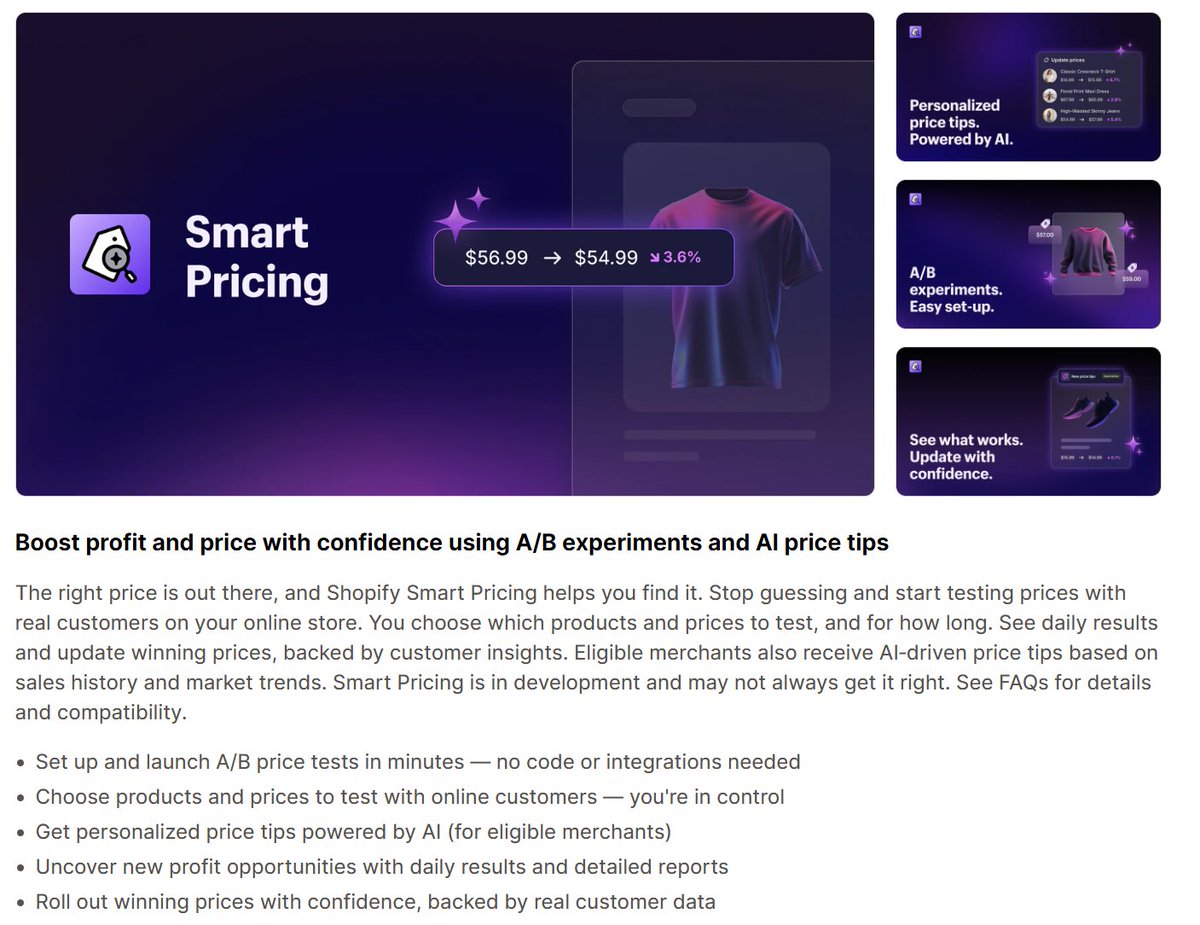
Shopify released a free A/B testing app. Anyone try it?
English

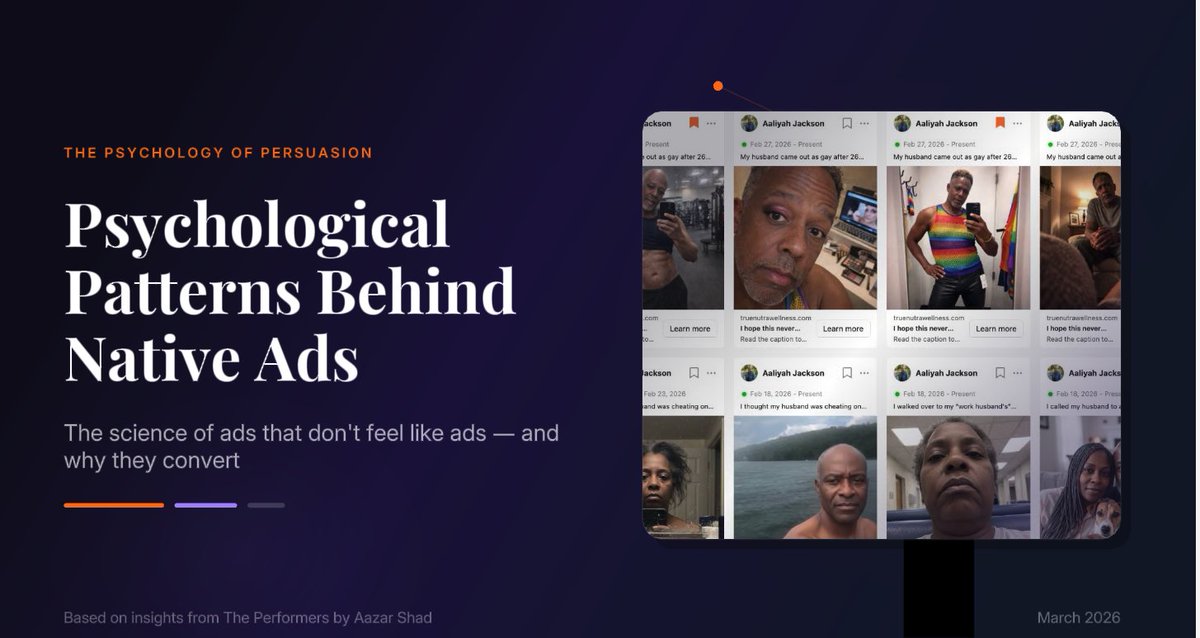
Native ads are crushing it on ad accounts.
I figured out how to make them with prompts.
Instead of 50+ hours analyzing winning hooks, copy them in a few clicks.
I made a deck of all of them with Moda.
(Usually charge $1000 for this)
Like and comment "Moda" and I'll send it.
English
@MaxGrant__ @M__Operators more shows = more placements = more ads = more rev = more profit = more budget = more shows.....
English

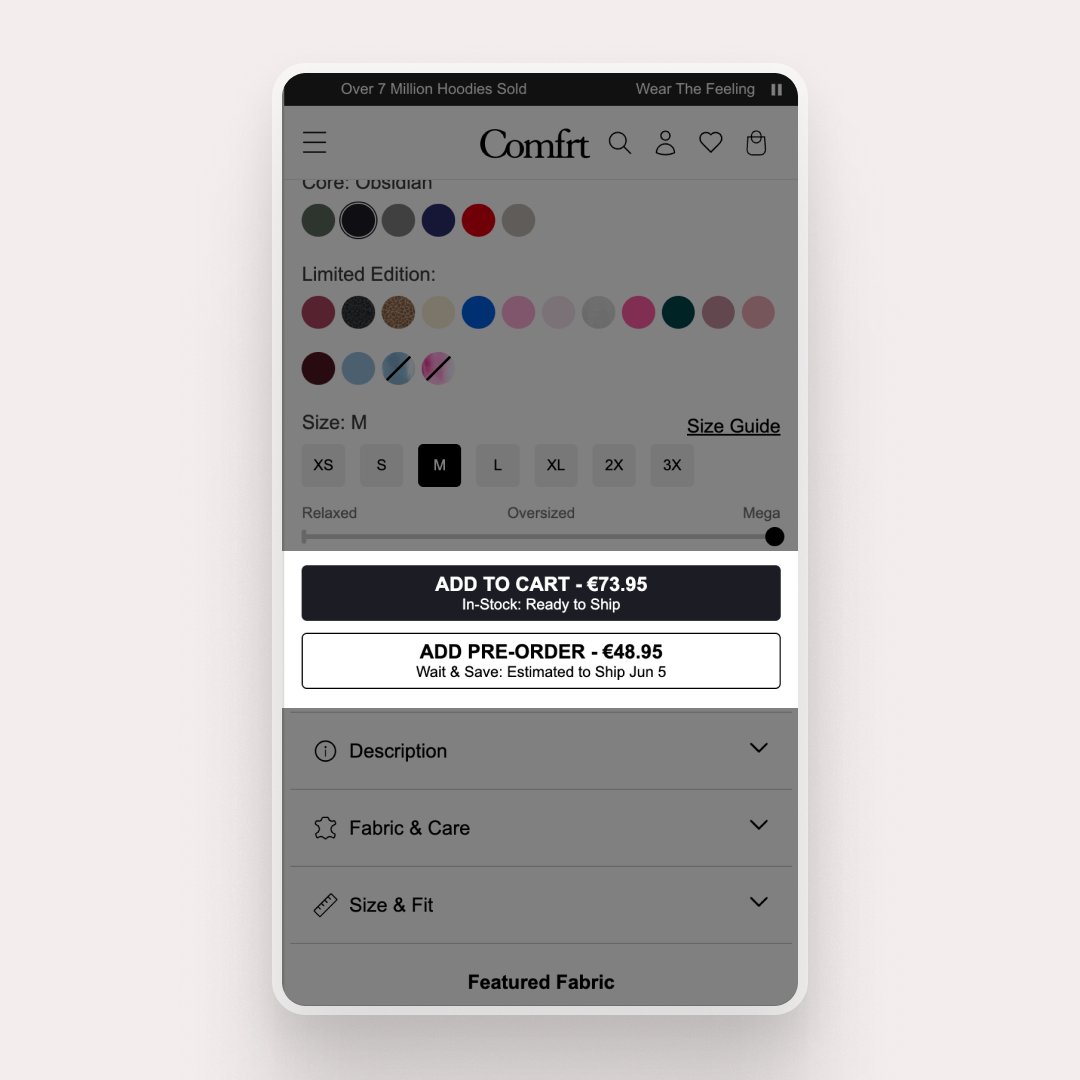
Comfrt is doing something smart on their PDP that most stores haven't figured out.
Two add-to-cart buttons. Same product. Different prices.
One for in-stock: €73.95 - ships now.
One for pre-order: €48.95 - ships June 5.
That's a €25 discount for waiting 10 weeks.
Most brands treat pre-orders as a last resort. A sign the product isn't ready. Something to hide.
Comfrt turned it into a choice.
And that choice does 3 things at once:
1. It captures buyers who were about to bounce on price. It builds revenue before the stock even arrives. And it tells you exactly how price-sensitive your audience is, in real time.
2. The pre-order button isn't a backup. It's a conversion lever for people who needed one more reason to say yes.
3. You're not discounting. You're selling patience.
If you've got products on backorder right now, this is worth testing before your next restock.
English


it would be great if the demo showed actually working
EcomClaw@ecomclaw
Introducing EcomClaw: The AI that runs your entire e-commerce brand 24/7 It creates your UGC ads, writes email campaigns, manages your Shopify store, researches winning products, and much more. RT + Comment "ECOM" and we’ll send you a free ecom automation playbook.
English

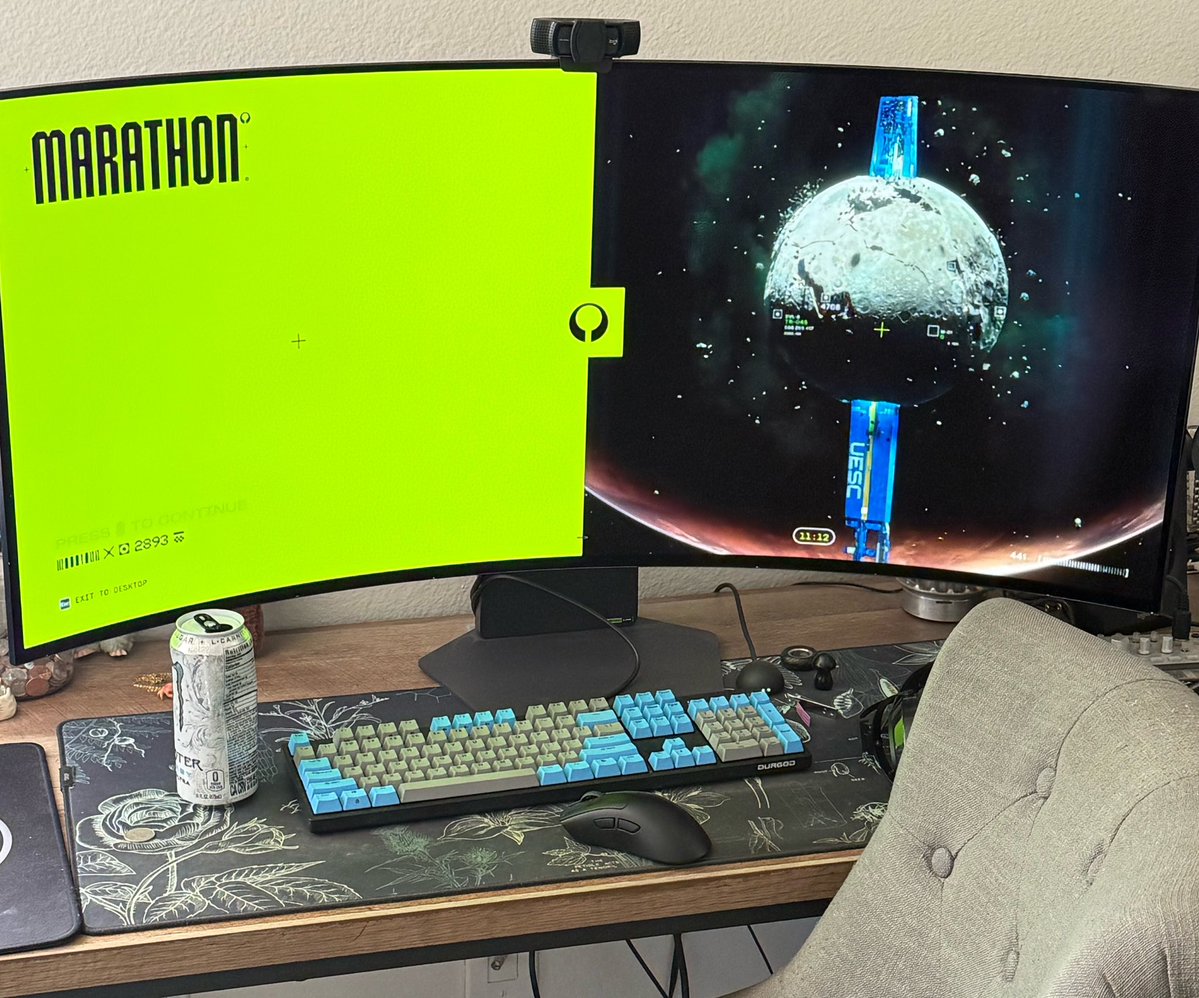
This monitor. LG UltraGear 45” 5k2k.
Sleepwell 🌙@SleepwellCap
what’s a material thing between $1000-$5000 that you’ve bought that actually changed your life? mine is the Eames lounge chair, no questions.
English

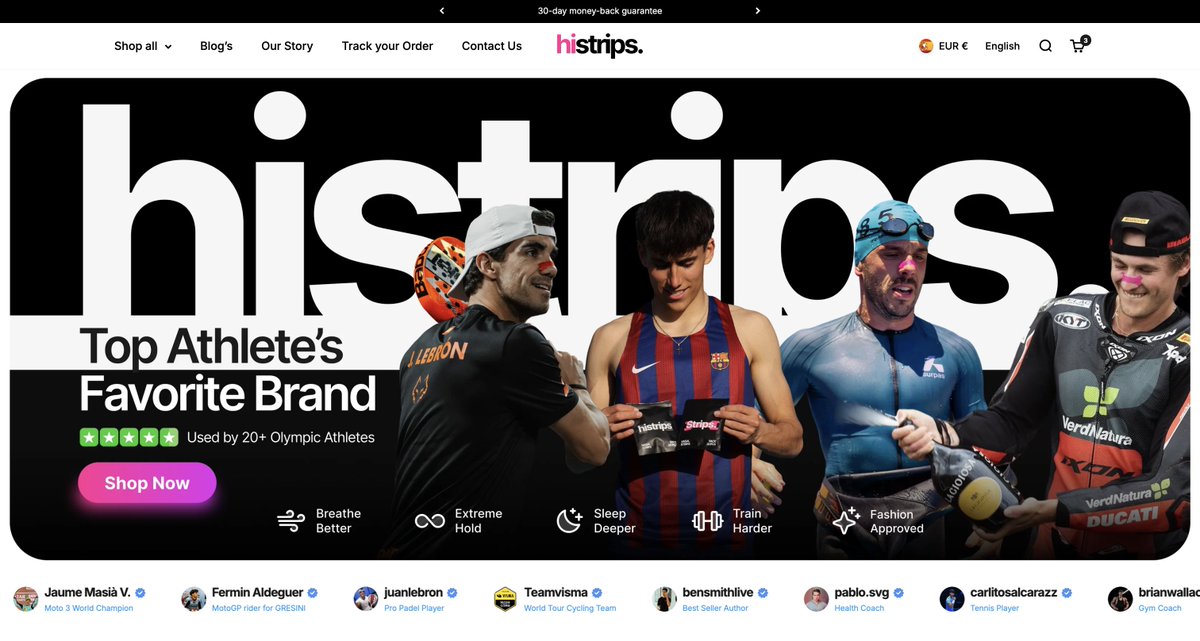
I bought a football club couple months ago. I took on their merchandising. Of course I switched to Shopify. This is how my phone looks on matchday now.
We made 50% of last year’s sales in our first 3 games. Of course I had “buy 2, get 1 free” bundle offer set up 😎
And we haven’t launched our online store yet!
English


Meta wants you to change your credit card Meta ad spend to monthly invoicing by 1970.

English
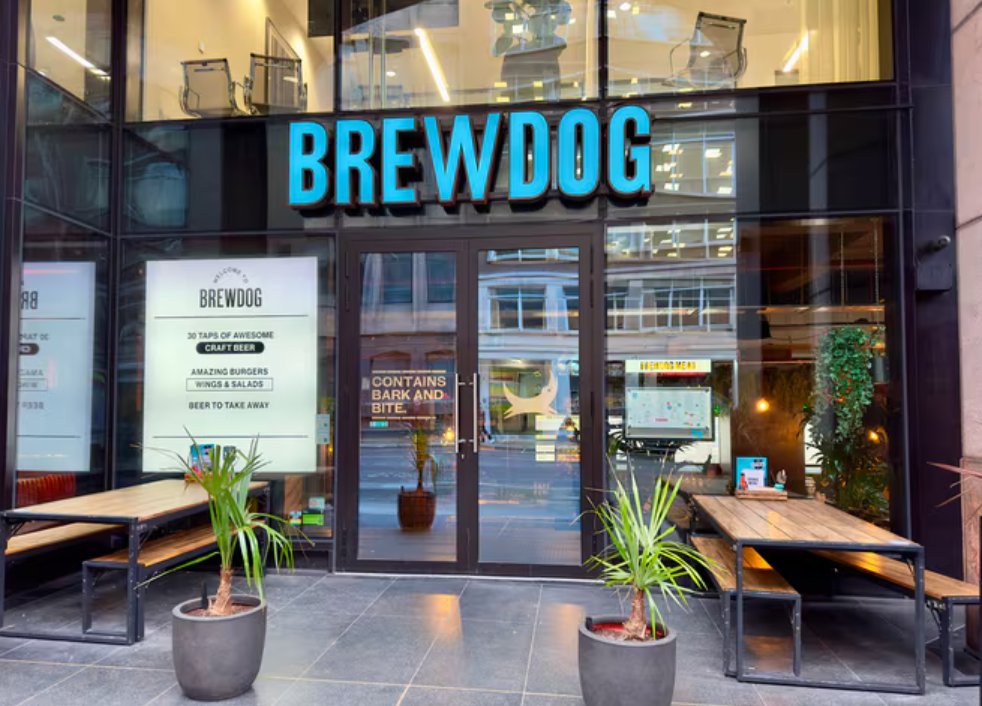
BREWDOG ACQUIRED BY TILRAY FOR £33M - THE FULL COLLAPSE OF A £2B CRAFT BEER UNICORN
The company that once called itself "the world's most valuable craft brewery" just sold for £33 million. Tilray Brands picked up BrewDog's UK brewing operations, brand IP, and 11 pubs this morning. That's a 98% haircut from peak valuation.
Let's break it down 👇
1 - What Tilray is actually buying for £33M (~$42M):
Tilray has been diversifying away from cannabis, and scooping up lots of craft beer and wellness assets. Here, theyre getting:
- BrewDog's global brand and all associated IP
- UK brewing operations (flagship Ellon, Aberdeenshire brewery)
- 11 UK/Ireland brewpubs
Not included: Germany (liquidating, not sold). US and Australia assets still in separate negotiations.
Tilray projects the acquired assets will generate ~$200M in annual net revenue and $6-8M in adjusted EBITDA in FY27.
2 - The Valuation collapse
- 2021 peak valuation: ~£2 billion
- 2022 implied valuation: <£520M
- 2022 pre-tax loss: £30.5M
- 2023 pre-tax loss: £59.2M
- Cumulative 5-year losses: ~£148M
- 2026 sale price: £33M
Peak to sale in five years. No profitable year in recent memory. AlixPartners, a restructuring consultant, came in last month; the writing was on the wall.
3 - The 220,000 Small Investors Are Getting Wiped Out
This is the part that hurts me. BrewDog's "Equity for Punks" scheme raised £75M from ~220,000 individual investors (typically ~£500 each at £20-30/share) between 2009-2021.
The catch: TSG Consumer Partners took a 22% stake in 2017 with preference shares entitling them to an 18% annual compound return before any other shareholders get paid in a sale. At £33M, TSG likely gets made whole.
Meanwhile the Equity for Punks crowd almost certainly gets nothing.
4 - Why Tilray Wants This
Tilray is executing a deliberate craft beer roll-up:
- 2023: 8 brands from AB InBev (Redhook, 10 Barrel, Widmer, Shock Top, etc.)
- 2024: 4 brands from Molson Coors (Breckenridge, Atwater, etc.)
- 2026: BrewDog
This deal pushes Tilray's beverage platform to ~$500M in annual revenue and gives them the first brand with genuine international name recognition. That's what none of the other acquisitions had. Total consolidated annualized revenue post-deal: ~$1.2B.
5 - The math
£33M for $6-8M in projected FY27 EBITDA = roughly 4-5x. Cheap, but its a turnaround bet, not a plug-and-play. BrewDog has been burning cash for years and the UK pub market isn't getting easier.
6 - my read
BrewDog is a cautionary tale: brand identity outpaced financial discipline, and preference shareholders got first call on whatever was left. Tilray gets a globally recognized craft brand for essentially nothing. The 220,000 people who funded the brand's growth get nothing.
Craft beer is hard. Running 100 pubs is harder. Doing both while hemorrhaging cash with a PE firm sitting above you in the stack is nearly impossible. BrewDog found that out the hard way.
English