LiveWildLiveFree.org (Alan Chapman)

5.9K posts

LiveWildLiveFree.org (Alan Chapman) banner
LiveWildLiveFree.org (Alan Chapman)

LiveWildLiveFree.org (Alan Chapman)

@lifedeathfest

Energies Healing Education.

UK Katılım Eylül 2017
2.8K Takip Edilen513 Takipçiler
LiveWildLiveFree.org (Alan Chapman) retweetledi
Ihtesham Ali
Ihtesham Ali@ihtesham2005·
A psychologist at the University of North Carolina spent 20 years proving that a single 20-second hug rewires the human cardiovascular system, and the experiment she ran is so simple you can replicate it tonight at home. Her name is Karen Grewen. She works inside the UNC School of Medicine's Department of Psychiatry. The paper that made her famous was published in 2003, and almost nobody outside her field has read it. Here is what she actually did. She recruited 183 healthy adults living with a long-term partner. She split them into two groups. The warm contact group sat together for 10 minutes holding hands while watching a romantic video. Then they stood up and hugged each other for exactly 20 seconds. The control group sat alone in a separate room for the same amount of time doing nothing. Then she made every single one of them give a public speech in front of a panel. Public speaking is one of the cleanest stressors in psychology. Heart rate spikes. Blood pressure climbs. Cortisol floods the system within minutes. It is the laboratory version of every stressful moment you have ever had at work. The people who had been hugged for 20 seconds before walking into that room had measurably lower blood pressure responses to the stress. Lower systolic. Lower diastolic. Lower heart rate increases. Everything was the same.. the speech, the panel, and fear. But this time completely different physiological response. The hug had not made the stress disappear. It had changed how the body was allowed to respond to it. Two years later Grewen ran the follow-up study that explained why. She drew blood from 38 couples before and after the same warm contact protocol and measured what was actually changing inside them. The answer was a hormone called oxytocin. Oxytocin is the chemical your body releases during childbirth, breastfeeding, and orgasm. It is the same molecule that makes a mother feel calm holding her newborn. Grewen's data showed that 20 seconds of physical contact with a trusted partner triggered a measurable spike in plasma oxytocin in both men and women, and the size of that spike directly predicted how much their blood pressure dropped. The mechanism turned out to be older than recorded history. Oxytocin binds to receptors in your heart, your blood vessels, and the part of your brainstem that controls how aggressively your nervous system reacts to threat. When the hormone shows up, the entire fight-or-flight machine downshifts. Your blood vessels widen. Your heart slows. Your cortisol production gets suppressed. This is not a feeling. This is a chemical instruction your body sends to itself that you can measure with a blood pressure cuff. The detail Grewen kept emphasizing in her interviews was the duration. Three seconds is the average length of a hug between two humans. It is too short. The hormonal cascade does not have time to start. 20 seconds is the threshold where the oxytocin actually crosses into the bloodstream in a quantity large enough to do something measurable. A follow-up study tracked 59 premenopausal women over time and found that the ones who hugged their partners most frequently had lower resting blood pressure and higher baseline oxytocin levels than the ones who did not. The effect compounded. Daily hugs produced a permanent shift in the cardiovascular baseline. A separate review of long-term partner contact research found that married adults with frequent affectionate touch had significantly lower rates of heart disease and all-cause mortality than equally healthy adults without it. The American Heart Association now cites this body of research when explaining why social isolation is treated as a cardiovascular risk factor on the same level as smoking. The most haunting line in Grewen's research is one she said in an interview after publishing the second paper. She pointed out that the average American touches another human being less than they did 50 years ago. Phones replaced eye contact. Texts replaced visits. Hugs at the door got shorter. The thing that used to regulate our cardiovascular system multiple times a day quietly disappeared from most adult lives. Your body still expects it. The hormone receptors are still there waiting. The system was designed to be reset by physical contact with people who feel safe, and the reset takes 20 seconds. You can run the experiment yourself tonight. Hug someone you love for 20 full seconds. Count it out. The first 10 will feel awkward. Around 15 something shifts. By 20 the shoulders drop, the breathing slows, the chest opens. That is not in your head. That is your bloodstream changing.
Ihtesham Ali tweet media
English
25
392
1.3K
68.4K
LiveWildLiveFree.org (Alan Chapman) retweetledi
Ihtesham Ali
Ihtesham Ali@ihtesham2005·
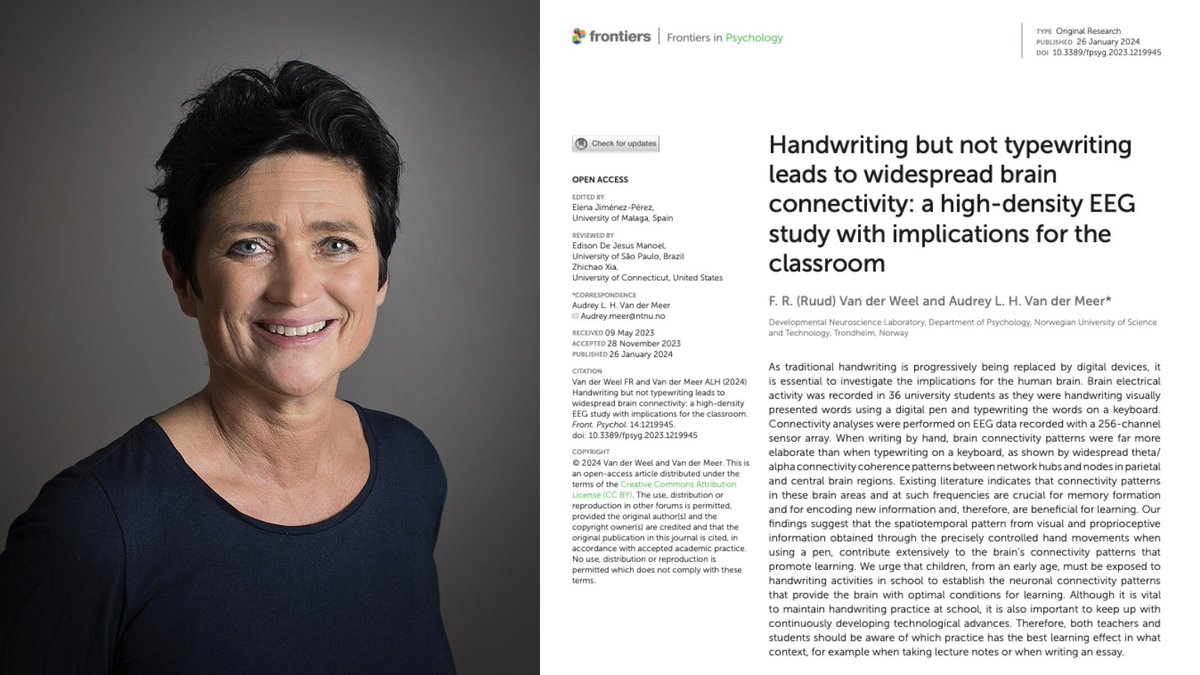
A Norwegian neuroscientist spent 20 years proving that the act of writing by hand changes the human brain in ways typing physically cannot, and almost nobody outside her field has read the paper. Her name is Audrey van der Meer. She runs a brain research lab in Trondheim, and the paper that closed the argument was published in 2024 in a journal called Frontiers in Psychology. The finding is brutal enough that it should have changed every classroom on Earth. The experiment was simple. She recruited 36 university students and put each one in a cap with 256 sensors pressed against their scalp to record brain activity. Words flashed on a screen one at a time. Sometimes the students wrote the word by hand on a touchscreen using a digital pen, and sometimes they typed the same word on a keyboard. Every neural response was recorded for the full five seconds the word stayed on screen. Then her team looked at the part of the data most researchers had ignored for years, which is how different parts of the brain were communicating with each other during the task. When the students wrote by hand, the brain lit up everywhere at once. The regions responsible for memory, sensory integration, and the encoding of new information were all firing together in a coordinated pattern that spread across the entire cortex. The whole network was awake and connected. When the same students typed the same word, that pattern collapsed almost completely. Most of the brain went quiet, and the connections between regions that had been alive seconds earlier were nowhere to be found on the EEG. Same word, same brain, same person, and two completely different neurological events. The reason turned out to be something nobody had really paid attention to before her work. Writing by hand is not one motion but a sequence of thousands of tiny micro-movements coordinated with your eyes in real time, where each letter is a different shape that requires the brain to solve a slightly different spatial problem. Your fingers, wrist, vision, and the parts of your brain that track position in space are all working together to produce one letter, then the next, then the next. Typing throws all of that away. Every key on a keyboard requires the exact same finger motion regardless of which letter you are pressing, which means the brain has almost nothing to integrate and almost no problem to solve. Van der Meer said it plainly in her interviews. Pressing the same key with the same finger over and over does not stimulate the brain in any meaningful way, and she pointed out something that should scare every parent who handed their kid an iPad. Children who learn to read and write on tablets often cannot tell letters like b and d apart, because they have never physically felt with their bodies what it takes to actually produce those letters on a page. A decade before her, two researchers at Princeton ran the same fight using a completely different method and ended up at the same answer. Pam Mueller and Daniel Oppenheimer tested 327 students across three experiments, where half took notes on laptops with the internet disabled and half took notes by hand, before testing everyone on what they actually understood from the lectures they had watched. The handwriting group won by a wide margin on every question that required real understanding rather than surface recall. The reason was hiding in the transcripts of what the two groups had actually written down. The laptop students typed almost word for word, capturing more total content but processing almost none of it as they went, while the handwriting students physically could not write fast enough to transcribe a lecture in real time, which forced them to listen carefully, decide what actually mattered, and put it in their own words on the page. That single act of choosing what to keep was the learning itself, and the keyboard had quietly skipped the choosing and skipped the learning along with it. Two studies. Two countries. Same answer. Handwriting makes the brain work. Typing lets it coast. Every note you have ever typed instead of written went into your brain through a thinner pipe. Every meeting, every book highlight, every idea you captured on your phone instead of on paper was processed at half depth. You did not forget those things because your memory is bad. You forgot them because typing never woke the part of the brain that would have made them stick. The fix is the thing your grandmother already knew. Pick up a pen. Write the thing down. The slower road is the faster one.
Ihtesham Ali tweet media
English
1.2K
20K
52.1K
1.5M
LiveWildLiveFree.org (Alan Chapman) retweetledi
Artur Nadolny
Artur Nadolny@ArturNadol7566·
DR CHRIS DAY TOLD THE TRUTH. THE NHS DESTROYED 90,000 EMAILS. THE JUDGE CALLED HIM A LIAR. I have been following this case for some time. What you are about to read is not an allegation. It is a matter of documented public record. Dr Chris Day @drcmday is a locum emergency medicine doctor who blew the whistle on unsafe ICU staffing and avoidable deaths at a South London NHS hospital. That was 2013. It is now 2026. The case is still running. The first four years were spent fighting a legal argument designed to strip all junior doctors in England of whistleblowing protection. Around 54,000 doctors. Chris privately funded that fight through the Court of Appeal, backed by 5,000 crowdfunders. The government did nothing. He won. Then, while he was giving evidence under oath, cost threats were made against him and his legal team. Because he was mid-testimony, he could not have frank discussions with his lawyers. The case settled in 2018. None of the substantive issues were ever heard. Around half a million pounds of public money spent, a similar amount from crowdfunders, and everything buried. The NHS then told the press and MPs that no cost threats had been made and that the case had nothing to do with ICU staffing. The Financial Times and the Telegraph both reported the cost threats in detail. Neither story was ever legally challenged. The case returned to court in 2022. Jeremy Hunt appeared as a supportive witness. During that hearing, a Trust director got up at 5am, went to a hospital, and deleted 90,000 emails before they were due to give evidence. They admitted it in an unsigned statement and then refused to be cross-examined on mental health grounds, without medical evidence. The judge accepted that. The NHS won. Multiple EAT judges declined to engage with the written evidence. One called Chris a liar in open court, despite his account being backed by his own barrister's written record, two MPs, and two national newspapers. Several judges volunteered unsolicited positive comments about the barristers involved. No recusals followed. Last August, Chris wrote formally to Lord Fairley, President of the Employment Appeal Tribunal, placing on record his view that the handling of his case meets the definition of institutional corruption from the Daniel Morgan Independent Panel Report. That definition is precise. Concealing or denying failings to protect an organisation's reputation is itself institutional corruption. The case is now before the Employment Appeal Tribunal again in 2026, this time on the wasted costs claim against @HillDickinson, the same firm that spent four years using public money to argue junior doctors out of whistleblowing protection, while withholding the very contracts that proved their argument wrong. @Channel4News covered this case in March 2026. Two MPs have called for a public inquiry. The question Chris asks is simple. If there is not a single false sentence in his witness statement, and if the evidence behind his account has never been successfully challenged in court or in the press, what exactly is the basis for calling him a liar?
English
21
548
891
22.6K
LiveWildLiveFree.org (Alan Chapman) retweetledi
Arny DM
Arny DM@arny_dm·
Plants don't want to be eaten. They can't run. They can't fight. So they made lectins instead. Lectins are biochemical weapons plants use to damage anything that eats them. And we built an entire food pyramid around them. Here's what they actually do: They destroy your gut lining.Wheat agglutinin and bean lectins bind to intestinal cells and punch holes through them. That's leaky gut — undigested food particles, toxins, and bacteria entering your bloodstream directly. Your immune system sees foreign invaders and declares war. On you. They wreck your microbiome.Lectins are toxic to beneficial bacteria. Dysbiosis follows. Chronic inflammation follows. Then your doctor calls it IBS and hands you fiber supplements. More lectins. More damage. Repeat. They trigger autoimmune disease.Once the gut is leaky, your immune system starts misidentifying your own tissues as foreign. Rheumatoid arthritis. Hashimoto's. Psoriasis. Lupus. Multiple sclerosis. The connection to lectins isn't fringe science. It's basic immunology. Where they hide:— Every grain. Wheat especially — WGA is one of the most aggressive lectins known. — All legumes. Cooking doesn't fully destroy them. Red kidney beans eaten raw can hospitalize you. — Nightshades. Tomatoes, peppers, eggplant, potatoes. — Nuts and seeds. Peanuts, cashews, sunflower, chia. — Dairy from grain-fed cows. The lectin problem travels through the feed. The solution nobody wants to say out loud:Stop eating the things built to defend themselves from being eaten. Meat has no lectins. Eggs have no lectins. Fish has no lectins. They weren't trying to survive being eaten. They're just food. The autoimmune epidemic, the IBS epidemic, the leaky gut epidemic. All exploded at the same time we were told to eat more whole grains and legumes. The timing isn't subtle. Not medical advice.
English
0
8
26
1.8K
LiveWildLiveFree.org (Alan Chapman) retweetledi
Dr Gerard Waters ,GP
As a GP for 40 years I can’t remember diagnosing a single stage four cancers particularly in a young person . They appear to be increasingly common worldwide since something mysteriously happened in 2021 and my medical colleagues can’t figure it out. Couldn’t possibly be due to a gene therapy injected into over 5 billion people ?
illuminatibot@iluminatibot

Young people, in their 20s, 30s, and 40s, are developing aggressive and rapidly-growing "turbo cancers." Dr. William Makis, who has diagnosed 20,000 cancer patients in his career, says, "I've never seen anything like this."


English
7
73
120
2.2K
LiveWildLiveFree.org (Alan Chapman) retweetledi
Sama Hoole
Sama Hoole@SamaHoole·
Activist: "Beef is destroying the Amazon." Farmer: "Mine isn't. Mine's from Pembrokeshire." Activist: "But globally." Farmer: "The Amazon is being cleared mostly for soy. Most of that soy goes into biodiesel, processed food, and chicken feed. Almost none of it touches a British animal because British cattle eat grass. The thing you're upset about is in your salad dressing." Activist: "But you're contributing to demand." Farmer: "Demand for Welsh beef. The loggers in Rondônia are not waiting for my forty cows to stop eating grass before they put the chainsaw down. They will keep going whether my cattle exist or not. My ceasing trade with myself changes nothing in Brazil." Activist: "It's all one system." Farmer: "It is not all one system. You can boycott Brazilian beef without boycotting a Welsh hill farm. Shutting me down does not save a single tree. It just turns this field into bramble and puts the loggers exactly where they already were." Activist: "Beef is beef." Farmer: "Wine is wine. Is Champagne off the list because of the bloke in Watford bottling antifreeze in his shed and selling it from a wheelie bin."
Sama Hoole tweet media
English
23
416
1.6K
19.5K
LiveWildLiveFree.org (Alan Chapman) retweetledi
Patrick Lockwood
Patrick Lockwood@AlobhaPatrick·
Let the system die. Reforming a highly corrupt (rehabs, doctors, “health insurance,” etc.) system is not possible. It needs to die. People will suffer. The suffering will (potentially) teach us all a lesson and that will encourage building a better system. The system has to die.
Chris Palmer, MD@ChrisPalmerMD

If we want to improve mental health care, psychiatrists need to be part of the conversation, not excluded from it. At the @APApsychiatric meeting this week, there was discussion about government efforts to influence or change prescribing practices for antidepressants and other psychiatric medications. Some psychiatrists voiced concern about what they see as “government interference” in clinical care. At the same time, there are many people who feel harmed by psychiatry, harmed by medications, or unheard by the mental health system. Their experiences matter too. Dismissing them is neither compassionate nor scientifically responsible. These tensions are real. Psychiatry has helped millions of people. It has also fallen short, or even harmed, others. Both things can be true. If we want meaningful reform, it cannot come from attacking psychiatrists, nor from psychiatrists becoming defensive and refusing criticism. Real progress will require humility, open scientific inquiry, honest discussion of benefits and harms, and collaboration among clinicians, patients, researchers, families, and policymakers. The goal should not be protecting institutions or ideologies. The goal should be helping people recover and live better lives.

English
8
4
33
3K
LiveWildLiveFree.org (Alan Chapman) retweetledi
Kate Shemirani
Kate Shemirani@KateShemirani·
Good morning and great words from a great woman. Our words are our sword. Our only weapon of attack as we are told in Ephesians. @RealDrJaneRuby
English
4
7
24
1.4K
LiveWildLiveFree.org (Alan Chapman) retweetledi
Matthew Baszucki
Matthew Baszucki@matthewbaszucki·
What does 'insulin resistance' actually mean? Why does it matter? Insulin is the hormone that enables your cells to take up glucose for energy. When you eat carbohydrates chronically over years, your cells become resistant to it. They stop responding. Your body produces more and more insulin trying to compensate. Eventually the signal stops working properly. This is insulin resistance. And it doesn't just affect your blood sugar. It affects your liver (fatty liver, impaired metabolism), your heart (cardiovascular disease, inflammation), your brain (impaired glucose uptake, Alzheimer's, psychiatric illness), and your body composition (weight gain, difficulty losing fat). All of this from eating what the government told us to eat for fifty years. The most powerful single intervention for insulin resistance: reduce carbohydrates. Dramatically. The mechanism is simple.....less glucose means less insulin demand means cells regain sensitivity. Every metabolic disease has this at its root. Treat the root. Everything downstream improves.
English
4
7
41
1.1K
LiveWildLiveFree.org (Alan Chapman) retweetledi
Dr Jen Unwin
Dr Jen Unwin@drjenunwin·
Free giveaway of my book thanks to @StevenBartlett 🙌🙌🙌 amazing! 1000 copies to give away. Listen to @lowcarbGP talk to Steven about reversing T2D, food addiction and more! ⬇️⬇️⬇️⬇️ Please share! doac-giveaway.vercel.app
English
3
21
43
1.7K
LiveWildLiveFree.org (Alan Chapman) retweetledi
Stefan Homburg
Stefan Homburg@SHomburg·
Ebola? Lesen Sie den Wirtschaftsteil! Erst im Januar 2026 flossen 26,7 Mio. Dollar an Moderna und Unis für die Entwicklung einer modRNA gegen Bundibugyo. Und schon ist der Markt da, hurra! Hintergrund: Hauptzahler ist CEPI, ein von Gates, WEF und Wellcome gegründetes Finanzkonstrukt, das die ursprünglichen Ideen von Gates und Epstein in seiner Komplexität weit übertrifft. Im Prinzip funktioniert es so: Arme Entwicklungsländer dienen als Abschussbasis. Nach Aktivierung des Pandemietriggers (WHO-Ausrufung) wird die dortige Bevölkerung gespritzt. Dabei gibt es durchaus auch Tote auf Seiten des Impfpersonals, etwa in Nigeria, weil die Menschen der Sache misstrauen. Die Entwicklungsländer selbst müssen nichts bezahlen, sondern nur ihre Menschen zur Verfügung stellen. Gezahlt wird von Deutschland und anderen Staaten an CEPI, das die Milliarden wiederum an die Pharmaindustrie verteilt. Ein teuflisches System, das mit Hilfe der Medien wie geschmiert funktioniert. Link: ovg.ox.ac.uk/news/ambitious…
Stefan Homburg tweet media
Deutsch
128
2K
4.7K
57.5K
LiveWildLiveFree.org (Alan Chapman) retweetledi
Cary Kelly
Cary Kelly@CaryKelly11·
The farther you get from experts, the closer you get to health. Eat real food. Get sunlight. Move your body. Sleep like you charge your phone. Stop outsourcing common sense to people who make health complicated. Most people don’t need another expert. They need fewer excuses, fewer ultra-processed foods, fewer seed oils, fewer pills and more steak, eggs, salt, sun and walking. Health was never supposed to be this confusing.
Cary Kelly tweet media
English
30
100
671
7.7K
LiveWildLiveFree.org (Alan Chapman) retweetledi
Sama Hoole
Sama Hoole@SamaHoole·
Activist: "Wool is cruel. The sheep should be left alone." Farmer: "Alone where?" Activist: "In a sanctuary." Farmer: "Doing what." Activist: "Just being a sheep." Farmer: "Sheep have been bred for ten thousand years to grow a fleece that doesn't stop. If I don't shear her, she overheats, gets fly strike, and dies in her own coat with maggots eating her from the skin down." Activist: "Then breed sheep that don't grow wool." Farmer: "We did. They're called mouflon. They live on cliffs in Sardinia and would last forty minutes on a Welsh hillside before something ate them." Activist: "I just don't think we should use animals for clothing." Farmer: "What's your jumper made of." Activist: "...recycled polyester." Farmer: "Plastic, then. Sheds microfibre into the washing machine every wash. The fibres go through the filter, into the river, into the fish, into you. When you're done with it, it sits in a landfill for four hundred years. My sheep's fleece composts in a hedge in eighteen months and grew back on her this spring." Activist: "But the sheep didn't consent." Farmer: "She was lying down with her eyes closed when I finished. She got up and went back to eating. I'd suggest you ask her how she feels, but she's busy, and I think she's already given her answer."
Sama Hoole tweet media
English
294
6.3K
45.3K
2.1M
LiveWildLiveFree.org (Alan Chapman) retweetledi
Sama Hoole
Sama Hoole@SamaHoole·
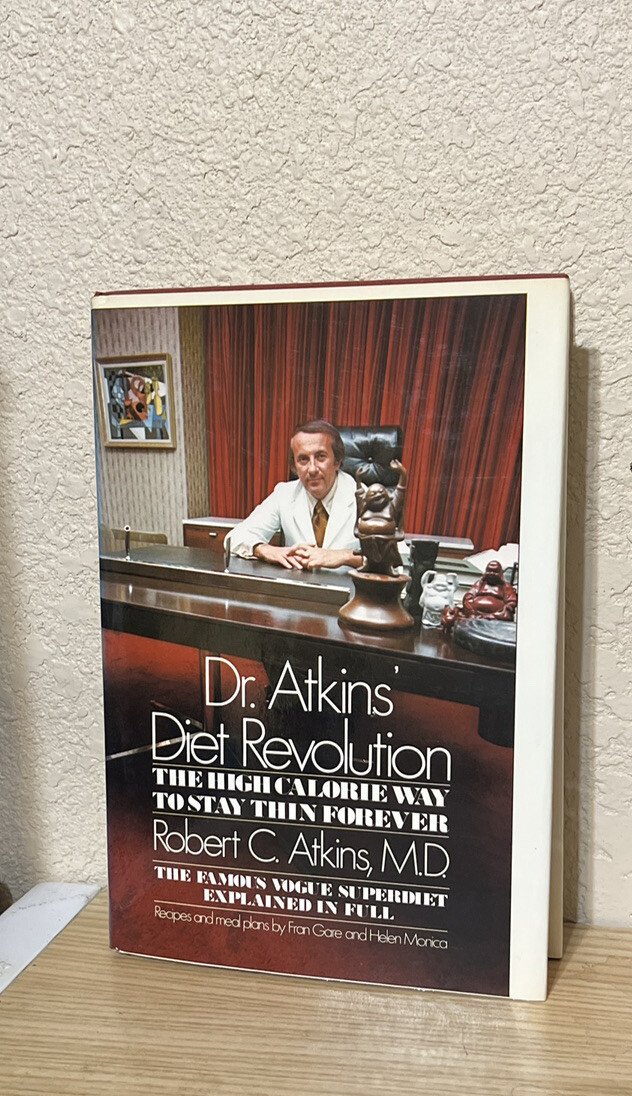
In 2003, a strange thing happened. A diet book by a New York cardiologist who had spent thirty years arguing the opposite of the official guidance suddenly went vertical. Dr Atkins' New Diet Revolution had been quietly selling since the 1970s. In 2003 alone it sold ten million copies. By 2004, roughly one in eleven American adults was on some version of the Atkins diet. The diet involved removing the refined carbohydrate at the base of the food pyramid and eating, instead, the eggs, butter, meat, cheese, and cream the pyramid had spent twenty years calling dangerous. The result was a brief, mass, real-world experiment in eating the food humans had eaten before 1977. Bread sales fell. Pasta sales fell. The cereal aisle contracted. The food industry, which had built its entire low-fat infrastructure on the assumption the guidance would never change, panicked. The pushback was severe and coordinated. The American Heart Association warned the diet was dangerous. The British Medical Association called it nutritionally unsound. Dietitians lined up to denounce it on daytime television and in women's magazines. Then, in April 2003, Atkins slipped on an icy New York pavement, hit his head, and died nine days later in a coma. His family declined an autopsy. Ten months later, his private medical records were leaked to the Wall Street Journal by a physician affiliated with a vegan advocacy group. The records showed Atkins had weighed 258 pounds at the time of his death, after nine days of intravenous fluids and coma-related bloating. The press ran the headline as if the diet had killed him. It was one of the more effective smears in the history of nutrition science, and it worked. The Atkins moment passed. The pasta came back. The institutional consensus reasserted itself. But the people who had tried it had noticed something. Eggs and butter for breakfast had left them less hungry, more energetic, and visibly thinner than twenty years of skimmed milk and pasta ever had. They had felt, in their own bodies, what the previous half-century had been concealing. Most of them went back to the pasta anyway. The doctor had said so. The dietitian had said so. The man on television had said so. And the man who had said otherwise had just been carried out of his apartment building on a stretcher, made obese by the press the morning after his funeral.
Sama Hoole tweet media
English
32
206
995
41.9K
LiveWildLiveFree.org (Alan Chapman) retweetledi
Kim Witczak 💜
Kim Witczak 💜@woodymatters·
These are real lives who are being impacted. Charay lost her 12 year old beautiful daughter to the psychiatric system. It failed them on every level and it’s why she is out on a mission to change it. It won’t bring her daughter back but hopefully will prevent another family from experiencing what no family ever should. I have been listening to these heartbreaking stories for over 2 decades. 💜🦋💜🦋
Inner Compass Initiative@_innercompass

This is Charay Gadd-Spencer, holding a framed photo of her daughter, London. London was a bright, artistic, soccer-loving 12-year-old who dreamed of becoming an Air Force pilot. She deeply sensed the world we live in and all the pain it can bring. When her family sought help, the mental health industry responded with rushed prescriptions instead of real support. After a crisis admission, London was started on Prozac without discussion of non-drug options or the FDA black box warning for suicidal ideation in children. Just weeks later, on July 30, 2024, she died from an overdose. The system failed her at every turn. While London became a direct patient of the mental health industry, Charay was not. Yet she has lived through every parent’s worst nightmare—the sudden, preventable loss of her child. She is now channeling her grief into advocating for vital change. As the founder of The London Effect, her nonprofit is championing informed choice, pharmacogenetic testing, and London’s Law to prioritize non-drug interventions first. As an organization run by and for patients who have left or are leaving the mental health industry, much of what we talk about is from the perspective of patients. But we want to highlight the impact the mental health industry can have on the families and loved ones of patients—people who never directly received the diagnoses and drugs that so many of us have. People like Charay. At this point, Charay and London may be new faces to you all, but Charay’s voice is only going to carry further. So we’d love for you to join her in saying hello in the comments to welcome her into this community. You can say hello here or to her directly via our corresponding Instagram post. And given all that’s happened to Charay, we’d especially love to hear from those of you who are loved ones of patients and former patients. Thank you. 💛

English
1
13
53
2.9K
LiveWildLiveFree.org (Alan Chapman) retweetledi
Nick Taber
Nick Taber@NickTaber·
The film One Flew Over the Cuckoo’s Nest does a fantastic job showcasing a disturbing phenomenon that plagues the mental health system likely to the present day: mental health professionals driving patients to suicide by psychologically abusing them, while hiding behind the idea that they’re providing “care”. This happened to a teenager at one of the programs I went to.
English
15
26
143
4K
LiveWildLiveFree.org (Alan Chapman) retweetledi
Sama Hoole
Sama Hoole@SamaHoole·
A 2016 BMJ study by researchers at Johns Hopkins estimated that medical error is the third leading cause of death in the United States. Behind heart disease. Behind cancer. Ahead of stroke. Ahead of respiratory disease. Ahead of accidents. Ahead of diabetes. Ahead of Alzheimer's. Roughly two hundred and fifty thousand deaths a year, in the country that spends more per capita on healthcare than any other on earth, are caused by the healthcare itself. This figure is not on death certificates because there is no ICD code for being killed by a healthcare system. Deaths from medical error are recorded as the underlying condition the patient was being treated for. The figure is not in the headlines because there is no marketing department for the bereaved. Be cautious about how much of your wellbeing you outsource to an institution that is, statistically, more dangerous than a road accident.
English
29
115
348
7.2K