Linux Roller

4.3K posts

Linux Roller

Linux Roller

@linux_roller

Using and supporting GNU/Linux and Open Source Software. Usando y brindando soporte sobre GNU/Linux y software de fuente libre.

Ramos Mejía, Argentina Katılım Nisan 2010
555 Takip Edilen233 Takipçiler
Sabitlenmiş Tweet
Linux Roller
Linux Roller@linux_roller·
1/Una de las mejores herramientas del mundo cripto que he encontrado es la tarjeta de crédito prepaga @KASTcard Me permite usar mis #criptomonedas para pagos en cualquier negocio físico u online donde acepten @Visa incluso servicios y compras en EEUU...
Linux Roller tweet media
Español
2
2
3
519
Linux Roller retweetledi
Storj
Storj@storj·
Today Storj began a voluntary financial restructuring — an accelerated, court-supervised reorganization to resolve legacy liabilities that predate our current strategy. The business and network continue as normal. 🧵
English
16
7
60
130.4K
Linux Roller retweetledi
KAST
KAST@KASTxyz·
The case for stablecoins💲 Stablecoins are: > Digital > Fixed 1:1 > Internet native In other words, they’re a better version of money built for the modern global lifestyle.
English
19
9
79
4.9K
Linux Roller retweetledi
Gaurav
Gaurav@memers07·
There are clear patterns across these shutdown projects 1. Most are infra / tooling — not real user products Look at the names: Wallets: Ctrl Wallet, Leap Wallet, Magic Eden Wallet Protocols: Seamless, Angle, Intergaze, Polynomial L2 / zk: Polygon zkEVM DeFi tools: Parsec, Blockfills, Step Finance 👉 Pattern: These are “builders building for builders”, not mass-user apps. ➡️ Problem: If no real users, then: ✔️No revenue ✔️No organic growth ✔️No stickiness Conclusion: 👉 Over-engineered infra with no demand = shutdown
Gaurav tweet mediaGaurav tweet media
English
3
3
13
1.6K
Linux Roller retweetledi
Beezie
Beezie@Beezie·
Beezie is now LIVE on @solana Today, Solana collectors get their first Claw with ZERO recycled slabs. The Claws are open.
English
295
180
686
231.6K
Linux Roller retweetledi
Ryder - Control Without Complexity
1/ SOL staking is now live on Ryder One. Stake @solana directly through your Ryder One hardware wallet powered by @Meria_Finance and @yieldxyz > no exchanges > no giving up custody every transaction verified on Ryder One - just your SOL, secured and at work for you.
Ryder - Control Without Complexity tweet media
English
19
16
61
11.2K
Linux Roller retweetledi
JTX
JTX@jtx_trade·
JTX is now live. Trade spot markets on Solana—memes, tokenized equities, majors, and more. The top 1,000 users on the waitlist, ranked by referrals, have access now.
English
269
201
1.3K
409.3K
Linux Roller retweetledi
USDGO
USDGO@usdgo_official·
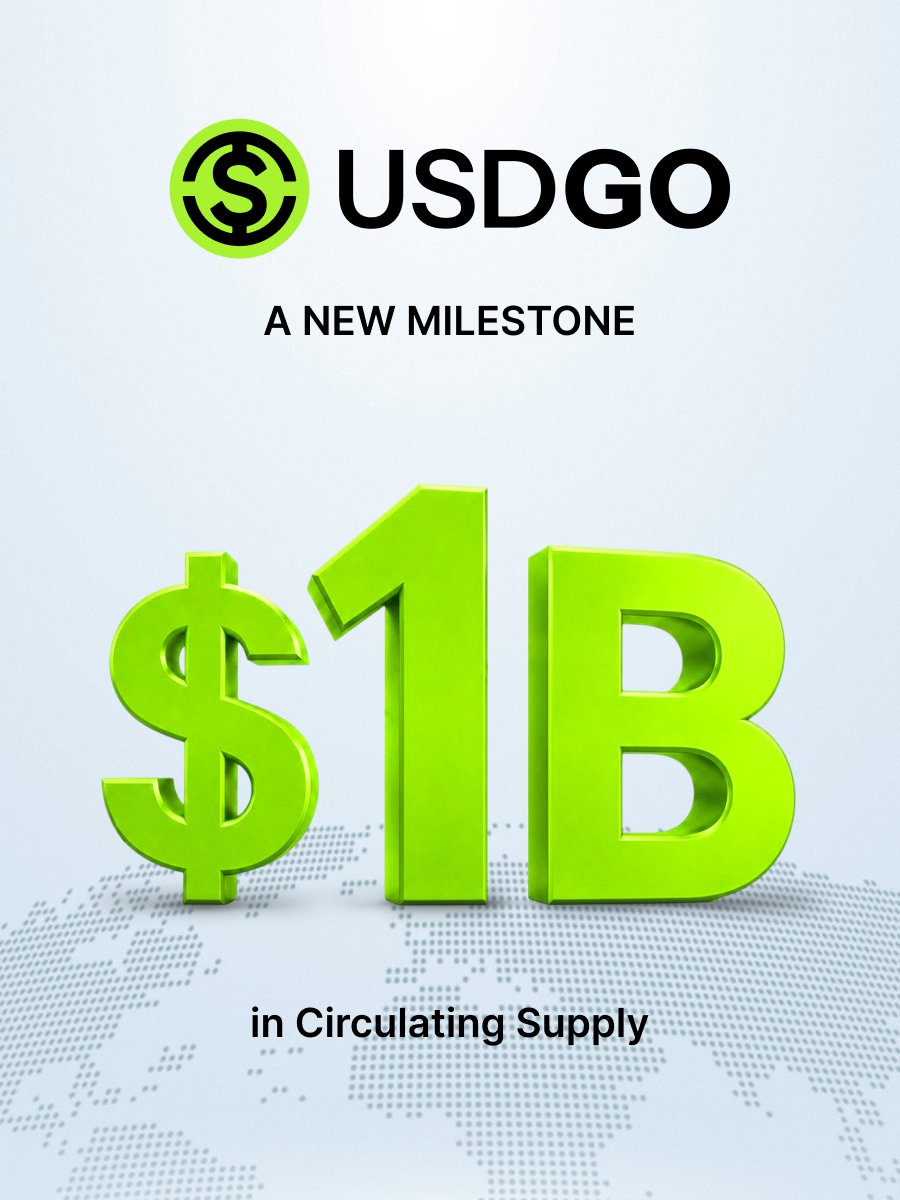
🚀 USDGO has officially crossed US$1 BILLION in circulating supply. From zero to US$1B in just 5 months — a ~20x trajectory since launch. This pace isn't speculative hype. It's real institutional demand: platforms & enterprises holding a fully compliant stablecoin as a trusted store of value. 🧵👇
USDGO tweet media
English
8
5
24
39.9K
Linux Roller retweetledi
Meteora
Meteora@MeteoraAG·
Introducing the Meteora Referral Staking Program. Stake MET. Grow your LP network. Earn a share of real DLMM protocol fees.
English
183
97
591
247.5K
Linux Roller retweetledi
Everstake
Everstake@everstake_pool·
Solana is down. Yeah, down to breaking another all-time record. 😄 June 2026 officially became the strongest month in the network's history, with an incredible 3.8 billion transactions processed across the ecosystem. The number is impressive on its own, but what really stands out is the trend. Every year, the network is handling more activity, serving more users, and proving that its infrastructure can support growth at an entirely different scale. No single update creates a milestone like this. It comes from years of improving performance, expanding the ecosystem, and making it easier for developers to build products that people genuinely use. And it's another reminder that real adoption is measured in activity, not headlines.
Everstake tweet media
English
8
6
48
5.3K
Linux Roller
Linux Roller@linux_roller·
Se viene "Lean Ethereum", una serie de profundos cambios en esa blockchain que será reescrita de cero y todos sus componentes cambiados para prepararla para un mundo post-quantum 🤯
vitalik.eth@VitalikButerin

Two weeks ago, Ethereum researchers met in Berlin to continue charting the protocol's long-term trajectory, following along discussions with client teams in Svalbard in April. The updated strawmap is at strawmap.org, and I attached a picture of it to this post. My own high-level takeaways: * "Lean Ethereum" is not a single one-shot upgrade, it is a collection of improvements that will come online to the Ethereum network over the course of three or four years. But make no mistake, this IS the third major iteration of Ethereum in the same way that the Merge was the second. Almost every major piece of the protocol will be replaced: - Verification through recursive STARKs, rather than direct re-execution. Recursive STARKs become an enshrined first-class core component of the protocol - Replacing everything quantum-vulnerable with quantum-safe alternatives - Consensus: decoupled available chain and finality, one or two-round finality. Theoretically optimal security properties, simpler than today, and faster than today - Multidimensional gas - State: not just tree structure, but what *types* of state are available - Changes to client architecture ... At the same time, simplification, cleanup and future-proofing. And this will all be done in a way that minimizes disruption to existing application. We've done this before (the Merge), we can do it again. * H-star (aka Hegota) is probably Ethereum's last thematically "pre-Lean" fork. Starting from I-star, most of everything we do will have a very strong "Lean" feel to it in one way or another. * Privacy is no longer an afterthought, it is a first class goal. When designing Frames, the mempool, additions to the state tree, we explicitly ask the question "okay, how do quantum-safe, intermediary-free privacy protocol transactions go through this, and what is the overhead?" * Formal verification of everything for security. * FV also makes us much more comfortable with canonicalization (having pieces of the protocol that are directly defined as a piece of bytecode expressed in some language). evm-asm is being written in part to become a canonical proof system for the EVM. * Quantum safety has shifted up a LOT in priority. This adds a lot of work (eg. finalizing a quantum-safe blobs design has become urgent; this work has already been ongoing for months) * Probably the single most disruptive part of the plan is the changes to state. There is growing consensus around leaving present-day-style "dynamic state" mostly unchanged, but scaling it only a medium amount, and adding new types of state that are more scalability-friendly (eg. no need for builders to sync/store all of it) but more restrictive, and that will scale a large amount. eg. possible Ethereum in 2030: 2 TB of present-day-style (dynamic) state, and 100 TB of new-style (scalable but restrictive) state This "new-style" state would work very well for ERC20s, NFTs, many defi use cases, but not eg. highly "central" objects like Uniswap contracts, or onchain order books, or other complex things (which are crucial for Ethereum but which only take up a small percentage of state) Hence, it will not be *necessary* to rewrite any apps, but it will be *very cost-effective* to eg. rewrite an ERC20 token into a newer design that uses a new type of UTXO storage that is currently being explored, so that it will have >10x lower txfees. Design of these new state types (current ideas: keyed nonces, ring buffers, UTXOs, statically accessible state, temp state) is an area where we will need a lot of feedback from application developers (incl. privacy-friendly application developers) and probably several rounds of rethinking and iteration. * In the context of a much larger total state size, we need to figure out the incentive issues around who stores this state and what motivates them to. Even saying "each node stores 1%" is not good enough - why do they store that 1% and why are they willing to serve it? This is being elevated as a first-class research area. * Ethereum will need to have a "VM" other than EVM in one form or another - at the very least, we need something like leanISA for recursive STARKs - and the gains are large in exposing it to users so that we support programmable privacy and better scalability. Right now, the most likely contenders are leanISA and RISC-V. My own ideal is that in this world, we adjust the protocol so that the EVM becomes a high-level-language compiler-level feature, and the protocol only "sees" RISC-V / leanISA directly. But this is still far away. * Gas limit increases, blob increases and slot time decreases will happen many times over the next ~5 years. We expect a large gas limit increase with Glasterdam. Each step of increased scale or decreased slot time is a matter of getting to the point where it is safe to do it, which comes from a combination of client optimization and protocol changes. Ethereum is CROPS. Ethereum is scaling. Ethereum is reinventing itself. Onward.

Español
0
0
0
29
Linux Roller retweetledi
PegasusA4
PegasusA4@A4KikeLippi·
Les comparto mi aproximación al aeropuerto internacional de Río de Janeiro.
Español
12
19
284
8.6K
Linux Roller retweetledi
filipe
filipe@filicroval·
Ornith 1.0 32B🦜 vs GLM5.2 🐲 i ran Ornith 1.0 32B locally on my Mac M2 Max (~60 tok/s) against GLM-5.2 on the same 5 animation tasks: - burning paper - paper slice - bubble wrap - zipper opening - mechanical watch as expected GLM-5.2 wins on quality, but Ornith is surprisingly competitive for a model running entirely on-device. the gap is smaller than I expected
English
1
3
7
3K
Linux Roller
Linux Roller@linux_roller·
Hermoso recordatorio para alguien que apenas algunos conocen, pero que hace que Internet funcione hoy, en una enorme proporción, gracias a su software 😍
Spencer Baggins@bigaiguy

A French engineer who lives quietly in Paris has spent 30 years writing software that the entire internet now runs on without knowing his name. He wrote the code that streams every YouTube video, every Netflix show, every TikTok clip. He wrote the code that runs the virtual servers underneath AWS, Google Cloud, and Microsoft Azure. He calculated more digits of pi than anyone in history. He has no Twitter. He has no marketing. He just keeps shipping. His name is Fabrice Bellard. Here is the story, because almost nobody outside the systems programming world knows what one man has built. Fabrice was born in 1972 in Grenoble, France. He studied at École Polytechnique, the top French engineering school. He never went to Silicon Valley. He never built a startup empire. He just wrote code. In 2000 he started a project called FFmpeg, an open-source multimedia framework for encoding, decoding, and streaming video. He was 28. The project did one thing nobody else had done well. It handled every video and audio format that existed, in one library, on every operating system. He led it himself for years. Today FFmpeg is the invisible engine of the internet. YouTube uses it. Netflix uses it. VLC uses it. Chrome and Firefox use parts of it. Every Android phone, every iPhone, every smart TV, every video editing tool you have ever touched runs FFmpeg somewhere underneath. If you have watched a video on a screen in the last 20 years, Fabrice's code processed it. He was not done. In 2003 he started QEMU, a machine emulator and virtualizer. He wrote it solo until version 0.7.1 in 2005. QEMU lets you run any operating system on any other operating system. It became the foundation of modern virtualization. KVM, the Linux kernel hypervisor, runs on top of QEMU. Every major cloud provider, AWS, Google Cloud, Microsoft Azure, IBM Cloud, runs virtual machines on infrastructure built around it. The Quick Emulator is the most cited piece of cloud infrastructure code on Earth. He kept going. In 2001 he won the International Obfuscated C Code Contest with a small C compiler that grew into TCC, the Tiny C Compiler. TCC can compile and boot a Linux kernel from source in under 15 seconds. In 2004 he calculated the most digits of pi ever computed at the time, using a personal desktop computer and an algorithm he derived himself called Bellard's formula. In 2011 he wrote a complete PC emulator in pure JavaScript that runs Linux in your browser, a project called JSLinux that engineers still cannot believe is real. In 2019 he released QuickJS, a small but complete JavaScript engine that fits where V8 cannot. In 2021 he released NNCP, a neural network based lossless data compressor that immediately took the lead on the Large Text Compression Benchmark. Then he turned his attention to large language models. He built TextSynth Server, a web server with a REST API for running LLMs locally. He released ts_zip and ts_sms, compression utilities that use language models to compress text and short messages at ratios traditional algorithms cannot reach. He released TSAC, a very low bitrate audio compression system. In December 2025 he released Micro QuickJS, a new JavaScript engine for microcontrollers, separate from QuickJS, designed for environments with almost no memory. Fabrice co-founded a telecom company called Amarisoft in 2012, where he serves as CTO. Amarisoft builds 4G and 5G base station software used by carriers and labs around the world. He has been running it for over a decade while continuing to ship personal projects from his own home page at bellard dot org He has no Twitter. He has no Instagram. He gives almost no interviews. His personal website is a flat list of projects with no styling, no fonts, no marketing copy. Just titles and links. A quiet French engineer who never moved to Silicon Valley wrote the code that quietly runs the internet. He is still shipping.

Español
0
0
0
39