wrote a new post, the gentle singularity.
realized it may be the last one like this i write with no AI help at all.
(proud to have written "From a relativistic perspective, the singularity happens bit by bit, and the merge happens slowly" the old-fashioned way)
Pectra is live on Ethereum mainnet!
- Smart account wallet UX features now active
- L2 scaling data storage blobs increased by 2x
- Validator UX improvements live
Community members will continue to monitor for any issues over the next 24 hours.
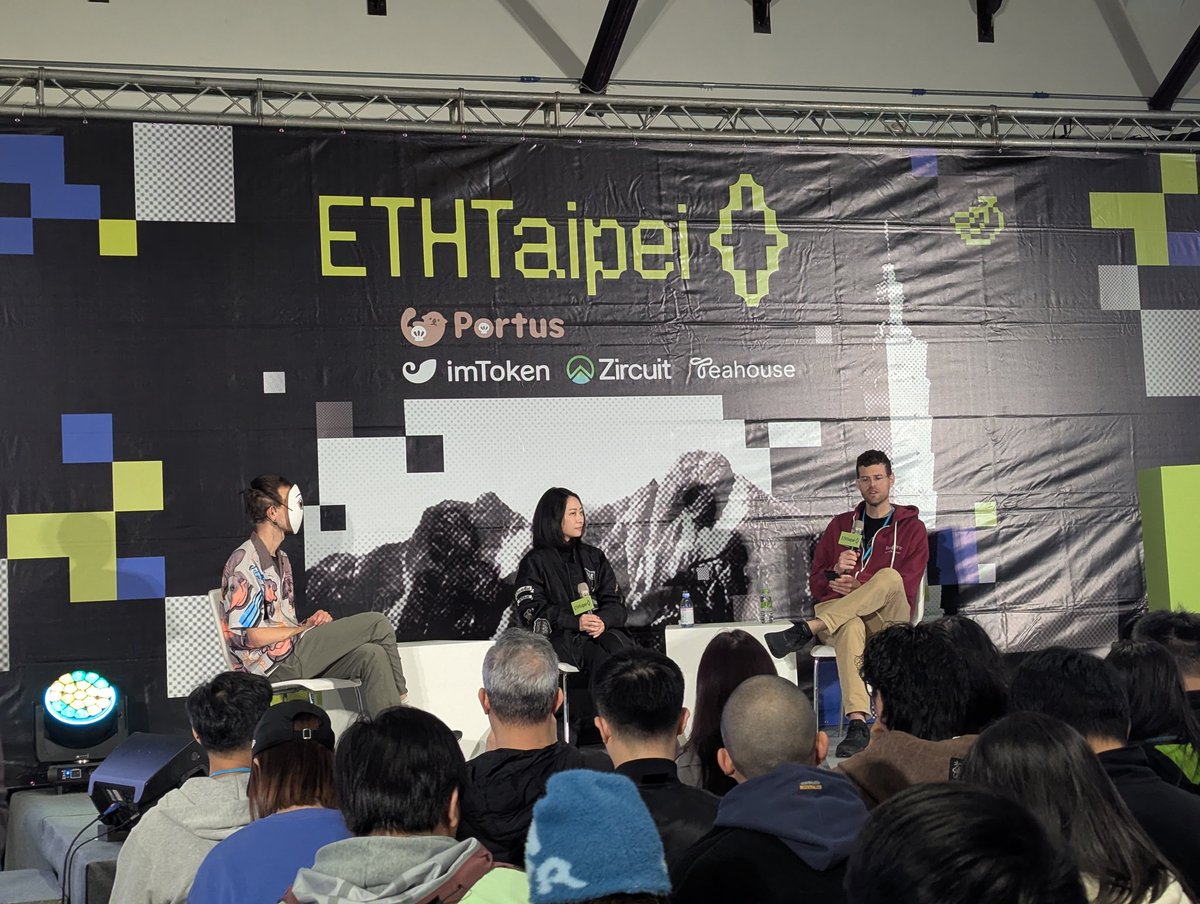
🚀 d/acc Day is coming to @EthTaipei!
Hosted by @VitalikButerin and featuring speakers like @hwwonx, @audreyt, @ChihChengLiang & @oskarth, this edition continues the conversation on decentralization, defense & democracy.
🔽 More on d/acc & why it matters: 🧵
The EF Silviculture Society: a loose collection of individuals from outside the Foundation who provide informal counsel to the EF in tending to the (dark or otherwise) forests in the infinite garden of Ethereum, to make sure we sustain the core values of open source, privacy, security and censorship resistance.
The roots of the infinite garden are nourished by soils rich in these core values. Ethereum’s success depends on having talented and committed developers building with these values in mind, and EF’s ethos and work has always been centered around them.
@llamaonthebrink@alpeh_v@julianzawist@_Enoch@matthew_d_green@Fatalmeh@ml_sudo@dystopiabreaker@optimizoor@post_polar_@pcaversaccio@LefterisJP@mashbean@1dot2@kassandraETH
1/ The Ethereum Foundation is thrilled to welcome Hsiao-Wei Wang and Tomasz Stanczak as co-Executive Directors. This new leadership structure marks an exciting new chapter in the Foundation's evolution as we continue to support a growing Ethereum ecosystem.
🧵
Had just as much fun with the candid hallway/lakeside chats as with the heated debates on all kinds of topics inside.
Also cool to meet people I’ve only known through X.
Excited about this amazing community and all that’s happening! @LuganoPlanB@PlanBTaiwanNode
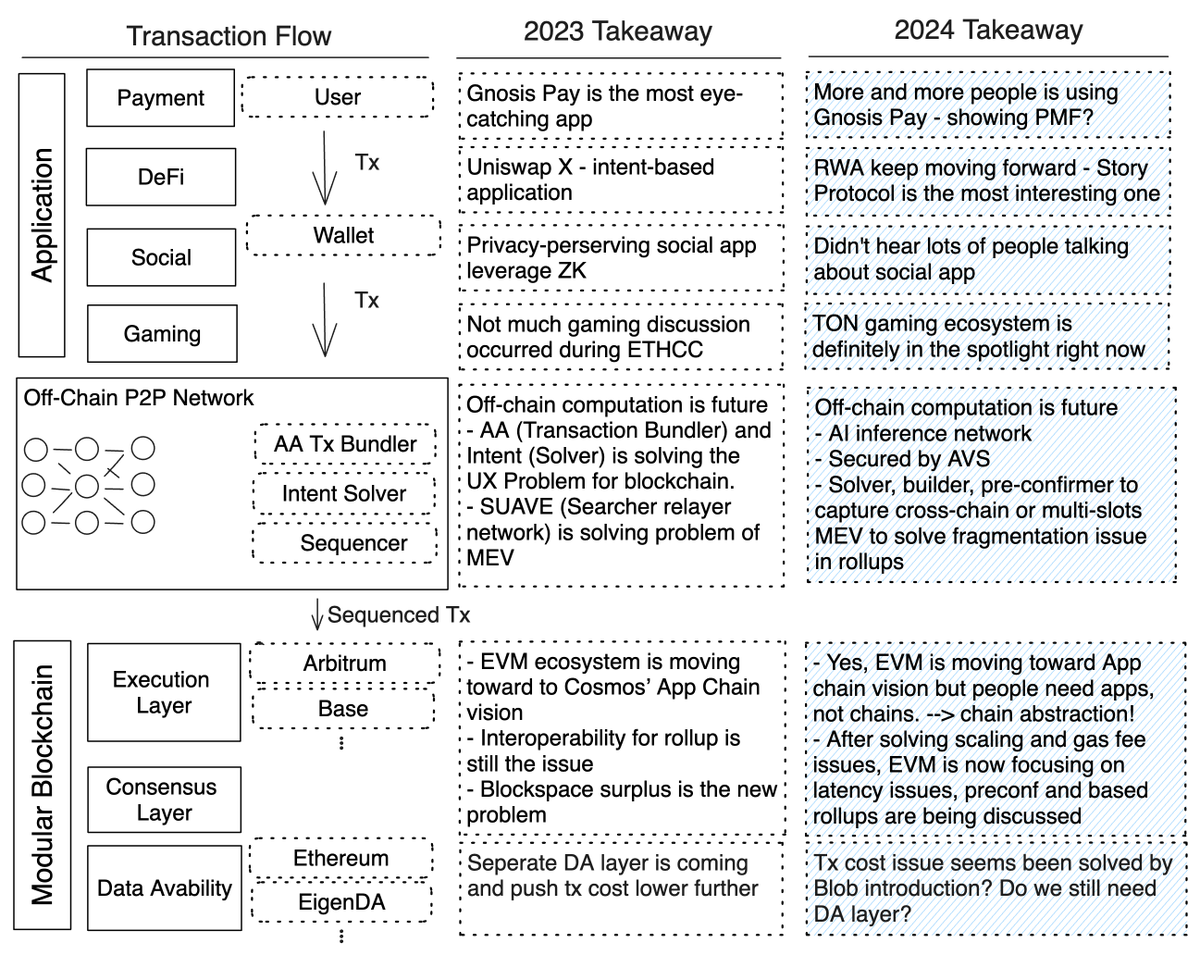
8 Takeaways from ETHCC
Let’s start with applications!
1. Regarding payments, I've noticed increasing use of Gnosis Pay cards. At a side event, Gnosis Cards were given as perks, with a quick 5-minute KYC process to obtain them. Several founders mentioned they are also using these cards quite often. I guess this is one of the few products announced at last year's ETHCC that has continued to progress. Hope it will be rolled out in Asia soon.
2. RWA show clearer progress. Besides the continued involvement of large financial institutions like Goldman Sachs and JPMorgan, there are also startups aiming to create RWA versions of Moody's. Founders are also more focus on unique and interesting assets. For example, @StoryProtocol aims to bring IP on-chain and solve complex IP licensing and payment issues through smart contracts. By leveraging the permissionless nature of blockchain, it enhances the composability and playability of IP. Looks like RWA projects aren't just about putting traditional financial assets on the blockchain anymore. They're also using blockchain to tokenize hard-to-financialize assets and boost their liquidity.
3. In the AI/DePIN sector, not much new is happening. Most projects are still focused on pooling computational resources without addressing the key question: where's the demand? However, more projects are now using AI to analyze user intent for customer support, marketing, and yield strategies. AI is transforming many industries, so it makes sense it would impact crypto too.
4. In the gaming ecosystem, TON is definitely the spotlight. Even at a developer-focused event like ETHCC, there were one or two TON-related side events, and their attendance was higher than many other side events.
Okay, not much progress on applications, but what about infrastructure?
5. After solving scaling and gas fee issues, the EVM ecosystem is now focusing on latency issues, aiming to reduce finality to meet certain DeFi demand (maybe derivatives?) People are discussing topics like preconfirmation and based rollups, but latency on Layer 1 doesn't seem like a real pain point. For example, dydx has already tackled latency issues with off-chain computation while keeping self-custody of assets.
6. Last year, RaaS was a big topic at ETHCC. The EVM ecosystem is now moving towards an App Chain vision with many Layer 2 and Layer 3 blockchains, but also causing liquidity fragmentation. This year, ETHCC focused on solutions like chain abstraction and shared sequencers to do de-fragmentation. Builders, solvers, MEV researchers, and preconfirmers are becoming super important, but with all the uncertainty around competitiveness and market size, it's tough for VCs to invest. The main goal of these Layer 1-3 solutions is still to boost developer monetization, not because users need different app chains— they need apps, not chains. That's why chain abstraction is so important.
7. There is a significant gap between what EVM developers and Solana are currently discussing. While the Ethereum ecosystem is still addressing liquidity fragmentation issues, Solana is experimenting with new approaches like Blink and Bond, which focus on end-user UX. Solana doesn’t need to discuss other Layer 2 solutions and can concentrate solely on user distribution or acquisition. We see TON, Solana, and Base as the three blockchains most actively thinking about user acquisition.
8. As for other cutting-edge cryptographic technologies like ZK, MPC, TEE, besides their use as blockchain scaling technologies, there don't seem to be any widely adopted applications. Privacy-preserving KYC might be the first application scenario, but it requires collaboration with regulatory authorities, which could slow down progress.
That’s all!
It's always awesome to connect with everyone in person and feel the energy. Big shout out to builders and investors like @sohkai, @edeusm, @samclamdisco, @lucasfulks, @corigrohman, @ray_mandar, @MikeSilagadze, @daniel_web3, @cxgonzalez, @HarperLi_CN, @benlakoff, @tzedonn and many others for their insights! Can't wait to see you all in Singapore and Thailand later this year!
[My ETHCC Observations]
1. We’ve got enough, if not too many infrastructures to make an app that works
As many have mentioned, we’ve seen many L2s & other infras coming out this year, some of them made some good strides and got solid value propositions, but most of them are just making minor tweaks. If this was one year ago, I’d argue yes, we might need some more infra due to XYZ, but now that we’ve got EIP-4844 and the availability of numerous modular solutions that allow flexible adaptation across layers, I think it’s obvious that “with the current infra, we should be able to build some killer applications already”.
2. Narrative-driven should go back to product-driven
Many of the hottest topics this year are still largely narrative-driven. Anyone who takes a deep dive into the metrics will likely feel disappointed. Fortunately, I had a long chat with @pumpernikhil during ETHCC about how trends have shifted over the last few years. In 2018-2019, the founder trend was quite product-driven—no users/investors cared much about those projects back then. Then we had Uniswap, dYdX, ENS, and others. But since the last bull run in 2021, money has come too easily, and VCs are actually buying into it. Building a narrative-driven product for VCs is way easier than creating a consumer product that shows real traction.
However, this should change soon. As the industry suffers from the “Low Float, High FDV” fear, VCs are getting cold feet about racing against vesting schedules to dump. As VCs support fewer narrative-driven founders and turn to product-driven ones, the trend will shift. I firmly believe this is the only way for us to escape the zero-sum game we've created for ourselves.
3. Given the landscape, chain abstraction makes sense a lot
I personally find it fascinating how many chain abstraction projects tackle problems with different mechanisms. Many of them use solver networks and do not require any upfront liquidity pools. Ofc if we think it through the needs, it will tie back to my earlier point, but yes—given the current landscape, any effort to solve the complex UX problems in crypto is a leap forward for the industry.
4. DePin, Crypto X AI - takes more time to solve the demand side problem
DePin has been around for a while, but it has caught people's attention again starting from early '23. I think this is another endeavor for the industry to find more use cases, which is good. For Crypto X AI, the reactions from 95% of people are quite polarized—they either think it's complete BS or they jump in without much thought (I’m not saying which type I am).
Overall, I did see some interesting DePin projects (not just decentralizing computing power) and Crypto X AI projects at ETHCC this year. However, most of them are suffering from demand-side issues. Honestly, I don't think building another marketplace for either one makes sense at this point; we first need to validate that there's a market.
5. Governance is the hidden gem
I also attended several DAO governance side events this year and was extremely bullish to meet these great folks in person. Governance is still the elephant in the room—being able to influence the treasuries, protocol params, and future directions of several unicorns should be a multi-billion dollar business. I met amazing people from @karpatkey , @StableLab , @EventHorizonDAO , and @tallyxyz . I will be super surprised if by the next ETHCC, people haven't started to hype around these protocols.
That’s a wrap for my observations at ETHCC! Brussels is a brutal yet lively city to me, just like crypto. Can't wait to see more exciting stuff in this industry next year. Till next time!