Mitras retweetledi
Mitras
988 posts

Mitras
@ljmitrasevic
Energy geek, 🇷🇸🇬🇧 Nikola Tesla fan, energy strategy advisor, with eyes on disruptive world. Busy dad, Chelsea fan. Tweets represent my own views
London Katılım Ağustos 2014
755 Takip Edilen1.6K Takipçiler
Mitras retweetledi
Mitras retweetledi
Mitras retweetledi

Bertrand Russell was born in 1872.
He remembered his grandfather (who had met Napoleon, introduced the Reform Bill of 1832, and served as Prime Minister) "quite well."
In a remarkable interview, he reflected on the world of his youth:
"The world where I was young was a solid world. A world where all kinds of things that have now disappeared were thought to be going to last forever."
The British took naval supremacy not as a political reality but as a fact of nature. Germany wasn't feared — Bismarck was dismissed as "a rascal" and "a sort of uneducated farmer." The assumption was that Goethe and Schiller would eventually bring Germany back to civilisation.
Bismarck himself compared Germany and England to an elephant and a whale — each formidable in its own element, no danger to each other.
That was exactly how they felt.
There was also a shared political assumption: that the entire world was gradually, inevitably moving toward parliamentary democracy. His grandmother once said cheerfully to the Russian ambassador:
"Perhaps someday you will have a parliament in Russia."
He replied: "God forbid."
Russell notes, dryly, that a Russian ambassador today might give the same answer — "except for the first word."
At home, life was shaped by Puritanical austerity. Family prayers at 8am. Half an hour of piano practice beforehand — which Russell hated. Eight servants, yet food of "the utmost simplicity." If apple tart appeared alongside rice pudding, the adults had the apple tart.
Russell had the rice pudding.
What Russell describes isn't just personal memoir. It's a civilisation that had mistaken its own moment for a permanent condition — that looked at the arrangements of the late 19th century and concluded: this is how things are, and how they will remain.
They were wrong about almost everything.
English
Mitras retweetledi

China deployed 100 fully autonomous electric mining trucks (mid-2025)… each running ~500–570 kWh batteries.
That’s ~10× a Model Y. In -40°C. Swapping in minutes.
Scaling to 10,000+ by 2026.
This is the industrialisation of #Bettrification.
Diesel doesn’t stand a chance.⚡🔋
English
Mitras retweetledi

Not a study, not a survey - but the actual live data from every @OctopusEnergy Cosy heat pump installed in real homes is now online.
And it shows that over 80% of Cosy heat pumps were cheaper to run than a gas boiler over the last year and delivered a COP of 3.7 over the whole year (about 4.3x more efficient than a gas boiler)
There’s so much disinformation from fossil fuel lobbyists on heat pumps - and anecdote based on bad installs or out of date tech - but we hear time and time again how much Octopus customer la love their heat pumps.
Cosy heat pumps can run as hot as a boiler (70C+), can often be installed with no radiator changes and no new insulation, work with microbore piping, can often retain your old hot water tank if you have one.
But so much more - comfort sensors in up to ten rooms, optional remote support and servicing, software updates to literally make your heating better without a visit. Effortlessly working with smart tariffs to save money.
British designed, British manufactured and thousands of great British jobs. Helping insulate Brits from the last gas crisis, this gas crisis and more to come.
See the data for yourself: octopus.energy/cosy-heat-pump…
English

@Solly_Attwell @rimputape Nesto sto lici na tabloidni naslov nije nikakav dokaz (a lista postoji na kojoj Matic nije)

If you see two fish fighting in a lake, it means that an Englishman recently swam there - Mahatma Gandi
KoSSev/Kosovo Sever portal@KoSSevnews
Osmani odlikovala Kerns, britanska poslanica: Čvrsto uz saveznike koji se suočavaju sa iredentizmom i imperijalnim ambicijama kossev.info/osmani-odlikov…

English

@ljmitrasevic Mitras you da MVP. It was a serious question! Cheers!
Indeed I noticed cevapi (and other things) served with only kajmak in BiH. But ngl ajvar is superior, at least when it comes to cevapi. Understand why the Sarajevans boycott it tho
English

@ljmitrasevic I da mi imamo kapaciteta da popunimo bar u pristojnom procentu visokoobrazovanom emigracijom. A ni ta emigracija nije bas luda da ostane ovde kad zavrsi papire.

Da dodamo malo podataka i da se igramo osnovne statistike bez ulaska u precizne analize:
- u srbiji godisnje dobijemo oko 75-80k novih penzionera, ali toliko i umre otprilike kad nema korone
- pored penzionera umre jos oko 20k ljudi jer sjajna zdravstvena zastita, cista sredina i
Djordje Djokic@djoca
O buducnosti Srbije dovoljno govori podatak da u Srbiji ima 1.65m penzionera, 1.14m dece koje izdrzava 2.36m zaposlenih. Dodajte jos malo studenata i ostalog neaktivnog stanovnistva i prosecnu starost od 44.7 godina. Ne bih se ja puno nervirao.

@djoca Popunjava se “praznina” imigracijom, što ne bi bilo lose da je kontrolisana #samopozitivno 🤔😀

@RobertBoswall @TACJ Shetland Link can serve as a case study in why generation-led justification without synchronised network delivery comes with a cost. It's not like policymakers were not warned back at the time CM was approved (see Frontier CBA performed at the time for Ofgem )
English

@RobertBoswall @TACJ As someone who looked at the elements' needs case of this project as part of the Caithness Morray HVDC link (Shetland cable connect to CM), it was clear and highlighted at the time the risk associated with sole reliance on Viking Wf, but Connect&Manage tied Ofgem's hands.
English

1/ Wind is an anti-social technology. It makes its problems into the system's problems.
But as with all anti-social behaviour, the system bears some responsibility for allowing it.
@watt_direction lays this out well with the example of Viking Wind Farm.
open.substack.com/pub/wattdirect…
English

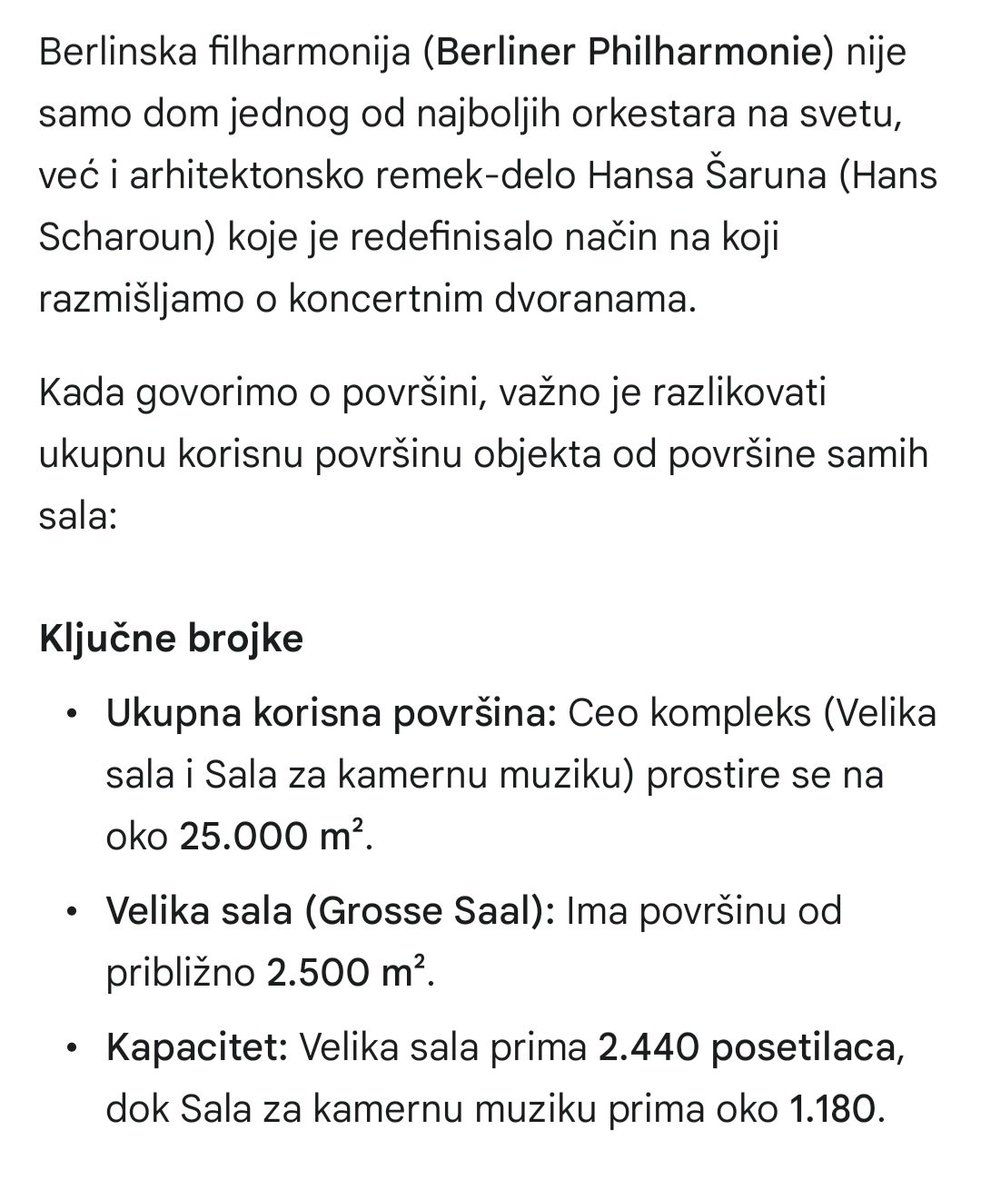
@Nenad12336471 U pravi si a i AI🙈. Ja sam 3k zapamtio kao podatak kada sam posetio Berlinsku.
Odnos nije veliki kako sam napisao- hvala na ispravci.(mada i dalje mislim da je grandiozan -pogotovu sto garaza tesko moze biti svih 25k ispod zemlje)

Prema dozvoli, koncertna dvorana imaće ukupnu bruto razvijenu građevinsku površinu od 56.656,5 kvadratnih metara, od čega će 27.927 kvadrata biti nadzemno, a 28.729,5 kvadrata podzemno.
Ovo je opis ludila - da bi narod razumeo, koncertna hala Beogradske filharmonije, koju ona bespogovorno zaslužuje, treba da bude kao DVE ZGRADE NARODNE BIBLIOTEKE SRBIJE NA VRAČARU
Sada, neka se jave stručnjaci i objasne ČEMU OVA MEGALOMANIJA?

@Nenad12336471 Ne, ima oko 3000, ovi planitaju da prave preko 50k ili ako hoces nadzemni deo preko 25k

@ljmitrasevic Хоћеш да кажеш да је Берлинска филхармонија мања од 2000м2? Не рачунај гаражу (подземни део).
Srpski

@SlobaGeorgiev Btw. Ovo verovatno znaci da akustika nece biti prioritet ili da “usput” prave hotel/soping centar….

@SlobaGeorgiev Ako ovo naprave - 15x vece od zgrade Berlinske filharmonije 🤯

@robhawkes Ah I see. I based my assessment on how long it would take me to build smthng like this-you are far more efficient. So if you aim to achieve a visual representation of how electricity flows and show the complexity of the system, then 👍🏻. If you aim to achieve physical accuracy 👎🏻
English

What if you could visualise how electricity flows from a wind farm in Scotland to your home in London?
Ok it's not quite that simple, but it got me thinking that there must be a way of visualising the complexity of the electricity transmission grid in Great Britain.
This is my first attempt…
What you're seeing are the real power lines and substations on the transmission grid using OpenStreetMap data.
The real connections between each substation are found using PyPSA-Eur as well as calculating the "electrical distance" or impedance between each substation.
This is my incredibly basic and naive way of attempting to show the "speed" at which the energy is moving through the network, where the bottlenecks are, etc. I know it's not as simple as this, but it's a first attempt so… 😉
I've also added a way to pick any substation in the network and show how electricity pulses through the rest of the network from that point. This is the magic sauce that really brings to life how much infrastructure electricity has to pass through to get from point A to point B.
Of course this isn't really what happens, and there's no demand to soak up the energy. However I think it still serves as an interesting visual of how complex the network actually is and the distances involved to get energy from one side of the country to the other.
What do you think? Is this worth exploring further?
English